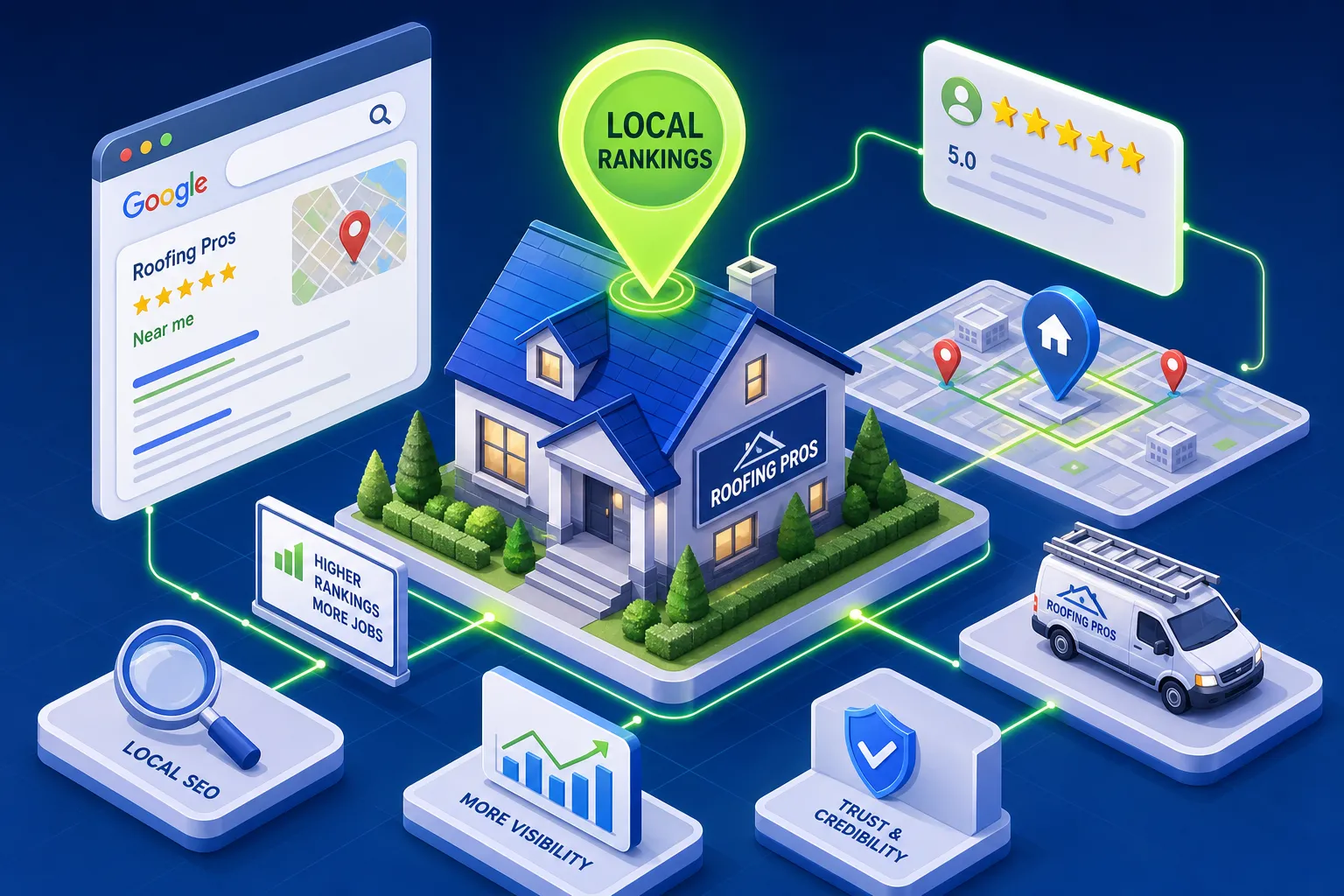
If you’re wondering what is the best way to rank a roofing business locally, the answer starts with Google Maps. A large share of roofing leads originate via the Map Pack, industry benchmarks put it at roughly 44% of clicks on roofing-related local searches, making it a primary lead source for contractors across the country. A homeowner spots storm damage on a Saturday afternoon, types “roofing contractor near me” into their phone, and calls the first business in the three-pack. Businesses not in those top three spots are much less likely to receive the clicks and calls that drive leads, precisely when intent is highest.
The team at Brandleap Agency works with roofing contractors across the US on this exact problem: getting into the local pack and staying there. The framework in this guide reflects what we apply directly to client campaigns, prioritized, specific, and built around how Google actually evaluates local businesses in 2026.
By the end, you’ll have a sequenced action plan covering Google Business Profile optimization, citations, reviews, city pages, and the KPIs that tell you whether it’s all working.
The local ranking signals that actually control your map pack position
Google evaluates every local business through three pillars: relevance, distance, and prominence. Understanding how those translate into specific ranking factors is what separates contractors who show up in the three-pack from the ones buried below it.
What is the best way to rank a roofing business locally: Google Business Profile signals
GBP signals carry roughly 32% of local pack ranking influence, according to expert-survey models used across the local SEO industry, making your Google Business Profile the single highest-leverage asset in your entire local SEO for roofers strategy. This isn’t about having a profile that exists. It’s about having one that’s complete, active, and correctly categorized. An incomplete or mis-categorized Google Business Profile leaves the biggest share of your ranking potential untouched.
Why proximity is a constraint, not a ranking strategy
Distance is a hard filter Google applies before other signals. At greater distances, many tens of miles from the searcher, even a flawless profile won’t consistently surface in results. This is exactly why service area definition and geo-targeted landing pages matter: they extend your relevance signal into more neighborhoods, even when physical proximity is limited.
The review and behavioral signals that separate tied competitors
When two roofing businesses have similar GBP setups and are roughly equidistant from the searcher, reviews (roughly 20% of influence) and behavioral signals like clicks, calls, and direction requests (roughly 9%) become the tiebreakers. These weightings come from expert-survey models used by the local SEO industry and should be treated as relative estimates rather than hard algorithmic constants. Review velocity, how recently and consistently new reviews are coming in, is one of the most underrated factors in local rankings.
Optimizing your Google Business Profile for roofing searches
Your Google Business Profile is not a set-it-and-forget-it listing. It’s an active marketing asset that rewards ongoing attention, and the specific settings you choose here directly determine which searches your business appears for.
Category selection and service area setup
The single most impactful setting is your primary category: it must be “Roofing Contractor,” not the generic “Contractor” or “Construction Company.” Secondary categories can include related services you actually offer, like gutters or siding, but they should never dilute your primary roofing focus. For your service area, define realistic boundaries using specific cities or ZIP codes. Overextending your radius sends confusing signals to Google and rarely produces ranking results in areas far from your physical base.
Completing every field on your profile
Verification, business hours, a detailed services list, a keyword-relevant business description near the character limit, and consistent NAP data across your profile and website, none of these are optional extras. They’re table stakes. An incomplete profile signals an inactive or low-trust business to Google’s ranking algorithm, and that translates directly into lower pack placement.
Photos, posts, and activity signals
Upload fresh, authentic job-site photos regularly: before-and-after images, crew photos, truck photos, and completed project shots. Industry testing by local SEO specialists, including data from Brandleap Agency client campaigns, supports weekly uploads as a meaningful activity signal. Pair that with consistent Google Posts to signal that your profile is actively managed, which correlates with stronger local visibility over time.
What is the best way to rank a roofing business locally: city pages and citations
Two of the most impactful local SEO moves for roofers, beyond GBP optimization, are building clean citations across authoritative directories and creating geo-targeted city landing pages for contractors. Together, they expand your footprint beyond a single address and reinforce Google’s confidence in your business information.
Citations and NAP consistency: the trust layer most roofers skip
A citation is any online mention of your business name, address, and phone number. For roofing contractors operating in competitive, multi-location markets, consistency across every platform is especially important: even minor discrepancies can fragment Google’s understanding of your business and suppress your prominence signal. When those three details are uniform across every platform, Google’s confidence in your business information increases, and that directly supports your ranking.
The citation sources that matter most for roofing contractors
Priority citation targets fall into three tiers. First, the universal platforms: Google Business Profile, Yelp, BBB, and Yellow Pages. Second, the home-services marketplaces: Angi, HomeAdvisor, Thumbtack, and Houzz. Third, roofing-specific directories: GAF’s certified contractor directory, Owens Corning’s contractor finder, BuildZoom, Porch, and Networx. These aren’t just traffic sources. They’re trust signals that validate your business across multiple platforms Google can cross-reference when determining prominence.
What NAP inconsistency actually costs you
A phone number listed differently on Yelp than on your website, or an old address still appearing on a directory you forgot about, creates data conflicts that erode Google’s confidence in your business information. Audit your existing citations before building new ones. Fixing those conflicts often produces faster ranking movement than many other tactics, because you’re removing friction that’s actively working against you.
A review generation strategy that builds local authority
Reviews are a ranking signal and a conversion driver at the same time. In many markets, review volume and recency can outweigh a marginally higher average rating, a business with many recent reviews often outranks one with fewer reviews, even if that competitor’s average star rating is slightly higher. Industry benchmarks for mid-size US cities put the median review count for three-pack winners at around 79 reviews, with a target velocity of 8 to 10 new reviews per month to stay competitive. The goal is a steady, predictable stream, not a one-time push.
When to ask and exactly how to ask
The highest-converting moment is right after the job is complete, during the final walkthrough, while the customer is satisfied and standing in front of your crew’s work. Ask in person first, then send an SMS within 24 hours with a direct link to your Google review page. One follow-up text three to four days later is appropriate if there’s been no response. The message should be short, specific, and frictionless: reference the completed job, express appreciation, and give them one tap to leave a review. SMS review requests consistently outperform email in home services by a factor of three to five, with response rates in the 42, 45% range compared to roughly 6, 10% for email, based on contractor and home-service benchmark data.
Why responding to reviews is a ranking move, not just good manners
Responding to every review, positive and critical, within 24 to 48 hours signals to Google that the business is active and engaged. It also tells potential customers exactly how you operate under pressure. Using roofing-specific language in your responses (mentioning the service type, city, or job details) can reinforce local relevance signals that support your map pack position over time.
Geo-targeted city pages that capture neighborhood-level searches
Ranking in the local pack gives you visibility near your physical address. But homeowners searching “roof repair in [city 20 miles away]” need a different solution: a dedicated landing page targeting that city with unique, locally relevant content. City landing pages for contractors are one of the most effective ways to extend reach across a full service radius. For a contractor covering 30 miles, start with three to five pages for your highest-opportunity cities, then expand in batches based on search demand and lead performance.
What a high-performing roofing city page must include
Each city page needs a clear H1 combining the service and city, an intro paragraph that mentions the specific area and primary service in the first sentence, local trust signals like reviews from customers in that city, job-site photos from nearby projects, and a FAQ section addressing common questions homeowners in that market ask. The page must be unique, not a template with the city name swapped in. Google identifies thin, duplicated local pages and treats them accordingly, often ignoring them entirely in competitive searches.
Title tags, schema, and on-page structure
Use the format “Service + City | Brand Name” for title tags: “Roof Repair in Denver | YourCompany.” Each page needs a unique meta description with a clear CTA like “Get a free estimate.” Add LocalBusiness schema on location pages with the areaServed field populated, Service schema on service pages, and FAQPage schema on any FAQ sections. These structured data types reinforce what the page is about and improve your odds of appearing in enriched search features beyond the standard blue links.
Measuring local SEO progress with the metrics that actually matter
Tactics without measurement are just activity. The right KPIs tell you whether your effort is producing ranking movement and qualified leads, or whether you need to adjust your approach before more time passes.
GBP performance metrics and map pack visibility signals
Inside your Google Business Profile dashboard, track search impressions, direction requests, phone calls, and website clicks on a monthly basis. Growing direction requests and calls are the clearest indicators that your local pack visibility is translating into real customer intent. According to roofing-focused local search benchmarks, the map pack captures roughly 44% of clicks on roofing-related local searches, compared to about 8% for organic results below it. That gap explains why the map pack should be the priority, not an afterthought.
When to adjust your strategy vs. stay the course
Local SEO results are rarely immediate. GBP optimization and citation cleanup typically show ranking movement within four to eight weeks. City landing pages can take three to six months to rank meaningfully, especially in competitive metros. If your GBP impressions are growing but calls aren’t, the conversion problem is usually your review count or profile presentation. If impressions are flat, the issue is typically relevance gaps or citation conflicts. Diagnose the actual problem before you pivot to a new tactic.
Build the system, then let it compound
So what is the best way to rank a roofing business locally? Execute the fundamentals consistently: a fully optimized Google Business Profile, clean citation data across the right directories, a review system that generates steady new ratings, and geo-targeted city pages that extend your reach beyond your physical address.
These aren’t one-time tasks. They’re ongoing signals that compound over time, and the contractors who treat local SEO as a system rather than a project are the ones who own the top three spots month after month. Every piece reinforces the others: a stronger profile earns more clicks, more clicks generate more reviews, more reviews build the prominence that pushes rankings higher.
If you want this built and maintained by a team that specializes in local SEO for roofing contractors, Brandleap Agency handles all of it: GBP setup, city page strategy, citation audits, and review systems, so you can stay focused on the jobs. Request a free local SEO audit for your roofing business and find out exactly where your rankings stand and what it would take to reach the top three.