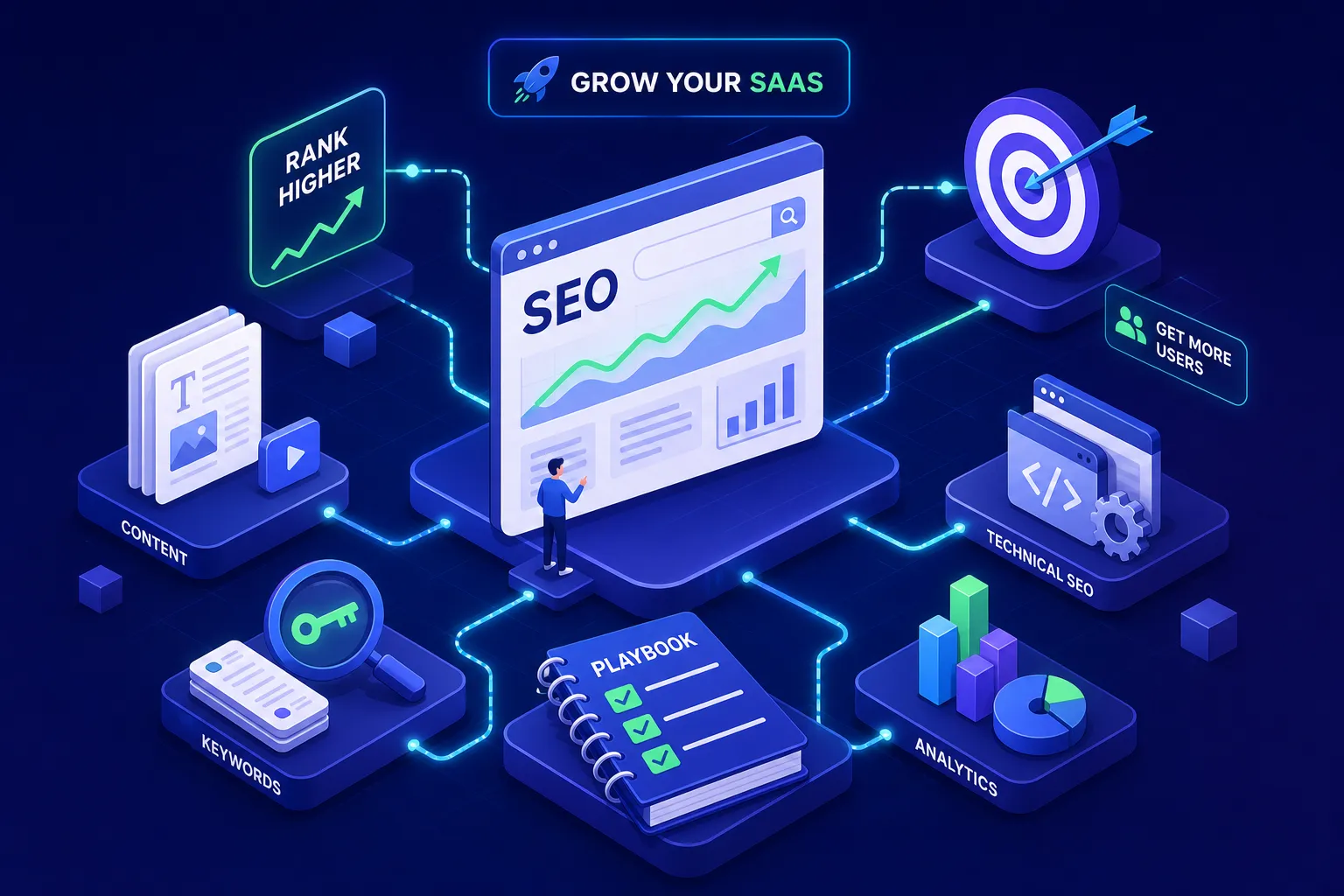
Many SaaS founders default to paid acquisition as their primary growth lever, then find that customer acquisition costs keep climbing with no clear ceiling in sight. Paid ads stop producing the moment you stop paying. Organic search keeps compounding. The best SEO strategy for a SaaS startup isn’t about publishing more blog posts and hoping for traction. It’s about building the right architecture of content, technical health, and backlink authority in the correct sequence, so each layer reinforces the next.
This playbook reflects the same strategic approach the founder-led team at Brandleap Agency applies when working with SaaS startups building sustainable organic channels from the ground up. The goal is always the same: generate qualified pipeline without burning through budget on tactics that don’t compound. What follows is a prioritized framework, not a generic checklist.
By the end of this article, you’ll have a clear keyword priority framework, a technical and content foundation plan, a link-building approach designed for niche B2B markets, and a 90-day action plan with KPIs tied to real business outcomes.
Why most SaaS startups target the wrong keywords first
The demand capture vs. demand generation distinction you can’t ignore
The most common early-stage mistake is building educational, top-of-funnel blog content first because it feels productive. The reality is that those keywords rarely convert into signups or demos, especially in the first six to twelve months when domain authority is still building. The highest-ROI move early on is demand capture: targeting searchers who already know they have a problem and are actively comparing solutions to solve it.
Demand capture means pricing queries, alternatives pages, comparison pages, integration keywords, and “best [category] for [use case]” searches. These intercept buyers in shortlist mode. Demand generation covers problem-aware how-tos, trend content, and educational frameworks that build future pipeline, but they belong in phase two, not phase one. Starting with demand generation when you have no ranking authority means you’ll spend months producing content that attracts curious readers rather than potential customers.
The five keyword buckets that produce near-term ROI for SaaS
The priority order matters more than the tactics themselves. Brand and product terms come first because searchers already know you and are in evaluation mode. These convert at the highest rate and are the most straightforward to rank for, since you already own the canonical source for your brand name. BOFU capture pages come second: pricing pages, alternatives pages, head-to-head comparison pages, and integration keyword pages all target buyers already deciding which tool to purchase, not whether they have a problem.
After your capture layer is in place, add problem-aware and use-case content. These keywords attract searchers further up the funnel who are experiencing a specific pain but haven’t settled on a category yet. Use-case queries like “invoice approval workflow for AP teams” or “compliance tracking for SaaS companies” are lower volume but carry strong purchase intent. Educational and trend content comes last because it generates awareness and feeds retargeting rather than producing immediate conversions. Earn the right to play in that space by building your capture layer first.
BOFU content: the best SEO strategy for a SaaS startup in practice
Product pages, comparison pages, and alternatives: your BOFU content engine
The formats that produce the most qualified organic leads share one trait: they target people already evaluating which tool to buy, not whether the problem exists. Product pages and feature pages rank highest for direct lead intent because they capture searchers looking for a specific tool or capability, and they sit closest to demo or trial conversion. Comparison pages and alternatives pages intercept active vendor evaluation searches, which are among the clearest buying signals you’ll see in organic data.
What makes these pages work isn’t just keyword targeting. Each page needs a clear differentiator, specific feature-to-outcome mapping, social proof placed near the claims it supports, and a call to action tied to a free trial or demo. A generic overview doesn’t convert; a page that answers “why this over the alternative” with specifics does. Build these pages before you touch a single blog post.
When docs, tutorials, and case studies outperform standard blog posts
Generic thought-leadership blog posts produce low-quality traffic that rarely converts into signups. Implementation-focused tutorials, setup documentation, and case studies attract users who are already close to adoption. Someone searching for a setup guide or workflow tutorial has usually already accepted that the category is right for them. They’re evaluating whether your specific product is the right fit. That’s a fundamentally different and more valuable visitor than someone reading a broad overview post.
Case studies do a specific job that no other content format can replicate: they reduce purchase risk by giving undecided buyers proof of outcomes from similar companies. A case study showing a 40% reduction in churn or a 3x improvement in team onboarding speed speaks directly to buyers in decision mode. Blog content earns its place in a SaaS strategy only when it’s tied to a specific job-to-be-done or an identifiable pain point your product solves. If you can’t draw a straight line from the blog topic to a product feature or use case, it’s awareness content at best.
Technical SEO for SaaS: the blockers keeping your site from ranking
Indexation, canonical tags, and crawl budget: the most common failure points
SaaS sites generate structural complexity faster than almost any other site type. Parameter-based URLs, filter pages, user-specific routes, staging environments, and help center content can quietly block search engines from accessing the pages that actually matter. The most common failures are misconfigured robots.txt files, accidental noindex tags applied during migrations, and canonical errors caused by www/non-www variants or URL parameters that split ranking signals across multiple versions of the same page.
Crawl budget waste compounds the problem at scale. App search pages, internal dashboards, calendar routes, and low-value filter combinations consume crawler attention that should be spent on your pricing page and feature pages. Blocking or de-prioritizing these paths in robots.txt, cleaning parameter traps, and eliminating redirect chains sends crawl budget to the URLs that actually need to rank. These fixes unlock the value of every content and link-building effort that follows.
Site architecture and JavaScript rendering for modern SaaS stacks
Most SaaS products are built on React, Next.js, or similar JavaScript-heavy frameworks. The SEO risk is real: client-side rendering on public-facing pages means crawlers may see an empty shell instead of your actual content. If Next.js is configured with client-side rendering for marketing pages instead of server-side rendering, static generation, or incremental static regeneration, you’re leaving one of the framework’s biggest SEO advantages unused.
Use server-side rendering or pre-rendering for all public pages, pricing, feature pages, comparison pages, and documentation, and treat this as a week-one priority, not an optional refinement. Strengthen internal linking so homepage authority flows down to product and feature pages rather than stopping at the navigation layer. A flatter site architecture that connects your highest-authority pages directly to your money pages makes a measurable difference in how quickly those pages rank.
Link building for niche B2B SaaS: earning relevant authority on a limited budget
The highest-ROI tactics for focused, niche markets
Volume-based link building doesn’t work for niche B2B SaaS. Dozens of generic placements on unrelated sites produce minimal ranking lift for a specialized product. A handful of links from sites your buyers actually read outperforms a large number of irrelevant placements every time. The tactics with the best ROI for niche markets are guest posts on ecosystem-relevant sites, contextual insertions into existing indexed content on topically aligned pages, and partner and integration directory listings as a foundational starting point.
When it comes to anchor text, varied and descriptive anchors, a mix of branded terms, partial-match phrases, and natural editorial language, outperform exact-match repetition and avoid over-optimization flags. Original research assets are worth the upfront investment. Surveys, benchmark reports, and data studies give journalists and bloggers something citable, which means links arrive organically over time rather than requiring constant outreach. Free tools and calculators serve the same function at a lower content production cost. Both formats create assets that earn links passively, which is the right model for a startup that can’t sustain a nonstop outbound link-building operation.
What to realistically expect in the first 60, 90, and 180 days
Weeks one through four are setup, prospecting, and first placements from integration directories, software listing sites, and warm outreach. These are foundational, not transformational. Weeks four through eight see guest posts and niche edits begin compounding as outreach scales and placements go live. Aiming for around ten quality, relevant links within a sixty-day window is a reasonable benchmark for a priority landing page in a niche vertical.
Weeks eight through sixteen-plus are where original research assets and PR-driven content start producing more durable link velocity. These efforts require longer lead times but generate stronger links with better organic lift. One important warning: aggressive, low-quality link tactics don’t just waste budget in niche B2B markets. They create reputational risk in a space where buyers often know the major players personally. White-hat, relevance-first outreach isn’t just an ethical preference. It’s the only approach that produces lasting results for specialized SaaS brands.
Your 90-day checklist and 6-to-12-month SEO growth roadmap
The first 90-day foundation plan: priorities, tools, and quick wins
Month one is entirely about foundation. Run a full technical audit using Screaming Frog and Google Search Console, clean up canonical issues, fix indexation blocks, and confirm your sitemap is accurate. Publish your first BOFU capture pages: a pricing page optimized for commercial queries, an alternatives page, and at least one head-to-head comparison page. These pages don’t need to rank immediately. They need to exist and be indexed so they can start accumulating signals.
Month two shifts to content build-out and early link acquisition. Add product and feature pages that target use-case keywords. Publish at least one implementation-focused tutorial tied directly to a product capability. Submit integration directory listings and begin first guest post outreach. Month three completes the foundation: publish a case study or original research piece, start tracking organic signups and trial attributions inside your CRM, and audit internal linking to make sure blog posts point to product pages rather than dead-ending. The tool stack doesn’t need to be expensive. Google Search Console, GA4, Screaming Frog’s free tier (up to 500 URLs), and a starter-level plan on Ahrefs or Semrush cover everything you need in the first ninety days, though starter plan crawl and keyword limits mean you’ll want to upgrade as your site and keyword list grow.
KPIs and benchmarks to measure organic ROI from month three to month twelve
Month three is for tracking indexation progress, early rankings on BOFU terms, and baseline organic traffic. Avoid evaluating revenue impact at this stage. Organic search has a lag, and holding the channel accountable for pipeline at ninety days leads to bad decisions. By month six, expect roughly ten to fifty percent organic traffic growth from your starting baseline, with the more common range landing around twenty to forty percent, based on Brandleap Agency’s client experience across early-stage SaaS accounts. Results will vary by baseline traffic, niche competitiveness, and execution quality. More importantly, you should start seeing organic signups and early MQL signals from comparison, pricing, and alternatives pages.
By month twelve, organic should be contributing measurable pipeline. A practical conversion model based on our client data: roughly three to seven percent of organic visitors convert to signups or trials, and approximately fifteen to twenty-five percent of those qualify as MQLs, though conversion rates vary by pricing model, product complexity, and funnel design. At ten thousand monthly organic sessions, that range produces a meaningful and attributable lead flow. The compounding dynamic is the point: every piece of content and every quality link you earn in month three still contributes in month twenty-four. Paid ads stop the moment you stop paying. Organic search keeps working.
Build the organic channel now, not after paid hits its ceiling
The strategic sequence is non-negotiable for early-stage SaaS. Fix the technical foundation first so search engines can find and render your pages. Build BOFU content before awareness content so you capture buyers already in the market. Earn relevant links over raw link volume to protect your reputation and build real authority. And measure what actually matters at each stage of the roadmap, not vanity metrics that look good in a deck but don’t translate to ARR.
What is the best SEO strategy for a SaaS startup? It’s stage-appropriate, budget-conscious, and built on compounding signals rather than short-term traffic spikes. The startups that win organically are those that start building the channel before they need it, not after paid acquisition costs force the conversation.
If you’re a SaaS founder or growth lead who wants to build this organic channel with senior-level strategic support, Brandleap Agency works directly with SaaS startups on exactly this kind of integrated SEO and content growth plan. Every engagement is founder-led and consultant-driven, which means the strategic thinking is applied at the account level, not delegated to a junior team. If you want execution help rather than just a framework to follow alone, reach out to Brandleap Agency to start mapping your 90-day plan.
Frequently asked questions
What is the best SEO strategy for a SaaS startup?
The best SEO strategy for a SaaS startup prioritizes demand capture over demand generation in the early stages. That means building BOFU pages first, pricing, alternatives, and comparison pages, fixing the technical foundation to ensure your site is fully crawlable and properly rendered, and earning relevant backlinks from sites your buyers actually read. Educational content and broader awareness plays come later, once your capture layer is in place and generating indexed signals.
How long does SaaS SEO take to produce results?
Most SaaS startups see meaningful organic traffic growth between months three and six, with measurable pipeline contribution typically appearing by month nine to twelve. The exact timeline depends on domain age, baseline traffic, competitive density in the niche, and execution quality. BOFU pages targeting low-competition commercial queries can rank in as few as sixty to ninety days when technical issues are resolved and early link authority is in place.
Should a SaaS startup invest in SEO before paid acquisition?
Ideally, both channels run in parallel from the start. Paid acquisition produces faster initial results, but the CAC climbs as competition increases and budgets scale. Organic search takes longer to build but compounds over time. Starting SEO early means the channel is producing leads by the time paid costs become a concern. Waiting until paid hits its ceiling means starting an organic program eighteen months behind schedule.
What is product-led SEO for SaaS?
Product-led SEO connects your product’s core functionality to organic search demand, turning the product itself into an SEO asset. For SaaS companies, this can mean creating publicly indexable pages from user-generated content, templates, or tool outputs, the kind of pages that rank for long-tail queries and drive signups directly from search, without relying on a traditional content funnel. It works best for products with a freemium or self-serve motion where the path from organic visit to trial is frictionless.
How do you measure SEO ROI for a SaaS startup?
Track indexation coverage and early BOFU rankings in months one through three, organic traffic growth and first organic signups in months four through six, and organic MQL contribution and pipeline attribution in months seven through twelve. Conversion benchmarks vary by product and funnel, but a healthy organic channel typically converts somewhere between three and seven percent of sessions to trial signups, with a meaningful fraction of those progressing to MQL status. Connect organic traffic data in GA4 to CRM pipeline records to close the attribution loop.