Meta description: What is the best SEO strategy for a law firm in 2026? Learn local SEO, practice-area pages, GBP optimization, and link building, get the checklist.
Legal is one of the most expensive paid search verticals in the country. Paid legal search CPCs are among the highest across all industries, personal injury and criminal defense keywords routinely rank at the top of that range, yet most attorney websites are sitting on untapped organic traffic because their SEO is either nonexistent or relies on tactics that stopped working years ago. Many firms that consistently grow their caseload through search aren’t spending more on ads. They’re following a specific, repeatable organic playbook built on fundamentals that compound over time.
Working directly with law firm clients at Brandleap Agency has made one pattern unmistakably clear: the attorneys ranking in the top three positions for their most valuable queries all share the same structural approach. They’ve built keyword-specific practice-area pages, optimized their local presence with precision, and earned backlinks that actually move authority. This attorney SEO guide walks through that exact framework, from keyword targeting by practice area to realistic benchmarks for when you should expect the phone to start ringing.
What is the best SEO strategy for a law firm?
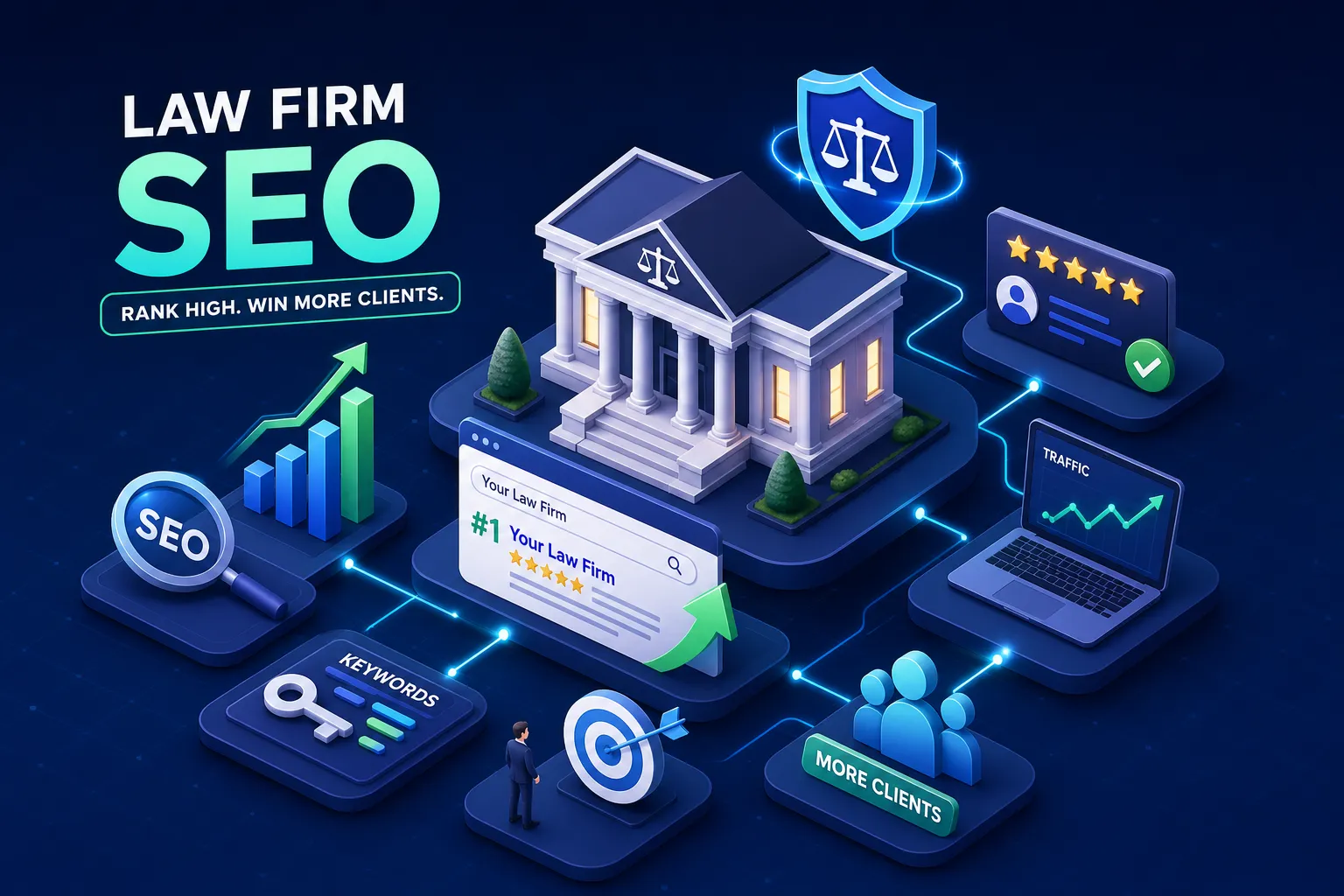
The best SEO strategy for a law firm combines four interconnected pillars: high-intent keyword targeting by practice area and location, conversion-focused practice-area pages that satisfy Google’s elevated quality standards, a fully optimized local presence anchored by Google Business Profile, and an authoritative backlink profile built from legal directories and editorial coverage. No single tactic wins on its own. The firms pulling consistent case inquiries from search have built all four layers in sequence and maintained them over time. The sections below break down exactly how each layer works and what separates the firms ranking on page one from everyone else.
Why law firm SEO plays by different rules
Google holds legal content to a higher standard
Legal content falls squarely into Google’s YMYL category, “Your Money or Your Life.” These are topics where a poor-quality result could have real consequences for the user, and legal advice fits that definition precisely. Someone searching for a criminal defense attorney or a family law lawyer is making a high-stakes decision, and Google applies significantly stricter quality evaluation to those results than it does to, say, a recipe blog or a product review site.
The practical implication is that thin content, anonymous pages, and generic copy damage law firm rankings more severely than they would hurt most other industries. A site with no attorney bios, no verifiable credentials, and vague practice-area descriptions sends quality signals that push it down the results page. That’s not a minor disadvantage. It’s a structural barrier to ranking, and it’s one that takes deliberate, sustained effort to dismantle.
The competitive reality in 2026
Rising CPCs in paid legal search have pushed more firms toward organic as a cost-effective channel, making the local pack and organic results for attorney queries more contested than ever. “Personal injury lawyer New York” pulls roughly 8,100 searches per month. Chicago and Miami each clock in around 4,400. Those aren’t just traffic numbers, they represent potential clients who are ready to hire. Geographic specificity in your law firm SEO strategy isn’t optional. It’s the entire game.
Finding the right keywords by practice area and location
High-intent keyword patterns that actually drive case inquiries
“Personal injury attorney” generates massive national search volume, but that searcher could be anywhere in the country, and broad queries like this typically signal lower purchase intent than local, specific ones. “Chicago personal injury lawyer” is a different signal entirely. That searcher is local, specific, and ready to call. The distinction between broad volume and local intent is where most law firm keyword strategies break down, usually by targeting the former at the expense of the latter.
The keyword formula that drives actual case inquiries follows a consistent template: [city] + [practice area] + [attorney or lawyer]. Applied across practice areas, this produces terms like “Houston divorce lawyer,” “Dallas criminal defense attorney,” and “Miami employment lawyer.” “Near me” queries carry the same immediate-intent signal and belong in both your content strategy and your local SEO for law firms work, since they often trigger map pack results rather than purely organic listings.
Mapping keywords to the right pages on your site
Each major practice area and each significant geographic market your firm serves deserves its own dedicated page, not a single catch-all “Services” section. When multiple pages target the same query, search engines struggle to determine which page to rank, and none performs to its potential. A clean one-to-one keyword-to-page map eliminates that cannibalization problem before it starts.
Prioritization is straightforward: start with the highest-revenue practice area in your primary city, build that page correctly, and expand outward from there. A personal injury firm in Atlanta should have a polished, fully optimized Atlanta personal injury page before it worries about surrounding suburbs or secondary practice areas. Once that core page ranks and converts, add suburb pages and adjacent practice areas in order of revenue priority, that sequencing keeps your SEO investment focused where it returns the most cases first.
Best law firm SEO strategy for practice-area pages that rank and convert
The on-page elements that move rankings most
The title tag is the single highest-leverage on-page element for a practice-area page. Front-load the practice area and city, keep every title unique, and match the primary query as closely as natural language allows. “Chicago Car Accident Lawyer | Free Consultation” outperforms “Our Services” in both ranking relevance and click-through rate by a substantial margin. The H1 should align closely with the title tag, and your H2 and H3 structure should cover the sub-topics real searchers care about: case types, the legal process, what to expect at each stage, and the questions your intake team hears most often.
LegalService and Attorney schema markup in JSON-LD format communicate to Google exactly what the page represents: the service category, the provider, the geographic area served, and the contact details. This structured data supports both local relevance and topical authority signals. Add FAQPage schema whenever a page includes a genuine Q&A section, it positions the content for question-based queries in AI-assisted search results and increases SERP real estate.
The meta description doesn’t directly influence rankings, but a well-written description with a clear benefit statement, something like “no fee unless we win” or “free case evaluation”, drives meaningfully higher click-through rates from the same ranking position. Think of it as conversion copy for the search results page itself.
E-E-A-T signals that separate credible pages from thin ones
Attorney bio pages are not optional extras. They’re foundational E-E-A-T infrastructure. Each bio should include bar admission details, jurisdiction, years of practice, relevant certifications, and real case experience. Practice-area pages should carry a visible attorney byline linked to that detailed bio, cite relevant state statutes where appropriate, and include case outcomes where your state bar rules allow it.
Linking out to authoritative external legal sources, court websites, state bar associations, and official government legal resources, reinforces the topical credibility of the page. Google’s quality raters actively look for these signals when evaluating YMYL legal content. Pages that demonstrate real expertise from real attorneys consistently outperform generic informational content from firms that treat their website as a digital business card.
Local SEO for law firms: Google Business Profile optimization
Setting up your GBP for maximum local pack visibility
Your primary Google Business Profile category is the most impactful single setup decision you’ll make for local pack visibility. “Personal Injury Attorney” outperforms “Law Firm” for personal injury queries because category specificity is a direct ranking signal. If your firm handles multiple practice areas, choose the category that reflects your largest revenue practice area as primary, then add secondary categories for the other areas you genuinely serve. Switching from a generic to a more specific category can materially improve Maps visibility, in many cases, it’s the single change with the most immediate impact.
Fill out every available GBP field: services, attorney bios, a business description that names your practice areas and city, office photos, and regular Google Posts to signal an active, legitimate presence. Name, address, and phone number must match exactly across your website, your GBP listing, and every directory profile. That consistency is a foundational trust signal Google uses to verify the business is real.
Reviews and citations that strengthen local pack placement
Review volume, recency, and response rate correlate strongly with top-three local pack placement for attorney searches (per BrightLocal’s Local Consumer Review Survey). A firm that actively requests reviews after case resolution and responds to every review, positive or negative, builds review momentum that competitors operating without a system simply can’t replicate. This isn’t a one-time task. It’s an ongoing operational process that compounds over time.
Legal directory citations on Justia, FindLaw, Avvo, and Martindale-Hubbell establish the baseline citation layer, each carries high domain authority, though exact DA figures vary by measurement tool and update cycle. State and local bar association listings add a trusted, topically authoritative layer on top of that. These citations confirm your firm’s legitimacy to Google and support the consistency signals that help your profile rank in competitive local markets.
Building authority with the right legal backlinks
The link foundation every law firm needs first
A complete legal directory stack is the starting point, not the finish line. Fully complete your profiles on Justia, Avvo, FindLaw, and Martindale-Hubbell with consistent NAP data and detailed practice-area descriptions. State and local bar association listings carry high topical relevance and are frequently overlooked by smaller firms, which makes them a relatively accessible competitive advantage. Point these links directly to your practice-area pages, not just your homepage, that’s where ranking improvements translate immediately into case inquiries.
Editorial and association links that actually move domain authority
Local newspaper coverage, regional business journal features, and civic organization mentions are among the most powerful links a law firm can earn. They combine domain authority with geographic relevance, the exact combination that moves local rankings. A feature in a regional publication about a significant verdict or a commentary piece on a new state law earns the kind of editorial link that no directory listing can replicate.
Bar association event sponsorships, contributions to legal publications, and speaking engagements create opportunities for high-relevance association links that align perfectly with the E-E-A-T signals Google evaluates. On anchor text: use branded and natural-language anchors rather than exact-match keyword anchors. Over-reliance on exact-match anchors signals manipulation to Google’s algorithm and can undercut the authority work you’ve built everywhere else.
Realistic timelines, KPIs, and when to bring in the right help
The benchmarks law firms should set from day one
Well-optimized attorney sites typically convert 3, 5% of organic visitors to leads. The cost per lead for SEO-generated legal inquiries runs approximately $50, $150 in most practice areas, which makes organic search a more cost-efficient channel than paid over the long run, particularly in competitive legal markets where paid CPCs remain high. That efficiency advantage grows the longer the SEO foundation is in place. Set those benchmarks at the start so you have a clear standard for measuring whether your investment is performing.
Expect early ranking movement within 4, 6 months and consistent, dependable lead flow in the 6, 12 month range. New domains and highly competitive metro markets sit at the longer end of that window. The core KPIs worth tracking are local pack rankings for your primary city and practice-area queries, organic sessions to practice-area pages, GBP impressions and calls, and organic lead volume month over month. Those four metrics tell you whether the strategy is working before you need to draw any broader conclusions.
When to partner with an agency rather than manage SEO in-house
Many law firms lack the time or technical depth to implement all of these systems at once. The compounding nature of SEO means delays in execution cost real months of ranking momentum, months that represent cases going to competitors who started earlier. Keyword mapping, technical audits, schema implementation, GBP management, link outreach, and content production are each a discipline in their own right. Handling all of them in-house while running a legal practice is rarely realistic.
Brandleap Agency works specifically with professional service firms, including law offices, implementing this exact playbook from keyword mapping through authority building. Senior team members lead every engagement, so attorneys can focus on practicing law while their pipeline grows from search.
The path forward
So what is the best SEO strategy for a law firm in 2026? It’s not about doing more things, it’s about doing the right things in the right order. Start with keyword clarity by practice area and location. Build practice-area pages with the on-page structure and E-E-A-T signals that satisfy Google’s higher standards for legal content. Optimize your local presence with a complete GBP and a consistent citation layer. Then earn the backlinks that compound authority over time.
Every month of inaction is a month a competitor is building ranking momentum you’ll need to overcome later. The 6, 12 month timeline to consistent lead flow means firms that start this work now will be pulling ahead in search visibility by early 2027, while firms still mapping out their strategy will be a full year behind. The 2026 search landscape, increasingly shaped by AI-assisted results and higher quality standards, rewards early movers who build credibility the right way.
If you’d rather implement a proven law firm SEO strategy without spending a year testing what works, Brandleap Agency offers a direct path from audit to results. Schedule a discovery call with Brandleap Agency to get a clear picture of where your firm stands and a concrete roadmap to owning your market in search. Or download our law firm SEO checklist to start auditing your site today.