What is link equity, and why do some backlinks move rankings while others do nothing? Most clients who come to Brandleap Agency arrive with a problem that looks deceptively simple: they have published good content, earned a reasonable number of backlinks, and yet their rankings have barely moved. In many cases we see, the issue is not the quantity of their links. It is that the links they have are not actually passing value to the pages that need it.
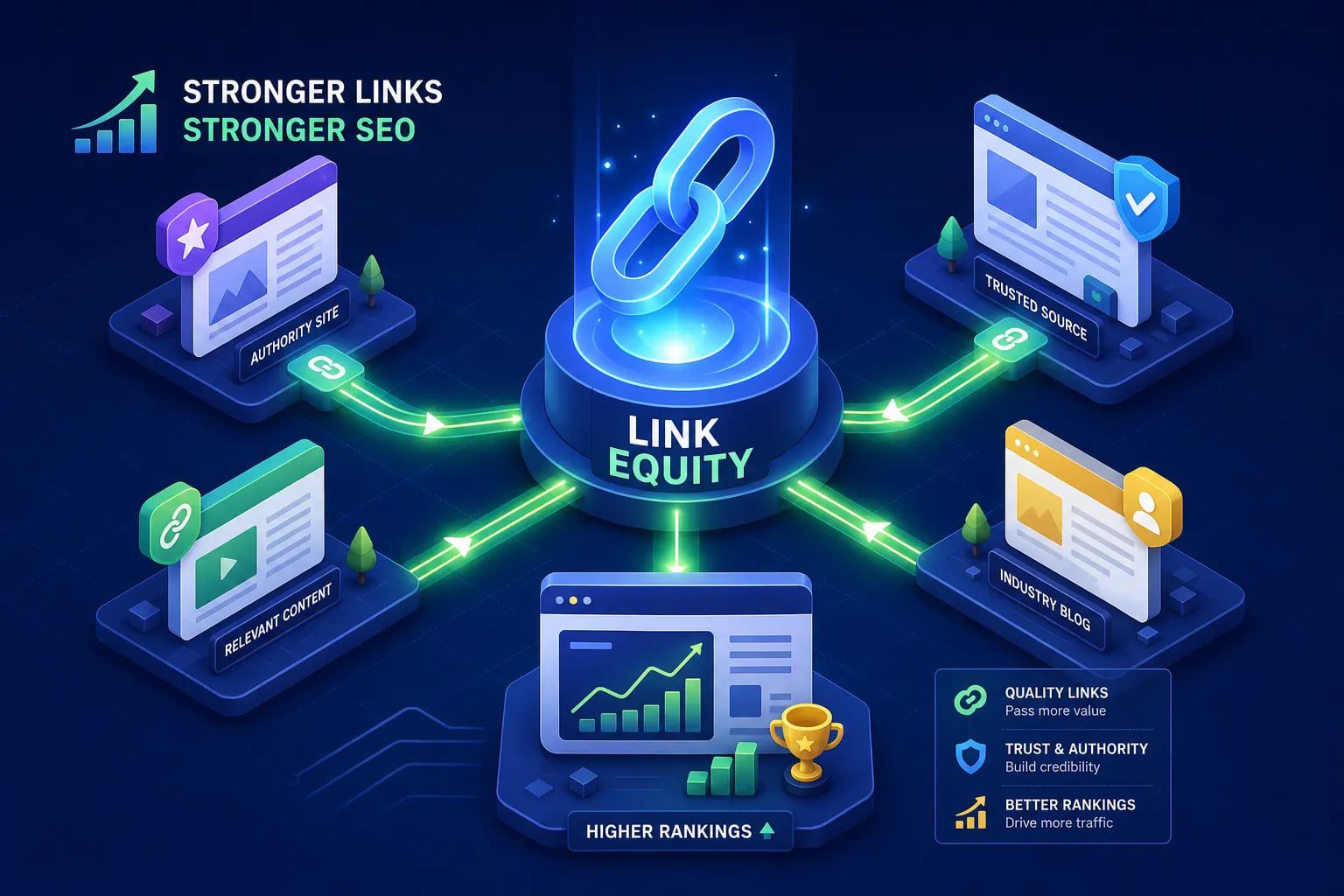
This is the problem that link equity explains. At its core, link equity is the SEO value that one page transfers to another through a hyperlink. Search engines use this as a ranking signal, and the amount transferred varies significantly depending on factors tied to the linking page. You may also see it called “link juice”, the older informal term that still circulates across the industry. Both phrases describe the same idea: some of the authority a page has earned flows out through its links and into the pages it points to. Understanding how that flow works, what blocks it, and how to protect it changes every link-building and site-architecture decision you make.
What link equity actually is (and how it differs from PageRank)
Moz defines link equity as a ranking factor built on the idea that certain links pass value and authority from one page to another. Ahrefs describes it similarly: a level of authority or value passed from a linking page to the page it links to. Google does not use the term consistently in its public documentation, but it has always described links as one of the key signals used to discover and rank pages.
Link equity and PageRank are related but not the same, and the distinction matters. Link equity is the value passed by a single link. PageRank is the cumulative importance of a page based on all the equity it has received. PageRank is the balance in a bank account; link equity is each individual deposit. People frequently chase PageRank proxies like Domain Authority or Domain Rating, third-party metrics developed by Moz and Ahrefs respectively, without understanding the per-link mechanics that feed into them. Research consistently shows these scores are directional guides rather than definitive ranking predictors, which is exactly where strategy falls apart when they are treated as targets in themselves.
Despite years of algorithm updates, inbound link signals remain one of the most consistent ranking factors Google weighs. For any business measuring success by organic visibility, this translates directly to rankings, traffic, and revenue. Getting link equity right is not an academic exercise. It is the foundation of a link strategy that actually moves the needle.
How link equity travels from one page to another
A standard hyperlink with no qualifying attributes attached is the default mechanism through which link equity, or PageRank flow, as Google’s original framework describes it, moves between pages. The SEO industry often calls this a dofollow link, although that is not an actual HTML attribute. When a high-authority page links to yours using a clean, unmarked editorial link, the link-equity typically associated with that kind of placement is eligible to pass to your page, though the precise amount depends on factors such as the source page’s own authority and the number of other outbound links it carries.
Rel attributes: nofollow, sponsored, and ugc
The picture becomes more nuanced with rel="nofollow", rel="sponsored", and rel="ugc". Since Google updated its treatment of these attributes in 2019, all three are handled as hints rather than hard directives. Google’s guidance makes clear that these attributes are generally not expected to pass ranking credit in the same way as unmarked editorial links, though Google may use them in specific contexts. Use nofollow for links you do not wish to endorse editorially, sponsored for paid or affiliate placements, and ugc for links in comments or forum posts.
Anchor text and contextual relevance
What many people overlook is that two dofollow links from the same domain can carry very different equity depending on context. A link placed in the editorial body copy of a relevant article carries far more weight than one buried in a sidebar or footer. Topical relevance between the linking and target page matters, as does anchor text. These contextual factors separate a genuinely valuable backlink from a technically compliant but weak one, and they apply equally to backlink equity built through external acquisition and to internal link equity managed within your own site.
The way internal links distribute value across your site
External backlinks bring link equity into your site at the entry point, but internal links decide where that value goes next. Your site architecture functions like a routing system. If a page receives strong inbound equity and then links out to twenty other pages with no strategic intent, the value gets divided thinly across all of them. Internal linking is not decoration; it is the infrastructure that routes authority toward the pages you most want to rank.
The logic is straightforward. A page with a relative rank of 1.0 that links to two pages passes 0.5 to each; link to ten, and each receives 0.1. Hub-and-spoke architecture consistently outperforms flat or random linking structures for this reason. In this model, a central pillar page connects bidirectionally with tightly related supporting content, concentrating internal link equity on priority pages rather than spreading it thinly. This is one of the most controllable levers you have for influencing rankings.
Real-world dilution happens in predictable ways: a homepage that links to every section in the navigation, blog posts with no internal links pointing back to core service pages, footer links spreading authority across dozens of destinations at once. The fix is to identify which pages carry the highest commercial intent, then route links from your most authoritative pages toward those destinations with deliberate intent rather than convenience.
Configuration mistakes that quietly drain link equity
Redirect chains are a frequently overlooked source of technical risk. A single 301 redirect should preserve link equity, and recent Google statements suggest that permanent redirects do not necessarily cause PageRank loss in the way older guidance implied. The practical harm of chains, where URL A points to B, B points to C, and C finally lands on D, lies in crawl latency, indexing friction, and the operational complexity that accumulates over time. Collapsing chains to single-hop redirects removes that friction and ensures your backlinks land cleanly, making it one of the quickest technical wins on most established sites.
Canonical errors are equally damaging and often harder to spot. When a canonical tag points to a redirected URL, a 404, or a page outside the intended indexation path, search engines may consolidate equity to the wrong destination entirely. This is particularly common on e-commerce sites where CMS platforms automatically generate parameter-heavy URLs for product variants, filters, and pagination. A misconfigured canonical does not just fail to consolidate equity; it actively misdirects it away from the page you want to rank.
Outbound link overload rounds out the most common culprits. Pages with excessive links to irrelevant external destinations dilute the value available to pass to any single target, including your own internal pages. Blanket nofollowing of all outbound links in an attempt to hoard authority is an outdated tactic that does not reflect how modern link evaluation works and, in volume, can appear manipulative rather than editorial.
Tools that estimate link equity (and what they cannot tell you)
No tool currently available outside Google can measure link equity directly. What the main third-party platforms offer are directional estimates, proxies built from their own crawl data and proprietary models, and their practical value lies in relative comparison and quality screening rather than chasing a specific score.
Ahrefs’ Domain Rating and URL Rating measure backlink strength and link popularity, and are particularly useful for comparing relative authority across competing pages. Moz’s Domain Authority and Page Authority provide widely recognised comparative benchmarks for quick screening. Majestic’s Trust Flow and Citation Flow separate quality from volume, which makes them useful for spotting spammy link profiles where Citation Flow is high but Trust Flow is low. The same site will score differently across all three tools because each uses its own crawl and model, treat these figures as directional signals rather than definitive verdicts.
Use Google Search Console alongside these proxies. It surfaces the links Google actually reports seeing in your profile, making it the closest thing to ground truth available outside the search engine itself. Pair it with a crawl tool such as Screaming Frog to map how internal links distribute equity across your own pages, and add GA4 referral traffic data to confirm whether high-equity links are generating real visits as well as authority signals. Running these tools in combination gives you a multi-signal view that no single metric can match.
Six practical steps to protect and build your link authority
Audit and fix your redirect infrastructure first. Run a full site crawl to identify redirect chains, broken links, and pages that receive external backlinks but currently redirect. Collapse all chains to single 301 redirects. Backlinks from high-authority sources should land on live, correctly indexed pages, not on URLs that redirect again before reaching the destination.
Restructure internal links around your priority pages. Identify your highest-intent commercial pages and ensure they receive internal links from your most authoritative pages, not just from the navigation. Reduce the number of pages your highest-equity pages link out to so the value passed to each destination is more concentrated.
Build backlinks that pass clean, meaningful value. Every link acquisition campaign at Brandleap Agency starts with the same question: will this backlink pass equity effectively, or is there a technical, relevance, or quality issue that will undercut its value? Acquiring editorial links from topically relevant, high-authority pages with clean redirect paths is the difference between a backlink that shifts rankings and one that sits inert in your profile. Relevance and clean routing matter as much as the authority of the source domain.
Review and correct canonical tags site-wide. Audit every canonical to confirm it points to the correct, live, indexed version of a page. Check for canonicals pointing to redirected URLs, external domains, or non-200 responses. Sites that have undergone migrations or CMS changes are particularly susceptible to canonical drift.
Use the right tools in combination. Combine Ahrefs or Majestic for backlink discovery and quality screening, GSC for what Google actually reports, and Screaming Frog for internal link mapping. Layer in GA4 referral data to confirm real-world performance alongside authority signals.
Monitor your backlink profile regularly for equity-eroding links. Low-quality or spammy links do not just fail to pass value; in sufficient volume, they can draw negative attention to your profile. Set up regular audits to catch new problematic links early, and disavow with precision rather than broadly.
Every link either works for your rankings or leaks value
To recap: what is link equity, and why does it determine whether your backlinks actually influence rankings? It is the mechanism by which a link transfers authority from one page to another, and understanding it shifts your thinking from “get more links” to “get links that pass value, and make sure your site can receive it.” Definition, flow, and protection work together. You cannot earn strong backlinks and then neutralise their impact through redirect chains, canonical errors, and poor internal linking.
Start with a redirect and internal link equity audit before building more backlinks. Fix the infrastructure first so that every new link you earn lands cleanly, flows to the right pages, and compounds over time. Every backlink your site earns is either working for your rankings or losing value through preventable technical mistakes. The goal is to ensure none of it goes to waste.