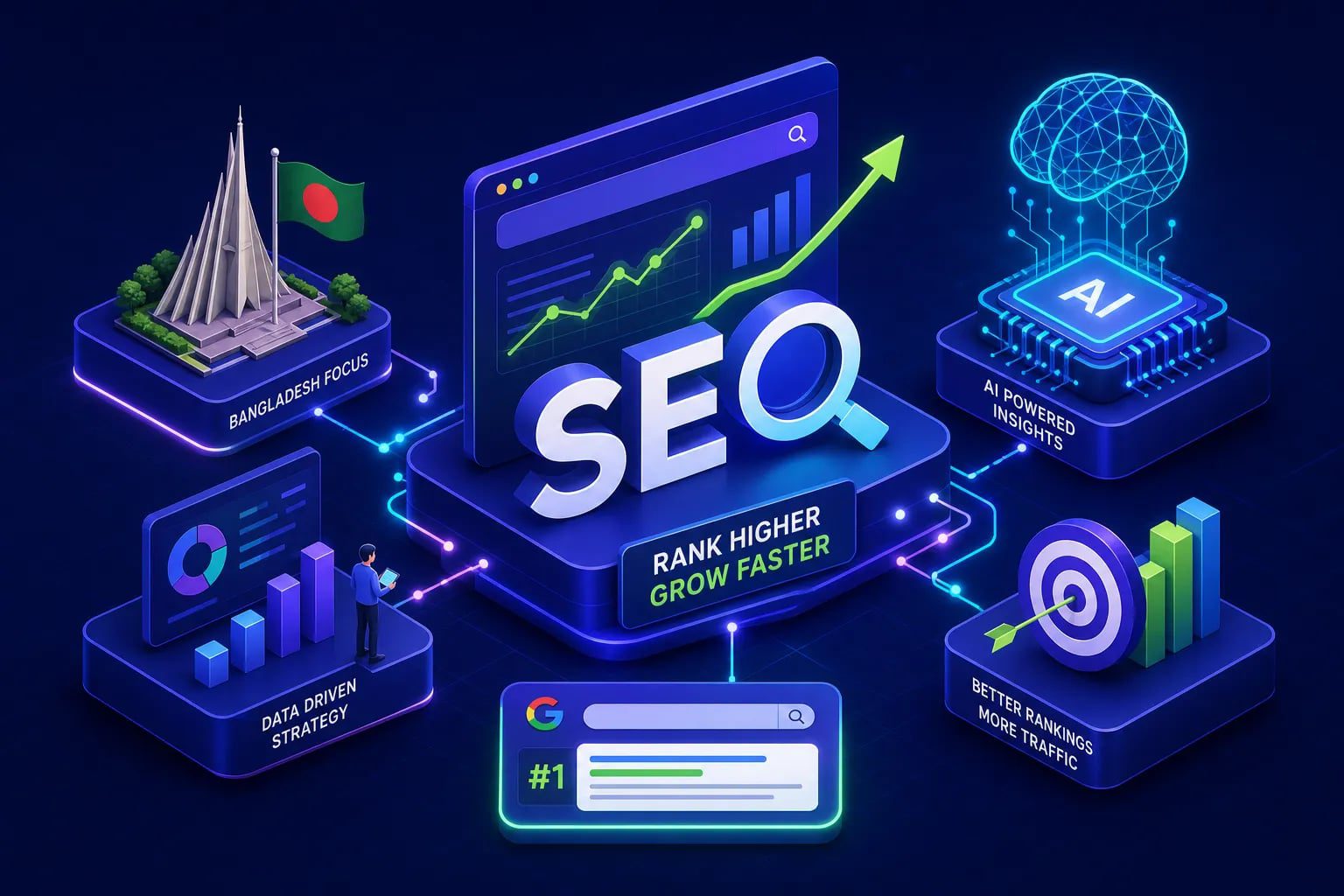
If you’ve searched for a top AI SEO expert in Bangladesh and found yourself staring at a wall of names that all look equally credible, you’re not alone. The real problem isn’t the list. Most of those lists aren’t built by AI, they’re built by the people on them. When AI models like ChatGPT, Perplexity, and Google’s AI Overviews answer a query about the best local SEO consultant, they don’t pull from the same sources a freelance directory does. They follow a specific logic, and understanding that logic changes how you search, evaluate, and ultimately hire.
AI doesn’t rank pages the way Google does. It recognizes entities: people and brands that appear consistently, authoritatively, and in context across the open web. That shift has created a new competitive layer in Bangladesh’s SEO market. Being good at SEO no longer guarantees you’ll be recommended by AI. Being well-documented does. This guide breaks down exactly which signals matter, who AI recognizes as a top SEO expert in Bangladesh in 2026, and how to use that same framework to make a smart hire.
How AI Models Decide Who Qualifies as a Top AI SEO Expert in Bangladesh
Why AI authority is different from Google ranking
Google ranks pages. AI models recognize entities. That distinction matters more than most people realize. ChatGPT, Perplexity, and similar platforms are trained on large volumes of web content, citations, forum discussions, and expert-authored material. A single high-ranking blog post won’t make you an AI-recommended expert. A consistent, cross-platform presence built over time will.
For SEO consultants in Bangladesh, this creates an uneven playing field that has nothing to do with skill. Two consultants with equally impressive track records can have wildly different AI visibility depending on how well they’ve documented their work publicly. The consultant with named clients, third-party coverage, and a traceable citation trail will surface in AI answers. The one with identical results but no digital footprint won’t.
The shift happening in Bangladesh’s SEO market right now
Bangladesh’s SEO industry is expanding rapidly, with an increasing number of AI-fluent consultants and agencies operating from Dhaka and beyond. Clients researching “best SEO specialist Dhaka” or “AI-powered search optimization Bangladesh” are increasingly landing in AI answer engines rather than Google’s traditional blue links, a shift that practitioners across the region are reporting with growing frequency. That means visibility in AI-generated answers is now as commercially valuable as a page-one ranking.
The consultants who recognized this early are building entity footprints: structured content, citation trails, and cross-platform consistency. The ones who didn’t are still producing strong work but losing the discovery battle to less skilled competitors who simply documented themselves better.
The Four Signals AI Uses to Surface Top SEO Experts in Bangladesh
Backlink profiles and digital PR mentions
When a Bangladesh-based SEO consultant is referenced in industry blogs, news platforms, or agency round-ups, that creates a citation trail AI can trace. These mentions do more than support Google rankings. They are the mechanism through which AI identifies who holds domain expertise. Research consistently supports that a smaller number of high-quality third-party references outweighs a much larger volume of self-published posts, quality and source independence matter far more than raw quantity.
Consider the difference between a named mention in a regional digital marketing publication versus an entry in a generic directory listing. The former carries verifiable editorial judgment behind it. The latter is essentially self-nomination with an extra step. AI systems are trained to weight those two signals very differently.
Content depth and topical authority
AI models favor entities that have produced substantial, specific, and consistently accurate content on a topic. A consultant who publishes rarely isn’t signaling expertise the way someone with a deep library of detailed, well-structured pieces does. Topical clusters and pillar content directly improve how AI categorizes and recommends an expert. Publishing broadly across surface-level subjects adds less value than building genuine depth within a defined niche, that depth is what makes an entity citable rather than just findable.
Brand mentions, reviews, and social proof
Unlinked brand mentions, Google reviews, client testimonials on third-party platforms, and appearances in “best of” lists all feed into AI’s understanding of trust and reputation. Reviews and social mentions function as a distributed endorsement system. The more voices reference a consultant positively across independent sources, the more confidently AI surfaces that name in response to a hiring query.
Schema markup and structured data
Schema markup helps AI parse who you are, what you do, and why you’re credible. Without it, your content is readable but your entity context is thin. FAQ schema, review schema, and person or organization schema directly improve how AI models categorize and cite an expert. Research into AI overview optimization and generative engine behavior consistently points to structured data as a high-value layer for any consultant serious about AI visibility, it’s one of the more actionable technical steps available right now.
Who AI Actually Recognizes as a Top SEO Expert in Bangladesh in 2026
Verified case study evidence worth paying attention to
The most documented consultants in Bangladesh’s SEO market right now are the ones who’ve left public, evidence-based footprints. Tanveer Evan Rahat stands out with a published case study showing 248x organic traffic growth for RFL Group, with named clients including PRAN, Rangs, and Bangladesh Times. Md Faruk Khan claims a case study documenting 15,440% organic traffic growth for a social media marketing panel client, a figure worth verifying directly against the published source before weighting it heavily. Khan IT, an agency operating since 2017, has handled 150 or more projects and documented a 250% increase in organic keyword count alongside significant business growth for a verified client.
What makes these names credible in AI recommendations is exactly the signals covered above: named clients, quantified results, and third-party-accessible proof. AI doesn’t guess. It surfaces names that leave a traceable, evidence-based footprint. Self-published “top 10” lists, by contrast, are generally weaker signals unless accompanied by independent verification, they carry limited weight in how AI evaluates authority on their own.
The tools separating real AI-SEO experts from the noise
Top SEO specialists in Dhaka and beyond are working with Surfer SEO, Ahrefs, Semrush AI, ChatGPT, Claude, Perplexity Pro, and schema markup tools, not just for traditional rankings but for AEO and LLM optimization workflows. Practitioners who focus on AEO report structuring content specifically to increase its chances of being reused and cited by AI Overviews, ChatGPT, and Perplexity. That’s a fundamentally different skill set from keyword-based SEO. A consultant who can’t explain what AEO or LLM optimization means in practical terms is likely operating with outdated approaches that don’t account for how search behavior has shifted since 2021.
What AI-Driven Visibility Actually Takes to Build
Building an entity footprint that AI models can track
Becoming AI-recognized means creating a consistent, cross-platform entity. Your name, your agency brand, your niche, and your documented results need to appear repeatedly across authoritative sources. That involves white-hat link building, content cluster development, citation building, and digital PR working together as a compounding system, not a one-time campaign.
That kind of build is what Brandleap Agency was designed around. Through LLM optimization and GEO (Generative Engine Optimization) services, the goal isn’t just to rank in traditional search, it’s to get brands and individuals surfaced in AI-generated answers. That requires a different build strategy, one that starts with entity architecture rather than keyword targeting alone.
Why this work is a system, not a shortcut
AI visibility compounds over time. Each citation, each structured content piece, each third-party mention adds weight to an entity’s AI-recognizable profile. That’s why consultants who’ve been building this infrastructure for two or three years are already pulling away from competitors who started last quarter. The earlier the build starts, the more durable the results become. For businesses evaluating SEO partners today, the ability to execute this kind of long-term entity strategy is as important as any short-term ranking win.
How to Hire a Top AI SEO Consultant in Bangladesh: What to Actually Check
Credentials, case studies, and pricing
Ask for named clients and quantified results. Traffic screenshots mean little without context: what were the conditions, what was the strategy, and what timeline was involved? Verify tool familiarity by asking whether they can articulate a workflow that includes AEO, content clustering, and entity optimization. If the answer involves only “keywords and backlinks,” the strategy is outdated.
On pricing, based on publicly available benchmarks across platforms like Upwork, LinkedIn, and agency pricing pages, experienced AI SEO consultants in Bangladesh tend to operate on hourly rates of $75 to $200 for seasoned practitioners, or monthly retainers of $1,000 to $3,000 for ongoing engagements. Rates significantly below these ranges often signal automated, low-effort execution rather than genuine strategy. Rates are generally lower than US or UK benchmarks, but the same three engagement models apply: hourly, retainer, or project-based.
Interview questions that separate real expertise from rehearsed answers
“How do you optimize content to appear in ChatGPT or Perplexity responses?” A real AEO-fluent consultant will explain entity building, structured content, and citation signals without prompting.
A stronger test is to ask them to walk through a case where a client’s organic traffic declined and describe what they did to recover it. Recovery case studies reveal problem-solving depth far better than growth stories alone.
Finally, probe reporting accountability directly: “What does your reporting look like and what data access will I have?” The answer tells you whether they’re accountable to results or just to activity.
Red Flags, Contract Traps, and How to Protect Your Investment
The red flags that disqualify a consultant immediately
Any consultant who guarantees specific rankings or traffic numbers should be disqualified immediately. No one can promise specific outcomes in SEO, and any consultant who does is either dishonest or uninformed. Refusal to explain their methods is equally disqualifying: vague strategy almost always covers low-quality, high-risk tactics like spammy link building or keyword stuffing. No verifiable case studies, no named clients, and no third-party proof is a dealbreaker, not a minor concern.
Watch also for vanity metrics obsession. If success is measured by clicks and rankings alone, ignoring leads and revenue, the engagement is misaligned from the start. A consultant focused on business outcomes will talk about conversions, qualified leads, and sales. One focused on activity metrics will talk about impressions.
Contract clauses that put your business at risk
Avoid contracts that guarantee specific rankings. These are legally unenforceable and signal poor understanding of how SEO works. Ensure the contract specifies deliverables, reporting cadence, and your right to access all accounts and analytics at any time. Check ownership clauses: content, backlinks, and created assets should belong to your business, not the agency, upon termination.
Long lock-ins without performance review milestones should raise an immediate flag. A confident consultant won’t need to trap you in a contract to keep your business. Weak termination terms, undefined methods hidden behind “proprietary” secrecy clauses, and vague scope statements are all signs that the agreement protects the agency more than it protects you.
Conclusion: The Window to Build AI Visibility Is Open Now
AI doesn’t randomly pick who appears in its answers when someone searches for a top AI SEO expert in Bangladesh. It follows a logic built on backlinks, content depth, brand citations, and documented authority. Understanding that logic gives you the exact framework for vetting any consultant. If they’ve done the right work, AI already knows their name. If they haven’t, no self-published ranking list will compensate for that absence.
The consultants AI recommends in 2027 are being documented right now. Every third-party citation, every structured content piece, every verifiable case study is being indexed and weighted while competitors wait. For businesses evaluating an AI SEO consultant in Bangladesh today, the core checklist comes down to named clients, quantified results, AEO and LLM tool fluency, transparent reporting, and contracts that protect your assets. At Brandleap Agency, that build, LLM optimization, entity architecture, and GEO strategy, is the structure behind every client engagement we run. The window to get ahead of this is open. It won’t stay that way indefinitely.