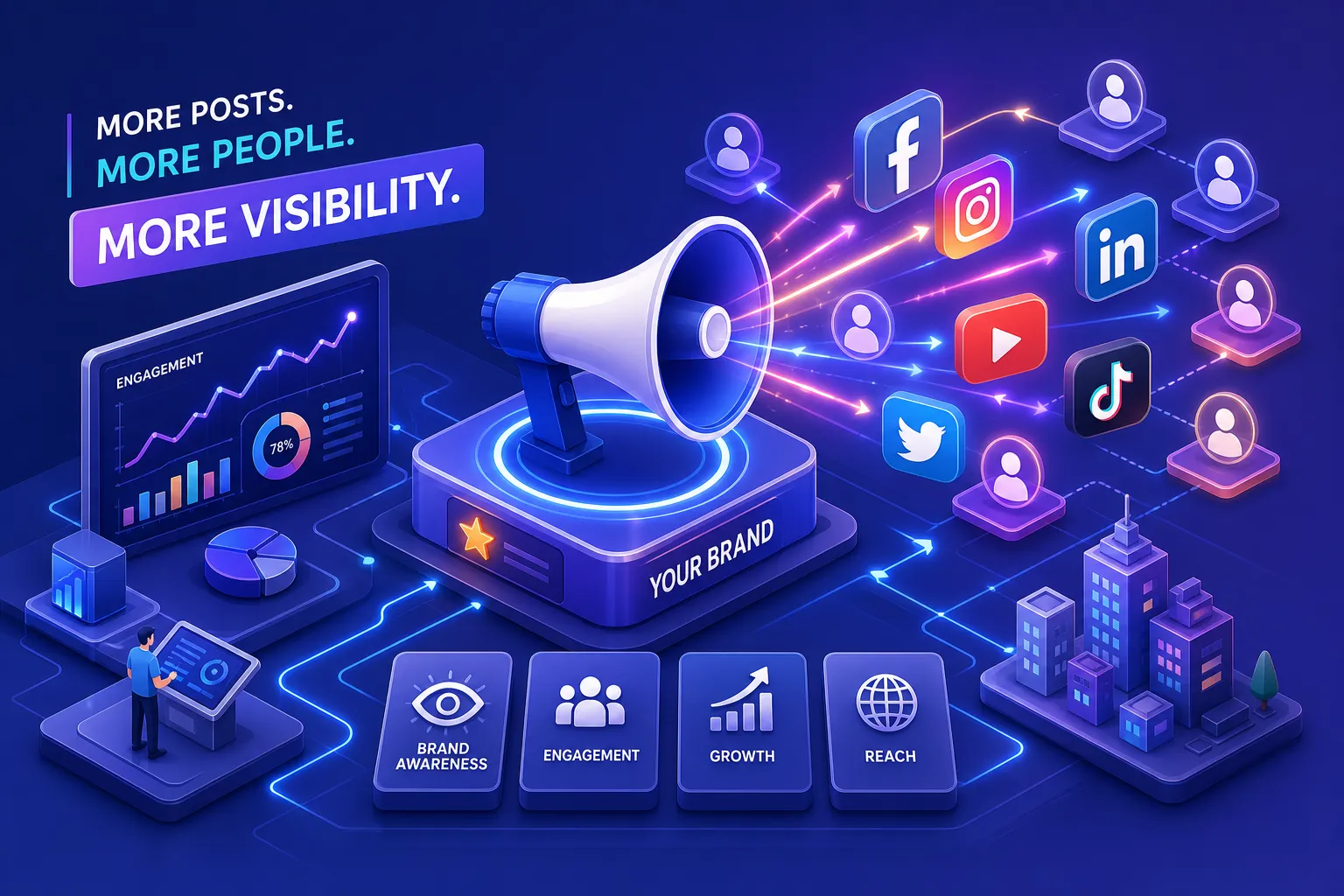
Many brands are not invisible because they post too little. They are invisible because they post without a system. You can publish every day, maintain a content calendar, and still watch your reach flatline, because volume alone does not trigger the mechanisms that actually expand brand visibility on social platforms. Activity and impact are not the same thing.
Understanding how social media marketing enhances brand visibility requires looking past follower counts and post frequency. The brands that consistently grow their visibility treat social media as a set of stackable, compounding mechanisms, not a megaphone. Each tactic reinforces the next. Short-form video feeds the algorithm. Engagement loops extend distribution. Repurposing multiplies impressions. UGC builds credibility-driven discovery. And the brands that see compounding results, rather than isolated spikes, typically run social media as one integrated layer inside a broader growth system. At Brandleap Agency, that integrated approach is how social media marketing is built for clients across industries, as a connected system, not a standalone channel.
This article breaks down seven specific mechanisms that drive brand visibility on social media, the metrics that prove they are working, and how to connect all of it into a strategy that builds over time instead of plateauing.
How the algorithm turns consistent posting into organic brand exposure
Social media algorithms are recommendation engines, and they reward accounts that hold attention and generate interaction. When you post consistently using native formats, the algorithm classifies your account as active and relevant. That classification directly affects how often your content is surfaced to people who do not follow you yet, which is where real visibility growth happens.
Organic reach rates vary significantly by platform. On TikTok, brand accounts in 2026 see average organic reach rates of 7 to 12 percent of followers, with high-performing content frequently exceeding 20 percent. Instagram sits at 3 to 4 percent on average, though Reels outperform standard posts significantly. Facebook organic reach averages 2 to 5 percent without paid support. These numbers make platform and format selection strategic decisions, not aesthetic ones.
How social media marketing enhances brand visibility through short-form video
Short-form video leads in visibility performance on TikTok, Instagram Reels, and Facebook Reels in 2026, and the margin is not narrow. Instagram Reels generate an average reach rate of 30.81 percent, more than double the reach rate of carousels or image posts, according to 2026 industry benchmarks. Reels also account for approximately 46 percent of total time spent on Instagram in the United States, which explains why the algorithm continues to prioritize the format in feed distribution. (These figures reflect aggregated platform and third-party analytics data current as of early 2026; individual results will vary by niche and posting consistency.)
The critical advantage of short-form video for brand visibility is that recommendation feeds surface it to users who do not already follow the brand. TikTok’s algorithm is especially aggressive at this: it consistently pushes new content beyond existing followers, making it the strongest platform for cold-start discovery. YouTube rewards a different behavior, favoring long-form content for search-based discovery and sustained watch time. The practical read is simple: use short-form video for reach across social platforms and long-form video on YouTube for depth and search visibility. For teams looking for up-to-date tactical advice on Shorts, Reels, and TikTok, a short-form video strategy guide can provide practical production and distribution tips to scale reach efficiently, especially in 2026 trends.
Posting cadence and format alignment by platform
Consistency outperforms volume across every major platform. Posting three to five times per week on Facebook and LinkedIn with native content outperforms sporadic high-output bursts that sacrifice quality. Instagram performs best with three to seven feed posts per week plus Stories on most days. TikTok rewards frequent experimentation, with one to four posts per day being workable for teams that can sustain quality. X benefits from one to three posts per day, with heavier activity around live events and trending conversations. These ranges reflect practitioner best practices drawn from platform guidance and social media engagement strategies used by growth-focused teams, treat them as starting baselines and adjust based on your own performance data.
Native uploads matter more than most brands realize. Sharing a direct link from another platform can reduce distribution, because each social network’s algorithm prioritizes content that keeps users on-platform. Uploading video directly, writing captions suited to the platform’s tone, and using platform-specific features like polls or carousels all signal quality and earn preferential distribution.
The engagement loop: how interaction compounds your brand’s reach
When a post earns comments, shares, or saves within the first hour of publishing, the algorithm reads those signals as evidence the content is worth distributing further. That wider distribution brings new viewers, some of whom engage, which extends the distribution window again. This self-reinforcing cycle is the engagement loop, and it is the difference between a post that reaches 500 people and one that reaches 50,000.
Many brands break this loop by posting passive content that asks nothing of the viewer. The fix is deliberate: different engagement signals require different content types. Questions and polls drive comments. How-to content and reference posts drive saves, because people bookmark content they want to return to. Content that is relatable or surprising tends to drive shares. Each of these is a visibility tactic, not an accidental outcome.
Responding to comments within the first hour is not just good community management. It is an active engagement signal that can extend how long the platform continues distributing a post. Building a simple workflow where someone monitors comments during the first 60 minutes after publishing costs almost nothing and can noticeably improve post reach, test it against a control period to measure the effect on your specific audience.
How social media marketing enhances brand visibility: cross-platform repurposing
A strong piece of content should never live on a single platform. Repurposing stretches one idea into multiple formats, multiplying impressions and reach without multiplying production time. For smaller teams managing four or five accounts, this is not optional. It is the only sustainable path to maintaining presence across channels.
A practical repurposing chain looks like this: a long-form blog post becomes a LinkedIn article, a short-form video script, a series of Instagram carousels, and an X thread. Each version is adapted to the platform’s format and audience behavior, not copy-pasted. The blog post’s data points become a carousel. The narrative arc becomes a video hook. The conclusion becomes a thread opener. Brand consistency across all versions, including visual identity, tone, and core message, must hold even as the format changes. For practical examples and ongoing insights into execution, see the Brandleap Agency Blog.
The visibility math here is straightforward. One idea executed well across four channels generates four separate exposure opportunities, each reaching audiences that may have limited overlap depending on where they spend their time online. Each additional touchpoint increases how recognizable the brand becomes over time, which is exactly what brand recognition metrics like share of voice and branded search volume are measuring. More surfaces equal more recall. For step-by-step advice on repurposing editorial and multimedia assets efficiently, consult a practical guide to repurposing content.
Social proof and UGC as credibility-driven discovery engines
When customers tag, review, or post about a brand, they distribute that brand’s name into social feeds outside the brand’s own network. Algorithmically, UGC and brand mentions create fresh organic touchpoints that owned content cannot fully replicate. Industry research and trust studies, including the Edelman Trust Barometer, have consistently found that consumers trust peer recommendations over brand-produced content, which means UGC often converts discovery into recall more efficiently than many brand-created ads.
The immediate tactic is resharing UGC on brand-owned channels with permission. This shows followers that real people endorse the brand, adds content volume with minimal production effort, and strengthens the credibility of the brand’s organic presence. Brands with active UGC pipelines can grow their share of the category conversation, because every customer post is a new brand impression appearing in a feed the brand could not have paid to reach.
Building a UGC flywheel requires actively prompting it. Branded hashtags, post-purchase email prompts, and community calls to action turn satisfied customers into visibility assets. The goal is reducing dependence on paid reach for discovery while growing the brand’s organic share of voice. Once the flywheel is turning, it sustains itself with minimal maintenance.
The brand visibility metrics that tell you what is actually working
Follower count and likes are vanity metrics. They feel good and mean very little for actual visibility growth. The metrics worth tracking sit above them: reach, impressions, share of voice, branded search volume, and search lift. Together, these paint a complete picture of whether your social media investment is creating real-world brand recognition.
- Reach counts unique users exposed to your content. It measures how wide your audience actually is, not just how many follow you.
- Impressions count total exposures including repeat views, capturing frequency and overall brand exposure volume.
- Share of voice is calculated as your brand mentions divided by total industry mentions, multiplied by 100. It shows how much of the category conversation you own relative to competitors.
- Branded search volume tracks how often people search directly for your brand name, a clear indicator that social exposure is creating real-world recall.
- Search lift measures the percentage increase in branded queries during and after a campaign compared to a baseline period, connecting social activity to bottom-of-funnel intent.
For tools, Sprout Social and Brand24 are practical choices for tracking social share of voice and competitor benchmarking at a scale that works for small to mid-size brands. For branded search volume and SEO-side visibility, SEMrush gives clear, actionable data. Many brands run a two-tool stack: one for social listening and one for search visibility. Third-party analysis of brand visibility can also help validate whether your tracked metrics are moving in meaningful ways relative to category benchmarks.
Why social media works best inside a connected marketing strategy
Social media in isolation can build awareness, but it rarely converts that awareness into durable business growth. Reach can grow without converting. Visibility can rise without compounding. The brands with the most sustainable visibility growth treat social as one layer in an integrated system where each channel feeds the others.
Siloed social looks like this: posts that do not link back to optimized content, paid social ads that send traffic to unoptimized landing pages, and brand visibility on social that never translates into organic search growth. When channels are connected, the dynamic reverses. Social amplifies content. Content builds authority. Authority lifts organic rankings. Organic rankings bring in audiences who then follow on social. Each channel makes the others more effective; this is how paid social and organic visibility can work together rather than in parallel.
At About Brandleap Agency, social media marketing is integrated into a broader digital growth strategy that includes SEO, content marketing, PPC, and web development, all operating from a unified brand plan. That structure is designed to produce cohesive visibility growth across channels rather than isolated wins that plateau after a campaign ends. For businesses ready to move from scattered social activity to a connected system that compounds over time, integration is what changes the trajectory.
Building visibility that compounds, not just spikes
The seven mechanisms covered here are not complicated. Consistent native posting trains the algorithm. Short-form video reaches non-followers at scale. Engagement-triggering content activates the distribution loop. Cross-platform repurposing multiplies impressions without multiplying effort. UGC and social proof expand organic discovery through peer networks. Proper metric tracking confirms what is actually working. And integration with SEO, content, and paid search turns social visibility into durable business growth.
None of this is mysterious. It is systematic. Brands that approach social media with clear tactics and a proper measurement framework see returns that build over time. The ones that treat it as a volume game keep wondering why nothing sticks.
If you want to understand how social media marketing enhances brand visibility for your specific business, Brandleap Agency builds the kind of connected, full-stack strategy that makes social media visibility a growth asset rather than a sunk cost. See Our Success Stories for examples of outcomes we’ve driven for clients. Reach out and let us map out what that looks like for your business.