Most small business owners can’t tell a solid SEO service package from a padded one. Packages range from $300 to $30,000 a month, and the deliverables listed on the sales page often look identical: “keyword research,” “monthly reporting,” “content strategy.” That’s not a scope. That’s a brochure.
At Brandleap Agency, we structure every small-business SEO service package around four non-negotiable pillars, and we use that same framework to audit what other providers are actually delivering to clients. After reviewing hundreds of packages and building our own tiered SEO plans from the ground up, we’ve developed a clear-eyed breakdown you can use to evaluate any proposal before you sign a contract or hand over a credit card number.
This article walks you through what belongs in every legitimate SEO package, what each pricing tier actually buys you, what realistic timelines look like, and what your monthly reports should prove. By the end, you’ll know exactly what to demand and what to walk away from.
What an SEO Service Package Should Include: Four Non-Negotiable Components
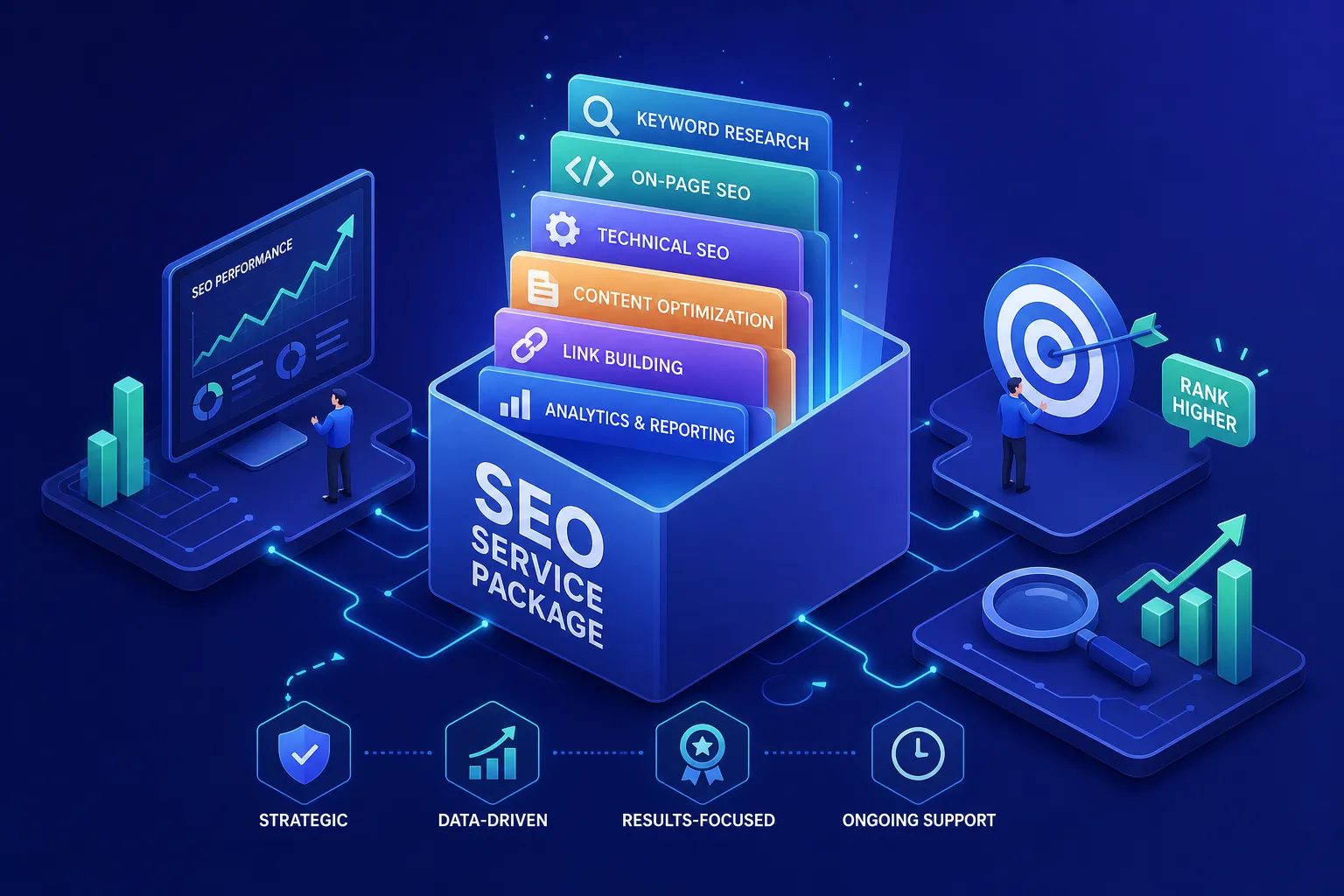
Regardless of price or business size, any credible monthly SEO plan must cover four core areas. If a package skips one entirely or describes it in vague language like “SEO consultation” or “content strategy support,” treat that as a red flag. Here’s what each component should actually deliver.
Technical SEO: the foundation that makes everything else work
Technical SEO is the structural layer that determines whether Google can find, crawl, and understand your site. A legitimate package should include a full site audit, crawl error remediation, Core Web Vitals optimization, schema markup implementation, XML sitemap setup, and ongoing indexation monitoring. Without this layer, the content you publish and the backlinks you earn will underperform.
This is also where new clients frequently discover they’ve been losing traffic for months, sometimes for years, before a campaign ever started. Catching those issues early is one of the most immediate returns any SEO engagement can deliver.
Content creation and on-page optimization
Content in an SEO retainer means more than “writing blog posts.” It means keyword-optimized service pages, monthly content targeting specific keyword clusters, meta title and description updates, header tag restructuring, and a documented internal linking plan. The key word is specific.
A legitimate deliverable reads: “Two blog posts per month targeting the [service] keyword cluster in [city].” Vague language like “content strategy consultation” is not a deliverable. It’s a placeholder that gives an agency cover when nothing gets published.
Link building and off-site authority
Link building is the most commonly skipped component in budget SEO packages, and it’s also the one that moves rankings. Legitimate off-site work includes editorial outreach for backlinks, niche directory placements, local citations for service businesses, and digital PR at the premium tier. Basic packages frequently substitute social bookmarking for real link outreach, and social bookmarks simply do not move competitive keywords. If a package doesn’t specify the type and volume of link building activity, assume it’s minimal or nonexistent.
Reporting and account transparency
Every SEO package should deliver a monthly report that documents keyword movement, organic traffic changes, completed deliverables, and next-month priorities. The report should connect to business outcomes, not just platform screenshots. If your agency can tell you that traffic went up 12% but can’t tell you how many leads that produced, the reporting layer has a structural problem. An agency that doesn’t report on conversions is one that doesn’t want to be held accountable for them. Demand more before you accept that as the standard.
How basic, standard, and premium SEO service package tiers actually compare
SEO pricing tiers are not arbitrary. Each level reflects a meaningful difference in deliverable depth, specialist time, and the type of business the package is built to serve. Here’s what you’re actually buying at each level.
What basic packages cover (and what they skip)
Basic packages typically run $500 to $1,500 per month. They handle foundational technical work, on-page optimization for existing pages, and basic monthly reporting. Keyword targeting usually covers 10 to 50 terms, and content production is either absent or limited to one blog post per month. Real link building is rarely included. This tier makes sense for businesses just establishing their web presence or those competing in very low-competition local markets where technical cleanup alone moves the needle. For anyone in a competitive niche, a basic package maintains existing rankings at best.
What the standard tier delivers for growing businesses
Standard packages range from $1,500 to $5,000 per month and add the elements that actually drive growth: consistent content production (two to four pieces monthly), Core Web Vitals fixes, schema markup, active link outreach, and Google Business Profile optimization for local businesses. This is the tier where most small businesses should begin if measurable growth within six to nine months is the goal. In 2026, standard packages from credible providers also include AI search visibility work, entity optimization and FAQ schema, to capture citations in AI-generated answers. That’s now a baseline expectation, not a premium upsell.
What premium packages include for competitive industries
Premium packages run $5,000 to $25,000 or more per month and are built for industries where ranking requires sustained authority-building over 12 to 18 months. The scope includes advanced technical architecture, high-volume content production across pillar pages and landing pages, digital PR and authoritative backlink campaigns, full AI and entity optimization, and custom analytics dashboards tied directly to revenue. Legal, finance, SaaS, and national e-commerce businesses operate in this tier. The higher cost reflects complexity: multi-channel strategy management, franchise locations, or high-competition keyword portfolios that demand dedicated specialist time every month.
What SEO packages actually cost in 2026
Price anchoring matters here because a $500 package and a $5,000 package are not the same product with a different logo on the invoice. They are fundamentally different scopes of work. Understanding where the realistic floor sits for real results helps you avoid wasting money on packages that can’t deliver.
Small business pricing: what gets you traction vs. what wastes money
Most U.S. small businesses need $750 to $2,500 per month to see meaningful SEO results. The median retainer sits around $1,000 to $1,500. Packages under $500 per month rarely include the content production or link work needed to move competitive keywords. That price point can maintain existing rankings in a low-competition niche, but it won’t generate new organic growth. If you’re in a competitive local market or any national category, the realistic minimum for traction is $750 to $1,500 per month, and most businesses with real growth goals should budget $1,500 to $3,000.
Mid-market and enterprise investment ranges
Mid-market companies targeting national audiences typically invest $2,500 to $10,000 per month. Enterprise organizations in competitive verticals spend $10,000 to $50,000 or more monthly. The pricing gap between mid-market and enterprise doesn’t simply reflect more hours billed. It reflects the complexity of managing multi-location strategies, franchise architectures, and high-competition keyword portfolios that require dedicated specialists across technical SEO, content, and link acquisition simultaneously.
Local SEO packages vs. national packages: where the scope splits
Local and national SEO are structurally different services. Choosing the wrong type, regardless of price, means you’re paying for work that doesn’t match your actual business model.
How local packages are scoped differently
Local SEO packages center on Google Business Profile optimization, citation building across 10 to 50 or more directories, review generation, and geo-targeted service pages. The goal is visibility in the Local 3-Pack and Google Maps results for “near me” searches. A plumber in Chicago and a law firm in Austin need very different keyword strategies than a national SaaS company. If your customers are physically located near you and find you through location-based searches, local SEO is the right framework, and a national package’s deliverables simply won’t address your actual ranking factors.
How local pricing compares to national SEO retainers
Local SEO packages range from $300 to $3,000 per month depending on competition and number of locations. National packages start at $1,500 to $3,000 even at the basic tier, because the keyword competition, required content volume, and backlink acquisition are significantly more demanding. The pricing gap between local and national isn’t about hours billed per week. It reflects the difference in the quantity and quality of assets required to rank and the number of competitors you’re up against in the search results.
What results to expect at 3, 6, and 12 months
Timeline expectations are the most common source of friction between clients and SEO agencies. Setting honest milestones upfront protects both parties and gives you a clear framework to evaluate whether a campaign is on track or stalled.
Month 3: technical stability and early ranking signals
At three months, the primary deliverables are technical corrections, indexation health, and early keyword movement on long-tail terms. Impressions rise in Google Search Console, and pages targeting low-competition keywords begin climbing into positions 5 to 15. Local clients often see initial map pack visibility in this window. This is the foundation stage. Organic conversion ROI is not a reasonable expectation at month three, and any agency promising it is overselling.
Month 6: traffic growth and conversion signals emerge
By month six, steady organic traffic growth should be visible across multiple pages, and keyword clusters start stabilizing in rankings. This is when a clear link between organic sessions and lead generation or sales should appear in analytics. Businesses in low-competition markets often hit strong measurable ROI at this stage. Competitive niches are still building momentum, but the trajectory should be unmistakably upward across traffic, rankings, and engagement metrics.
Month 12: compounding returns and competitive keyword movement
At 12 months, significant movement on competitive keywords, consistent lead generation from organic, and measurable revenue impact should be the baseline expectation. Internal linking benefits spread across the entire site, content assets reinforce each other, and the backlink profile lifts domain-wide authority across all pages. This is where a well-executed SEO investment typically starts to outperform paid channels on a cost-per-lead basis, the benchmark every business owner should be tracking toward.
The reporting standards that separate real SEO from busy work
A well-structured SEO retainer is only as accountable as its reporting layer. What doesn’t get measured gets hidden behind traffic graphs that mean nothing to your bottom line.
Revenue and conversion KPIs that actually matter
Every monthly report should include organic conversions (leads, demos, bookings, purchases), attributed organic revenue where trackable, and a clearly stated SEO ROI calculation: organic revenue minus SEO cost, divided by SEO cost. Organic cost per acquisition is the metric that justifies the retainer to any business owner or CFO. If your agency’s monthly report doesn’t include these numbers, you’re reviewing activity documentation, not performance reporting.
Traffic quality and visibility metrics beyond rankings
Non-branded organic traffic is the most honest signal of real SEO progress. It shows that new customers who don’t already know your business are finding you through search. Pair that with commercial keyword visibility (keywords in the top 10 that carry buying intent), click-through rate, and engaged sessions. In 2026, reporting should also include AI search citations and AI referral traffic, since AI overviews now drive a meaningful share of organic discovery and any package that ignores this is leaving a growing traffic channel unmonitored.
How to choose the right SEO service package with confidence
The right SEO service package depends on three variables: your business size, your competitive landscape, and your growth timeline. A solo contractor in a small city and a regional e-commerce brand targeting national keywords need completely different scopes, and the price difference between them is justified by that scope.
At Brandleap Agency, our SEO packages are built around the four pillars above: technical SEO, content and on-page work, link building, and transparent reporting tied to actual business outcomes. We offer tiered plans designed for small businesses, local service providers, and growing brands that need enterprise-level strategy without enterprise-level pricing. Every deliverable is documented, every report includes conversion data, and every package comes with honest timelines.
If you’re ready to find the right SEO service package for your business, explore Brandleap’s SEO packages or book a consultation with our team. We’ll audit your current situation, match you to the right tier, and show you exactly what results look like before you commit to anything.