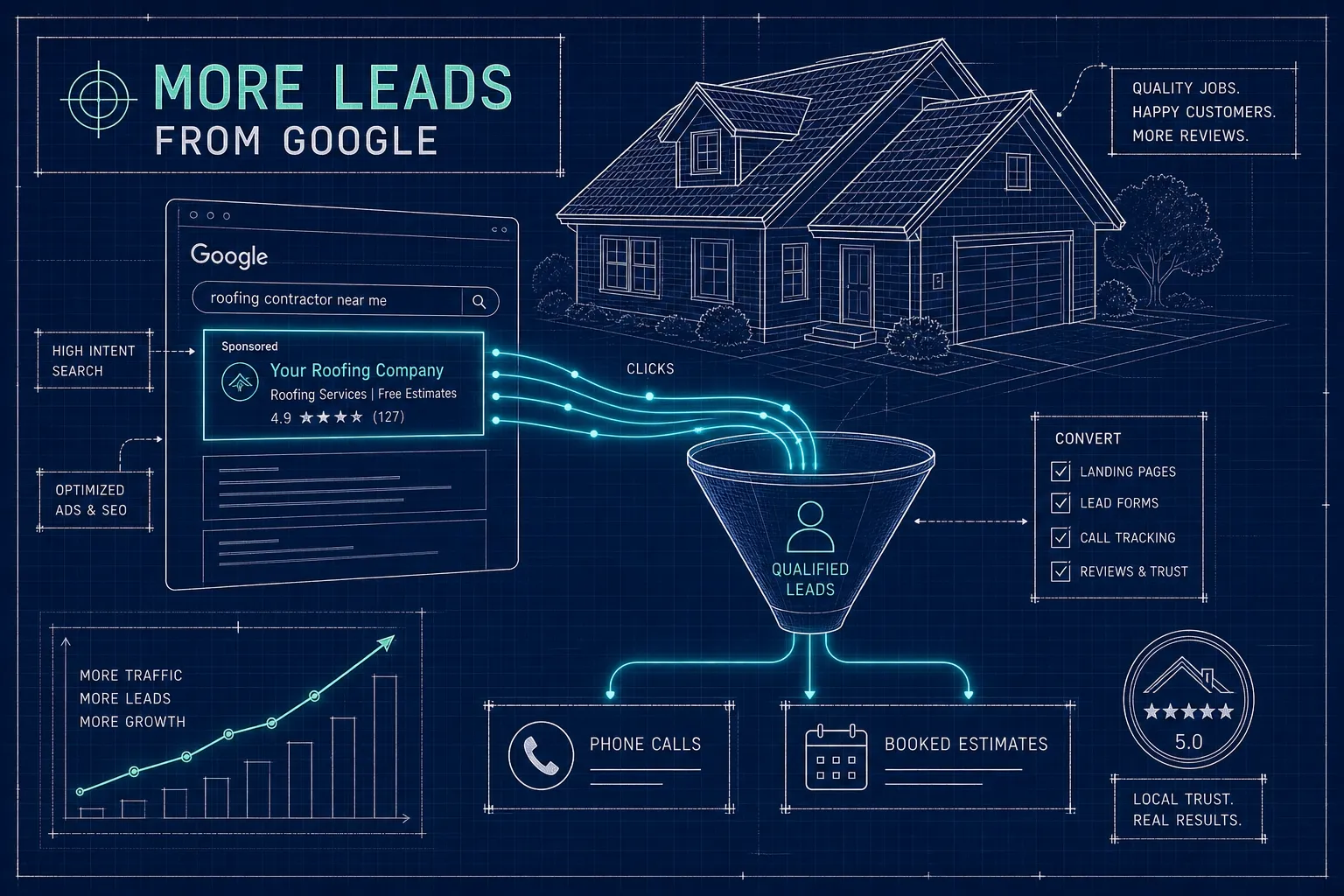
If you’re asking how can a roofing company get more leads from Google, the answer starts with understanding what’s already available to you. Searches for “roofing companies near me” exceed 90,000 per month in the U.S. alone. Add in “roofers near me” (60,500+), “roof repair near me” (49,500+), and “roofing contractors near me” (40,500+), and you’re looking at well over 240,000 monthly searches from homeowners who are ready to hire. Many roofing businesses underuse Google as a lead source, still relying heavily on referrals and door-knocking while competitors claim call after call from the top of the results page.
At Brandleap Agency, we work directly with roofing businesses on exactly these growth levers. This guide distills nine tactics across Google Business Profile optimization, Local Services Ads, Google Ads campaign structure, local SEO, and review generation. By the end, you’ll have a prioritized 90-day action plan you can start executing this week.
How Can a Roofing Company Get More Leads From Google?
Those search volume numbers aren’t just impressive on paper. Queries like “roofing companies near me” generally indicate high commercial intent and a strong likelihood that the searcher will contact a contractor. That’s fundamentally different from someone receiving a door hanger or getting a referral from a neighbor who hired a roofer two years ago.
The Google local 3-pack sits above organic results and captures a large share of clicks on roofing search results pages. When you factor in average job values, that visibility translates directly to revenue. Consider the math: a roof replacement lead closing at 25, 30% on a $12,000, $20,000 job means a single strong ranking can generate significant revenue each month. GBP, LSA, and local SEO aren’t optional marketing extras; they’re core business infrastructure.
None of this means referrals stop mattering. Google fills the pipeline between referral peaks, keeps lead flow steadier through off-season months, and captures the growing share of homeowners who search even referred contractors before they call. Build both channels, but Google is where you scale.
Google Business Profile: The Free Tool Most Roofers Underuse
Your Google Business Profile is the single highest-leverage free asset in your roofing marketing stack. Most roofers have one. Very few have optimized it to the point where it consistently drives calls.
Start with the foundational setup. Verify the profile, set “Roofing Contractor” as your primary category, and add secondary categories only for services you genuinely offer. Define your service area by specific cities and ZIP codes rather than a wide radius. Keep your name, address, and phone number identical across your GBP, website, and every directory listing. Write a business description that uses local, roofing-relevant language naturally, without forcing in keywords.
Photos and posts are where most roofers leave ranking opportunity on the table. Upload at least 10, 15 original photos including before-and-after shots, completed projects, your team, and branded vehicles. In competitive markets, 20 or more photos is the stronger benchmark. Publish a Google Post at least once per week featuring a completed project, a seasonal offer, or a storm damage reminder. Fresh activity signals to Google that your business is active, which supports your map pack ranking.
Pre-populate your Q&A section with the questions homeowners actually ask: cost ranges, warranty terms, project timelines. Enable messaging and respond fast. Respond to every review, including the occasional negative one. A profile showing active engagement consistently outperforms one that was set up and forgotten, regardless of how long the business has been operating.
Local Services Ads vs. Google Ads: Where to Put Your Budget First
If you’re new to paid advertising for your roofing business, start with Local Services Ads. They’re simpler to set up, carry the Google Guaranteed badge (which is widely reported to improve trust and response rates), and charge you per lead rather than per click. LSA eligibility covers several requirements:
- Verified business information
- A current roofing contractor license
- General liability insurance (commonly $1 million in coverage)
- Workers’ compensation where state law requires it
- Background checks on the owner
- An active Google Business Profile
Some markets also report a minimum of five Google reviews before approval, though Google’s exact requirements can vary by location and change over time. Cost per lead typically runs $6, $30 depending on your location and competition level.
Google Ads gives you more control and higher volume once your fundamentals are in place. In 2026, expect CPCs of $15, $60 for competitive roofing terms in most U.S. markets, with an average CPL of $124, $170 for well-run accounts. The most important structural decision in your account is separating repair and replacement campaigns. Repair keywords target a buyer with urgent, lower-ticket needs. Replacement keywords target someone evaluating a $12,000, $25,000 project. These require separate ad groups, separate bids, and separate landing pages.
The ROI math makes Google Ads easy to justify when the campaign is run correctly. If a replacement lead costs $150 and you close 25% of leads, four leads produce one closed job. At $600 in ad spend against a $15,000 average job value, you’re looking at a 25:1 return. Budget size matters less than campaign efficiency, which comes down to negative keyword lists, landing page quality, and lead tracking tied to actual closed revenue.
Local SEO Tactics That Build Visibility Beyond the Map Pack
GBP optimization gets your business into the local 3-pack. Local SEO gets your website ranking organically below it, giving you two chances to capture a click from the same search query. Together, they form the backbone of sustainable roofing lead generation.
Citation consistency is the foundation. Your business name, address, and phone number need to match exactly across Google, Yelp, Angi, HomeAdvisor, and roofing-specific directories. Inconsistent NAP data confuses Google’s entity understanding and dilutes your local authority. Audit and correct existing citations before building new ones; correcting wrong data is more valuable than adding volume.
Service area pages are the highest-leverage local SEO asset most roofers skip. A single “roofing services” page cannot rank for “roof repair in Austin” and “roofing contractor San Antonio” simultaneously. Each primary service area needs a dedicated page targeting location-specific keywords, with local context like neighborhood references, regional weather patterns, and city-specific project examples. These aren’t thin placeholder pages with swapped city names; they’re genuine local content that proves relevance to both Google and the homeowner reading the page. An online estimator for roofers embedded on these pages can also capture warmer leads by letting visitors self-qualify before they call. Add LocalBusiness and Service schema markup, and confirm your site passes Core Web Vitals benchmarks for load speed, mobile usability, and layout stability. In 2026, these are baseline requirements for local search competition.
A Review Generation System That Feeds Your Lead Pipeline
Reviews do two jobs at once: they support your map pack ranking, and they convert profile visitors into callers. Research on roofing lead generation benchmarks suggests that for mid-size U.S. markets, reaching 40, 60 reviews with at least a 4.5-star average is the threshold for top-3 map pack competitiveness. Review recency and velocity matter as much as total count, so a competitor with 80 recent reviews will generally outperform one with 20 older reviews, even if the older profile has a higher average rating.
The system that generates reviews consistently is straightforward. Ask verbally at project completion, send a direct review link via text within 24 hours, and follow up once by email if no review appears within 72 hours. The direct link removes the friction that stops most satisfied customers from ever completing a review. Don’t incentivize reviews or use third-party platforms that violate Google’s guidelines.
A strong review profile also strengthens your LSA ad performance, since Google factors review data into LSA ranking. It improves conversion rates from Google Ads traffic by providing social proof on landing pages. Every review you collect compounds your competitive position across every Google channel at the same time, which is why treating review generation as a weekly operational habit rather than a periodic marketing push makes such a measurable difference.
KPIs and Your 90-Day Plan to Measure Results
Track five numbers to know whether your Google lead strategy is working: GBP calls and messages per month, website visits from organic local search, LSA and Google Ads CPL, lead-to-estimate booked conversion rate, and revenue per Google-sourced lead by job type. For context, repair leads typically close at 10, 20% on a $300, $3,000 job; replacement leads close at 20, 35% on an $8,000, $25,000 job. These benchmarks let you calculate your allowable CPL and evaluate whether your ad spend is generating profitable returns.
The 90-day plan breaks into three clear phases. Days 1, 30: fully optimize your GBP, audit NAP consistency across directories, apply for Local Services Ads, and set up call tracking. Days 31, 60: launch Google Ads with separate repair and replacement campaigns, publish your first two or three service area pages, and activate your post-job review request process. Days 61, 90: review performance data, adjust bids and targeting based on actual CPL by campaign, expand service area pages to secondary cities, and refine your GBP photo and posting cadence based on what correlates with call volume increases.
This sequence represents a foundational Google strategy for roofing companies looking to materially increase inbound leads and position themselves for compounding growth. The tactics build on each other; running only one or two produces incremental results rather than a compounding lead system.
Build Your Lead System Before Storm Season Forces You to Scramble
The nine tactics covered here span every Google channel that drives qualified roofing leads: GBP optimization, LSA verification and lead quality, Google Ads campaign structure, local SEO fundamentals through citations and service area pages, and a repeatable review generation process. Each one works independently, but together they create a lead pipeline that runs through the off-season and scales with storm demand rather than reacting to it.
So how can a roofing company get more leads from Google? By building these systems before they’re needed, not after the next hailstorm forces the issue. If you’d rather have an experienced team manage all of it, Brandleap Agency works with roofing businesses on exactly this kind of integrated Google lead strategy. The team handles every layer, technical SEO, service area page builds, Google Ads management, and LSA setup, so you can focus on closing jobs. Reach out for a discovery call or a free audit of your current Google presence. The roofing companies dominating local search over the next 12 months are the ones building these systems now.