The benefits of hiring an SEO agency over a freelancer become clear the moment a campaign grows beyond a single, well-defined objective. When a business owner starts searching for SEO help, the choice lands on two options almost immediately: a solo freelancer or a full-service agency. Both promise better rankings, more traffic, and stronger leads. Both can sound convincing in a sales call. But the decision matters more than most people realise, because the wrong hire can leave you several months into a retainer with little tangible progress to show for it, a real risk given that SEO outcomes typically take three to six months to materialise even under optimal conditions.
This is a question we think about constantly at Brandleap Agency, where every discipline from technical SEO to content to paid media is handled by a dedicated specialist. That structure shapes how we see this debate. The real advantages of hiring an SEO agency rather than a freelancer are concrete, but they are not universal. The right answer depends on your scale, your budget, and the complexity of work you actually need. This article covers those advantages, the realistic pricing at each tier, the genuine risks on both sides, and the scenarios where a freelancer is genuinely the smarter hire.
Benefits of hiring an SEO agency over a freelancer: team depth and specialisation
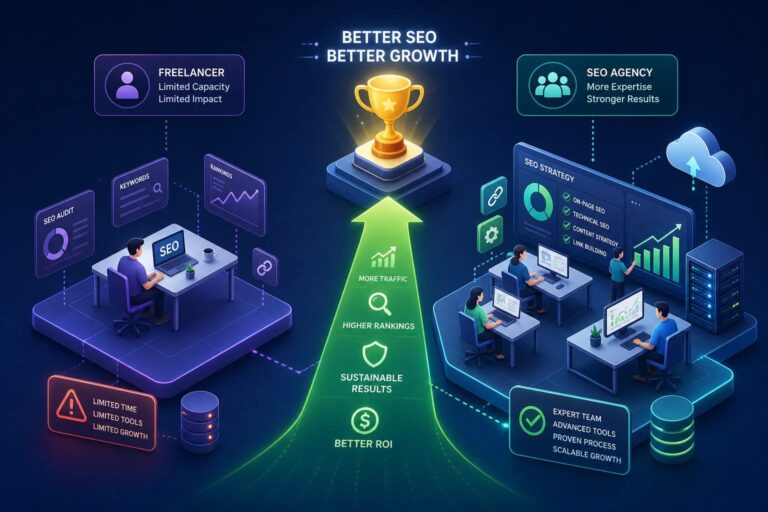
A freelancer, even a highly skilled one, is still one person. When your site simultaneously needs a technical crawl fix, a content production push, and an active link acquisition campaign, a solo operator becomes a bottleneck by definition. There are only so many hours in a working week, and depth in one area almost always means shallower coverage somewhere else.
Agencies field people whose entire job is one specific discipline. A technical SEO specialist who spends every working day on crawl analysis and site architecture will consistently outperform a generalist who covers technical work alongside content, reporting, and outreach. Depth of specialisation is not a luxury; it is what separates campaigns that gain traction from those that plateau.
The specialist depth advantage
A genuine multi-specialist agency team has separate people handling technical SEO, on-page optimisation and content strategy, off-page authority building and digital PR, and paid media management. Each discipline gets full attention rather than whatever time remains after higher-priority tasks are done.
At Brandleap Agency, each service area is owned by a dedicated specialist whose primary focus is that layer of the campaign, which means execution quality does not degrade at the edges of the work. A freelancer, by contrast, typically covers one or two of these areas consistently. That is often sufficient for narrowly scoped work, but it becomes an inherent problem when a campaign needs all of those disciplines firing simultaneously and at a consistent standard.
The single-person dependency problem
If your freelancer goes on holiday, falls ill, or takes on a larger client, your campaign stalls. There is no backup team member, no account manager to pick up the slack, and no documented workflow to ensure continuity. This is not a reflection on the freelancer’s character; it is an operational reality of working with a solo operator.
Agencies carry internal redundancy. Account managers, specialised team members, and documented delivery processes mean that work continues even when individuals are unavailable. For businesses that cannot afford gaps in momentum, that continuity is a measurable practical advantage, not a marketing talking point.
Access to enterprise-grade tools that most freelancers cannot justify
The SEO platforms that agencies use at serious scale carry substantial monthly costs. True enterprise licences, for platforms like Botify, the enterprise tiers of Semrush and Ahrefs, and proprietary reporting stacks, are priced for teams running dozens of campaigns simultaneously. Tools like Screaming Frog are valuable but comparatively affordable; the real cost gap lies in the high-end platforms that surface capabilities standard subscriptions cannot match. A freelancer managing five to ten clients can rarely justify those enterprise costs, which means they typically work from standard tool tiers with real capability gaps.
An agency running thirty or more campaigns can absorb the cost of enterprise subscriptions, API integrations, and custom dashboards. That investment flows directly to the client in the form of better data, more thorough analysis, and faster identification of problems and opportunities.
What agencies can see that freelancers often cannot
Enterprise platforms surface capabilities that standard tool tiers do not include. Crawl analysis across tens of thousands of pages, backlink velocity tracking at scale, and competitor content gap analysis across entire domains give agencies a substantially more complete picture of a site’s health and competitive position. Increasingly, agencies also work with emerging AI visibility tools, platforms that track whether your content appears in AI-generated answers, though this remains a fast-developing area rather than a standardised metric across the industry.
For a business owner, this translates to fewer blind spots. Issues that would take weeks to surface through manual review are identified in hours, and the decisions that follow are grounded in cleaner, more complete data.
Proprietary reporting and what it changes for you
Agencies typically build custom reporting dashboards that connect organic rankings, traffic volume, lead generation, and revenue impact in a single view. This is a different category of output from a monthly PDF listing keyword positions. When a client can see rankings, organic sessions, enquiry volume, and conversion rate moving together in one place, they make faster and better-informed decisions about where to push the strategy next. Reporting becomes a decision-making tool rather than an administrative obligation.
Structured accountability beats an informal arrangement
One of the clearest practical differences in any SEO agency vs freelancer comparison is how accountability is built into the relationship from the outset. Agencies operate with service-level agreements, defined deliverables, account managers, and formal reporting cadences. These are not bureaucratic add-ons; they are the mechanisms that keep a campaign moving predictably over months.
Freelancers typically work on a more personal and informal basis. Progress updates often happen when the client chases rather than on a defined schedule, and there is no internal QA layer reviewing work before it reaches you. That informality can feel refreshingly direct at the start of an engagement, but it creates friction when deliverables slip or strategy needs to change quickly.
SLAs, deliverables, and what agencies actually commit to in writing
A well-structured agency SLA defines content production volume, technical fix turnaround times, reporting frequency, response time tiers for urgent issues, and escalation paths when something goes wrong. These commitments are documented in a master service agreement or statement of work, which gives the client something concrete to hold the agency to throughout the engagement. When budget is real and timelines are tight, that contractual clarity matters enormously.
Freelancers can and do sign similar agreements, but enforcement and continuity depend on the individual rather than on an established operating model. The scope of what is included is also typically narrower, reflecting one person’s realistic capacity rather than a team’s.
Why reporting cadence matters more than most clients realise
Regular, structured reporting is how a business spots a strategy that is not working within the critical three-to-six-month window before significant retainer spend accumulates. A typical agency reporting rhythm includes weekly status updates, monthly performance reviews against agreed KPIs, and quarterly strategy sessions to assess direction. This cadence creates natural checkpoints where course corrections happen based on evidence rather than instinct.
Freelance arrangements more commonly involve lighter-touch check-ins that vary with workload and communication style. That is not inherently problematic on a short project, but on a twelve-month SEO campaign, the absence of a structured review rhythm is how small misalignments compound into significant wasted spend.
A broader service scope handled under one contract
SEO campaigns that produce substantive results rarely live in a single channel. Technical fixes, content production, link acquisition, local citation management, and AI visibility optimisation all need to run in parallel for a campaign to gain real momentum. An agency delivers all of this under one engagement and one strategic plan. A freelancer handles one or two of these layers and relies on the client to source and coordinate the rest, which adds operational complexity and creates gaps where coverage falls between contractors.
What a full-service SEO engagement actually covers
A genuine full-service agency provides technical SEO audits and implementation, on-page optimisation and content strategy, off-page link building and digital PR, and local citation management. Many are now also offering AEO and LLM optimisation to support AI-driven search visibility, an emerging service area that leading agencies are actively building into their delivery frameworks. For a growing business, having all of these disciplines coordinated by one team under a single strategic framework is operationally simpler and strategically stronger than stitching together multiple freelancers who are not communicating with each other.
How Brandleap Agency puts this into practice
Brandleap Agency is built around exactly this model. Dedicated specialists handle technical SEO, content and on-page optimisation, off-page authority and link building, paid media management, and web development as separate disciplines within a coordinated team. Each person owns their area completely, which means the execution quality at every layer of a campaign reflects deep expertise rather than a generalist’s best effort.
For small and mid-sized businesses that need agency-level results without enterprise pricing, this structure delivers genuine specialisation across every discipline, applied to campaigns at a scale where the investment is realistic. It is not a one-size-fits-all service model; it is a coordinated team where every layer of the campaign is owned by someone whose entire focus is exactly that area.
Understanding the risk on both sides before you decide
A fair SEO service comparison acknowledges that both options carry genuine risks. Agencies are not the automatic answer for every business, and freelancers are not inherently unreliable. The risks are built into the design of each model, and knowing what they are allows you to make a more informed decision.
The real risks of hiring a solo SEO freelancer
Single-person dependency is the most significant risk by design. If your freelancer becomes unavailable due to illness, overload, or a more attractive client, your campaign stops. Knowledge and context walk out with them, and there is no internal team to provide continuity. Quality control also depends more heavily on the client, because there is no internal review process before work reaches you. Experienced freelancers are genuinely skilled, but they are limited by the operational constraints of working alone.
Scope is the other practical limitation. One person executing technical SEO, content production, link building, and reporting to a high standard simultaneously is extremely difficult to sustain over a long campaign. Something will receive less attention than it should.
Agency risks and how to protect yourself
Higher cost and communication overhead are the most commonly cited agency disadvantages, and both are legitimate. The bigger risk is misalignment between what is promised in the sales process and what is delivered in practice. This gap is common enough that it deserves specific mitigation. Before signing a long retainer, require named key personnel in the contract, insist on specific deliverables and measurable KPIs in the statement of work, ask for references and case study evidence from comparable businesses, and consider a short pilot engagement before committing to a twelve-month arrangement. These steps will not eliminate every risk, but they significantly reduce the risks you can actually control.
Making sense of the cost: what each model actually delivers for your money
In the UK in 2026, freelance SEO consultants typically charge between £300 and £2,000 per month depending on experience and scope, with experienced practitioners sitting towards the upper end of that range. Small to mid-tier agencies start at around £600 to £2,500 per month and scale to £7,500 or more for mid-market campaigns, with enterprise retainers reaching £20,000 per month for large, multi-market programmes. A practical rule of thumb puts the average agency retainer at around £2,500 per month and the average experienced freelancer retainer at around £800 to £1,200 per month in the UK market.
The agency premium reflects team capacity, tool access, and coordinated delivery across multiple disciplines, not simply overhead. At a £2,500 per month retainer, a well-structured agency is typically delivering technical audits, monthly content production, active link building, and structured reporting. A freelancer at £1,000 per month is realistically covering one or two of those areas consistently.
When a freelancer is genuinely the better choice
If the scope is narrow, the budget is limited, and the work is well-defined, an experienced freelancer is often the smarter hire. A one-off technical audit, a local SEO setup for a single location, or a content refresh project does not require a full agency team and does not justify agency pricing. When you are weighing up whether to hire an SEO company vs a freelancer, the agency model’s advantages compound at scale, across multiple disciplines running in parallel over a sustained period. For a small business with a single focused objective and a tight budget, a skilled freelancer can deliver faster and more affordably than an agency whose minimum retainer outpaces the actual scope of the work.
The bottom line: choosing the model that fits your scale
The benefits of hiring an SEO agency over a freelancer rest on five concrete factors: specialist team depth, access to enterprise-level tools, structured accountability, broader service scope under one contract, and built-in operational continuity. These advantages compound over time and become most significant on campaigns where multiple disciplines need to run in parallel and sustain momentum over six to twelve months.
For businesses that need a fully coordinated campaign, the agency model consistently delivers more reliable outcomes. For businesses with a narrow, well-defined objective and a constrained budget, a skilled freelancer is a legitimate and often better option. The decision is not about which model sounds more credible; it is about matching the model to the complexity and scale of the work.
If your business needs a structured, multi-discipline campaign with measurable outcomes and genuine specialist depth at every layer, Brandleap Agency is built exactly for that. Book a thirty-minute discovery call with the team to get a clear picture of what a coordinated campaign would look like for your specific situation. Get in touch today to start that conversation.

BrandLeap Agency & BrandLeap Fashion | Founder & CEO
Mithun is an experienced SEO consultant recognized for helping businesses improve their digital presence through technical SEO, content optimization, and sustainable organic growth strategies. Working in the digital marketing industry since 2019, he has developed expertise in increasing search visibility, driving targeted traffic, and building long-term growth through data-driven SEO solutions. He has worked with businesses across multiple industries, helping brands strengthen their online authority and achieve measurable growth results.