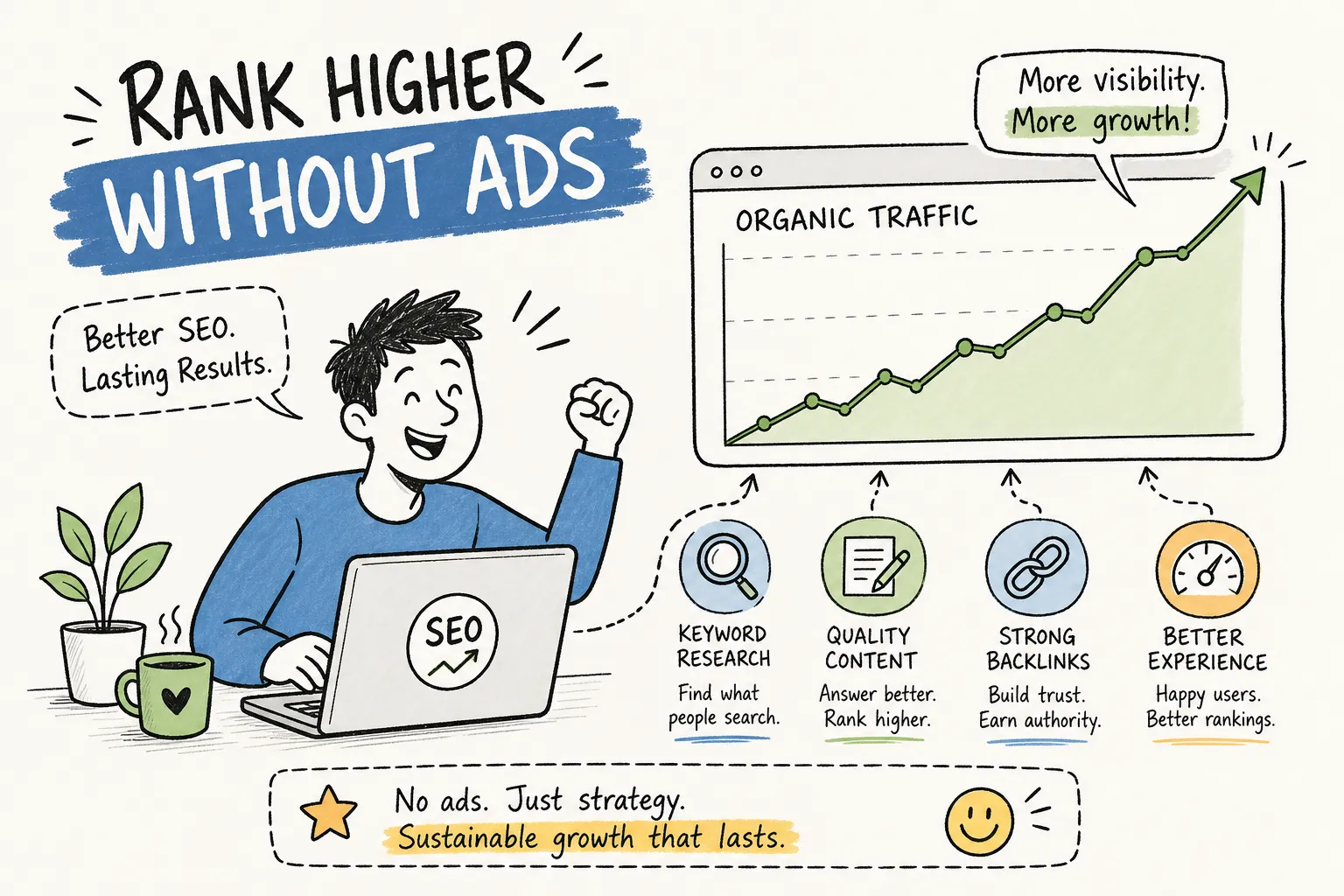
Here’s how most businesses lose: they run Google Ads, traffic spikes, the campaign pauses, and the site goes quiet. Every dollar they spent rented visibility instead of building it. The moment the budget stops, so does the growth. If you want to learn how to improve website rankings without spending on ads, organic search is the answer, the effort you put in this month compounds into next month, and the month after that, without an ongoing invoice attached to it.
At Brandleap Agency, we regularly audit sites where businesses are spending thousands per month on paid search while their organic potential sits completely untapped. Pages that could rank on page one with the right structure, the right content, and a few technical fixes instead sit buried on page four. That’s a fixable problem, and it doesn’t require a budget.
This guide covers five proven levers for organic search optimization: on-page improvements, technical health, content strategy, link building, and local SEO. By the end, you’ll have a clear, prioritized 30-to-90-day action plan you can start implementing this week.
How to Improve Website Rankings Without Spending on Ads: On-Page Fixes That Directly Lift Organic Rankings
Every page on your site is either helping or quietly dragging your rankings down. On-page SEO is where most of the controllable gains live, and none of it costs money. These are the changes that produce the fastest measurable movement.
Match search intent before you touch a single keyword
In 2026, the real ranking signal is intent-matching, not keyword density. Google’s job is to return the most satisfying result for a query, and it has gotten remarkably good at recognizing when a page actually delivers on what a searcher wants. Before you rewrite anything, identify whether the query behind your page is informational (the person wants to learn), navigational (they’re looking for a specific site), or transactional (they’re ready to act). Then restructure the page’s angle and opening paragraph to match that intent directly.
If you’re targeting an informational query, answer the core question in the first 40 to 60 words. This improves your eligibility for featured snippets and signals to Google that your page gets to the point. Don’t bury the answer three paragraphs down behind a company introduction nobody asked for.
Structure pages so Google and users both understand them instantly
Clear hierarchy isn’t just good UX. It’s a ranking signal. Use one descriptive H1 per page, logical H2 and H3 subheadings that reflect what each section actually covers, and descriptive internal anchor text that tells both users and crawlers what they’ll find when they click. Breadcrumb navigation helps on larger sites with deep page structures.
Write title tags that are specific and compelling, not generic. “Digital Marketing Agency” is a wasted title tag. “Affordable SEO Services for Small Businesses in the US” is a title tag that earns clicks. Meta descriptions don’t directly affect rankings, but they do affect click-through rate, which does. Finally, add schema markup where it applies: FAQPage for content with Q&A sections, HowTo for step-by-step guides. Both unlock rich result formats in the SERP at zero cost.
Technical SEO Issues That Quietly Drag Your Site Down
Strong content sitting on a technically broken site still underperforms. Technical SEO is the foundation everything else sits on, and most issues can be diagnosed with free tools like Google Search Console and PageSpeed Insights.
Core Web Vitals fixes with the highest ROI
Google measures three core performance metrics: Largest Contentful Paint (LCP), Interaction to Next Paint (INP), and Cumulative Layout Shift (CLS). LCP is the most ranking-relevant fix for most sites. It measures how quickly the main content element loads, and slow LCP scores are typically caused by unoptimized hero images or render-blocking resources. Google’s threshold for “good” LCP is under 2.5 seconds.
Start there. Compress images and serve them in WebP or AVIF format. Preload your above-the-fold hero image so the browser prioritizes it. Lazy-load everything below the fold. Defer non-essential JavaScript so it doesn’t delay the initial render. For CLS, set explicit width and height on all images and reserve space for any dynamic elements like ads or cookie banners. Run PageSpeed Insights for free to see exactly where your pages stand and what to fix first. For official guidance on the metrics and thresholds, review the Core Web Vitals documentation.
Crawlability and indexation basics every site needs
Search engines can only rank pages they can find and read. Submit a clean XML sitemap through Google Search Console so Google knows which pages to crawl, and add canonical tags to handle any duplicate content, common on e-commerce sites with filtered pages or sites serving content over both www and non-www URLs. Broken internal links bleed crawl budget and kill user experience simultaneously, so fix them as part of your initial audit. Finally, check your robots.txt file to confirm you haven’t accidentally blocked important pages from being crawled. These are one-time fixes with permanent benefits.
Steps for How to Improve Website Rankings Without Spending on Ads: Content Strategy
Publishing blog posts without a strategy is just noise. What earns organic traffic is a deliberate structure built around topic clusters, content depth, and regular updates. The goal is to become the most authoritative source on a set of interconnected topics, not to publish as many posts as possible.
Format and length that Google rewards in 2026
Pillar content in the 2,000 to 2,500 word range consistently outperforms thin pages on competitive queries. A 2024 Backlinko analysis of over one million articles found that pages with at least one embedded video attracted significantly more organic traffic than text-only posts. These aren’t arguments for padding word count; they’re arguments for covering topics thoroughly enough that a reader doesn’t need to go elsewhere to complete their understanding.
A practical formula: one detailed pillar page per topic cluster, targeting the broad head keyword, supported by shorter cluster articles that go deep on specific subtopics. Each cluster post links back to the pillar, and the pillar links out to the cluster posts. This structure signals topical authority to search engines and distributes ranking strength across the cluster.
Topic clusters and content refreshes that build topical authority
The hub-and-spoke content model works because it mirrors how search engines think about expertise. A pillar page covering “content marketing for lead generation” links to cluster articles on email nurturing, blog strategy for B2B, and case study formats. Each cluster article reinforces the pillar’s authority and closes ranking gaps on long-tail queries the pillar can’t target alone.
Don’t treat published content as finished. Revisit high-value pages every 6 to 12 months. Update statistics, add new subheadings for questions that have emerged since publication, replace outdated examples, and republish with a fresh date to signal content freshness to Google. A refreshed article often sees a meaningful ranking bump within 30 to 60 days of the update going live.
Free link-building strategies that actually move authority metrics
Backlinks remain one of the most powerful ranking signals in organic search. You don’t need a paid tool or a large budget to earn them. You need a repeatable outreach process and at least one piece of content worth linking to. If you’re looking for practical, step-by-step approaches to earning links without a budget, see this guide on how to get free backlinks.
Guest posting, broken link building, and resource page outreach
Guest posting is straightforward: find relevant sites in your niche, pitch a specific angle that their audience would genuinely value, and write content that earns a contextual link back to your site. Focus on relevance over volume. One link from a relevant, trusted site moves authority metrics more than ten links from unrelated directories.
Broken link building is underused and highly effective. Use Ahrefs’ free backlink checker to find dead outbound links on relevant pages in your niche, then reach out to the site owner and offer your content as a replacement. You’re solving their problem while earning a link. Resource page outreach follows the same logic: find “best resources on [topic]” pages, review what’s listed, and pitch your strongest content as an addition if it genuinely belongs there. For a quick list of practical tactics, see 10 free link-building techniques that actually work.
Digital PR and linkable assets for passive authority growth
The highest-upside free strategy is building one strong linkable asset: original industry data, a genuinely useful free calculator, a detailed research study, or a template that practitioners actually want. This type of content earns links passively over time because other writers reference it when they need a credible source. It’s the difference between fishing with a line and fishing with a net.
Pair that asset with digital PR: pitch it to journalists covering your industry, relevant bloggers, and niche newsletters. Monitor new referring domains using Google Search Console’s Links report or Ahrefs’ free tier to track whether your domain authority is actually moving. If referring domains are growing month over month, the strategy is working.
Local SEO and Google Business Profile without paying for placement
For businesses with a local customer base, Google Business Profile optimization delivers ranking movement faster than almost any other lever covered in this guide. It’s completely free, and the impact on local search visibility is immediate when done correctly.
Google Business Profile optimization step by step
Start by claiming and verifying your listing if you haven’t already. Google explicitly ties profile completeness to local ranking eligibility, so every unfilled field is a missed opportunity. Select the most specific primary category available for your business type. Complete every available field: services, hours, Q&A, attributes, and business description. Add high-quality photos and videos regularly, and respond to every review, positive or negative. An active, complete profile signals to Google that the business is legitimate, engaged, and worth surfacing in local results. For hands-on optimization guidance, see this resource on how to optimize Google Business Profiles.
NAP consistency, citations, and local content that closes the gap
Your Name, Address, and Phone number must be identical across every directory listing. Even minor inconsistencies, “St.” versus “Street” or a missing suite number, create conflicting signals that weaken your local authority. Fix the core citations first: Bing Places, Apple Maps, Yelp, and any industry-specific directories that matter in your vertical.
Once the foundation is solid, build local content that closes the relevance gap. Create service-area landing pages targeting specific cities or neighborhoods you serve. Write FAQ content built around “near me” queries and city-specific searches. Publish local blog posts that answer the real questions your customers ask before they call. This combination reinforces geographic relevance and helps you rank for the queries that drive actual foot traffic and phone calls.
Measuring progress and your 30-to-90-day action plan
Knowing what to do only gets you halfway. The other half is building a review habit so you know whether it’s working and where to adjust. Here’s which free tools to use and exactly what to check at each milestone.
Free tools to track rankings, traffic, and technical health
The essential free stack covers every metric you need. Google Search Console tracks impressions, clicks, average position, and index coverage, check it weekly for any coverage errors or ranking movement on target queries. Google Analytics 4 tracks organic traffic sessions and goal completions so you can see whether ranking improvements are translating into actual visits and conversions. PageSpeed Insights gives you a current snapshot of Core Web Vitals for any URL. For backlink monitoring, the Google Search Console Links report and Ahrefs’ free tier both show new referring domains without requiring a paid subscription.
KPIs and milestones at 30, 60, and 90 days
Set concrete checkpoints so progress is measurable, not subjective. By day 30, all on-page and technical fixes should be complete and submitted for re-crawl through Google Search Console. By day 60, initial ranking movement on long-tail keywords should be visible in the Search Console Performance report. By day 90, organic sessions should show an upward trend, and at least two to three new referring domains should be earned through outreach or linkable asset distribution.
Businesses that want to compress this timeline with expert execution can work with Brandleap Agency. We specialize in sustainable, ads-free organic search optimization for small businesses, e-commerce brands, and B2B service companies across the US. We offer tailored services including SEO company in London, Results-Driven SEO Services in New York, and WordPress SEO Services. The strategy is the same; what changes is how quickly it gets done.
The compounding advantage of organic search
On-page optimization, technical health, content strategy, link building, and local SEO don’t work in isolation. They reinforce each other. A technically clean site makes your content easier to index. Better content earns more links. More links strengthen the authority of every page on the domain. Local SEO layers geographic relevance on top of that foundation. The result is a system that grows stronger over time instead of stopping the moment you stop paying.
Learning how to improve website rankings without spending on ads is not a shortcut strategy. It requires consistent effort over 30, 60, and 90 days. But the work you do in month one keeps paying off in months six, twelve, and twenty-four. That’s the fundamental difference between renting traffic and owning it.
If you’re ready to stop depending on paid ads for every new visitor and start building something that compounds, Brandleap Agency is here to help. Our team handles the full stack: technical audits, on-page strategy, content creation, link building, and local SEO. All under one roof, with transparent reporting on every metric that matters. Reach out today and let’s build your organic growth plan together.