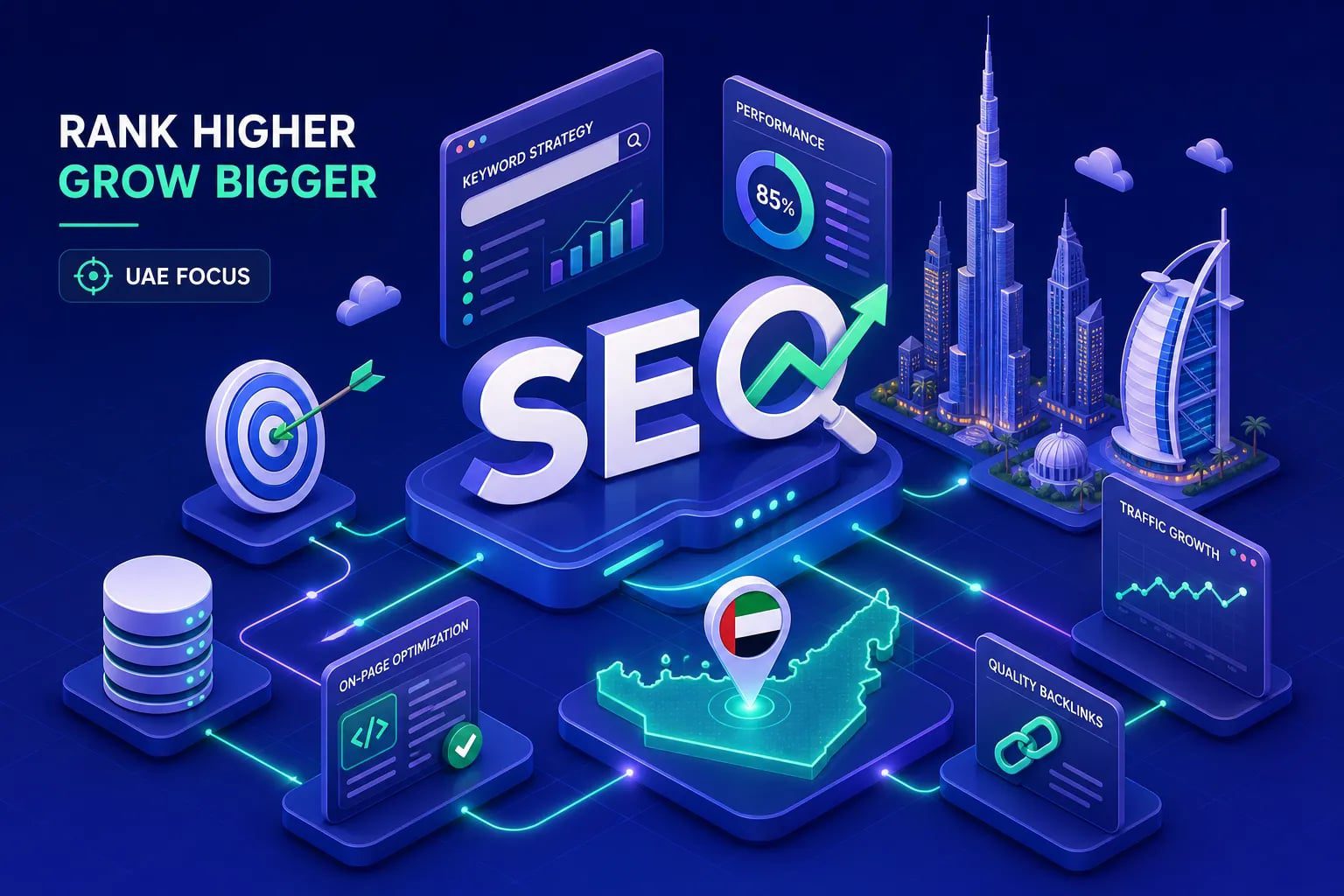
The UAE’s digital market doesn’t play by the same rules as Western markets, and businesses that arrive with a standard European or US SEO playbook find that out quickly. Many users in Dubai and Abu Dhabi search in both Arabic and English, the Google local pack is highly competitive across major service categories, and what “ranking” means is actively being redefined by AI-powered search features. For businesses targeting the Gulf, advanced SEO in UAE requires a fundamentally different approach, one built around technical precision, genuine multilingual strategy, and an understanding of how AI search is reshaping visibility. The gap between generic SEO and a properly advanced UAE SEO strategy shows up directly in revenue, often more sharply than businesses expect.
The pattern observed across high-growth global markets is consistent: the businesses winning organic visibility in the UAE are combining technical precision, a real multilingual content strategy, and a clear understanding of how AI search is reshaping results. This article breaks down the most effective advanced tactics across each of those areas, in the priority order that actually produces results.
Technical SEO in UAE: Foundations Businesses Get Wrong
Technical SEO in the UAE has specific failure patterns that differ from what you’d typically see in Western markets. Most stem from heavy JavaScript architectures, multilingual site structures set up incorrectly from the start, and hosting decisions that ignore local latency for users in the Gulf region.
Core Web Vitals: INP Is Now the Biggest Culprit
LCP gets the most attention in SEO guides, but on UAE sites, INP (Interaction to Next Paint) is now the most frequently failed Core Web Vital. The cause is rarely images. More often it is chat widgets, analytics stacks, A/B testing scripts, and bloated JavaScript frameworks that clog the main thread and delay response to user input. The fix requires auditing every third-party integration, deferring non-critical scripts, and breaking long tasks into asynchronous chunks.
The target thresholds to hit are LCP under 2.5 seconds, INP under 200ms, and CLS below 0.1. One critical note: use field data from Google Search Console rather than lab scores from PageSpeed Insights alone. Lab scores reflect a controlled environment; field data reflects what real UAE users on real devices and networks actually experience.
Schema Markup Gaps and What They Cost You
Most UAE business sites either have zero structured data or partial implementations full of validation errors. Both outcomes produce the same result: no rich results, no enhanced SERP appearances, and no clear entity signal for AI-driven features. The schema types that matter most are LocalBusiness, Service, Product, and FAQ, these commonly cover many revenue-generating pages such as local services, product listings, and enquiry flows. For LocalBusiness schema specifically, include precise UAE location data and, where appropriate, service descriptions that reflect what your business offers; this strengthens entity signals for AI Overviews and local search alike.
Schema isn’t just about rich snippets anymore. AI-powered search features use structured data to understand what your business is, what it offers, and how to summarise it. A site with valid, complete schema gives Google’s systems far more to work with than one relying on unstructured page text alone.
Hreflang for Arabic and English: The Most Common Setup Mistake
Serving Arabic and English content without correctly implemented hreflang attributes creates duplicate content issues and causes Google to serve the wrong language version to the wrong user. The correct implementation uses hreflang="ar-AE" and hreflang="en-AE" as region-specific codes, not just ar and en, with every page version referencing itself and its counterpart reciprocally, plus canonical tags on each language version.
This matters beyond traditional SEO. AI search systems rely on clear entity-to-language signals to summarise content accurately for users. A broken hreflang setup doesn’t just confuse Google’s crawlers; it creates ambiguity that reduces your chances of being cited in AI Overviews for either Arabic or English queries.
Arabic and English Content Strategy That Actually Ranks
Multilingual SEO in the UAE is not a translation project. Arabic-speaking and English-speaking searchers in the UAE have distinct query patterns, distinct intent signals, and distinct content expectations, treating the Arabic version of your site as a translated copy of the English version is one of the most expensive strategic mistakes a UAE business can make.
Why Translated Pages Underperform
The difference between translation and localisation is measurable in engagement data. A translated page replicates words. A localised page uses UAE-specific examples, AED pricing references, references to local regulations, Dubai and Abu Dhabi place names, and a tone that matches how the target audience actually communicates. Google treats a translated page as thin content if it lacks unique local signals, and rankings reflect that consistently.
Available UAE studies consistently show that localised Arabic pages deliver better engagement and conversion than translated equivalents, with meaningful differences in time-on-page, bounce rate, and conversion rate. For commercial pages where a session should end with an enquiry or a purchase, that engagement gap translates directly into revenue.
Keyword Research Across Both Languages Independently
UAE keyword research must be conducted in Arabic and English separately, not by translating English keywords into Arabic. Arabic search terms capture intent that English-only pages miss entirely, particularly for local-intent queries in Dubai and Abu Dhabi where users phrase searches in Gulf dialect or Modern Standard Arabic rather than anglicised alternatives.
The structural approach that works is dedicated /ar/ and /en/ subdirectories, with city- and service-specific landing pages treating Dubai, Abu Dhabi, and Sharjah as distinct search targets rather than interchangeable locations. This architecture gives Google clear relevance signals for each market and each language, building topical authority independently across both versions over time.
Local SEO Dubai and UAE: Winning the Local Pack
Google’s three core local ranking signals are relevance, distance, and prominence. In the UAE’s high-density urban markets, where dozens of competitors operate within the same postcodes and all target the same service queries, the businesses that win the local pack are the ones that have systematically optimised every controllable factor rather than relying on proximity alone. Google Maps optimisation in UAE cities is particularly competitive; a disciplined, consistent approach to every profile signal is the minimum requirement for serious contention.
Google Business Profile: The Signals That Matter Most
The primary GBP category is the single strongest lever available on the profile itself. Choosing the wrong category or being too generic kills relevance before any other factor has a chance to work. Beyond category, the full optimisation stack covers services list, photos (updated regularly, not uploaded once and forgotten), posts, hours, and attributes. Keyword presence in the business description should be written naturally and accurately, not stuffed.
Behavioural signals also feed directly into prominence: calls, direction requests, and website clicks from the profile all tell Google that real users find the listing useful. Taken together, clicks, calls, and direction requests signal active engagement, and an optimised GBP profile that users engage with consistently grows in prominence as that activity accumulates. The profile is not a set-and-forget asset.
Reviews, Citations, and Local Authority Signals
Review quantity matters, but so does recency and the business’s own response activity. A profile with 200 reviews from three years ago and no responses performs differently from one with 80 reviews that are recent, varied, and met with genuine responses. Both factors feed into prominence in the local pack.
Consistent NAP (Name, Address, Phone) citations across UAE directories and local backlinks from regional publications reinforce entity trust across the web. For AI search visibility specifically, consistent third-party mentions across trusted sources carry more weight than map-pack signals alone. The two strategies reinforce each other: strong local authority builds both map visibility and the entity credibility that earns AI Overview citations.
Advanced SEO in UAE: Winning Visibility as AI Overviews Reshape Search Results
Ranking on page one in 2026 is no longer the same as being visible. Google’s AI Overviews appear above organic results for informational, comparison, and many commercial research queries, including high-value UAE service and product searches. The visibility model has shifted, and SEO services in UAE that don’t account for this shift leave significant exposure on the table.
How AI Overviews Are Changing Click Behaviour
A 2024 analysis found organic click-through rates fell by 8.9% when an AI Overview was present, and longitudinal data from Seer Interactive showed the CTR decline reached as steep as 61% at its peak before partially recovering as user behaviour adapted. Zero-click sessions increase because users get answers without visiting a page. For UAE commercial queries specifically, informational, how-to, comparison, and decision-stage research queries are the most affected. Local transactional queries such as “best SEO consultant Dubai” are currently less disrupted.
The new visibility model requires thinking about citation-based exposure, not just ranking position. Being cited inside an AI Overview creates exposure above the organic results, even when the user doesn’t click through. That citation is now as strategically important as a first-page ranking.
Content Structure Tactics That Earn AI Citations
Answer-first writing is the foundation: put the direct, specific answer at the top of the page before supporting detail. This is how Google’s systems extract and quote content. Clear H2 and H3 structure, concise sections, FAQ blocks, and scannable formatting make content machine-readable as well as human-friendly, and both qualities are necessary for AI citation.
Entity credibility matters as much as content structure. Verified company details, consistent brand facts across the web, relevant schema, and topical depth on core service pages all increase the probability of being cited. Analysis of AI Overview citation patterns suggests roughly half of top-ranking pages get included, but ranking in the top ten doesn’t guarantee inclusion. Content structure and entity authority are the differentiating factors.
What SEO ROI Looks Like Across UAE Sectors
Advanced SEO requires budget and commitment. Before briefing an agency or allocating resources internally, understanding what documented outcomes actually look like in the UAE market gives you a realistic basis for planning rather than projections built on optimism.
E-Commerce SEO UAE: The Sector with the Clearest Benchmarks
UAE e-commerce case studies provide the richest public ROI data in the region. Reported outcomes in documented UAE campaigns include monthly organic revenue moving from AED 12,000 to AED 186,000 while paid ad spend dropped by 55%, with ROI figures reaching 3,000%+ over 12-month periods. These results reflect what happens when technical SEO, content, and off-page authority building run as an integrated strategy rather than separate tactics executed in isolation.
The consistent pattern across UAE e-commerce campaigns is that organic traffic builds steadily over time, reducing dependence on paid channels and improving overall margin. The payback period for e-commerce is generally shorter than for professional services, making it the sector where the commercial case for advanced SEO is easiest to model from the start.
Hospitality and Professional Services: Different KPIs, Same Logic
Hospitality SEO in the UAE is measured through booking volume, direct-booking share, and reduced OTA commission spend, not just traffic. A documented pattern for UAE hospitality brands is a 264% organic traffic lift translating into measurably higher booking volume when technical and content SEO run simultaneously. The strategic goal is reducing OTA dependency, and organic search is the most scalable route to achieving it.
Professional services firms, including law firms, finance consultancies, and healthcare providers, measure SEO ROI through lead volume, qualified enquiry rate, and cost-per-acquisition. Documented UAE cases show 47% more qualified leads and CPA reductions of over 50% compared to paid campaigns.
For planning purposes, realistic first-year ROI in UAE campaigns typically falls between 150% and 300% for established websites, and between 75% and 150% for newer sites, with e-commerce payback periods generally shorter than professional services.
Where to Start and How to Approach Advanced SEO in UAE
The five strategic layers covered here form a connected system: technical foundations, multilingual content authority, local search dominance, AI visibility optimisation, and sector-realistic ROI expectations. The priority order matters. Fix technical blockers first, because they limit the effectiveness of everything built on top of them. Build multilingual content authority next. Then layer in local pack optimisation and AI-visibility tactics as the site’s domain authority grows.
The UAE market rewards businesses that approach these layers as a system rather than a checklist of isolated actions. Generic SEO advice built for other markets won’t produce the same outcomes here. The cultural complexity, the bilingual search behaviour, and the competitive density of Dubai and Abu Dhabi demand a more precise approach, and the ROI data shows clearly that businesses willing to invest in that precision outperform those that don’t.
At Brandleap Agency, applying these advanced SEO frameworks across competitive UAE and global markets is what the team specialises in across every engagement. If you’re ready to move beyond surface-level SEO and build durable organic visibility in the UAE, the Brandleap team covers every layer, from technical audits and Arabic content strategy to local authority building and AI search optimisation in UAE. Get in touch with the Brandleap team to discuss where your site currently stands and what a structured UAE SEO strategy would look like for your business.