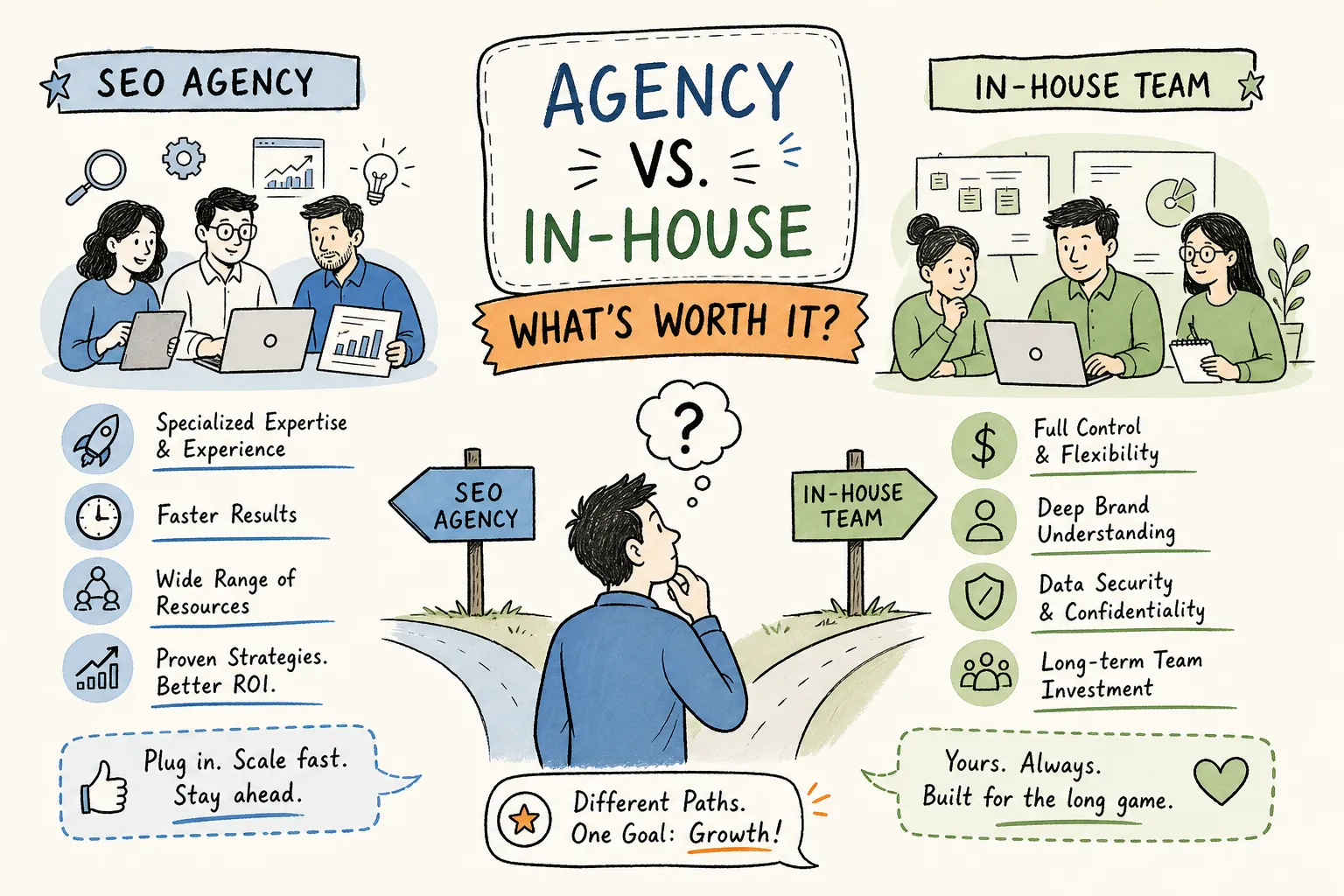
Picture this: you’re a founder or marketing lead staring at two open tabs. One is a job posting for an “SEO Manager.” The other is a proposal from a digital marketing agency. Both promise results. Neither makes the cost comparison obvious. And the wrong choice doesn’t just waste money; it costs you months of compounding growth you’ll never get back.
For growing businesses weighing the best SEO agency vs. in-house SEO team option, this is one of the highest-leverage decisions you’ll make. Most founders assume in-house is cheaper because they see the salary number and stop there. The real math looks very different once you factor in everything a functioning SEO operation actually requires. On the agency side, the fear isn’t cost but capability: the worry that you’ll pay a retainer and end up with a junior account manager running your strategy.
This article breaks down the real costs, speed-to-results timelines, and practical decision frameworks across every growth stage, so you can make this call with clear numbers rather than assumptions.
SEO Agency vs. In-House SEO Team: The Real Cost Comparison for Growing Businesses
The salary and overhead math most businesses miss
A single mid-level SEO specialist in the U.S. costs between $95,000 and $145,000 per year on a fully loaded basis. That number includes base salary, employer-side payroll taxes, benefits, tools, and training. Most businesses budget for the salary and forget the rest.
Scale that to a two- or three-person team and the numbers climb fast. A manager plus a specialist runs $260,000 to $370,000 per year. Add a third hire and you’re looking at $369,000 to $441,000 annually before you’ve written a single piece of content or built a single link. Tools alone, Ahrefs, Screaming Frog, SEMrush, and reporting dashboards, typically add $3,000 to $12,000 per year on top of those headcount costs, depending on tool tiers and usage volume.
Roles you actually need to cover all of SEO
Effective SEO requires five distinct skill sets: strategy, technical execution, content production, analytics, and link building. A single hire covers two or three of these at best. The rest either gets dropped or outsourced anyway, which often means paying both a salary and a vendor simultaneously.
Growing websites also outgrow a generalist faster than most businesses expect. Once organic traffic starts compounding, the technical demands increase, the content calendar expands, and the link acquisition work intensifies. Forcing a second or third hire before you have the budget extends both the timeline and the cost. That’s the sticker-versus-full-price problem in practice: the number on the job posting is the minimum, not the total.
What Hiring an SEO Agency Actually Delivers
Retainer cost versus in-house equivalent
Agency retainers for growth-stage businesses typically run $5,000 to $10,000 per month for smaller companies and $10,000 to $25,000 per month for scaling mid-market firms. At $60,000 to $120,000 per year, a retainer buys access to a full team of specialists covering technical SEO, content, link building, analytics, and strategy, with no recruiting costs, no onboarding delays, and no benefits overhead.
Compare that directly to $260,000 to $441,000 for an equivalent two-to-three-person in-house team. The math heavily favors outsourcing at most growth stages, particularly when you account for the fact that the agency team is already staffed, tooled, and process-ready from day one.
Why the “junior account manager” objection misses the mark
The real risk with agencies isn’t agencies in general. It’s agencies that pitch senior strategists and then hand off execution to entry-level staff after the contract is signed. That’s a vendor selection problem, not an inherent agency-model problem.
Some agencies are structured to address this directly. Founder-led models like Brandleap Agency apply senior-level strategic thinking to each account rather than filtering decisions through layers of account management. When you’re evaluating the SEO agency vs. in-house SEO team question for your growing business, the right follow-up question isn’t simply “agency or in-house”, it’s “which agency operates like a senior partner, not a production shop.” An integrated agency covering SEO, content, technical optimization, paid media, and link building under one roof can also eliminate the multi-vendor fragmentation that frustrates most in-house marketing leads.
Speed to Results: How Fast Each Model Generates ROI
Agency ramp-up versus the hiring process alone
Agencies onboard in weeks, not months. Most begin execution within 30 to 60 days of a contract start. A single in-house hire, by contrast, typically takes two to three months from job posting to start date, plus two to four additional weeks of onboarding before reaching initial productivity, with full output often developing over several months beyond that. For a growth-stage company, that timeline can mean a quarter or more of missed compounding before a single optimization goes live.
When each model starts producing measurable SEO improvements
Agencies typically deliver measurable ranking movement and organic traffic growth within three to six months because the team is already staffed, tooled, and running proven processes from the start. In-house teams more commonly need six to twelve months to produce comparable results after accounting for the hiring delay, onboarding period, and the slower build-up of workflow and institutional knowledge.
For businesses trying to compete now rather than next year, the agency timeline advantage is significant. That speed differential often justifies the retainer cost on its own, especially in competitive verticals where organic rankings compound over time and every delayed month represents lost ground to faster-moving competitors.
Where Building an In-House SEO Team Genuinely Wins
Deep brand knowledge and cross-team alignment
In-house SEO professionals develop intimate knowledge of brand voice, product roadmap, customer insights, and internal data that external agencies don’t have access to by default. For content-heavy businesses or highly regulated industries like healthcare, legal, or financial services, having a dedicated internal editor who understands compliance and nuance is genuinely valuable. The feedback loop between SEO, product, and sales is tighter when the team sits inside the company.
Long-term scalability for enterprise-level needs
At the enterprise level, think $20M or more in revenue with large content operations and complex technical infrastructure, a dedicated in-house team becomes more economically competitive. When SEO work is constant, high-volume, and deeply integrated with product development, internal headcount can beat agency retainers on cost per output. Industry benchmarks generally place this break-even zone at roughly $15,000 or more per month in SEO spend, or the point where three or more full-time specialists can be kept fully utilized year-round.
For most growth-stage companies, enterprise-level SEO complexity is still years away. In-house investment before that threshold is reached tends to be premature, and the fully loaded cost of an in-house team rarely outperforms a well-run agency retainer on a pure ROI basis.
The Hybrid Model: Agency Strategy with Internal Execution
What to keep in-house versus what to outsource
A practical hybrid setup keeps brand voice, content approvals, and internal stakeholder communication in-house while outsourcing technical SEO, link building, and strategic direction to an agency. This structure lets a single in-house content coordinator or marketing manager work alongside an agency team rather than trying to build every SEO capability internally from scratch.
Of the three structural options, agency-only, in-house-only, and hybrid, the hybrid model often carries the most attractive cost profile. One internal hire at $95,000 to $130,000 per year combined with a leaner agency retainer at $3,000 to $7,000 per month frequently totals far less than a full three-person in-house build, while still covering all five of the core SEO skill sets a growing site requires.
How to structure the agency and internal partnership effectively
Clear ownership is what makes a hybrid model work. The agency leads on technical audits, keyword strategy, and link acquisition. The internal person manages the publishing workflow, content production coordination, and brand review. Overlapping responsibilities without defined accountability is where hybrid arrangements break down.
Monthly strategy calls, shared reporting dashboards, and defined KPIs keep both sides aligned and accountable. The most useful metrics for this evaluation are organic conversion rate, MQL growth, LTV:CAC ratio (a 3:1 minimum is the standard benchmark), and keyword ranking velocity on commercial pages. The hybrid model works best when the internal person understands SEO well enough to act as a strategic partner rather than just a task manager passing briefs back and forth.
Which Path Fits Your Current Growth Stage
Startups and early-stage businesses (under $2M revenue)
At this stage, working with an SEO agency is almost always the right call. The fully loaded cost of a single senior in-house hire exceeds most SEO retainers, and the agency’s speed-to-execution advantage is most valuable when a business needs early organic traction fast. Key metrics to track at this stage: organic traffic growth, keyword ranking velocity, and conversion rate from organic sessions.
Growth-stage and scaling businesses ($2M to $20M revenue): the best case for an SEO agency vs. in-house SEO team evaluation
This is the zone where the hybrid model often makes the most sense, agency-led strategy with light in-house coordination. For businesses at this stage that haven’t tested an agency yet, a focused six-month retainer with clear ROI benchmarks is a low-risk way to validate before committing to in-house headcount. Positive ROI within six months and a 3:1 LTV:CAC ratio are the practical minimums to hold any engagement accountable.
When to seriously consider going fully in-house
Full in-house investment makes sense when SEO volume justifies three or more dedicated roles, the business runs a large content operation, or internal product knowledge is a genuine competitive differentiator. Most practitioners put this threshold at roughly $20M to $30M in annual revenue for many businesses, and closer to $50M ARR for more complex multi-market organizations. Below that revenue level, a well-structured agency retainer typically delivers stronger ROI than the equivalent in-house build.
Making the Right Call for Your Business
For most growing businesses, choosing the right SEO agency vs. in-house SEO team comes down to one number: where you are relative to the $15,000 per month spend threshold where in-house economics start to close the gap. Below that level, an agency delivers more output, faster, for less than the fully loaded cost of an equivalent internal team. In-house wins at enterprise scale and in businesses where brand alignment is a genuine competitive edge, but those conditions rarely apply before the $20M revenue mark.
The nuance matters: the agency model only outperforms in-house when the agency itself operates at a senior level. If you’re handed off to junior staff after the pitch, you get neither the speed advantage nor the expertise depth that makes the retainer worthwhile.
If you’re a growth-stage business weighing this decision right now, the right next step is understanding what a founder-led, full-service SEO partner looks like in practice. Brandleap Agency was built specifically to close the gap between agency convenience and senior-level strategic depth. Their integrated team covers SEO, technical optimization, content, paid media, and link building under one roof, with founder-level thinking applied directly to every account, no hand-off to junior staff after the contract is signed. If you’re ready to see what that looks like for your business, connect with the Brandleap team and get a clear picture of what six months of focused organic growth can actually produce.
Frequently Asked Questions: SEO Agency vs. In-House SEO Team for Growing Businesses
When should a growing business hire an SEO agency instead of building an in-house team?
An agency is typically the right call when annual revenue is below $20M, when speed to results matters, or when the fully loaded cost of in-house headcount exceeds what a comparable retainer would deliver. Most growth-stage businesses hit that condition well before they expect to.
How much does a typical SEO agency retainer cost?
Retainers for growth-stage companies generally range from $5,000 to $10,000 per month for smaller businesses and $10,000 to $25,000 per month for scaling mid-market firms. Leaner retainers in the $3,000 to $7,000 range are common in hybrid arrangements where one internal hire handles coordination.
What is the fully loaded cost of an in-house SEO team?
A two-to-three-person in-house SEO team typically runs $260,000 to $441,000 per year when you include base salaries, payroll taxes, benefits, tools ($3,000, $12,000/year), and training. A single mid-level specialist alone costs $95,000 to $145,000 on a fully loaded basis.
How long does it take for an SEO agency to produce results?
Most agencies begin execution within 30 to 60 days of contract start and deliver measurable ranking movement within three to six months. In-house teams typically need six to twelve months to produce comparable results after accounting for hiring timelines and onboarding.
What is the break-even point where in-house SEO beats an agency?
Industry benchmarks generally place the break-even threshold at roughly $15,000 or more per month in SEO spend, the point where three or more full-time specialists can be kept fully utilized year-round. For most businesses, this aligns with $20M or more in annual revenue.
What does a hybrid SEO model look like in practice?
A hybrid setup keeps brand voice, content approvals, and stakeholder communication in-house while outsourcing technical SEO, link building, and strategic direction to an agency. One internal hire paired with a $3,000 to $7,000 per month retainer frequently costs less than a full three-person in-house build while covering all five core SEO skill sets.
What KPIs should I use to evaluate SEO agency performance?
The most useful metrics are organic conversion rate, MQL growth from organic sessions, LTV:CAC ratio (3:1 is the standard minimum benchmark), and keyword ranking velocity on commercial pages. Track these monthly against agreed baselines from the start of the engagement.
Is the hybrid model the best SEO approach for $2M, $20M businesses?
For many businesses in this revenue range, yes. Agency-led strategy combined with light in-house coordination balances cost, speed, and coverage more effectively than either a fully external or fully internal model. A focused six-month agency retainer with clear ROI benchmarks is a low-risk starting point before committing to additional headcount.