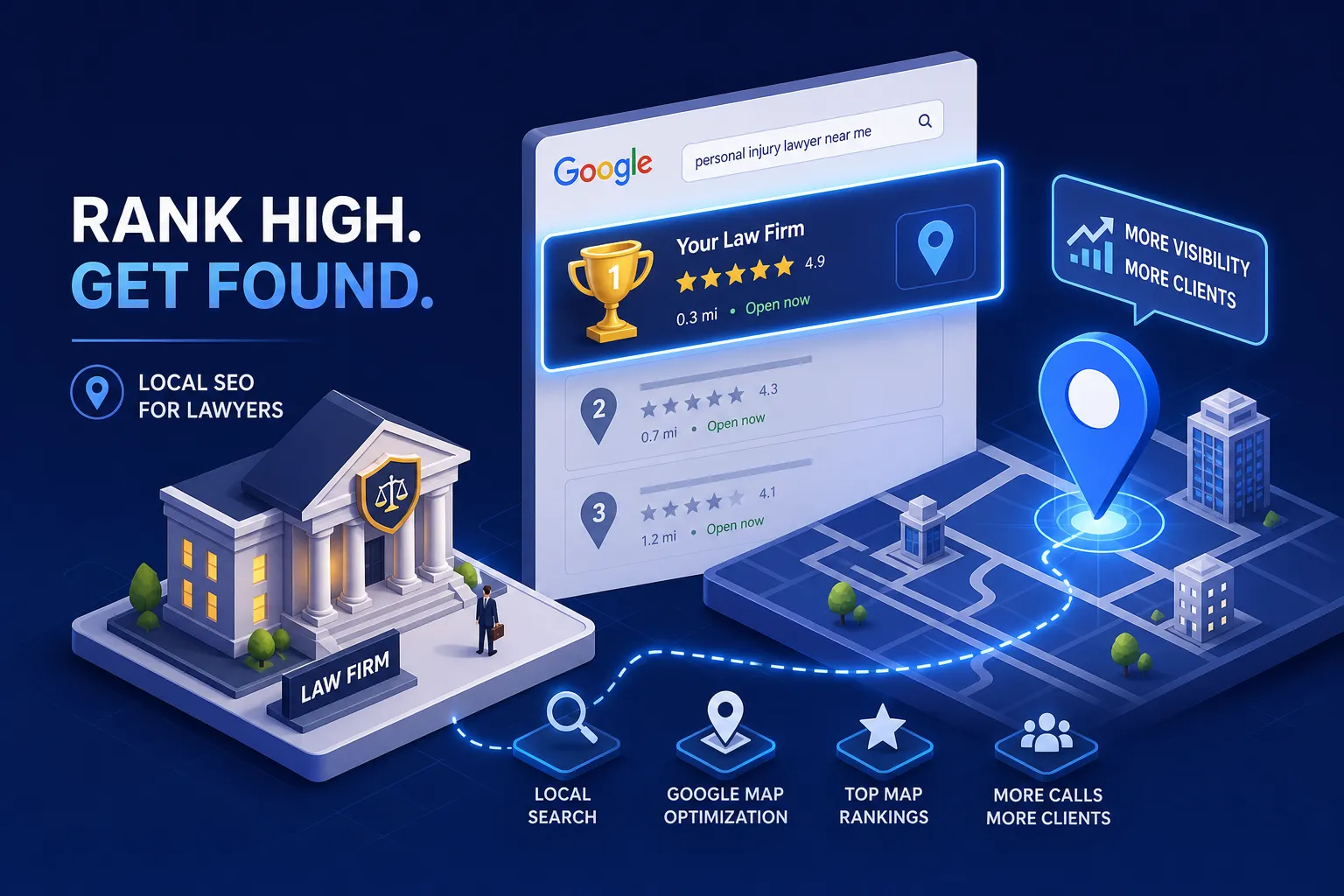
Local SEO for lawyers determines whether your firm appears in the Map Pack when clients search for attorneys in your city. When someone types “divorce lawyer near me” or “personal injury attorney [city]” into Google, three law firms capture a large share of clicks before a single organic result appears. That’s the Map Pack. It sits above the standard search listings and dominates local legal queries. The firms occupying those three spots aren’t there by accident. They’ve built a deliberate, repeatable local SEO system, and they maintain it consistently.
Local SEO for lawyers has shifted from a nice-to-have into the primary intake driver for most practice areas. Prospective clients searching for attorneys have high intent, and they make decisions fast. If your firm isn’t visible in the Map Pack for your core practice area in your city, you’re effectively invisible to the majority of people who are actively looking to hire right now. At Brandleap Agency, we work specifically with professional service firms, including law practices, to build and execute these systems from the ground up. This guide covers five core areas: Google Business Profile optimization, citation building, geo-targeted location pages, review strategy, and the LSA vs. organic decision.
Why the Map Pack Controls Attorney Client Acquisition
Google treats legal searches differently from general informational queries. Searches like “criminal defense attorney Chicago” or “estate planning lawyer near me” carry local intent, and Google responds by surfacing a local result set at the top of the page. Three listings. Everything else gets pushed below. The practical consequence for law firms is stark: if you’re not in those three positions, the organic rankings below them receive a fraction of the traffic they otherwise would.
Google decides which firms appear in the Map Pack using three core signals: relevance, proximity, and prominence. Relevance is how well your Google Business Profile and website match the specific search query. Proximity is how close your office is to the searcher’s location. Prominence is the weight of your online authority, built through reviews, citations, and your website’s overall standing.
How Google Decides Which Three Law Firms Make the Cut
Proximity is largely fixed. You can’t move your office to every neighborhood in your city, so competing on distance alone isn’t a viable strategy. The firms that consistently win in the Map Pack compete hard on relevance and prominence instead. Relevance comes directly from your GBP category selection and how well your service descriptions align with what people search for. Prominence is built over time through review volume, citation consistency, and site authority. For firms that serve multiple cities, geo-targeted landing pages let you extend your reach into nearby areas without opening additional offices.
What Winning Local Search Actually Looks Like for a Law Practice
The target state is concrete: your firm appears in the Map Pack for your core practice area in your city, holds a substantial volume of Google reviews with strong recency, and ranks organically for location-specific landing pages across your service area. In competitive markets, many firms target 50 to 100 reviews depending on how crowded the landscape is, the right number varies by market, but consistent volume and recency both matter. That combination of Map Pack presence, review strength, and location page rankings creates a dominant local footprint that captures high-intent leads consistently. Each section below builds toward that outcome.
Local SEO for Lawyers: Google Business Profile Checklist
Your Google Business Profile is the single highest-leverage asset in local SEO for lawyers. It feeds directly into Map Pack rankings and is often the first thing a prospective client sees before they ever visit your website. Getting it right means more than filling out the basics and walking away. It demands ongoing attention.
Choosing Categories, Services, and Your Business Description
Your primary GBP category is one of the strongest individual ranking signals available to a law firm. A personal injury firm that selects “Personal Injury Attorney” as its primary category gets a direct relevance match for those searches. Selecting “Law Firm” instead is a weaker, more generic signal that forces Google to guess at your specialization. Choose the most specific practice-area category that reflects your dominant work, then add secondary categories for additional services you actually provide.
From there, fill out your services section with individual descriptions that mirror the language on your website. When your profile and your site reinforce the same topics, the relevance signal compounds. Your business description should name your primary practice areas and your city in the opening lines. Keep it accurate and specific. The first few sentences carry the most weight in how Google and prospective clients read the description, so lead with substance rather than generic positioning language.
Photos, Posts, and Q&A: The Active Maintenance Most Firms Ignore
Google rewards profile engagement. Upload a full photo set: office exterior, entrance, reception area, conference room, attorney headshots, and team photos. Refresh photos monthly and publish a Post every week covering legal FAQs, local community involvement, or case-type education. These Posts signal that the business is active and keep your profile fresh in Google’s index.
The Q&A section is an often-overlooked opportunity. Seed it with the questions your intake team actually hears from prospective clients. Answering those questions proactively reduces friction before the first phone call and tells Google exactly what your firm does.
Local Citations and NAP Consistency: The Authority Layer Beneath Your Profile
Local citations are any online mention of your firm’s name, address, and phone number. They appear across directories, review platforms, legal-specific sites, and local business associations. Citations build prominence by telling Google that your firm is a real, established business with a consistent presence across the web. The value isn’t in raw quantity, it’s in accuracy and coverage of the right directories.
The Legal Directories That Carry the Most Weight for Attorney Local Listings
For law firms, the citation stack has two clear tiers. Tier 1 includes the must-haves: Google Business Profile, Yelp, Apple Maps, Avvo, FindLaw, Justia, and BBB. These combine legal relevance, high domain authority, and strong consumer traffic. Tier 2 adds meaningful weight without being strictly required: Martindale-Hubbell, Super Lawyers (if eligible), your state bar listing, Lawyers.com, Nolo, and your local Chamber of Commerce. Legal-specific directories carry more trust signal for law-related searches than general citation platforms, so prioritize them before filling out broader general business directories.
How to Audit and Fix NAP Inconsistencies Across the Web
Start by establishing one canonical NAP: a single exact version of your firm name, address, and phone number that will appear everywhere. Then search your firm name, phone number, and address separately to inventory every existing listing. Compare each result against your canonical version and flag anything that differs, old addresses, alternate phone numbers, abbreviated street names, or different suite formats. Inconsistent NAP data creates conflicting signals that suppress local rankings. Fix the highest-authority directories first (GBP, Avvo, FindLaw, Yelp) and work down from there. Tools like Moz Local, Whitespark, and BrightLocal can accelerate the audit and surface listings you’d otherwise miss.
Location Pages and Local Schema for Law Firms: Ranking Beyond Your Office Address
Most law firms serve clients across multiple cities or counties but maintain a single office location. Geo-targeted landing pages solve the reach problem by creating city-specific, practice-area-specific pages that let your firm appear in local searches across its full service footprint. The key word is specific. Pages that simply swap a city name into a template get filtered out. Pages built with genuine local context rank.
What a Geo-Targeted Landing Page Actually Needs to Rank
A high-performing location page addresses one practice area in one city with enough depth to be genuinely useful. Cover local legal context: relevant courts, jurisdiction-specific statutes, local deadlines, or the legal landscape specific to that city. Include an attorney bio relevant to that area, local trust signals like bar admissions and years of service to that community, and a clear call to action. Primary market pages should run 1,200 to 1,500 words of unique content. Secondary market pages need at least 800 words with a minimum of 50% location-specific material. One page per city per practice area outperforms a single broad city page that tries to cover everything.
Local Schema Markup That Gives Google Clear Signals About Your Firm
Local schema for law firms is structured data that removes ambiguity about who your firm is and what it does. Use LegalService schema on your homepage and main office pages, covering your firm name, address, phone, URL, service area, and hours. Use Person markup on individual attorney biography pages, with a worksFor connection pointing back to the firm entity. On practice area pages, add service-level schema describing the specific legal service and jurisdictions served. Structured data doesn’t guarantee rankings, but it helps Google surface accurate information in rich results and builds clearer topical signals across your site.
Getting Client Reviews Ethically Without Crossing Bar Rules
Reviews are among the most influential Map Pack signals for local SEO for lawyers, alongside GBP relevance and proximity, though the exact weighting varies by market and search query. Attorneys also operate under state bar advertising rules that most marketing content ignores entirely. A compliant, systematic review process is completely achievable. It requires a defined workflow and a clear understanding of where the guardrails actually sit.
Building a Review Request Workflow Your Intake Team Can Run Consistently
The operational model is straightforward. A matter closes successfully. A designated team member, whether a paralegal, marketing coordinator, or receptionist, identifies the client as review-eligible and sends a brief, friendly message within 24 to 48 hours with a direct link to your GBP review page. One polite follow-up is appropriate if there’s no response. Assign a single owner for the process so it doesn’t get skipped between cases.
Review velocity and recency matter alongside total volume. Based on current market data, a consistent process that generates steady reviews month over month outperforms an inconsistent burst followed by long periods of silence. Sustained cadence signals an active, trustworthy practice to both Google and prospective clients.
The ethical guardrails are non-negotiable: never offer compensation for a review, never draft or steer the content of the review, and never make the request feel mandatory. Most state bar rules treat targeted email and text outreach to clients as advertising communications, and several states, Florida, New York, and Texas among them, have specific labeling requirements. Keep your request neutral and factual.
Responding to Reviews Without Creating Ethics or Confidentiality Problems
Every review, positive or negative, deserves a response. For positive reviews, thank the reviewer briefly and professionally without confirming specific details of the representation. For negative reviews, invite the person to contact your office directly to resolve the concern rather than engaging with case specifics in a public reply. Never dispute facts in a way that reveals or implies confidential information. The response should be professional, short, and compliant. A single sentence is often enough.
LSAs vs. Organic Local SEO for Lawyers: Where Does Your Budget Go First?
Law firms frequently face a budget allocation decision between Local Services Ads for attorneys, the Google-guaranteed badge listings that appear above the Map Pack, and investing in organic local SEO. Both have a role. The cost structure and timeline are fundamentally different, though, and mixing them up leads to poor resource allocation.
What Local Services Ads Actually Cost for Attorneys and When They Make Sense
LSAs operate on a pay-per-lead model. In competitive U.S. metro areas, attorney LSA leads typically run $140 to $340 per lead based on current market benchmarks, with personal injury in major markets often reaching $400 or more. That’s a direct cost tied to every single intake opportunity. Local Services Ads for attorneys make the most sense when you need immediate call volume: a new office launch, a short-term intake gap, or a high enough case value to comfortably absorb a $300 lead cost while your organic rankings mature. The Google Guaranteed badge also adds a trust signal that some prospective clients specifically look for.
Why Organic Local SEO Wins on Long-Term Cost Per Lead for Most Firms
Organic rankings compound. Once your firm holds a Map Pack position and maintains location pages ranking for city-specific queries, the marginal cost per lead drops sharply because you’re not paying for each one individually. The investment timeline is real: organic local SEO for lawyers typically takes six to twelve months to gain meaningful traction. Once it’s established, though, the cost-per-lead comparison with LSAs is not close. The most effective model for firms with the budget to support both channels is to run LSAs while SEO matures, then reduce LSA spend as organic rankings take hold. Brandleap Agency helps law firms build exactly that kind of integrated channel strategy, with transparent tracking so you can see where each lead actually comes from and what it costs.
Your Five-Step Local SEO Action Plan for Lawyers
The path from here is a prioritized sequence, not a list of independent tasks. Work through these steps in order:
- Claim and optimize your Google Business Profile. Choose the most specific primary category for your practice area, fill out services and descriptions completely, upload a full photo set, and commit to weekly Posts.
- Run a NAP audit. Establish a canonical name-address-phone version and fix inconsistencies starting with your highest-authority legal directories, GBP, Avvo, FindLaw, and Yelp first.
- Build geo-targeted location pages. Create one page per city per practice area across your full service footprint, with real local content and proper
LegalServiceschema on each page. - Implement a review request workflow. Assign a single owner, build the process around matter closings, and maintain consistent outreach so review velocity stays steady month over month.
- Make an informed LSA decision. Evaluate your growth stage and intake timeline, then decide whether to run Local Services Ads for attorneys alongside your organic local SEO build or hold that budget for site and content investment.
None of this is a one-time project. The firms that dominate local search in their markets treat local SEO for lawyers as an ongoing system, not a setup task. The firms that build this infrastructure now earn compounding returns in client inquiries while competitors locked into paid leads stay stuck in a cost structure that never improves.
If you want a clear picture of where your firm stands, start with a local SEO audit. Brandleap Agency offers strategy sessions specifically for law firms and professional service providers who want a prioritized roadmap built around their market, practice area, and growth goals. Getting into the Map Pack is achievable. Staying there is a system. We build both.