Most businesses that stumble on global expansion don’t fail because of their product. They fail because they treated international growth like a copy-paste of their US SEO strategy. The same keyword lists, the same site architecture, the same reporting dashboards pointed at a new country. When companies skip proper worldwide SEO services, the result is invisibility: you’re in the market on paper, but nowhere in the search results that matter.
Cross-border SEO is a distinct discipline with its own technical infrastructure, content requirements, and measurement framework. Without a structured international approach, you’re not competing in new markets. You’re simply not showing up in them. Some agencies build globally scalable strategies that keep US-market technical depth intact across every engagement, because that depth in your primary market is exactly what funds the intelligence you need to enter others. This guide covers what international SEO services actually include, when your business is ready for them, and what to demand from any agency before you sign.
What worldwide SEO services actually cover
The four pillars of an international SEO engagement
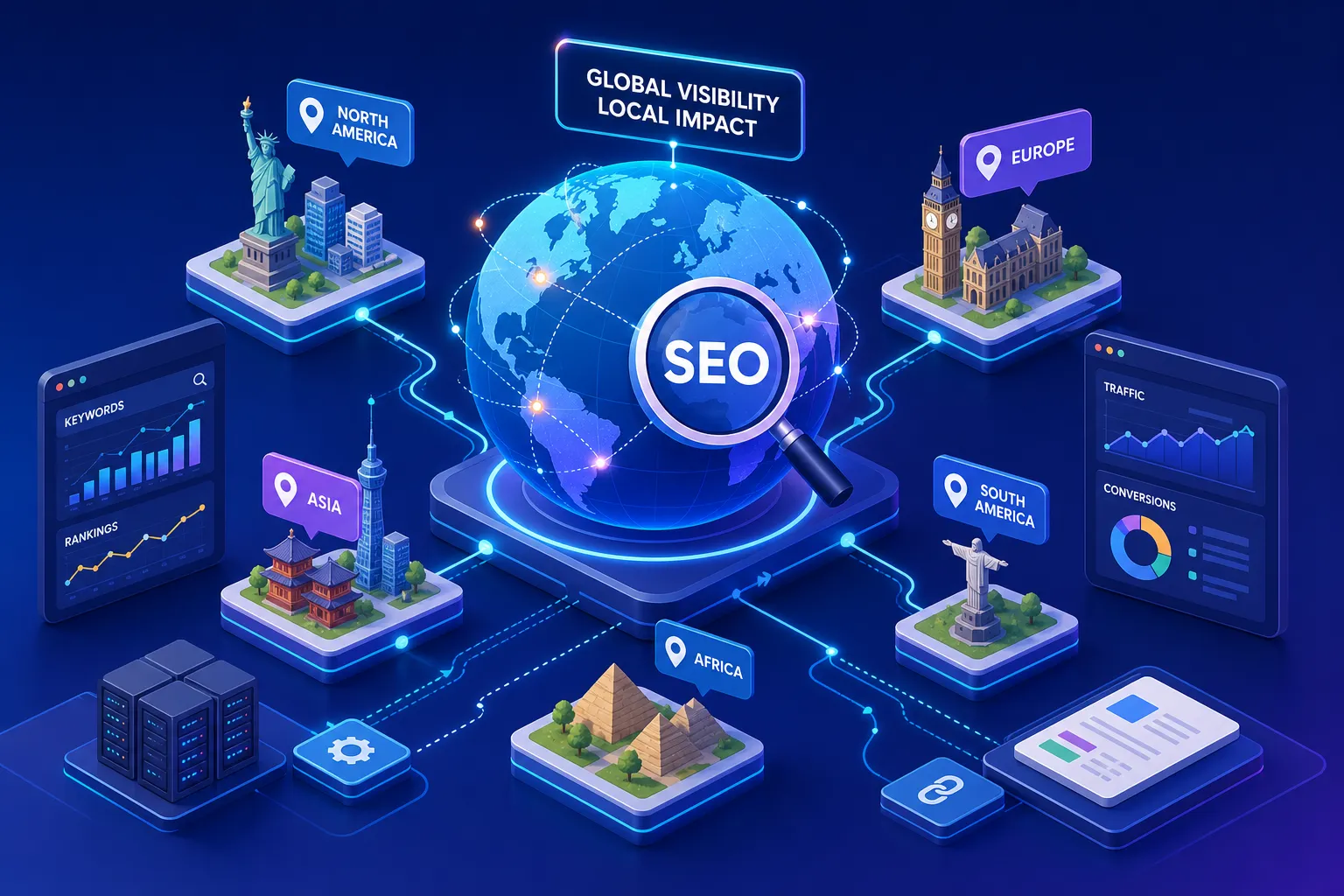
Worldwide SEO services are not a single tactic. They are a coordinated system built across four core areas that reflect how international search actually works in practice. A credible agency proposal spells out all four explicitly; vague scope language is a red flag covered later in this article.
- Technical infrastructure: Site architecture decisions, hreflang implementation, crawlability by region, and URL structure planning (ccTLDs, subfolders, or subdomains)
- Localized content strategy: Market-specific keyword research, native-language optimization, and intent mapping per country
- Analytics and reporting segmented by market: Country and language-level rank tracking, organic traffic attribution, and conversion reporting by geography
- Off-page authority building in target markets: Regional link building, local digital PR, and citation development for each country
How international SEO differs from scaling US campaigns
The difference isn’t just volume. Cross-border SEO requires geo-targeting signals that your current site likely doesn’t have, separate ranking environments where Google.de and Google.com behave differently based on domain signals and local content relevance, and market-specific user intent that doesn’t translate directly from English-language keyword data. A term that signals purchase intent in the US can be purely informational in Germany or Spain. Multi-regional SEO is a fundamentally different strategy, not an expanded version of a domestic one.
The technical backbone of an international SEO strategy
Hreflang: what it does and where implementations break
Hreflang tags tell Google which language or regional version of a page to serve in a given search environment. When implemented correctly, they prevent your French content from appearing in German search results and your US pages from cannibalizing your UK traffic. The problem is that Google silently ignores invalid hreflang, which means errors go undetected unless you’re actively auditing for them.
Three failures appear most often: missing self-referencing tags (every page must reference itself, not just its alternates), broken reciprocal annotations where Page A references Page B but Page B doesn’t reference back, and canonical tags that contradict hreflang directives. If your canonical points to a different URL than your hreflang target, Google follows the canonical and the hreflang cluster falls apart. Competent agencies treat hreflang as a graph integrity problem, one broken link can invalidate the whole cluster. It’s a structural dependency issue, not a tag-by-tag checklist.
Choosing between ccTLDs, subdomains, and subfolders
Each URL structure sends different signals and comes with different trade-offs. Country-code top-level domains (example.fr) send the strongest geo-signal and build trust with local audiences, but they split your domain authority, each country site earns its own backlinks separately. Subfolders (example.com/fr/) consolidate authority under one root domain, meaning every link your US site earns benefits your French presence as well. Subdomains sit in the middle but often behave more like separate domains in terms of authority sharing, making them the weakest default option for consolidation.
The right choice depends on market priority, content volume, and long-term brand strategy. As a general rule, subfolders tend to work well for businesses entering a handful of new markets, while ccTLDs make more sense when country-specific branding and local trust are non-negotiable priorities.
Setting up Google Search Console for multiple regions
Multi-regional Search Console configuration means creating separate properties for each regional section, whether that’s a ccTLD or a subfolder path, so you can track performance and targeting independently per market. Each property gets its own country targeting setting in the International Targeting report, where you assign or verify the intended country signal at the property level. That report also surfaces hreflang coverage gaps: missing return links, unsupported language codes, and alternate URLs that return errors instead of 200 responses. Running this audit monthly is common practice in a well-run international SEO engagement.
International keyword research and content localization
Why US keyword data doesn’t travel across borders
Search intent shifts by market even for the same product category. A keyword that converts well in the US may be informational in another country, or searched using entirely different terminology. Market-specific keyword research means building fresh data sets using local Google variants, local-language research tools, and native speaker validation. Running a US keyword list through a translation tool and calling it international keyword research is one of the fastest ways to invest heavily in content that ranks nowhere. Multilingual SEO done right starts with market-native data, not translated approximations.
Content localization vs. direct translation: a critical distinction
Localization adapts messaging, examples, pricing formats, cultural references, and calls to action to fit the target market’s context. Translation converts words. Google’s ranking systems reward content that satisfies local search intent natively, and that’s rarely achieved through word-for-word translation. A translated page may be grammatically correct and still use terms that nobody in that market searches for, which makes it invisible regardless of how well-built the technical infrastructure around it is. Strong worldwide SEO agencies build localized landing pages and content strategies for each market, not generic multilingual templates. The practical rule: translation makes content readable; localization makes it discoverable.
When your business actually needs worldwide SEO services
Organic signals that international demand already exists
Some businesses are already receiving traffic from non-US markets without a strategy to capture it. If Google Analytics or Search Console shows meaningful impressions or clicks from specific countries, that’s evidence of existing search demand worth supporting intentionally. Other triggers include active sales to international customers, a product-market fit signal in a new region, or a deliberate decision to enter a foreign market where your category already has strong search volume. Any of these signals means you’re leaving rankings, traffic, and revenue on the table by not having a structured approach.
The cost of deferring a multi-regional strategy
Waiting to build an international SEO foundation means competitors in those markets accumulate backlinks, content depth, and domain authority while you watch. Research-backed benchmarks suggest many programs take 6 to 18 months to show substantial gains; closing strong authority gaps can extend well beyond that. The earlier a business establishes its technical architecture and content presence in a target market, the cheaper it is to build and maintain rankings there. Entering a market late typically means a longer ramp-up period and a higher overall cost to reach the same position. Timing is a business investment decision, not an SEO scheduling preference.
How to evaluate worldwide SEO agencies before you commit
Agency types and which scales they serve best
There are four main categories worth shortlisting, depending on your scale and market complexity. Boutique international SEO specialists go deep on a narrow set of markets. Full-service agencies with international capabilities manage technical SEO, content, and paid media across multiple markets under one roof. In-country SEO firms in each target market offer native depth but require significant coordination overhead. US-based agencies with globally scalable infrastructure, like Brandleap Agency, apply senior-level strategic thinking across all market layers without the fragmentation of managing multiple vendors. For businesses entering two to three new markets simultaneously, a full-service agency that handles every layer of the campaign tends to be more efficient than coordinating between separate regional specialists, based on coordination overhead alone.
What a strong proposal actually looks like
Before signing anything, require clear written answers to these questions: Which countries and languages are explicitly covered? Is content localized or translated? How are technical fixes implemented rather than just recommended? How is reporting segmented by market? Does link building happen in target countries or just from generic outreach? A proposal that can’t answer these specifically doesn’t have a real international SEO plan. It has a domestic SEO plan with international branding on it.
Red flags worth walking away from
Some warning signs are worth treating as dealbreakers. A single sentence mentioning hreflang without an implementation plan means nobody has thought through the technical execution. Reporting structured only at the global aggregate level tells you the agency isn’t prepared to manage market-by-market performance. Promises of top rankings across five countries in six weeks reflect no understanding of how multi-regional search actually works. All three signal a domestic SEO playbook dressed up with international language, and all three will cost you time and budget before the gaps become undeniable.
Timeline and KPIs to set before the campaign starts
What to expect at months 3, 6, and 12
A realistic international SEO timeline breaks into three clear phases. Months zero through three cover foundation: technical setup, hreflang implementation, Search Console configuration per market, and baseline measurement across all target geographies. Months three through six bring indexation stabilization, initial ranking movement on lower-competition terms, and early organic traffic shifts in target markets.
Months six through twelve is where localized content, regional link building, and authority accumulation start translating into measurable traffic and conversion growth by country. Research consistently points to the six-to-twelve-month window as the earliest realistic point for meaningful conversion impact. Any agency promising results before that is overselling the timeline. Technical changes register in weeks; business impact builds over quarters.
The metrics that signal real market traction
The KPI stack that matters for cross-border campaigns includes organic traffic segmented by country and language, keyword rankings tracked in local Google variants (not just Google.com), organic CTR and impressions per market, and conversions or leads attributed to each target geography. Global aggregate metrics mask what’s actually happening market by market. A campaign that shows 20% traffic growth globally might be driven entirely by one country while three others are flat or declining. Demand market-level reporting from day one, and hold your agency accountable to it at every review.
Building your international SEO foundation before competitors do
Worldwide SEO services are not a premium add-on for enterprise brands. They are the practical infrastructure any business needs when entering a new country or language market where search demand already exists. The core components are clear: technical setup and hreflang implementation, localized content strategy built from market-specific research, multi-regional Search Console management, and country-level performance tracking tied to business outcomes.
Choosing the right partner comes down to scope clarity, implementation depth, and reporting transparency. The international SEO companies worth working with can specify exactly which countries are covered, how technical fixes get deployed, and how they’ll measure success per market rather than in aggregate. Businesses that build this foundation early enter markets cheaper and faster than competitors who defer the investment until they’re already behind.
If your current strategy doesn’t segment by market, doesn’t include hreflang, or doesn’t track rankings per country, that’s the gap to close first. A globally scalable approach built on US-market depth is the starting point, not the finish line. Assess where your international visibility stands today, and consider what structured, market-level SEO could unlock across the markets already searching for what you offer.