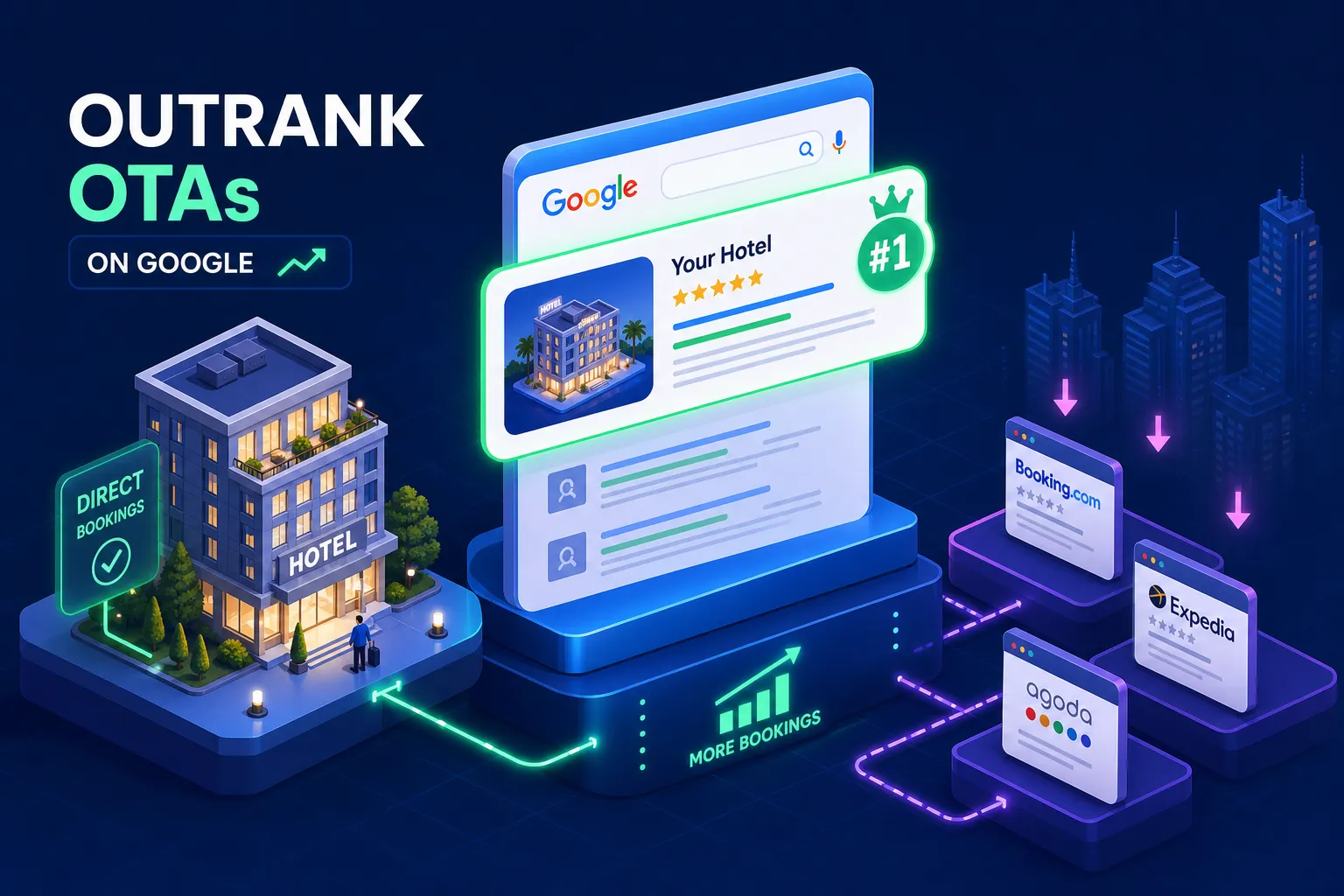
Every time a guest books through Booking.com or Expedia, your property pays somewhere between 15% and 25% in commission. On a $200-per-night room, that’s $30 to $50 gone before you’ve covered a single operating cost. Professional hotel SEO services exist specifically to break that cycle. OTAs have the budget to run large-scale Google Ads campaigns and have spent years building domain authority and review ecosystems that help them dominate the search results your guests use to find a place to stay. Many independent hotels struggle with distribution because OTAs hold those scale advantages by design, and competing on those terms alone isn’t a realistic strategy.
Independent and boutique properties do hold structural advantages that no OTA can replicate at scale. Hyperlocal relevance, authentic destination content, and genuine guest trust all favor the individual property. A focused hotel search engine optimization strategy turns those advantages into rankings, traffic, and direct bookings. Specialist hotel SEO agencies build around exactly this integrated model, combining technical SEO, local optimization, and content to help properties reclaim direct traffic from aggregators. Brandleap Agency, for example, connects those layers into a single program rather than treating them as separate services. This article covers what hospitality SEO services should actually deliver, which KPIs tell the real story, and how to evaluate an agency before you commit.
Why OTAs dominate Google search (and where they’re vulnerable)
The OTA playbook: domain authority, ad spend, and review volume
Booking.com and Expedia have accumulated decades of high-authority backlinks, massive review ecosystems, and the budget to run parallel Google Ads campaigns alongside their organic presence. For high-volume head terms like “hotels in Miami” or “New York City hotels,” independent properties simply can’t compete on those signals alone. OTAs rank because they’ve spent years building domain authority at a scale that a single property can’t match, that’s the honest starting point for any conversation about hotel SEO strategy.
Where independent hotels can actually win
OTAs are generic by design. They don’t write guides to the best local breweries near your property or publish seasonal landing pages about why fall is the perfect time to visit your city. They typically present generalized listings and are far less likely to have highly specific content, up-to-date staff photos, property-specific review responses, or immediate answers to last-minute guest questions, compared with the actual hotel. Long-tail destination searches, hyper-local intent, and brand searches are all territory where a focused hotel digital marketing approach beats OTA volume. Independent hotels win on specificity, and specificity is the foundation of a well-executed direct booking SEO strategy.
The technical foundation your hotel site can’t skip
Page speed, Core Web Vitals, and the booking engine problem
Slow hotel websites kill conversions before SEO can do its job. Hotel pages are unusually heavy: high-resolution room photography, third-party booking engine scripts, interactive availability calendars, and embedded map widgets all stack up and crush LCP (Largest Contentful Paint) and CLS (Cumulative Layout Shift) scores. Google’s 2026 Core Web Vitals thresholds require LCP at or below 2.5 seconds, INP at or below 200 ms, and CLS at or below 0.1 (per Google Search Central documentation), and those benchmarks apply to every key template, not just the homepage. A competent agency tests booking pages and room listing pages separately because those are the pages where conversions actually happen.
Booking engine crawlability is a specific issue that many hotels overlook. If Googlebot can’t access or render your room availability pages because the engine runs cross-domain scripts or blocks crawlers, those pages simply don’t rank. An audit needs to inspect robots.txt, meta robots tags, and whether the booking flow is accessible to search engine crawlers, not just human visitors.
Structured data that drives rich results
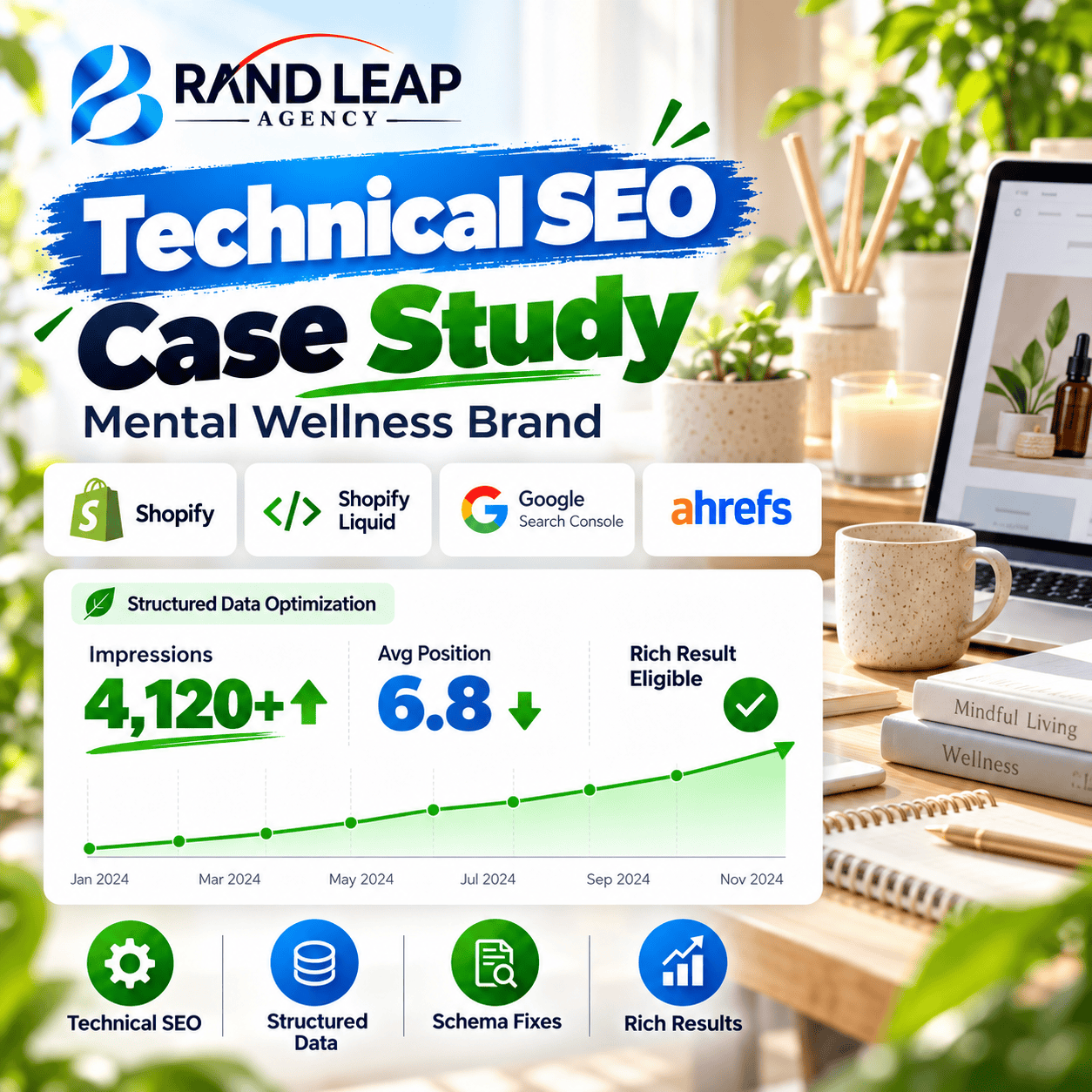
Schema markup is one of the clearest technical wins available to hotel sites, and most independent properties either skip it or implement it incorrectly. Google supports Hotel and HotelRoom schema types specifically for hotel price rich results (see Google’s structured data documentation), while LodgingBusiness is a broader schema.org type that helps search engines understand your property as an entity. Correct structured data tells Google what your property offers, what rooms cost, and how guests rate the experience. That improved clarity can make your listings eligible for richer search features, which may increase click-through rate before a single piece of new content is published.
Canonicalization and duplicate URL traps
Booking engine filters, language variants, date parameters, and trailing-slash inconsistencies routinely create duplicate content issues that split your ranking signals across multiple URLs. A proper technical audit maps these duplicates, establishes canonical tags, and aligns redirects so Google consolidates authority on your preferred URLs. This work happens before content or link building, because everything built on a fragmented crawl architecture leaks value.
Local SEO for hotels: capturing guests before OTAs even get a look
How to optimize Google Business Profile for direct booking intent
Google Business Profile is one of the highest-ROI levers in hospitality local SEO, and it’s often under-maintained. A complete, active profile with accurate categories, current photos, amenity attributes, and a working direct booking link can intercept travelers at the exact moment they’re ready to commit. Last-minute searchers rely heavily on GBP for trust signals, recent photos, up-to-date hours, and responsive Q&A answers all reduce friction and send clicks to your site instead of an OTA listing.
Google’s local ranking algorithm weighs three core factors: relevance, distance, and prominence. For hotels, prominence is especially driven by review volume, review recency, and average rating. A practical GBP operating cadence covers four areas: weekly posts, review responses within 24 to 48 hours, two to four new photos added monthly, and a quarterly audit of categories and attributes. Properties that maintain this rhythm consistently outperform those treating GBP as a one-time setup task.
Review strategy and the trust loop that drives direct clicks
Reviews don’t just build credibility; they influence map pack placement directly. A systematic review workflow compounds over time into a trust advantage that OTAs cannot replicate at the property level. That means requesting feedback at checkout, following up post-stay, and responding to every review calmly and on-brand. Your guests are reviewing your specific rooms, your actual staff, and the exact location, property-specific reviews and local signals often convert better than generic marketplace listings because they provide more relevant, trust-building detail, and they signal to Google that your property is genuinely prominent in its market.
How hotel SEO services improve direct bookings through content strategy
Room pages, area guides, and event-based landing pages
OTAs typically do far less hyper-local, destination-focused content than independent hotels can. They don’t publish guides titled “Best things to do near the Riverwalk this fall” or pages explaining why your junior suite works perfectly for a long-weekend anniversary trip. Independent hotels can build content that matches exactly what a traveler types when they’re planning, not just when they’re comparing prices on an aggregator. Room-specific pages with unique descriptions and detailed amenity information, local area guides, and seasonal or event-based landing pages target high-intent searches that OTAs are less likely to prioritize, creating real opportunity to capture that traffic directly.
How destination content shifts traffic away from OTA listings
When a traveler finds your blog post about the best wedding venues near your city, reads your local food guide, and then lands on a fast and well-structured booking page, they’re far more likely to book direct than through an aggregator. Content-driven hotel search engine optimization works because it captures intent at the planning stage, before the user ever reaches an OTA search results page. This is how independent hotels reclaim traffic systematically, not by outspending OTAs on ads, but by being more useful and more specific at every stage of the booking journey.
Hotel SEO services: KPIs, pricing, and what to expect
KPIs and attribution that connect SEO to actual bookings
The right hotel SEO agency reports on organic revenue, organic booking conversion rate, and assisted conversions, not just keyword rankings. Attribution matters because hotel booking journeys are rarely single-touch. A traveler might find your property through an organic search, leave, return via a branded search three days later, and then book direct. A multi-touch attribution setup in GA4, with data-driven attribution and a lookback window calibrated to your typical booking cycle, gives you a far more accurate picture of what SEO contributes than last-click reporting alone.
ROI for hospitality SEO services should also account for commission savings. Each direct booking that bypasses an OTA is worth roughly 15% to 25% more than the equivalent OTA booking, because that commission stays in your revenue. The practical formula: SEO ROI equals new organic revenue plus commission savings, minus SEO investment, divided by SEO investment. Hotels that run this calculation often find the payback period more favorable than they expected, particularly once commission savings are included alongside incremental organic revenue.
Pricing, deliverables, and how to evaluate a hotel SEO agency
Small independent hotels can expect a starting range of around $400 to $500 per month for baseline technical fixes, on-page optimization, and Google Business Profile management, based on hotel-specific industry benchmarks. Boutique properties with ongoing content production and link building needs typically invest more. When evaluating vendors, the key question is whether they handle every layer under one roof: technical SEO, content, local optimization, schema markup, and authority building. Fragmented vendors force you to manage coordination across multiple relationships, and the handoffs between them are where strategy breaks down.
Brandleap Agency builds client engagements around exactly that integrated model, connecting technical health, content strategy, and local optimization into a single program with shared goals and unified reporting. A ranking gain from schema markup that sits on a slow booking page with no destination content is a partial win at best. These components are designed to reinforce each other, and compounding results only happen when they’re managed as a unified whole.
Making the move from OTA dependency to direct booking growth
OTAs win on volume and domain authority. Independent hotels win on specificity, local trust, and content depth. The path to reducing OTA dependency runs through a technically sound website, a fully optimized Google Business Profile, destination content that targets planning-stage intent, and structured data that helps Google understand and surface your property correctly. Treating these as separate initiatives dilutes the impact of each; the reason agency selection matters is that you need a partner who manages them as a connected program.
Start by auditing your hotel’s current organic presence. Identify where direct booking gaps exist, which room pages are missing structured data, which destination searches send traffic to OTA listings instead of your site, and where your GBP is underperforming. Those gaps are your roadmap. If you want to reduce OTA commissions, look for hotel SEO services that tie every deliverable back to direct booking revenue from day one. The agencies worth working with will show you exactly how they plan to close those gaps, and they’ll be specific about it.