Many buyers searching for SEO content services report prior poor experiences with providers. Either they hired a content mill that produced unreadable keyword soup, or they paid an agency that delivered polished Word documents with no publishing, no optimization, and no results. The question isn’t just what these services are. It’s whether you can find a provider worth paying.
This guide breaks down exactly what serious SEO content services include, how they’re priced in 2026, and the specific checklist and KPIs you need before you sign anything. By the end, you’ll have a clear framework to evaluate any provider on your shortlist.
What SEO content services actually include
Many providers use the term loosely, budget options in particular tend to focus exclusively on writing while omitting research, publishing, and optimization entirely, which creates real confusion when you try to compare proposals. Real SEO content services aren’t just writing. They cover a full production workflow that starts well before a single word is drafted.
The deliverables you should expect from a serious provider
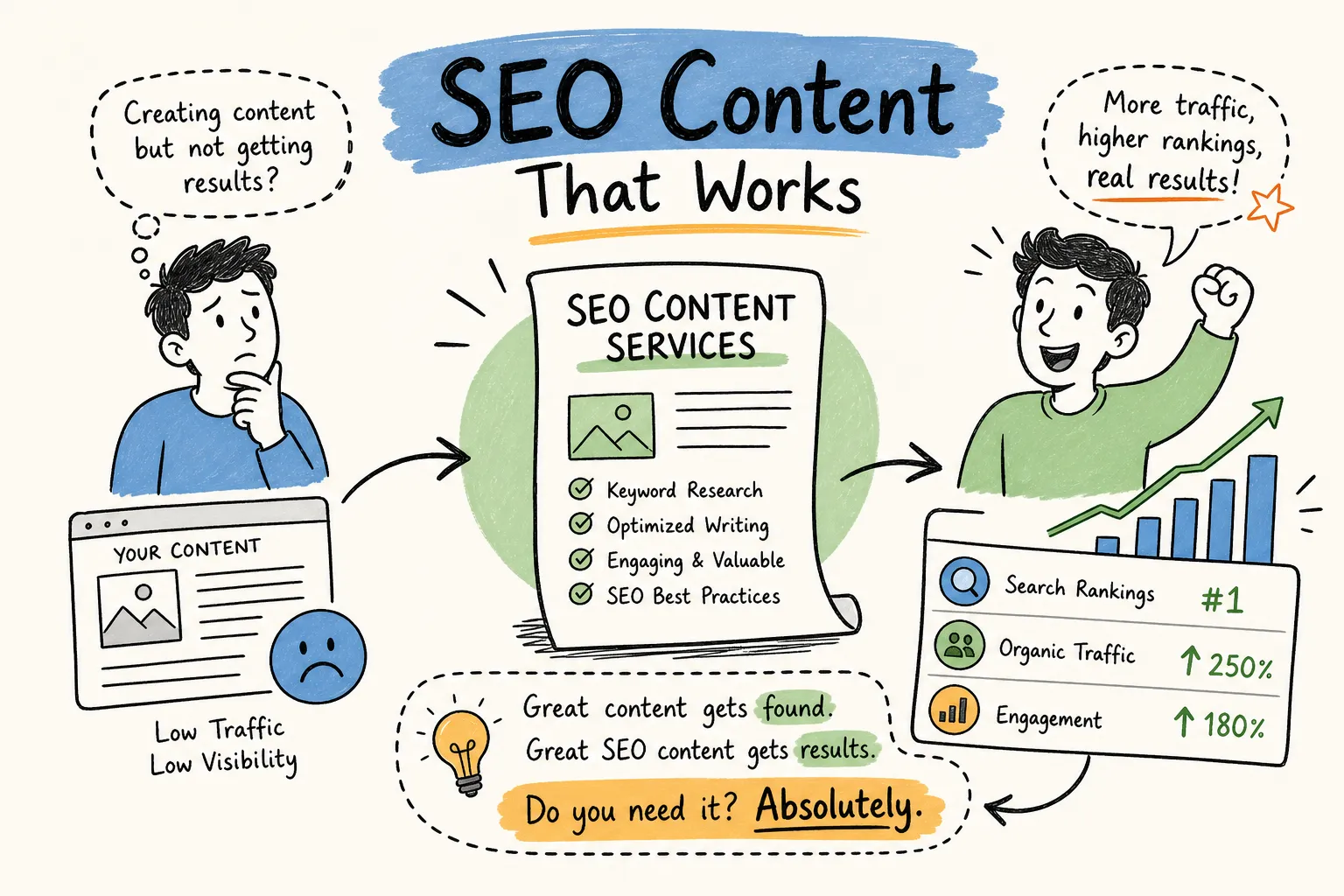
A complete SEO content service covers keyword and topic research, detailed content briefs (with search intent, target keyword, suggested outline, word count, and internal linking targets). Draft creation, editorial review, and on-page optimization follow from there. That last piece includes title tags, meta descriptions, header structure, and schema-ready formatting, not just clean prose. Strong providers also include content updates and revision cycles for underperforming pieces, because SEO content is iterative, not a one-time transaction.
The most common deliverable types are blog posts, pillar pages, long-form guides, landing pages, and service pages. Some providers extend into case studies, white papers, and product descriptions depending on your industry and funnel structure.
The production workflow from brief to publish
A serious provider follows a six-step workflow: research keywords and intent, build a content plan, create a brief for each asset, draft and optimize, publish with full on-page setup, then monitor and revise. Cutting any of these steps is where programs fail. Skip the brief stage and writers guess at intent. Skip on-page optimization and you end up with well-written content that search engines have no reason to surface. Both are common failure points at the cheaper end of the market.
SEO content writing services vs. generic content marketing services
Keyword insertion alone does not constitute SEO content. What actually moves rankings is search intent alignment, semantic keyword coverage, internal linking strategy, and content depth matched to what top-ranking pages already cover. A piece of content that satisfies the searcher’s real question and connects to related pages on your site will consistently outperform a piece that just includes the right phrase five times. When you’re in a discovery call with a provider, ask them to show you a content brief. If they can’t produce one, that tells you everything.
This distinction matters when comparing SEO content writing services against general content marketing services: the former is built around search performance from the start, while the latter may prioritize brand narrative or audience engagement without tying output to rankings or organic traffic goals.
How SEO content services are priced in 2026
Pricing varies more than most buyers expect, and proposals often look structurally different while offering nearly the same amount of work. Understanding the models lets you compare apples to apples.
The three pricing models explained
The market operates on three structures. Per-word pricing typically runs $0.10 to $0.30 per word at the mid-tier and $0.30 to $1.00 or more for specialist and technical content. Per-article pricing falls around $200 to $600 for mid-range work and $600 to $1,200 for expert-level, deeply researched pieces. Monthly retainers cluster around $1,500 to $5,000 for small business programs and $3,000 to $10,000 for mid-market. Industry pricing data places the average agency retainer near $3,209 per month, though figures vary by scope and market.
What each pricing tier actually delivers
Budget options in the $60 to $150 per article range typically reflect volume-focused writing with no strategy, no keyword research, and no on-page optimization. You’re paying for words, not outcomes. Mid-tier retainers in the $3,000 to $8,000 per month range usually include keyword research, content planning, writing, CMS publishing, and basic reporting. Higher-end programs at $10,000 per month and above layer in technical SEO, link building, content updates, and senior strategist involvement. The cheapest option almost always excludes the deliverables that actually produce rankings.
Agency, freelancer, or content network: which fits your situation
The right choice isn’t about preference. It’s about how central content is to your growth strategy and how much operational capacity you have to manage production in-house.
When a freelance writer is the right call
Freelancers work well for businesses with a limited content backlog, narrow topic needs, or a tight budget for initial testing. You get direct communication and flexibility. What you don’t get is keyword research, content strategy, or SEO optimization built into the scope by default. When the freelancer is on vacation, sick, or managing other clients, your output stops with them. That’s a ceiling most businesses hit faster than they expect.
When a full-service agency gives you the better return
Agencies are the right choice when SEO content is a primary acquisition channel and you need consistent monthly output with strategy, editorial oversight, and reporting. The higher cost reflects multiple specialists working on your account simultaneously. For businesses building a serious content program aimed at ranking for dozens of target keywords over 12 to 24 months, an illustrative but common goal for mid-market companies, a freelancer’s capacity ceiling becomes a structural problem, not just an inconvenience.
The content network trade-off
Content networks give you access to multiple writers at moderate cost, which solves the volume problem. The trade-off is quality consistency and strategic depth. Without a dedicated strategist overseeing the content plan and brief quality, high volume rarely translates to meaningful rankings, you’ll accumulate content that doesn’t rank instead of building authority.
How to evaluate an SEO content provider before you hire one
A polished website and a strong sales call don’t tell you much. The real evaluation happens in the discovery conversation and when you review their actual published work.
Green flags and red flags in a provider’s pitch
A strong provider asks about your target audience, existing content performance, and business goals before pitching a deliverable count. They can show you an example content brief. They have a defined revision policy and a clear reporting cadence.
Red flags look like this: the provider leads with article volume, guarantees specific rankings, can’t explain how they select topics, or won’t share writing samples from your industry. Any provider who opens with “we’ll publish 20 articles a month” before asking what you sell is optimizing for their production output, not your organic growth.
The selection checklist before you sign anything
Use this checklist to evaluate any SEO content services provider on your shortlist:
- Verify they conduct original keyword research, not just tool exports
- Review two to three published samples and check them in Google to confirm they rank
- Ask about their on-page optimization process and confirm it’s included, not an add-on
- Get clarity on revision rounds: how many, how fast, what counts as a revision
- Confirm reporting metrics, cadence, and format before work begins
- Ask how they handle content updates for pieces that don’t rank after three to six months
- Confirm who the actual writer is and whether it’s the same person every month
- Ask to see a real content brief they’ve produced for a client
- Ask whether their SEO content services include technical SEO coordination or only content production
The KPIs and outcomes you should require from any provider
Vague promises about “improved visibility” are not a contract metric. Before you pay the first invoice, define the measurement framework in writing.
The core KPIs that matter for SEO content programs
Five metrics together tell you whether your content program is actually working: keyword rankings by position band (top 3 and top 10 distribution for target pages), organic sessions broken out by landing page, organic conversion rate, CTR from search results, and engagement signals like scroll depth and time on page. Rankings tell you whether the content is being surfaced. Sessions tell you whether it’s being clicked. Conversion rate tells you whether it’s attracting the right audience once they arrive.
For contract language, be specific. Require the provider to report monthly on organic sessions, organic conversion rate, keyword visibility for your agreed topic cluster list, CTR, and referring domain growth. Require branded and non-branded traffic to be reported separately, otherwise, brand demand growth gets counted as SEO performance, which obscures whether the content is actually doing its job.
What realistic timelines look like for rankings and traffic
Timeline expectations should be calibrated to domain authority and keyword competition. Competitive terms on low-authority domains often take 6 to 12 months or longer to reach page one; lower-competition queries can rank faster, sometimes within weeks to a few months on domains with existing authority. A practical benchmark for a steady-state content program is 5% to 10% month-over-month organic growth, with 15% or more during an active content push. Anything less after six months warrants a direct strategy conversation with your provider.
Why integrated content and technical SEO compound over time
Content and technical SEO are most powerful when they operate as a single system, not as separate line items on different invoices. This is where the real performance gap between SEO content providers becomes visible.
The Brandleap approach: content built on a technical foundation
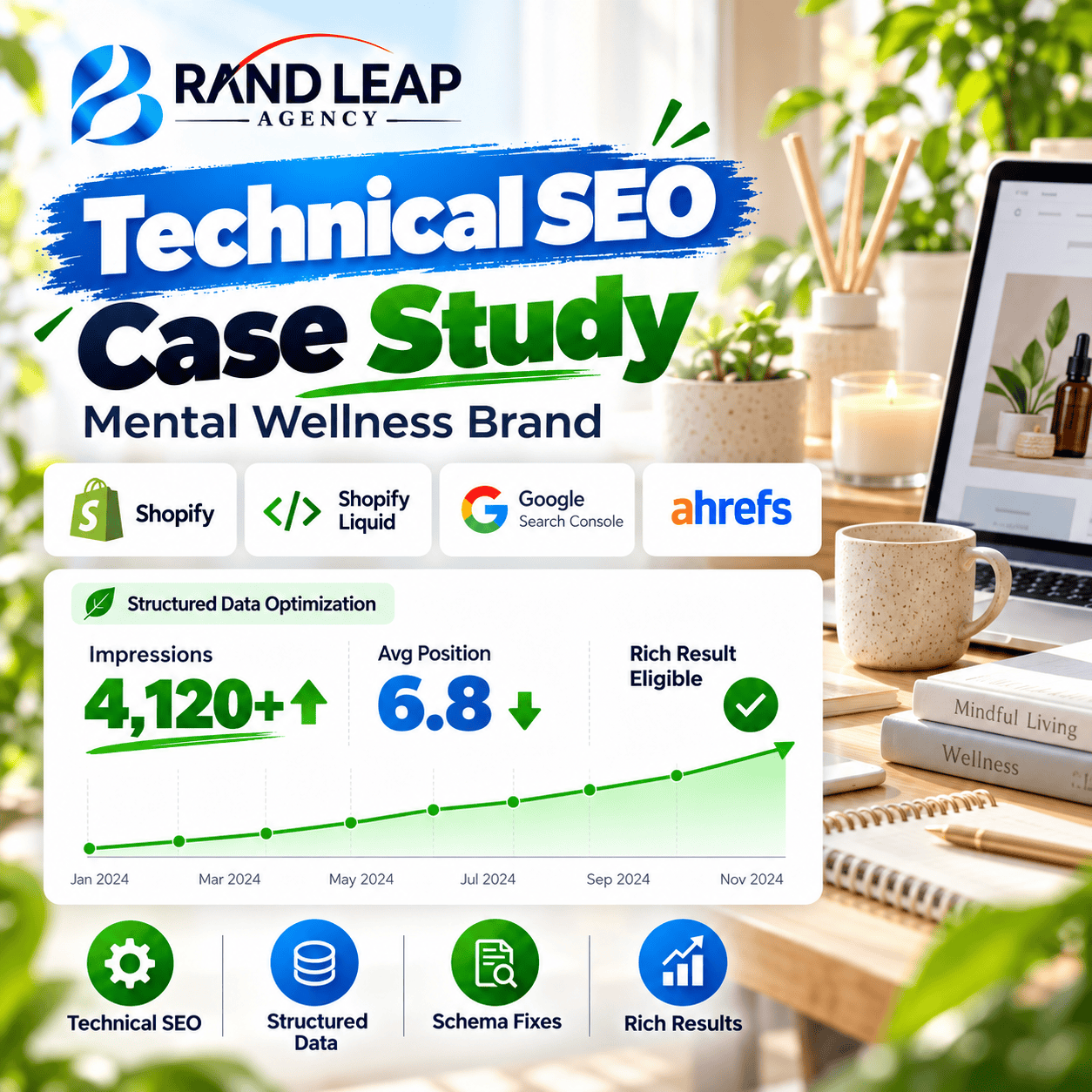
Brandleap Agency structures its SEO content writing service as part of a broader SEO system. Each piece starts with keyword research, gets written to a detailed brief, and is optimized for on-page SEO at the time of publish. That optimization is supported by the underlying technical health of the site, including Core Web Vitals, schema markup, and internal linking architecture. This integrated model differs from a content-only service that delivers a Word document and leaves optimization to the client. Strong technical SEO keeps the site indexable; strong content gives search engines something worth ranking. Both have to be in place for the content to perform.
What a compounding content program looks like over 6 to 12 months
The compounding effect is real, but it takes time to materialize. In months one to three, content indexes and starts gathering impressions. In months four to six, well-optimized pieces move into the top 20 and begin earning clicks. By months seven to twelve, established pages attract internal links from new content, authority distributes across the site, and organic sessions grow without proportional increases in content spend. This is why long-term retainers consistently outperform one-off content purchases. The flywheel builds on itself, but only if the foundation, including the briefs, the optimization, and the technical setup, is done correctly from the start.
What to do next
SEO content services range from simple writing packages to fully integrated strategy programs. The right choice depends on your growth goals, your budget, and how much of the workflow you can handle internally. Whatever option you choose, lock in the measurement framework before work begins. Require specific KPIs, not just rankings and traffic, but conversion rate, a clear position benchmark, and a defined timeline for review.
If you’re evaluating providers right now, use the checklist in this article as your starting point. Ask for a content brief. Check whether their published samples rank. Confirm what on-page optimization is actually included in the scope. These three questions alone will eliminate most SEO content providers who aren’t worth your budget.
If you want to see what an integrated content and SEO program looks like in practice, Brandleap Agency’s content writing service is built around the framework this article describes. Break after intent: senior-level strategy from day one, with reporting tied to real business metrics, not vanity numbers. Contact Brandleap Agency to start evaluating whether their approach fits your growth goals.