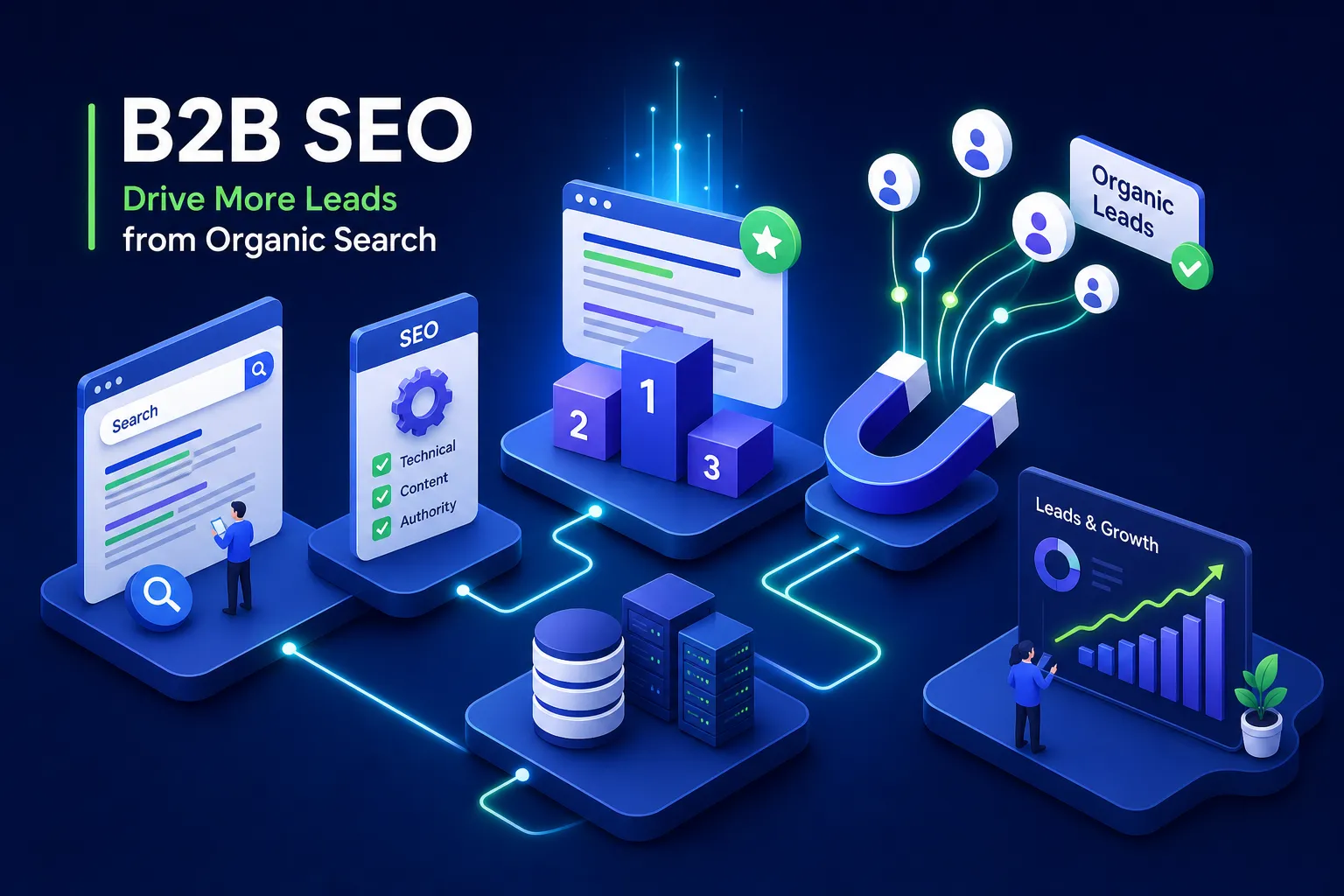
Most B2B companies rely on b2b seo services built around a B2C playbook, then scratch their heads when organic traffic climbs but the sales team still has nothing to call. The traffic is real. The problem is that the strategy behind it was built for a different buyer entirely. B2C consumers often search, click, and decide far faster than their B2B counterparts. B2B buyers research for months, involve multiple stakeholders across procurement, technical, and executive functions, and frequently begin their journey on lower-volume, highly specific queries rather than broad category terms.
That distinction changes everything about how B2B search engine optimization should be planned, executed, and measured. The keyword strategy looks different, the content funnel looks different, and the KPIs that actually matter are nowhere near what most SEO dashboards track by default. Specialist B2B agencies have built specific frameworks for this gap, adapting organic strategies to generate qualified pipeline rather than just sessions and impressions. Brandleap Agency operates in exactly that space, applying frameworks developed specifically for complex B2B sales cycles.
This article covers the full picture: decision-maker keyword strategy, content built for long sales cycles, LinkedIn integration, technical SEO for complex B2B sites, and realistic benchmarks at months 3, 6, and 12, plus a clear checklist for evaluating the right agency partner.
Why B2B SEO Is a Fundamentally Different Discipline Than B2C
The buying committee problem that changes everything
In B2C, you’re usually persuading one person who decides quickly and often emotionally. In B2B, a single deal typically involves multiple stakeholders, procurement, technical evaluators, and executive sponsors, each with different questions, different content preferences, and different search behaviors. A procurement manager searches for “enterprise contract management software pricing,” while a technical evaluator searches for “contract management API documentation.” A single keyword strategy can’t serve both audiences, which is why effective B2B SEO starts with mapping personas before mapping keywords.
This committee structure also means that B2B content needs to be built across multiple intent layers simultaneously. You can’t rank one page and call it done. Each role in the buying process needs content that answers their specific questions at their specific stage, or your organic presence stalls at awareness without ever moving to consideration.
Why low search volume doesn’t mean low value
B2B keywords almost always carry lower monthly search volume than their B2C equivalents. That’s not a weakness in the strategy, it’s a signal that the audience is highly specific and the intent is commercial. For companies with high average contract values, a single qualified inbound lead from organic search can represent significant pipeline, which means a page ranking for just 50 monthly searches can generate meaningful revenue if the targeting is precise. Optimizing for pipeline value rather than traffic volume is the core shift that separates effective B2B SEO from borrowed B2C tactics.
This framing also changes how you report to leadership. Instead of defending a low-traffic month, you’re connecting each organic session on a commercial page to deal value, a conversation that lands very differently with a CFO or VP of Revenue than a chart showing session counts.
B2B SEO Services: Keyword Strategy Built Around How Decision-Makers Actually Search
Mapping keywords to buying roles, not just job titles
Effective B2B keyword research starts with the buyer journey, not the keyword tool. Each stakeholder in the buying committee searches for information at a different stage and through a different lens. A CTO evaluating a SaaS platform searches for integration capabilities and security documentation. A VP of Marketing searches for ROI benchmarks and agency case studies. A CEO searches for competitive differentiation and contract risk. Your keyword strategy needs to cover all three, with dedicated landing pages and content pieces for each intent cluster rather than one generic page trying to rank for everything.
This role-based approach also surfaces keyword opportunities that volume-first research completely misses. Long-tail, high-specificity queries from technical evaluators can convert at higher rates than broad category terms in many B2B contexts, even though the volume numbers look underwhelming in a spreadsheet.
Commercial-intent keywords deserve the most investment
Many B2B brands over-invest in top-of-funnel informational content and under-invest in the commercial and transactional keywords closest to pipeline. A term like “enterprise SEO services pricing” signals that a buyer is actively evaluating vendors, that page deserves priority treatment for technical quality, conversion paths, and link acquisition above almost everything else. To illustrate the intent gap: a well-optimized commercial page ranking for 200 monthly searches will often outperform a blog post ranking for 2,000 monthly searches, because the commercial visitor is already in buying mode. The difference in lead quality is rarely close.
Content Funnels Designed for a 3-to-12-Month Sales Cycle
Top-of-funnel content that attracts the right accounts early
The top of the funnel in B2B is where you build awareness with future buyers who aren’t ready to talk to sales yet. Thought leadership guides, industry benchmark reports, and explainer content on complex topics pull in decision-makers during their early research phase. This is where B2B content marketing services earn their value: the content isn’t designed to convert immediately. It’s designed to get your brand into the consideration set before a buyer even starts evaluating vendors.
Done well, this content also creates a compounding organic asset. A single benchmark report that earns backlinks from industry publications and gets shared on LinkedIn continues generating impressions and referral traffic long after it’s published.
Middle and bottom-funnel content that moves pipeline
Mid-funnel content does the heavier conversion lifting. Comparison pages, use-case landing pages, case studies, and solution-specific guides speak directly to buyers in evaluation mode. Bottom-funnel content, including pricing pages, agency SEO packages, and demo request flows, is where lead-generation SEO earns its ROI. Pages at this stage need strong conversion architecture: clear CTAs, social proof, and tracking that connects organic sessions to form fills, demo requests, or RFQ submissions.
In one documented example from the B2B SaaS space, three bottom-funnel blog posts targeting high-intent queries produced 24 qualified leads over a short window. The traffic volume wasn’t large, but the quality was high because the content matched exactly what buyers search for right before making a purchase decision, a pattern that holds across industries when bottom-funnel targeting is precise.
LinkedIn Integration: Using Social Distribution to Fuel Your SEO Flywheel
Repurposing SEO content across LinkedIn to extend its reach
LinkedIn is where B2B decision-makers spend time that isn’t on Google. When you publish a high-quality SEO article, distributing its key insights as a LinkedIn post, carousel, or short-form video extends its reach to an audience that may never find it through search. It also drives branded search demand. When a VP reads your LinkedIn post and then searches your company name or a specific topic you cover, that navigational traffic signals topical relevance to Google, and over time, consistent branded search activity reinforces organic rankings.
The practical system looks like this: publish an SEO asset on your website, then break it into three to five LinkedIn posts, each with a distinct hook. Engage in the comments daily, track which posts generate profile visits from your ICP, and follow up with the most relevant accounts through outreach or retargeting. Each channel feeds the other rather than operating in isolation.
How social engagement feeds back into search performance
The relationship between LinkedIn and B2B SEO is not direct in terms of ranking signals, but it is powerful in terms of content amplification and backlink acquisition. When your content gets shared among a professional audience, it naturally attracts mentions, links from industry blogs, and referral traffic. These organic authority signals compound your SEO results in ways that purely technical work cannot replicate on its own. The brands winning at B2B search consistently treat LinkedIn and SEO as a unified system, not separate tactics.
Technical SEO Priorities That B2B Websites Consistently Overlook
Site architecture for complex service and product ecosystems
B2B websites are often structurally messy: multiple product lines, solution pages built for different verticals, resource libraries, case study archives, and documentation all competing for crawl budget and internal link equity. Strong technical SEO for B2B means building a clear hierarchy where your highest-value commercial pages receive the most internal links, load fastest, and are cleanest from a crawlability standpoint. Schema markup for services, reviews, and FAQs also improves how Google interprets and surfaces your pages in search results.
For B2B SaaS companies especially, JavaScript rendering issues are a common failure point. If search engines can’t render your dynamic product or pricing pages, those pages won’t rank regardless of how well-written the copy is. Confirming rendering works correctly on every high-intent template is a non-negotiable first step in any serious technical SEO audit.
Setting up conversion tracking that connects organic to pipeline
Most B2B companies track organic traffic but never connect it to leads or revenue. That gap makes it nearly impossible to justify SEO investment to leadership. Proper technical SEO for B2B includes GA4 and Search Console setup, event tracking on forms and demo requests, CRM attribution for organic-sourced leads, and dashboards that report on MQLs and pipeline, not just rankings. Without this infrastructure, you have no way to measure ROI and no leverage to scale investment when the strategy is working.
Choosing B2B SEO Services: What to Look for in an Agency Partner
KPIs and realistic timelines to set from day one
A reputable B2B SEO agency sets milestone-based expectations, not vague promises. By month 3, you should see technical fixes implemented, target pages properly indexed, and keyword impressions rising. By month 6, organic traffic should show consistent growth and early MQL volume should be measurable, a commonly cited benchmark is a 2 to 3 percent visitor-to-MQL conversion rate on commercial pages. By month 12, organic should be contributing to pipeline with page-one rankings across a growing set of commercial terms and SQLs traceable to organic sessions in your CRM.
Agencies that skip this timeline conversation and lead with guaranteed rankings are a serious red flag. No credible agency can guarantee specific rankings because Google’s algorithm isn’t something any vendor controls. What they can commit to is a disciplined process, transparent reporting, and milestones that reflect how B2B SEO actually compounds over time.
Red flags that signal the wrong agency for B2B
The warning signs are easy to spot once you know what to look for. Reporting focused on vanity metrics, domain authority scores or traffic rank rather than leads, is a strong indicator the agency isn’t aligned with your business goals. Generic strategies copied from B2C playbooks, no visibility into who actually handles your account, and lock-in contracts with no performance exit clauses are all patterns that consistently appear in underperforming engagements.
A qualified B2B SEO partner, and it’s the standard Brandleap Agency holds itself to, can explain exactly how the agency’s work maps to your sales cycle, which deliverables drive pipeline, and how progress is measured at each milestone. If an agency can’t walk you through that in the first conversation, it’s not the right partner for serious B2B growth.
Build Your Organic Pipeline on the Right Foundation
Effective b2b seo services drive leads when the strategy is built around how B2B buyers actually search and decide, not how B2C consumers do. The companies winning in B2B organic search aren’t necessarily spending more. They’re investing in the right framework from the start: one that connects keyword strategy to buying roles, content to sales cycle stages, and every organic session to pipeline rather than pageviews.
If you’re evaluating your options, the question worth asking is simple: can this agency show you B2B-specific results tied to real lead metrics, and will they report on revenue rather than rankings? Start there, and organic search becomes one of the most reliable and scalable lead channels in your entire marketing stack.
Brandleap Agency works specifically with B2B companies to build SEO programs tied directly to pipeline. If you’re ready to move beyond traffic metrics and start measuring what your organic channel actually contributes to revenue, that’s exactly the conversation we’re built for.