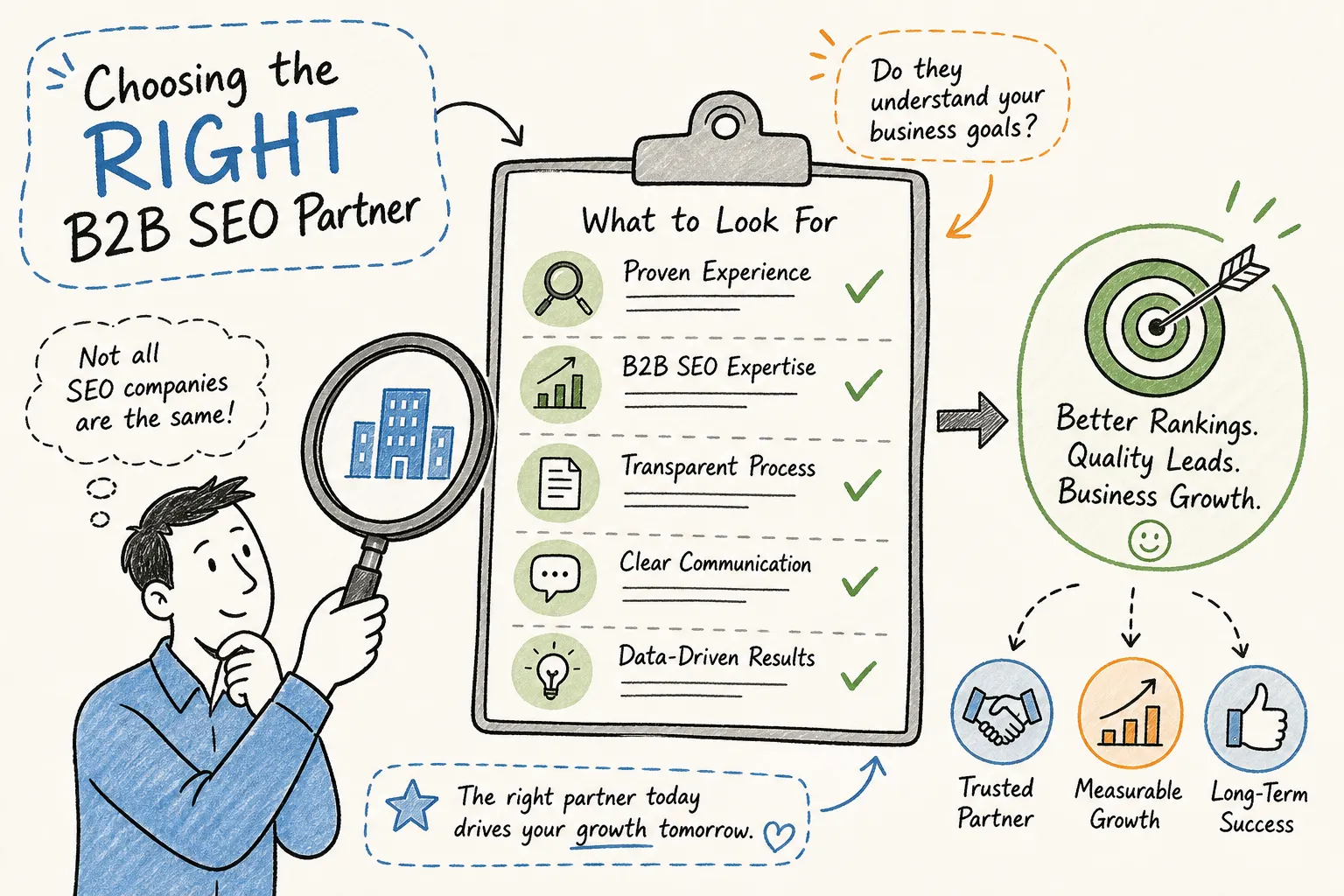
Many B2B companies don’t lose pipeline because of a weak product. They lose it because the agency they hired spent months chasing traffic instead of qualified leads. Choosing a B2B SEO company is one of the highest-leverage decisions a marketing team can make for organic pipeline growth, and getting it wrong costs you in both time and budget.
B2B search engine optimization is a fundamentally different discipline from B2C. It demands a deep understanding of long sales cycles, multi-stakeholder buying behavior, and content that moves researchers toward demo requests rather than just page views. A B2B buyer searching “best CRM for enterprise sales teams” is deep in an evaluation process that may take many months and involve several stakeholders, finance leaders, IT decision-makers, and department heads across the organization. That’s not a consumer impulse purchase.
At Brandleap Agency, we’ve worked with B2B teams who came to us after a year with an agency that delivered traffic reports but never moved the pipeline number. The vetting framework below is built directly from those experiences.
What separates a real B2B SEO company from a generic one
B2B keyword intent doesn’t operate on the same logic as B2C. Generic agencies optimize for search volume. Strong B2B SEO agencies optimize for buying stage intent, and that distinction is everything. A keyword like “best enterprise project management software” gets a fraction of the monthly searches that “project management tips” does, but a deal closed from that first term can be worth tens or hundreds of thousands of dollars for an enterprise account. Volume is the wrong metric.
B2B buying cycles also demand full-funnel content alignment. Many agencies focus primarily on awareness-stage content, blog posts that attract readers but don’t convert them. A serious B2B SEO services partner maps content across every funnel stage: awareness articles that attract researchers, comparison pages that capture evaluators, and ROI calculators or case studies that serve the decision-making committee. Without that structure, organic traffic accumulates without ever generating sales-qualified leads.
The real cost of hiring a generalist agency typically shows up within the first few months. Keyword strategy targets the wrong intent, content doesn’t resonate with technical buyers, and reporting focuses on rankings instead of pipeline movement. Recognizing these failure patterns early is how you avoid them entirely.
The capabilities your B2B SEO agency must actually have
Technical SEO
Enterprise and mid-market B2B websites are architecturally complex. Product suites, resource libraries, pillar pages, gated content, and localized versions all need to work together, and a competent agency audits for crawlability, JavaScript rendering (critical for SaaS platforms built on React or Next.js), internal linking structure, and schema markup. In 2026, that scope also includes Generative Engine Optimization (GEO): optimizing content for visibility in AI Overviews, Perplexity, and ChatGPT responses, not just traditional Google rankings.
Content Strategy
Content strategy needs to speak to buying committees, not just individual searchers. B2B purchases rarely involve a single decision-maker. Your SEO partner should produce content that addresses a CFO’s cost concerns, an IT team’s security questions, and end-user workflow pain points, all within a coherent cluster structure. Look for agencies that conduct voice-of-customer research and build content briefs mapped to specific personas and funnel stages, not just keyword lists extracted from a tool.
Pipeline Attribution
Pipeline attribution is the clearest signal of a mature B2B SEO operation. Top agencies connect organic traffic to demo requests, trial sign-ups, and closed pipeline through custom dashboards. If an agency only shows you keyword rankings and session counts, they aren’t measuring the right things. Ask specifically how they track MQL-to-SQL conversion from organic content and how they attribute leads to specific pieces of content in the CRM.
What B2B SEO services cost in 2026 (and what you get)
Monthly retainers dominate B2B SEO pricing, with most contracts running 6 to 12 months. For startups and early-stage B2B companies, foundational SEO work runs $1,500 to $5,000 per month.
Growth-stage and mid-market companies investing in full-service programs, including content production, technical SEO, and link acquisition, typically spend $3,000 to $15,000 per month. At the $3,000 to $10,000 range, buyers should expect roughly 15 to 20 content pieces per month, ongoing technical monitoring, link-building outreach, and monthly reporting tied to business outcomes. Below $1,500 per month typically signals freelancers or templated services without strategic depth.
Specialized B2B tech and SaaS engagements range from $15,000 to $60,000 or more per month, reflecting the need for senior strategists, programmatic content builds, and dedicated GEO implementation. Above $15,000 is justified when the agency delivers digital PR campaigns, programmatic content at scale, or multi-market international SEO alongside core deliverables.
The ROI context matters here. Industry benchmarks suggest that B2B SaaS companies investing in thought leadership SEO can see substantial three-year returns, with organic cost-per-lead frequently reported in the $147 to $164 range compared to $250 or more for paid search. SEO is a long-term asset, and the agency that gives you an honest ramp timeline, typically 6 to 12 months before significant pipeline contribution, is far more trustworthy than one promising fast rankings. Timeline honesty is itself a vetting signal.
SEO agency comparison: 12 questions to vet any B2B SEO company before you sign
Treat this as a vetting interview, not a printable checklist. The most revealing questions are the ones that separate strategic partners from generalist vendors.
Start with questions that test strategic fit and honesty:
- How does your B2B approach differ from what you do for B2C clients?
- When would you tell a client that SEO isn’t the right lever right now?
- Can you show pipeline results from a company in our specific industry?
- How do you structure keyword strategy around buying stage intent, not just volume?
Then move into questions that expose technical and content competence:
- Who actually writes the content, and how do they develop expertise in our industry?
- How do you handle JavaScript-heavy sites or React-based platforms?
- How do you structure internal linking to guide buyers through the funnel toward conversion?
- What does your GEO strategy look like for AI search visibility in 2026?
Finally, test their reporting and ethics:
- How do you connect organic performance to pipeline in your reporting?
- How do you build links, and will you show us the specific methods you use?
- How many client accounts does your team manage right now, and who will be assigned to ours?
- Can you guarantee specific ranking positions?
If they answer “yes” to that last question, don’t hire them. Legitimate B2B SEO consultants know no one can guarantee rankings. It’s the fastest filter for weeding out agencies that rely on shady tactics or unsustainable short-term wins. Any agency that can’t describe their link-building methodology in specific terms, or that never asks about your sales cycle length and average deal size, is not built for B2B.
How to match the right agency to your vertical and company stage
A SaaS SEO agency should be fluent in product-led growth, programmatic SEO at scale, and GEO for AI surfaces. The keyword strategy needs to address product-aware searchers doing comparison research (“Salesforce alternative for mid-market”), not just broad awareness terms. Agencies with SaaS case studies and MRR-attribution reporting are the right fit here.
Enterprise companies need technical depth and complex site architecture management. Common audit findings on enterprise B2B sites include crawl budget waste from faceted navigation, orphan pages that no internal links reach, JavaScript rendering failures that hide content from Google, and duplicate content created by URL variations across CMS instances. These aren’t surface-level fixes. They require an enterprise SEO firm with dedicated technical resources, not a generalist that outsources audits.
Manufacturing and industrial B2B clients have a different need: content that earns trust with highly technical buyers, backed by editorial authority from domain-relevant publications. A buyer researching industrial automation software is evaluating vendor credibility as much as product features. The agency needs to understand that content depth and author expertise signal trust in these verticals, not just keyword density.
When you’re evaluating which type of partner fits your company stage, it helps to think about what “success” looks like in your CRM before you open a single proposal. That lens changes which agency questions matter most. At Brandleap Agency, our approach treats the sales cycle as a design constraint from the first strategy session, building content clusters around the questions your buyers ask at each stage, fixing the technical issues that prevent Google from understanding your site’s authority, and tracking success in pipeline dollars rather than keyword movement. For companies that need SEO for B2B companies without an enterprise-level retainer price tag, that’s the gap we’re built to fill.
Building your shortlist and making the final decision
When you have three to five agencies under consideration, compare them across these dimensions:
- Vertical expertise and relevant case studies
- Technical SEO depth demonstrated in the audit or proposal
- Content strategy quality and production capability
- Reporting structure and which metrics they tie to business outcomes
- Team structure, specifically, who works on your account and how accessible they are
Price matters, but it should rank last on that list. This kind of SEO agency comparison only works if you’re evaluating strategic fit first.
A strong proposal from a serious B2B SEO company includes a preliminary technical observation about your specific site, a content gap analysis tied to your ideal customer profile’s search behavior, a clear ramp timeline with realistic expectations for when you’ll see pipeline movement, and a reporting framework that connects to CRM data. If the proposal reads like a templated PDF with your logo dropped in, that’s a reliable preview of what month six will feel like.
The right partner makes the pipeline case before the contract
Does this agency understand how your buyers research, evaluate, and purchase, and can they build an organic strategy around that reality? That’s the question every evaluation should come back to. Technical SEO, content production, and link authority all matter. But agencies that can’t connect those activities to pipeline metrics aren’t built for the way B2B deals actually close.
Use the vetting questions in this guide as your filter. Pressure-test proposals against the pricing benchmarks. Prioritize B2B SEO consultants who measure success the same way your sales team does: in qualified conversations and closed revenue.
If you’re evaluating B2B SEO services and want a partner that bridges advanced strategy with practical lead generation, Brandleap Agency is worth including in your shortlist. Start with a conversation about what pipeline-ready organic growth looks like for your business specifically.