Most businesses shopping for SEO retainer services get burned not because they chose the wrong agency, but because they signed a contract without understanding what they were actually buying. A monthly SEO engagement is not a subscription you set and forget. It’s a structured, ongoing partnership where deliverables, timelines, and success metrics need to be spelled out before month one begins, and any agency that resists that level of clarity is one you should walk away from.
By the end of this guide, you’ll know exactly what a standard monthly SEO plan includes, how agencies price their retainers, what realistic budgets look like by business size, and what contract terms to demand before signing. Many agencies structure their SEO retainer services around a defined scope and a compounding strategy, and that model serves as the reference point throughout this article.
What SEO Retainer Services Actually Cover
A legitimate ongoing SEO engagement bundles five core service areas, all delivered on a consistent monthly cycle. The volume of work within each area scales with your budget, but any proposal that skips one of these categories deserves a hard question before you sign anything.
Technical SEO and on-page optimization
Technical SEO on a month-to-month basis covers site audits, crawl error fixes, Core Web Vitals improvements, schema markup implementation, and XML sitemap management. On-page optimization runs alongside it, addressing title tags, meta descriptions, heading structures, and internal linking across a defined number of pages per month. At the $2,500 to $5,000 tier, that’s typically 10 to 15 pages per month. These two areas form the foundation of everything else. Content and link building compound faster when the technical base is clean.
Content production and link building
Content is what drives topical authority over time, and most retainers above $1,000 per month include original content production. Volume ranges from 2 to 4 pieces at the entry level up to 8 to 12 pieces at higher tiers. Link building runs in parallel: basic packages typically include 5 to 10 outreach-secured placements monthly, while advanced scopes push to 15 to 25 verified links. These aren’t vanity metrics. They directly influence domain authority and keyword velocity in measurable ways.
Reporting and strategy cadence
Good reporting means monthly performance summaries built from GA4 and Google Search Console data, keyword ranking movement, and a clear breakdown of work completed versus work planned. Quarterly strategy reviews are the standard for aligning SEO priorities with shifting business goals, and they’re where the best retainer relationships either strengthen or stall. A retainer without a defined reporting cadence is a retainer without accountability, a problem many clients feel acutely within the first few months.
How SEO Retainer Services Are Priced
Three pricing models dominate the market. Each carries a different risk profile for both the client and the agency, and understanding the difference gives you real negotiating leverage when you evaluate proposals.
Fixed monthly fee: why it dominates
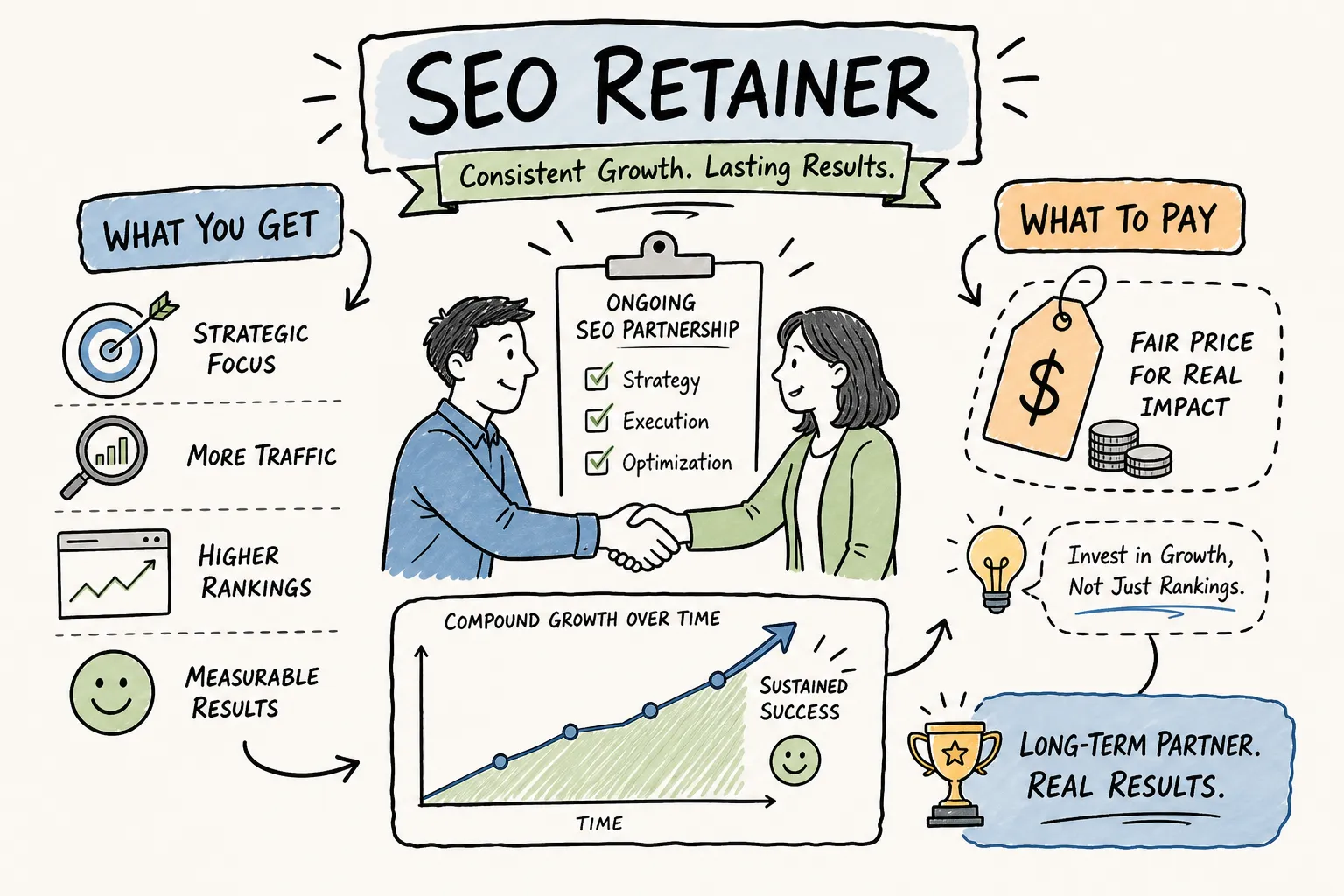
According to industry surveys, fixed-fee retainers represent the large majority of agency engagements. The client pays a set amount, typically $1,500 to $10,000 or more per month, in exchange for a defined scope of deliverables. The advantages are real: predictable budgeting, clear expectations, and the ability to build compounding SEO strategies across a 6 to 12-month horizon. The main risk is paying for a scope that doesn’t flex when business priorities shift. A well-written scope of work solves this problem before it starts.
Hourly billing and performance-based alternatives
Hourly billing is declining, industry data suggests only a small fraction of engagements use it exclusively, because it creates cost unpredictability on both sides. Performance-based models, where fees tie to rankings or revenue, sound appealing on paper but introduce attribution disputes and agency incentives that degrade service quality over time. When an agency is only paid for rankings, they tend to chase short-term wins instead of foundational strategy. Hybrid models, structured as a fixed base fee plus a performance bonus, offer the most balanced alternative for clients who want some accountability built into the contract. Most reputable agencies avoid pure performance pricing for exactly this reason.
SEO Retainer Services Pricing: What to Realistically Expect to Pay
Pricing varies by market competitiveness, scope depth, and provider type. These tiers exist largely because of the difference in overhead between full-service agencies and independent freelancers, a distinction worth keeping in mind when comparing proposals. The figures below are 2026 benchmarks for U.S.-based businesses across two broad categories, drawn from industry pricing surveys. Treat them as a sanity check when evaluating proposals, not as caps on what strong SEO is worth.
Local small businesses ($500 to $3,000 per month)
A single-location business in a non-competitive niche can expect foundational work in the $500 to $1,200 range: Google Business Profile optimization, basic citation building, and light content. Competitive urban service businesses like HVAC companies, dental practices, and plumbing contractors typically land between $1,200 and $3,000 per month. Multi-location local brands or aggressive local campaigns often push past $3,000. Industry pricing data puts the average local SEO retainer around $1,557 per month. Anything under $500 per month rarely includes strategic SEO; it’s more likely citation management and template reporting with no real strategy attached.
Regional and national campaigns ($2,500 to $15,000 or more per month)
Regional campaigns targeting multiple cities or service areas generally run $2,500 to $7,500 per month, with full-service on-page work, blog content, and monthly reporting included at the higher end. National campaigns in competitive verticals, legal, healthcare, finance, and home services, typically start at $5,000 and scale to $10,000 to $15,000 or more for heavy link acquisition and 15 or more content pieces per month. Industry pricing surveys place the national average across providers in the $2,800 to $3,500 range, but that figure includes freelancers; agency-delivered national programs generally start above $3,000 with serious scope.
The KPIs, SLAs, and Reporting Terms to Demand Before Signing
This is where most businesses lose negotiating leverage. They sign on deliverables without defining how performance gets measured or who’s accountable when results stall. Getting this right before signing is the difference between a productive partnership and a frustrating one.
Leading indicators vs. lagging results
A solid retainer agreement separates two types of KPIs. Leading indicators reflect process health: technical error backlog reduction, indexation rate, content publication velocity, and Core Web Vitals scores. These are the signals that tell you whether the agency is doing the work. Lagging indicators reflect outcomes: organic traffic growth year-over-year, keyword visibility in the top 10, organic click-through rate from Search Console, and conversions tied to organic sessions. An agency that reports only rankings is hiding the full picture. You want both layers visible in every monthly report.
SLA terms and reporting cadence
Service Level Agreements in an SEO contract should define response time for standard and urgent requests (24 hours for standard, 4 hours for critical issues), time-to-implement for approved technical fixes, and link verification windows. Best-practice guidance points to monthly reports delivered by the 5th business day, supplemented by biweekly or monthly working calls and a formal quarterly business review. Always ask for a live dashboard in GA4, Looker Studio, or an equivalent tool so you have real-time visibility between formal report cycles.
Protecting against scope creep
The scope of work must explicitly list what is in-scope, named pages, specific environments, and defined content types, and what is out-of-scope, such as full site migrations, rebrands, and net-new feature development. Ask for a formal 30/60/90-day milestone plan so both sides track compounding effects rather than reacting to month-to-month noise. Scope creep is a leading cause of retainer disputes; clear in/out-of-scope language and a defined change-order process substantially reduce this risk.
Why Ongoing SEO Investment Consistently Outperforms One-Time Projects
A one-time SEO project fixes what’s broken today. A sustained monthly engagement builds compounding authority over time. These are not the same thing, and treating them as interchangeable is one of the most expensive SEO mistakes a growing business can make.
The compounding argument for sustained SEO work
Search rankings don’t move from a single audit or a batch of published content. They compound. A technical fix in month one enables better crawling in month two, which amplifies the content published in month three, which earns more backlinks by month six. Each layer of work increases the return on the layer before it. One-time projects don’t have this runway: they spike briefly and decay as competitors continue publishing, earning links, and optimizing pages. Businesses that invest consistently in ongoing SEO services over a 6 to 18-month period tend to see compounding benefits that one-time projects simply cannot replicate.
What a structured retainer partnership looks like in practice
The model matters as much as the budget. At Brandleap Agency, retainers are built around a documented monthly roadmap, defined KPIs, and quarterly strategic reviews so clients always have a clear view of what their investment produced and what comes next. For small businesses evaluating their first retainer and for agencies outsourcing SEO to a trusted partner, that level of structure is what separates month-over-month progress from one-and-done results that fade by Q3. A retainer without a documented strategy is just a monthly invoice.
How to Use This as Your Evaluation Baseline
Know what deliverables to expect across the five core service areas. Understand which pricing model fits your goals and risk tolerance. Match your budget to your market’s competitive reality. And demand clear KPIs and SLA terms before signing anything. Use the pricing benchmarks in this article as a floor check: if a proposal comes in significantly below market for the scope it promises, ask exactly where the hours are going.
The businesses that lead local and national search a year and a half from now aren’t the ones who found the cheapest monthly SEO package. They’re the ones who signed onto a well-structured engagement with measurable deliverables, stayed consistent, and let the compounding work. Whether you’re evaluating your first retainer or renegotiating a current one, this guide gives you the baseline to make that decision clearly.
If you want SEO retainer services built around a defined scope and a compounding strategy, Brandleap Agency works with small businesses and partner agencies to structure exactly that. Reach out to start the conversation.