Migrations handled without professional SEO website migration services in place can trigger rapid ranking drops and traffic losses that take months to recover from. In our experience managing migrations across hundreds of client projects, sites that skip proper safeguards frequently lose significant organic visibility within days of launch, and recovery can stretch well beyond a year depending on how much went wrong. This is not an edge case. It is what happens when migrations get treated as a design or development project instead of an SEO-critical operation.
At Brandleap Agency, we have managed migrations for businesses ranging from local service providers to mid-market e-commerce brands. The same avoidable mistakes show up across projects of every size: missing redirects, staging tags left on the live site, sitemaps submitted before DNS propagated. Every one of those errors has a measurable cost in organic traffic.
This guide covers the complete pre-launch, launch-day, and post-launch process for a safe migration. You will learn what professional SEO migration services actually include, how to budget realistically by site size, and what to ask any vendor before you sign a statement of work.
Why website migrations put your organic rankings at risk
A migration is one of the highest-risk events in SEO because it changes multiple ranking signals simultaneously. URL structures, metadata, internal links, hosting environments, and sometimes entire domains shift at once. Google has to re-evaluate everything. When even one element breaks, the compounding effect on rankings is fast and severe.
The technical failures that trigger ranking drops
The single most common culprit is missing or misconfigured 301 redirects. When Google hits a URL that no longer exists and finds no redirect, it treats that page as permanently gone, stripping all the ranking power it accumulated. A single missed redirect on a high-authority page can cause a visible drop in impressions within days.
Other frequent technical failures include leaving noindex tags active from the staging environment, canonical tags pointing to old URLs, and robots.txt files blocking crawlers from sections of the new site. Redirect chains compound these issues. When a URL redirects through a second URL before reaching the final destination, Google often stops following the chain and treats the destination as unresolved, increasing crawl budget waste and the risk that critical pages go unindexed.
How content changes amplify the damage
Migrations that combine URL restructuring with major content rewrites are the riskiest category. Even correctly implemented 301 redirects do their job poorly when the destination page no longer matches the intent of the original. Google evaluates content relevance before passing any authority, and a page that no longer answers the same query essentially starts over.
Common content-side causes include deleted high-performing pages, missing or rewritten title tags and H1s, and internal link restructuring that buries previously strong cornerstone pages. Across the migrations we have managed, when both URL structure and content change simultaneously, ranking drops occur even when redirects are technically correct. This is why migrations require a content audit alongside the technical work, not instead of it.
The pre-launch phase: audits, baselines, and URL mapping
The planning phase determines how fast you recover after launch. Teams that compress pre-launch preparation to save a few weeks consistently spend more time in post-launch recovery than they saved. This work is not optional.
Running a full crawl and establishing your performance baseline
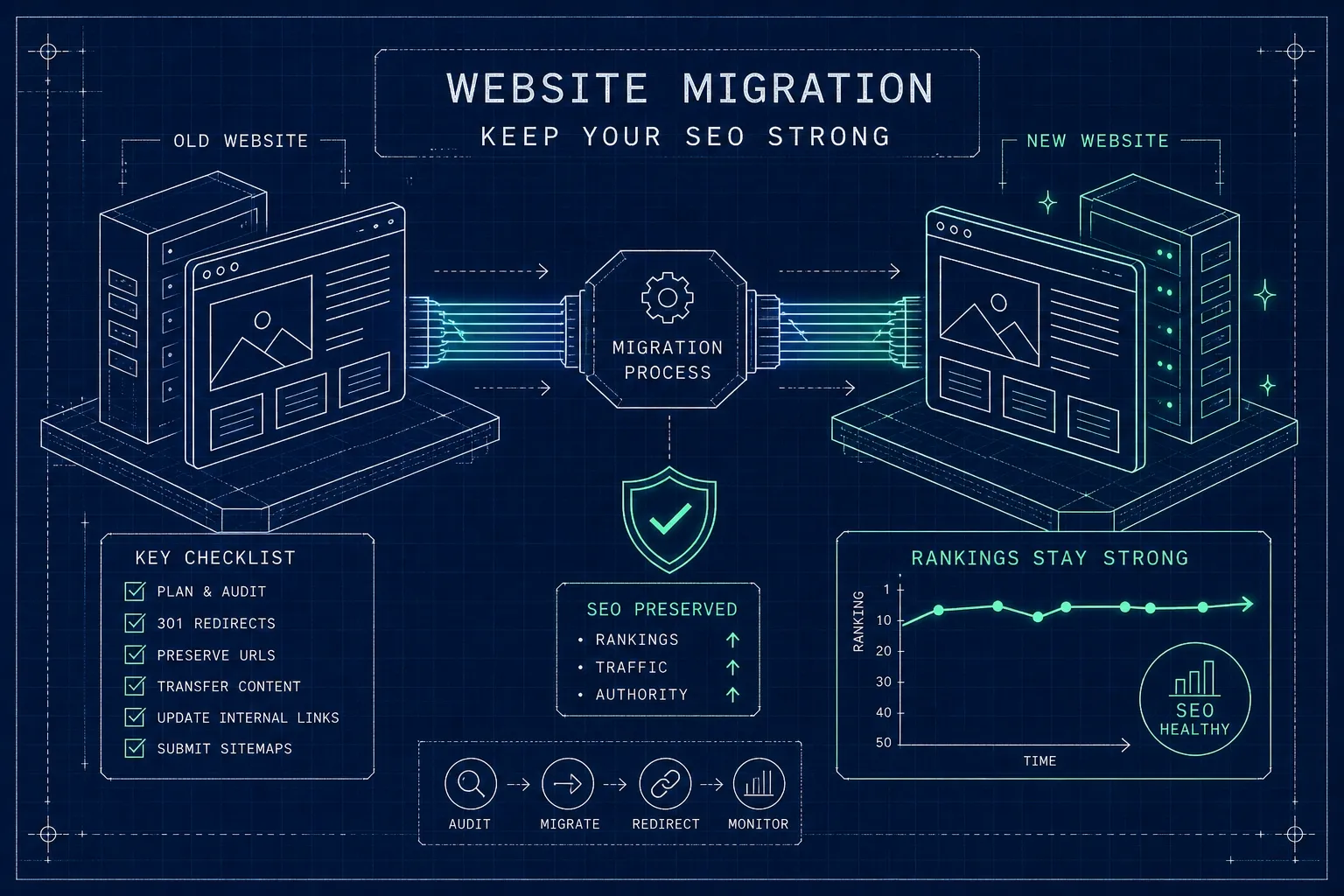
Before touching anything on the new site, crawl the existing site completely using Screaming Frog or Sitebulb. Export every indexed URL, image URL, and any pages receiving backlinks. This becomes the source of truth for your redirect map and the foundation of your post-launch comparison. Pull organic traffic, keyword rankings, and conversion data from Google Search Console and Analytics simultaneously. You will compare every post-launch metric against these numbers for the next 90 days.
Flag the top 20% of pages by traffic and backlink authority, identifiable through Ahrefs or GSC link reports, as your highest-risk assets. Every one of them needs a verified, clean 301 redirect to the corresponding new URL, confirmed before a single DNS record changes.
Building your 301 redirect map
Create a URL mapping document that pairs every old URL with its new destination in a strict one-to-one relationship. If a page is being removed with no equivalent, redirect it to the most relevant category page, not the homepage. A generic homepage redirect gives Google no signal about the removed page’s topic and passes far less authority than a topically matched destination.
Before going live, run chain and loop checks on every redirect in the document. Redirect chains, where a URL passes through one or more intermediate URLs before reaching its final destination, can cause crawling and indexing problems because Google may stop following the path entirely. Validate the staging site against this document: confirm that canonical tags are self-referencing on new URLs, that robots.txt blocks all staging crawlers, and that title tags and H1s match or improve on what existed on the original site. A thorough site migration SEO checklist at this stage is what separates migrations that hold rankings from those that do not.
Launch-day execution: the steps that protect your SEO
Launch day is where preparation either pays off or falls apart. The sequence of actions matters as much as the actions themselves. Doing the right things in the wrong order is how sites end up with 48 hours of 404 errors on their most important pages.
Activating redirects and removing crawl blocks
As soon as DNS is updated and the new server is live, activate all 301 redirect rules immediately. Any time an important URL returns a 404 instead of a 301 increases the risk of lost ranking signals, minimize the gap between DNS cutover and redirect activation. Remove noindex tags and password protection from the live site, then confirm the live robots.txt allows crawlers to access all critical pages, including the CSS and JavaScript files Google needs to render the page correctly.
After DNS propagates, manually test a sample of high-value redirects. Confirm that each old URL sends browsers and bots directly to the correct new URL without any intermediate hops. This manual check catches implementation errors that automated tools sometimes miss in the first hours after launch.
Sitemaps, Search Console, and analytics verification
Generate a new XML sitemap that lists only the new URLs and submit it to Google Search Console immediately. Use the URL Inspection tool to request priority indexing for your most important pages. If you are changing domains, use the “Change of Address” tool in Search Console and add the new domain as a property in both Google Search Console and Bing Webmaster Tools.
Verify that GA4 and Google Tag Manager are firing correctly on the live site. Create an annotation in Analytics marking the exact migration date. This single step makes post-launch analysis significantly cleaner. You can isolate migration-related traffic changes from normal fluctuations without guesswork.
Post-migration monitoring: catching drops before they compound
The teams that recover fastest from migrations are the ones actively monitoring from hour one. Waiting for a ranking drop to show up in a weekly report can delay your response by several days, and in migration recovery, that delay has a real cost.
The first 72 hours: immediate crawl validation
Run a full crawl of the live site within the first 24 hours. Look specifically for 404 errors, broken internal links, missing metadata, and any pages rendering as duplicates due to misconfigured canonicals. Check Core Web Vitals in Search Console; a new hosting environment or CMS can introduce performance regressions that hurt rankings independently of redirect issues.
Review server logs if accessible. Log analysis shows exactly which pages Google is crawling, at what frequency, and whether the bot is hitting dead ends. This data is more accurate than any third-party crawler because it reflects what Google is actually doing on your site, not a simulation of it.
The 90-day recovery window: long-term tracking
Compare organic traffic and keyword rankings against your pre-migration baseline weekly for the first month, then biweekly through day 90. Many correctly executed migrations begin to show stable or improving impressions in Search Console within 4 to 6 weeks, though timelines vary by site size and authority. If impressions are still declining at week 6, there is a technical issue that has not been resolved and needs to be diagnosed right away.
Watch for pages that remain unindexed on the new site after 2 to 3 weeks. Use the URL Inspection tool to diagnose whether the issue is a crawl block, a canonical problem, or a redirect that is not passing correctly. Continue reaching out to owners of high-value backlinks and ask them to update their links to the new URLs. Redirects transfer most of the equity, but a direct link to the new URL is always stronger than a redirected one.
What SEO website migration services actually include
The market for migration support ranges from developers who “handle SEO” as a checkbox to full-cycle SEO website migration services with dedicated audit and monitoring workflows. Knowing what a legitimate SOW looks like protects you from signing with the former while expecting the latter.
The deliverables to demand before signing anything
A legitimate SEO migration agency will deliver a complete content audit and URL mapping matrix before a single line of code changes. The mapping document should show every old-to-new URL pairing, confirmed redirect logic, and a metadata parity check that ensures title tags and H1s are preserved or improved. This document is not a summary; it is a line-by-line record that developers implement from and auditors verify against.
Post-launch deliverables should include a 90-day monitoring plan with a dedicated crawl schedule, Search Console reporting, and a clear escalation process for any 404 spikes or indexation gaps. The SOW should guarantee process outcomes, not ranking positions. Commitments like “100% of high-value pages will have validated 301 redirects” and “all staging noindex tags removed before DNS cutover” are what protect you. Vague promises about rankings are a red flag, not a selling point.
Why working with an experienced migration SEO agency matters
The migrations that fail are almost never the result of a bad platform choice. They fail because whoever executed the move did not understand the SEO implications of each technical decision. A 302 redirect instead of a 301, a canonical tag left pointing to the wrong domain, a sitemap submitted before redirects were active: these are small errors with outsized consequences that can take months to unwind.
At Brandleap Agency, our migration process was built specifically to prevent the ranking drops that take 6 to 12 months to recover from. We handle the full cycle: pre-migration audit, redirect mapping, staging validation, launch-day execution, and post-launch monitoring through the 90-day recovery window. For teams evaluating whether to handle this in-house or bring in outside support, the complexity of the monitoring phase alone is usually the deciding factor. If you are evaluating website replatforming services or a domain migration for an upcoming move, the most important question to ask any vendor is: “What does your post-launch monitoring include, and for how long?” Agencies that end their involvement at launch day routinely leave clients managing post-launch recovery on their own, increasing both risk and time to stabilize.
Migration cost and timeline: what to realistically budget
Cost and timeline estimates help you evaluate proposals and set internal expectations. Vendors who quote well below these ranges are almost certainly excluding the audit, redirect mapping, or monitoring work that determines whether the migration succeeds.
Cost ranges by site size
Small sites under 500 pages typically run between $2,000 and $7,000 for professional SEO website migration services that include redirect auditing, metadata preservation, and 30-day post-launch monitoring. Straightforward CMS migration SEO work on sites under 100 pages can start closer to $500 to $2,500, though the lower end of that range usually excludes post-launch monitoring entirely.
Mid-market sites with 500 to 5,000 pages generally fall in the $8,000 to $25,000 range. This scope includes full crawl-based redirect mapping, structured data review, canonical tag audits, and 30 to 60 days of post-launch monitoring. Enterprise sites with complex architectures, international configurations, or tens of thousands of pages can run from $50,000 to well over $100,000, particularly when log file analysis, crawl budget optimization, and 90-day monitoring are included.
Timeline expectations by project type
A CMS replatform on a small site can technically execute in 2 to 3 weeks, but plan for 6 to 8 weeks end-to-end to include pre-migration auditing and the first post-launch monitoring cycle. Mid-market migrations typically run 3 to 6 months from audit to stable recovery. Domain migrations require significantly more patience: according to industry research, full organic traffic recovery after a domain change can extend well beyond a year, and a meaningful percentage of sites never fully recover when the migration was mismanaged.
The timeline investment in the planning phase is what determines recovery speed after launch, teams that cut this phase short consistently spend more time in post-launch triage than they saved. The work happens before launch or after it. There is no third option.
What a well-managed migration protects
A website migration is not an event; it is a phased process that starts weeks before the new site goes live and continues for 90 days after. Every phase, from URL mapping and 301 redirect mapping to crawl testing and Search Console monitoring, has to execute correctly or the SEO equity your site has built gets left behind on the old platform.
The redirect map, the staging audit, the launch-day checklist for SEO website migration services, and the post-launch monitoring window are not optional extras. They are the difference between a migration that protects your rankings and one that costs you months of recovery work and revenue you cannot reclaim.
If your team is planning a migration and wants to make sure nothing falls through the cracks, Brandleap Agency offers full-cycle SEO website migration services, reach out before the project kicks off. The earlier we get involved, the more organic traffic we can protect through the transition.