
Why choose an SEO agency instead of a freelancer? It’s a question most growing businesses face the moment they receive two very different quotes. You already know you need SEO help. You’ve spoken to a freelancer who quoted £800 a month and an agency that quoted £2,000, and the freelancer suddenly looks like the obvious choice. The honest answer is that neither option is universally right. The right choice depends on the size of your campaign, how many SEO disciplines you actually need running at once, and what happens to your business if the whole effort stalls for two months.
What this article will help you do is cut through the vague comparisons and reach a clear decision. We’ll cover what each option actually delivers, the risks you won’t spot until they’ve already cost you, what UK businesses pay in 2026, and the specific contract points you need to check before signing anything. If you’re weighing up whether to hire an SEO consultant or go with a full-service agency, the answer hinges on scope, accountability, and the structural realities of how each model works.
What each option actually delivers
The gap between a freelancer and a full-service agency isn’t just headcount. It’s the range of what gets executed consistently, month after month, without things falling off the list because one person ran out of hours.
The freelancer model: focused and flexible, but limited in scope
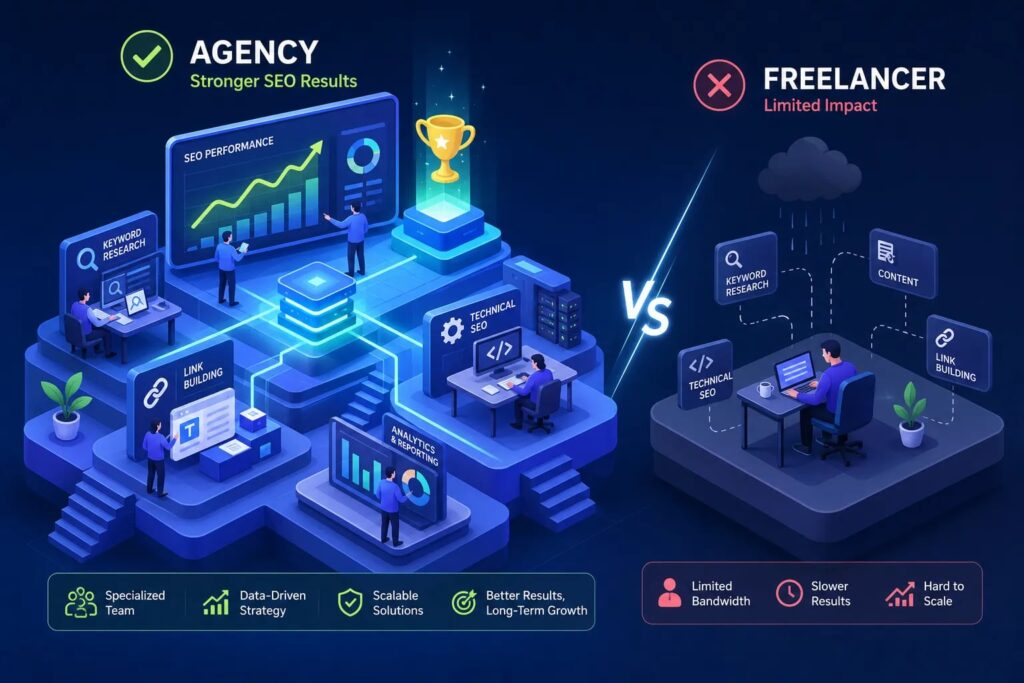
Most freelance SEO consultants are genuinely strong in one or two areas: typically on-page optimisation and keyword research, sometimes content strategy or technical audits. For a contained, clearly defined project, that’s often sufficient. The problem surfaces when a campaign needs simultaneous progress across technical SEO, content production, link acquisition, and monthly reporting. One person cannot run all of those workstreams to a high standard at the same time, across multiple clients, without something being deprioritised.
That’s not a criticism of freelancers. It’s simply a structural reality. A solo consultant who is doing your technical audit is not simultaneously building links, producing content, and managing your reporting dashboard. The scope has a ceiling, and growing businesses hit that ceiling faster than they expect.
The agency model: specialist teams across every discipline
A structured agency assigns each SEO function to a dedicated specialist. At Brandleap Agency, technical SEO, content, off-page authority building, and paid advertising are each handled by someone working exclusively in that discipline, not a generalist rotating between tasks depending on what the week demands. The practical result is that every layer of a campaign gets genuine depth, not a consultant squeezing it into their schedule between four other clients. When a technical issue emerges mid-month, the person who fixes it isn’t the same person producing your content or managing your outreach.
Why choose an SEO agency instead of a freelancer: the hidden risks
Choosing a freelancer based on the lower monthly cost is one of the most common mistakes growing businesses make. The risks aren’t always visible upfront; they tend to surface at the worst possible moments, often months into a campaign, a pattern commonly reported by businesses that have switched from freelance to agency arrangements.
Continuity and availability are structural problems, not personal ones
A freelancer is, by definition, a single point of failure. If they take on a demanding new client, fall ill, go on holiday, or simply move on, your campaign stalls. There’s no handover, no backup, and often no documented process for anyone else to continue the work. Agencies have built-in continuity: account managers, shared project documentation, and team coverage that keeps work moving regardless of individual availability. That redundancy is worth far more than its cost when a technical issue surfaces during a product launch.
Quality assurance gaps that compound over time
Without oversight or peer review, the quality of freelance SEO work can drift. Deliverable standards may be high at the start of an engagement and inconsistent six months later. At the lower end of the market, some freelancers still use outdated tactics: thin content, low-quality link schemes, or technical shortcuts that create problems you won’t notice until rankings drop and the damage is already done. A reputable agency runs QA processes, reviews outputs before they go out, and has reputational accountability at an organisational level, not just an individual one. That second set of eyes matters far more than it sounds.
Costs in plain terms: what UK businesses pay in 2026
Cost is the most common reason businesses lean towards a freelancer. It’s a fair consideration, but the numbers only tell the full story when you understand what they actually buy. Understanding agency SEO retainer versus freelance rates is essential before making any commitment.
Freelancer rates and what they typically include
In the UK in 2026, freelance SEO consultants generally charge between £300 and £1,500 per month on retainer, with experienced independents reaching £2,000 or more for demanding work. It’s worth noting that small-business ongoing engagements frequently cost towards the higher end of that range once hours and scope are factored in. Hourly rates sit broadly between £30 and £100, with senior consultants charging up to £150. At the lower end of that range, you’re typically receiving a defined set of tasks, an audit, some on-page recommendations, and a monthly report, rather than an active, multi-discipline campaign running across technical and content workstreams simultaneously.
Agency retainers and what the higher price reflects
SEO agency retainers in the UK typically start around £800, £1,000 per month for small-business campaigns, scaling to £2,500 or more for comprehensive multi-discipline work, with enterprise-level retainers going considerably higher. Some agencies offer entry-level packages from around £500, though these tend to cover a narrower scope. The additional cost covers the team structure: strategy, technical implementation, content production, outreach, and reporting carried out by multiple specialists rather than one person rotating across all of it. For businesses that need consistent output across all of those areas, the agency model is generally better suited to complex, multi-discipline campaigns and may deliver stronger value than a freelancer who can only address part of the brief at any one time.
Scale, accountability, and what happens when things go wrong
The clearest advantage of a reputable agency over a freelancer isn’t the range of services alone. It’s the accountability framework that surrounds the work.
What proper SLAs and reporting look like in practice
Established agencies operate with written service-level agreements that define scope, timelines, response windows, reporting cadence, and what happens if obligations aren’t met. Monthly reporting typically covers organic traffic, rankings, conversions, backlink growth, and campaign progress against agreed KPIs. Neither agencies nor freelancers can legitimately guarantee specific rankings, any provider who claims otherwise is waving a red flag, as widely acknowledged across SEO industry guidance. The difference is that agencies are far more likely to have formal escalation paths, remediation clauses, and contractual clarity on deliverables than a freelancer arrangement documented in an email thread.
How agencies handle campaigns that need to grow
When a business scales, launching new service lines, targeting new regions, or adding paid media to the mix, a freelancer’s available hours become the ceiling on your growth. An agency can extend disciplines, add resource, or integrate paid advertising and technical development without rebuilding the engagement from scratch. That structural flexibility is why businesses running multi-channel strategies often find agencies easier to work with as ambitions grow. Scaling with a freelancer usually means starting the hiring process again; scaling with an agency means a conversation with your account manager.
Why choose an SEO agency instead of a freelancer: how to decide
Neither choice is universally correct. The decision comes down to four practical factors: budget, scope, risk tolerance, and how much internal capacity you have to oversee and direct the work.
Scenarios where a freelancer genuinely makes sense
A freelancer is a reasonable fit when the scope is narrow and well-defined: a one-off technical audit, a content gap analysis, or a short-term project with clear deliverables and a fixed endpoint. It also works when you have an in-house marketing team capable of providing strategic direction, and you need execution support in one specific area rather than end-to-end campaign management. Budget constraints in the very early stages of a business are also a legitimate reason to start with a freelancer, particularly while organic search is still a secondary priority behind product or service development.
Clear signs your business needs an agency
If SEO is a primary growth channel and you’re generating consistent revenue, a freelancer’s bandwidth will become a bottleneck. If you’ve had inconsistent results, missed deliverables, or a consultant who went quiet mid-campaign, those are structural problems with the model, not isolated incidents of bad luck. Businesses that need technical SEO, content production, link building, and reporting running simultaneously, with someone accountable for the whole picture, are businesses that need an agency. The question isn’t whether you can afford one. It’s whether you can afford the compounding cost of a campaign that only ever half-delivers.
If you’re still uncertain, consider where your campaign actually sits. Does it span multiple disciplines, or is the scope genuinely contained? Do you have internal expertise to evaluate the quality of work being produced? And what does it actually cost your business if this campaign stalls for two months? Those three questions will point you in the right direction far faster than any rate comparison.
Making the right call before you sign anything
Whether you go with a freelancer or an agency, there are a few non-negotiable checks before committing. Ask to see a sample monthly report, not a template, but an actual anonymised report from a live client. Confirm in writing exactly who will be working on your account, what they will deliver each month, and what the process is if a deadline slips. For agencies, check whether the SLA includes escalation paths and termination notice periods. For freelancers, check whether they have documented processes or whether everything lives in their head, poor documentation and knowledge retention are among the most commonly cited risks in freelance SEO arrangements.
The choice between a freelancer and an agency ultimately comes down to what your campaign requires to perform. For narrow, contained work with strong internal oversight, a freelancer can deliver. For businesses that need consistent, multi-discipline execution with genuine accountability and room to scale, an agency is the more reliable investment.
If you’re still weighing up why to choose an SEO agency instead of a freelancer, the practical distinction is this: an agency gives you a team of dedicated specialists, each focused on their own discipline, rather than a single generalist spread across disciplines without clear accountability. Brandleap Agency is structured around exactly that principle, with dedicated specialists across technical SEO, content, off-page authority, and paid media. Book a free strategy call to see how that model applies to your specific campaign.

BrandLeap Agency & BrandLeap Fashion | Founder & CEO
Mithun is an experienced SEO consultant recognized for helping businesses improve their digital presence through technical SEO, content optimization, and sustainable organic growth strategies. Working in the digital marketing industry since 2019, he has developed expertise in increasing search visibility, driving targeted traffic, and building long-term growth through data-driven SEO solutions. He has worked with businesses across multiple industries, helping brands strengthen their online authority and achieve measurable growth results.