
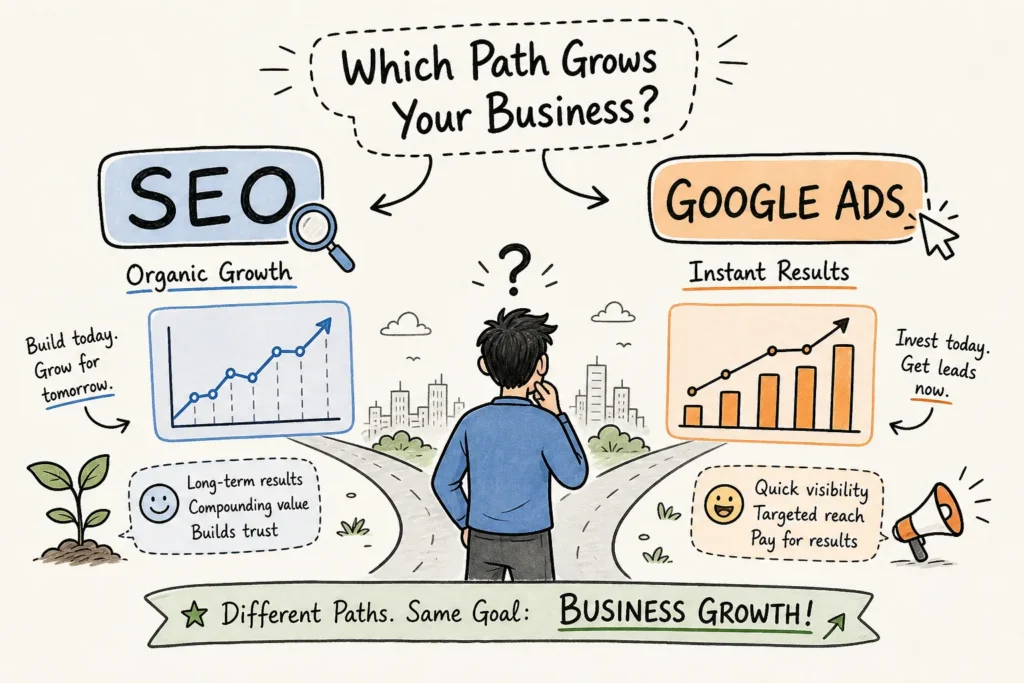
When weighing SEO vs Google Ads, every small business owner hits this wall eventually. You have a real budget, two channels pulling in opposite directions, and one question that nobody seems to answer directly: do you put your money into paid search for immediate results, or into organic search for compounding returns that build over time? Pick wrong, and you don’t just lose money. You lose months, sometimes years, of growth momentum that competitors are quietly accumulating while you course-correct.
At Brandleap Agency, this is one of the most common questions we hear from business owners before they launch any campaign. The answer is almost never a clean either/or. The right call depends on your timeline, your budget math, and the competitive dynamics of your specific market. Generic advice doesn’t serve any of those variables well.
What follows is the framework we use to make that call: real cost benchmarks, timeline expectations, budget allocation models, and a measurement approach that shows you which channel is actually driving your results. By the end, you’ll have enough to make a confident decision rather than an educated guess.
How SEO and Google Ads work on completely different clocks
What organic search delivers over time
SEO builds ranking authority through content quality, backlink acquisition, and technical site structure. None of that produces traffic overnight. For a brand new website, plan for six to twelve months before you see significant, stable organic search traffic. Research indicates that only 1.74% of new pages reach the top ten rankings within their first year, which means the majority of sites see meaningful impressions and clicks begin appearing around month three, but stable, significant traffic commonly requires six to twelve months to materialize.
The timeline varies by business type. B2C businesses targeting purchase-ready queries can see their first organic conversions within a few days or weeks of gaining initial traction. B2B companies typically wait thirty to ninety days because trust-building and consideration cycles are longer, regardless of how the visitor arrived. The compounding advantage, though, is what makes SEO worth the wait: traffic earned through organic rankings doesn’t stop when you stop paying. That’s a fundamentally different asset than anything paid advertising produces, and it’s the core reason the paid search vs organic search debate isn’t as simple as comparing conversion rates.
How paid search delivers visibility on launch day
Google Ads puts your business at the top of search results within twenty-four to forty-eight hours of launching a campaign, provided your targeting and budget are set up correctly. For B2C brands, that can mean first conversions within hours of going live. B2B businesses still track closer to the sales cycle, somewhere between ten and forty-five days, because the buying decision itself takes time regardless of how the prospect found you.
The trade-off is clear and non-negotiable: the moment you pause spend, the traffic stops. There’s no residual momentum, no compounding return, no asset being built in the background. Every click has a direct dollar cost attached, and that cost repeats every single month you stay in the channel. This is the fundamental distinction in any SEM vs SEO comparison, one builds equity, the other rents visibility.
Conversion rate reality check for both channels
In 2026, Google Ads averages a conversion rate of 4.40% to 7.52% across industries, based on benchmarks from sources including Digital Applied Q1 2026 and WordStream/LocaliQ, though rates vary by vertical and dataset. Organic search sits lower, at roughly 2.1% to 2.8% on average. Paid search converts higher on first touch because those visitors arrive with sharper purchase intent. They searched for something specific, clicked an ad that matched their query exactly, and landed on a page built for that moment. For broader industry benchmarking, see Digital Applied’s conversion rate benchmarks.
Organic visitors, by contrast, often enter earlier in the consideration phase. They require more nurturing, but they tend to carry stronger long-term value once they convert. Neither rate wins the argument in isolation. What matters is how those numbers translate to your specific cost structure, funnel stage, and customer lifetime value.
The real cost of SEO vs Google Ads, broken down honestly
What you’re actually paying for with SEO
SEO costs are less visible than ad spend, but they’re very real. You’re paying for content creation, technical audits, link building, and either an agency retainer or a significant chunk of internal time. In 2026, a small business SEO retainer from a reputable agency runs between $1,500 and $5,000 per month, with a median around $3,500 for national campaigns; local SEO engagements often run lower. Freelancers typically come in around $1,350 per month, though service scope varies considerably. (Figures reflect 2026 agency benchmarking data; ranges differ for local versus national campaigns.) If you’re evaluating options for execution, our piece comparing Organic SEO Services vs Paid Ads offers practical guidance on which approach fits different business models.
Unlike paid advertising, most SEO investment is front-loaded. You pay before results arrive, which creates cash flow pressure for early-stage businesses. The long-term payoff justifies that pressure: once you hold strong rankings, your marginal acquisition cost declines substantially as organic traffic compounds and the initial investment gets amortized across a growing visitor base. That’s the core ROI argument for organic search, and for businesses that can sustain the upfront investment, it’s a strong one.
What your Google Ads budget actually buys in 2026
Average cost per click across Google Search industries in 2026 sits between $2.96 (Digital Applied Q1 2026) and $5.26 (WordStream/LocaliQ benchmarks), depending on the dataset and vertical. High-competition categories push well above that floor: legal services average $6.75 per click, insurance comes in at $6.22. At a $1,500 monthly budget with a $3.50 average CPC, you’re buying roughly 430 clicks per month. At a 5% conversion rate, that’s about twenty-one conversions. Whether that math works depends entirely on what each conversion is worth to your business. For a deeper look at how much it actually costs to run search ads, review this analysis of the cost to advertise on Google.
The spend is predictable, scalable, and completely transparent. But there’s no equity being built. Stop spending, and the traffic stops with it. For businesses in high-CPC verticals operating on budgets under $3,000 per month, the math can close quickly against you. The numbers that work for a legal firm with $5,000 client retainers don’t work for a retailer selling $40 products.
Where cost-per-acquisition actually lands for each channel
In the Google Ads vs organic traffic comparison, CPA trajectories move in opposite directions over time. SEO cost-per-acquisition tends to drop as traffic compounds and the initial content and technical investment gets amortized across more visitors. Google Ads CPA stays relatively flat unless you’re actively improving quality scores and landing page performance. To put a number on it: a campaign generating twenty conversions per month at $75 CPA in month one may still be at $70 CPA in month twelve, but an SEO program generating the same volume could see effective CPA fall by 40% to 60% as content compounds. In lower-CPC verticals like retail, entertainment, and nonprofits, paid search at modest budgets can be highly efficient from day one. In higher-CPC categories, the economics often don’t close until budgets reach a scale that most small businesses can’t sustain.
SEO vs PPC: when one channel clearly outperforms the other
The situations where SEO is the smarter long-term play
If you’re building a content-driven brand, targeting informational queries, or operating in a space where trust drives the buying decision, organic search builds authority that paid advertising simply can’t replicate. Financial services, healthcare, and B2B SaaS are classic examples: buyers in those categories research extensively, read multiple sources, and assign credibility based on what they find organically. Showing up in those results consistently signals something an ad placement never can. For context on B2B behavior and benchmarks, see recent B2B conversion rate benchmarks.
Established businesses with twelve or more months of runway and consistent content production are the natural fit for an SEO-first approach. Local businesses targeting specific geographic markets also benefit disproportionately from organic visibility, particularly through Google Business Profile optimization and local pack rankings, where the cost of appearing is time and expertise rather than a media budget.
When Google Ads is the only move that makes sense
New businesses with no domain authority can’t wait six to twelve months for organic traffic to materialize. Neither can businesses running time-sensitive promotions or high-ticket service providers who need qualified leads now. In those situations, paid search isn’t just an option, it’s the only realistic path to near-term revenue. E-commerce brands launching new product lines also benefit from paid search’s ability to generate immediate purchase data before committing to SEO content production across an entire category.
The clearest signal to lean on Google Ads: when the cost of waiting for organic traffic is higher than the cost of buying paid traffic. That math is different for every business, but it’s the right question to ask before committing to either channel.
How to split your budget when you use both channels
Budget allocation models for startups building from scratch
Based on our experience working with early-stage businesses, startups typically see the best results allocating 50% to 60% of their digital budget to Google Ads and 40% to 50% to SEO during the early phase, though some models call for an even higher paid share (60% to 70%) for very early-stage companies with no organic foothold at all. Paid search fills the traffic gap while organic assets are being built. You’re not choosing between visibility now and sustainability later; you’re buying both in parallel, which is the right trade-off when you have the budget to do it. The optimal split ultimately depends on your CPC environment, customer lifetime value, and required lead velocity.
At a $5,000 monthly budget, a practical starting structure puts $2,500 toward content and SEO infrastructure and $500 to $1,000 toward Google Ads targeting two or three high-intent keywords. Don’t spread thin across dozens of keywords at that budget level. Concentration produces results; dilution produces mediocrity and data that’s impossible to act on.
How established businesses shift the mix over time
Once organic rankings are delivering consistent traffic, the rational move is to reduce paid search dependency and reinvest in SEO at a 60% to 70% share of the digital budget. Retargeting becomes the primary use case for Google Ads at this stage, not acquisition. You’re using paid search to re-engage visitors who discovered you organically, which tends to be far more cost-efficient than using it to reach first-time prospects who’ve never heard of you. Established businesses typically use the target conversions times cost-per-conversion formula to set their exact Ads budget rather than defaulting to an arbitrary percentage.
A practical starting point for small businesses under $3,000 per month
At this budget level, the right split depends on your timeline. If you have six or more months before you need leads, a 70/30 SEO-to-Ads allocation makes sense, treat it as a rule of thumb, and adjust based on your CPC environment and the lifetime value of a customer. If you need leads within sixty days, flip it to 60% Ads and 40% SEO. What you should not do is split the budget evenly from day one and try to do both channels at half-effort. That’s the single most common mistake we see at this budget tier, and it consistently produces underwhelming results in both channels.
Measuring SEO vs Google Ads performance without lying to yourself
Why last-click attribution makes Google Ads look like a hero
Last-click attribution assigns 100% of conversion credit to the final touchpoint before purchase. That final touchpoint is often a paid ad rather than the organic blog post that introduced the customer to your business six weeks earlier, though this varies by industry and buyer journey length. This default measurement approach causes businesses to systematically undervalue SEO, cut organic budgets prematurely, and overspend on paid search. Data-driven attribution research in GA4 consistently shows that SEO-assisted conversions are undercounted when last-click is the default model. The comparison between paid and organic search is only honest when the full customer journey is visible, not just the last step.
Setting up data-driven attribution in GA4 for a fair comparison
Data-Driven Attribution in Google Analytics 4 uses machine learning to distribute conversion credit across all touchpoints proportionally, based on actual influence rather than rigid positional rules. To switch, follow these steps:
- In GA4, navigate to Advertising → Attribution → Attribution Model and select Data-Driven.
- In Google Ads, go to Goals → Measurement → Attribution → Model Comparison.
Once DDA is active, you’ll typically find that SEO-assisted conversions were being ignored entirely in previous reports. The ROI picture shifts significantly when those contributions are visible, and that shift is often what reframes the entire paid search vs organic search budget conversation. For a deeper look at how different attribution approaches change campaign decisions, read about Google Ads attribution models.
The KPIs that actually tell you which channel to scale
For SEO, track organic sessions, keyword position velocity over thirty and ninety-day windows, and organic-assisted conversions in GA4. For Google Ads, track cost-per-conversion by campaign, impression share, and quality score, not just clicks or click-through rate. The decision trigger to scale a channel is a sustained thirty-day improvement in cost-per-acquisition or a measurable increase in assisted conversions at the top of the funnel. Both signals need to be present before you commit more budget.
Building a search strategy that actually fits your business
Why most small businesses get this decision wrong
The most common failure isn’t picking the wrong channel. It’s making the decision based on what someone else did rather than on your own numbers, timeline, and competitive landscape. A local service business in a low-competition market and a SaaS startup competing nationally have completely different math. Generic advice, including most comparison articles you’ll find online, doesn’t account for either situation with any precision. The organic search vs paid search decision only makes sense when it’s grounded in your specific cost-per-click environment, conversion rates, and growth timeline.
How Brandleap Agency helps small businesses make the call
At Brandleap Agency, every engagement starts with a budget-and-timeline audit before we recommend any channel mix. The goal isn’t to sell a package; it’s to map the right strategy to where your business actually is right now. For businesses that need both organic and paid working together, we build the allocation model, configure GA4 attribution correctly from day one, and track performance against the KPIs that match the client’s growth stage rather than industry averages. If you want the strategic framing that compares channel choices directly, check our SEO vs PPC guide for detailed decision criteria.
If you’re still uncertain where to start, the fastest path to clarity is a direct conversation about your goals and current budget, not another comparison article.
The bottom line on paid vs organic search
Google Ads wins when speed and precision matter most. Organic search wins when you’re building for compounding long-term returns. A blended approach wins for most businesses operating with a six-month or longer horizon, provided the budget allocation is deliberate rather than split arbitrarily. Neither channel is inherently better. The better one is whichever fits your timeline, your budget math, and your competitive position right now.
Before you draw any conclusions, set up data-driven attribution in GA4. Last-click data will mislead you every time, and decisions made on bad attribution lead to exactly the kind of budget misallocation this article is designed to help you avoid.
When you’re ready to build a search strategy around your actual goals and budget, rather than a template that worked for someone else’s business, reach out to Brandleap Agency and we’ll map the right channel mix for where you are today. For a comprehensive comparison of costs, timelines, and expected ROI between approaches, see our in-depth Organic vs Paid Search analysis, that’s where the SEO vs Google Ads question stops being theoretical and starts producing results.

BrandLeap Agency & BrandLeap Fashion | Founder & CEO
Mithun is an experienced SEO consultant recognized for helping businesses improve their digital presence through technical SEO, content optimization, and sustainable organic growth strategies. Working in the digital marketing industry since 2019, he has developed expertise in increasing search visibility, driving targeted traffic, and building long-term growth through data-driven SEO solutions. He has worked with businesses across multiple industries, helping brands strengthen their online authority and achieve measurable growth results.