The question comes up in almost every first conversation at Brandleap Agency: “Should I put my budget into SEO or Google Ads?” It sounds like a reasonable question. It is actually the wrong one. Treating organic vs paid search as a competition costs businesses money, momentum, and growth they never recover. By the time you finish reading this, you will know exactly how each channel works, what it realistically costs in 2026, what ROI to expect, and how to split your budget based on where your business actually stands right now. No recycled advice, just a clear framework backed by current data.
How Organic vs Paid Search Work (and Why They’re Not Rivals)
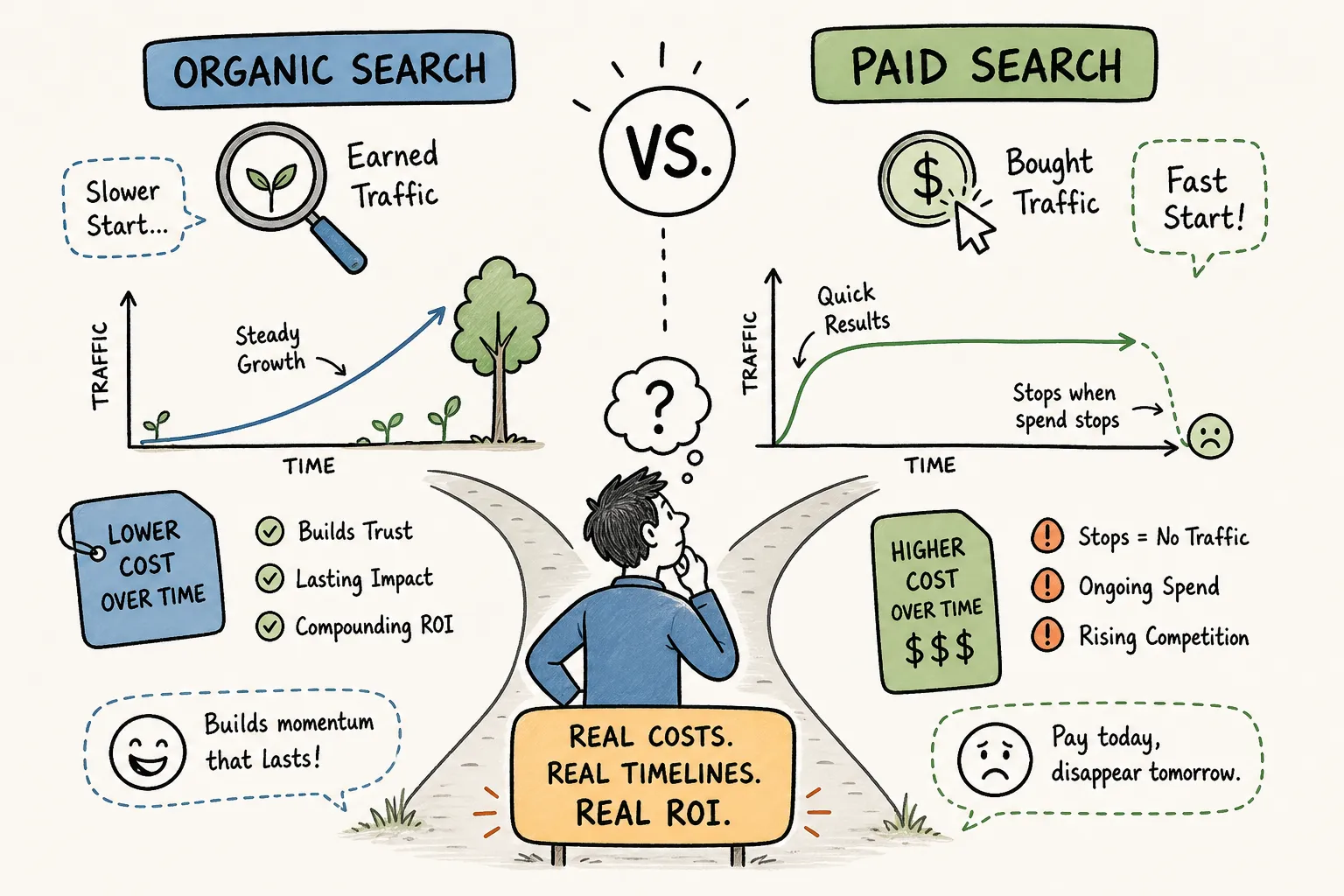
Organic search traffic is earned. It comes from Google’s algorithm deciding your content, technical setup, and backlink profile deserve a spot in the rankings. Paid search visibility is bought. You bid on keywords, your ad goes live within hours, and you pay each time someone clicks. Neither channel owns the search results page; they occupy different real estate and serve different buyer mindsets on the same SERP.
What organic search traffic actually means for your business
SEO works through a combination of content relevance, technical signals, and domain authority built over time. Google evaluates hundreds of factors, including page speed, mobile usability, backlink quality, and how well your content matches search intent. Organic listings appear below paid ads in most cases, but they earn significantly more trust and click volume over time because searchers know they were not paid for.
What Paid Search (PPC) Delivers from Day One
Pay-per-click advertising puts your business at the top of a SERP the same day you launch a campaign. You choose your keywords, set a bid, write your ad copy, and your listing goes live immediately. The trade-off is straightforward: the moment your budget runs out or you pause the campaign, the traffic stops completely. There is no residual value, no compounding equity, it is a direct exchange of dollars for clicks and nothing more.
How searchers interact differently with ads vs organic listings
The click-through rate data tells a clear story. The number one organic result earns approximately 39.8% CTR on searches without AI Overviews, compared to roughly 2.1% for the top paid ad. Even factoring in the impact of AI Overviews pushing that organic CTR down to around 27.6% in many searches, the top organic result still receives roughly 19 times more clicks than the top paid placement. That said, paid ads capture high-intent, bottom-of-funnel clicks effectively when the buyer is ready to act immediately, and that is precisely where their value lies. When you look at CPC vs organic CTR side by side, the trade-off becomes a timing question rather than a quality judgment.
Organic vs Paid Search: Real Costs and Timelines
SEO feels free until you account for the expertise, content production, and technical work it actually requires. PPC feels controllable until competitive CPCs erode your budget faster than leads come in. Both channels cost real money; the difference is in timing, trajectory, and what you own at the end.
What SEO costs in time and money
SEO investment starts with a technical audit, on-page optimization, content creation, and link building. The return follows a compounding curve rather than a linear one. Most small business websites move through three broad phases:
- Months 1, 3: Crawl activity increases and impressions start to build.
- Months 3, 6: Meaningful ranking movement and non-brand clicks begin to appear.
- Months 6, 12: Stable conversions and genuine lead generation kick in.
New domains or highly competitive niches like insurance or legal services can push that timeline further out. The critical point is that the work done in month one still generates returns in month eighteen.
What paid search costs across major industries in 2026
The cross-industry average CPC for Google Search campaigns in 2026 is $2.96, up 12% year-over-year from $2.64 in Q1 2025. That average masks significant variation by industry. Legal services averages $6.75 to $9.87 per click. B2B services run around $3.33. E-commerce can sit as low as $1.16. A modest Google Ads campaign in a mid-competition niche, factoring in management, testing, and enough volume to generate reliable lead data, typically consumes $1,500 to $3,000 per month before you see consistent returns.
How to think about total cost vs cost per acquisition
The more useful question is not “what does each channel cost per month” but “what does each lead actually cost me.” With SEO, your cost per acquisition decreases as rankings improve and your content continues generating traffic without additional spend. With PPC, your CPA is relatively fixed and tied to market competition, which means it rises as more advertisers enter your space. Industry benchmarks for CPC, CTR, and CVR can help validate expected CPAs as you test and scale. Over a 24-month horizon, a well-executed SEO strategy almost always produces a lower CPA than a comparable paid search investment. That dynamic is what makes the paid search vs organic traffic debate so dependent on time horizon.
Where each channel genuinely outperforms the other
Calling one channel “better” is a category error. Both organic and paid search dominate in specific scenarios. The smart move is matching the channel to the situation rather than picking a favorite and sticking with it regardless of context.
When organic search is the smarter investment
SEO is the right tool when your business can absorb a six- to twelve-month ramp before seeing significant lead volume. It performs best when your target keywords carry informational or research-based intent, when you want to build content assets that compound in value, and when your goal is sustainable lead generation that does not evaporate the moment you pause spending. For location-based businesses, affordable SEO services including local SEO and Google Business Profile optimization can produce visible results in weeks rather than months, making it one of the highest-ROI moves available to small businesses with a defined service area. Understanding the organic click-through rate by search position also clarifies why investing in higher rankings pays off over time.
When pay-per-click advertising makes more sense
PPC is the right tool when you need leads this month, not next quarter. It earns its place when you are entering a new market and have no organic authority to leverage, when a seasonal promotion demands immediate SERP visibility, or when you need keyword conversion data fast to inform your broader strategy. Queries with high purchase intent, like “hire a [service] near me”, convert well under paid search because the person searching is ready to make a decision, not still researching options.
The ROI picture over time: compounding vs linear returns
Understanding the financial shape of each channel over time is the single most clarifying thing a business owner can do before setting a marketing budget. SEO and paid search do not produce the same curve, and that difference determines which deserves more of your money at each stage of growth.
Why SEO returns compound while PPC returns stay flat
Organic rankings build domain authority, content equity, and backlink profiles that continue generating traffic long after the work is done. A well-ranking article from eighteen months ago still pulls in leads today without any additional spend. PPC has no such mechanic: the day the budget stops, the traffic stops. SEO builds an asset you own; paid search rents visibility you borrow. Both serve a purpose, but only one grows in value over time.
What happens when you combine both channels
Integrated campaigns consistently outperform single-channel strategies by a measurable margin. According to published performance analyses from multi-channel search campaigns, blended ROAS figures of 4.4x to 13.32x have been documented alongside 269% increases in new users and 68% higher click volumes when SEO and PPC are managed as one system rather than two separate efforts. There is also a direct mechanical benefit: strong organic authority reduces your paid CPC and improves your paid ad CTR, because Google’s quality scoring rewards overall relevance. The two channels actively lift each other’s performance when they share strategy, data, and messaging, and you can see the underlying CTR research in consolidated Google CTR statistics.
A budget allocation framework by business stage
Generic percentages only go so far. What actually helps is a stage-based model that reflects the real trade-offs at different points in a business’s growth. Use the splits below as a starting framework, then adjust based on how crowded your keyword category is and your current lead volume requirements.
Startups and new businesses (under $1M revenue)
With no organic presence, SEO alone cannot generate leads fast enough to keep the business moving. The recommended split at this stage is 70 to 80% of your digital marketing budget toward PPC for immediate traffic, and 20 to 30% toward SEO foundation work including technical setup, initial content, and local optimization. Investing in targeted PPC campaigns ensures revenue now while you build organic equity that will eventually reduce your dependence on paid spend.
Growing companies in scale mode ($1M to $10M revenue)
With some organic traction already established, a 50/50 split becomes the right framework. PPC keeps the pipeline full while SEO accelerates the compounding curve. At this stage, the two channels begin feeding each other: organic data reveals which content topics drive the most qualified traffic, and paid conversion data sharpens content priorities. The gap between what each channel costs per lead starts to close, and the integrated strategy begins outperforming either channel run in isolation.
Established brands with existing authority ($10M+ revenue)
Strong organic rankings allow paid search to focus exclusively on high-intent, bottom-of-funnel campaigns rather than carrying the full traffic load. The ratio flips: 60 to 70% toward SEO content and authority maintenance, 30 to 40% toward targeted paid search for competitive conquesting and seasonal pushes. At this stage, every dollar spent on SEO has a lower cost of entry because the domain already carries authority, new content ranks faster and with less link building required.
Why the best results come from managing both under one roof
The single most expensive mistake businesses make in search marketing is hiring separate vendors for SEO and PPC. Siloed execution creates competing keyword strategies, contradictory data, and budget wasted on redundancy. The businesses that consistently outperform their competitors treat organic and paid search as one integrated strategy with unified data, consistent messaging, and clear accountability across both channels.
What breaks when SEO and PPC are managed separately
When different teams manage each channel without coordination, the problems compound quickly. A paid team bidding on keywords the SEO team is already ranking for organically is a common and expensive problem. Misaligned messaging between organic content and ad copy undermines conversion rates because the buyer sees inconsistency between what the ad promises and what the landing page delivers. Separate reporting means no unified view of the customer journey, which makes it impossible to attribute revenue accurately or optimize intelligently.
What integrated search engine marketing actually looks like
When one team manages both channels, paid keyword data directly informs content priorities, organic authority reduces bid costs, and every campaign is measured against the same revenue outcomes. At Brandleap Agency, SEO and PPC are managed as a single growth system rather than two separate service lines. Clients get a unified strategy, one performance dashboard, and a single accountable team. No budget leaking between channels, no mixed signals in the data, and no situation where two vendors are optimizing against each other rather than toward the same goal.
The framework, simplified
The organic vs paid search debate is not a competition, it is a timing question. At early stages, paid search funds the growth while SEO builds the foundation underneath it. As organic authority compounds over months, the balance shifts and your cost per lead from organic steadily drops. The businesses that see the best long-term returns are the ones who stop asking “which channel” and start asking “how do I run both efficiently and use each one’s data to sharpen the other.”
If you want a clear picture of where your organic vs paid search budget is going and what a combined strategy could deliver for your specific business stage, Brandleap Agency offers growth audits that map both organic SEO services and PPC against your actual revenue goals. There is no generic advice and no templated pitch built for someone else’s business. An honest look at your numbers and a practical plan built around what your business needs right now, that is where the conversation starts. Reach out to the Brandleap team and begin with a conversation, not a contract.