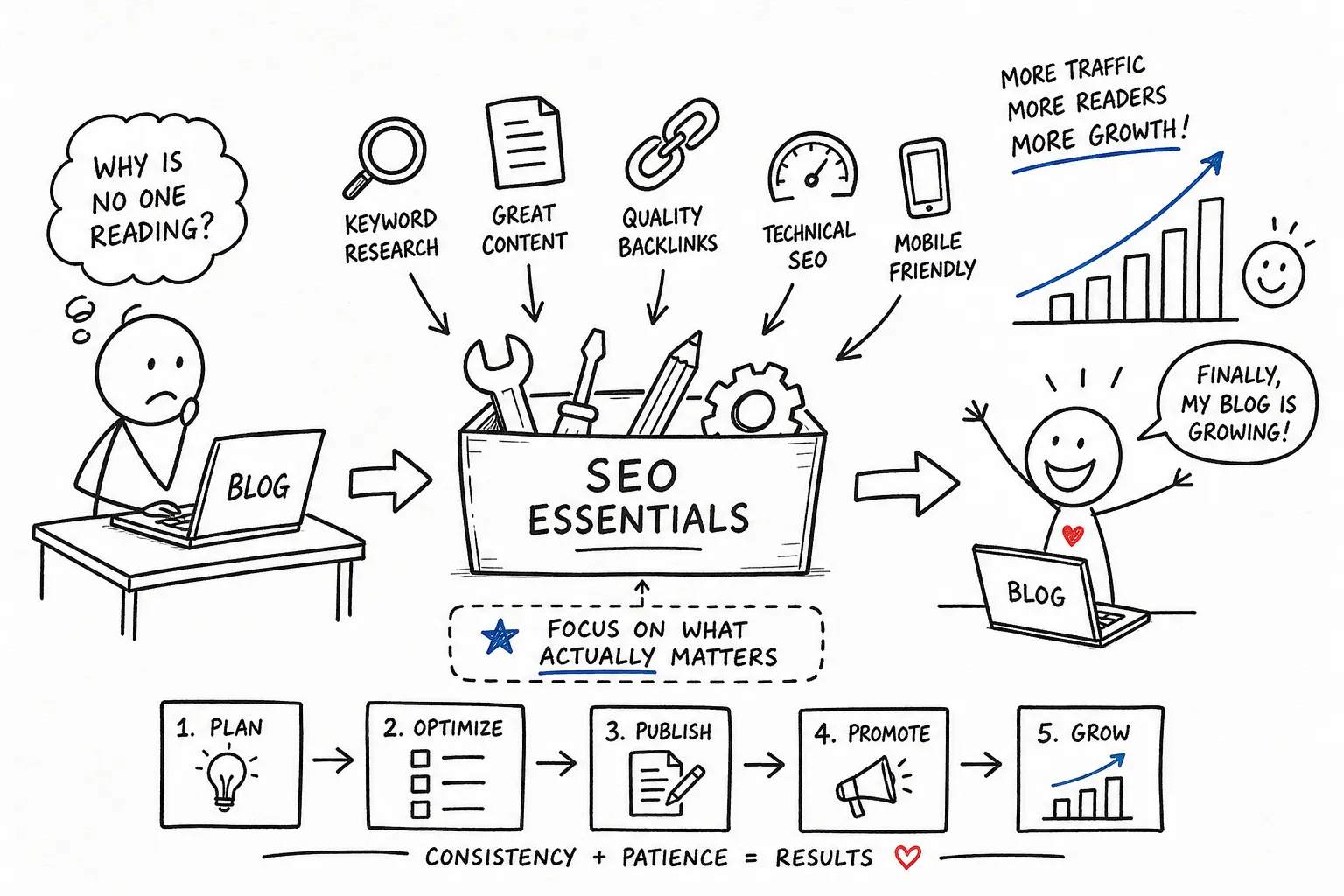
Many bloggers who aren’t growing share a familiar pattern. They have the tools: Semrush, Ahrefs, Yoast, maybe even a Google Search Console tab that’s been open for six months. But they don’t have results. The disconnect isn’t the data. It’s the execution, and that’s exactly what SEO services for bloggers are designed to close.
Publishing consistently without a clear ranking strategy is one of the most common traps in blogging. You’re creating content, but you’re not building traffic momentum. The pattern holds across content-first businesses: bloggers who finally break through aren’t the ones who found a better tool. They’re the ones who stopped guessing and started implementing. That’s the foundation Brandleap Agency builds every engagement on.
By the end of this article, you’ll know what SEO services for a content site actually deliver, what you should realistically pay, and exactly what questions to ask before signing anything. No vague advice. Just a clear decision framework you can act on today.
What DIY tools actually can’t do for your blog
The execution gap between insight and action
SEO tools surface problems. They don’t fix them. You can open PageSpeed Insights and see that your site loads in 6.2 seconds, but that doesn’t tell you which plugins to remove, how to configure your caching layer, or whether your hosting plan is the actual bottleneck. A professional brings prioritization and implementation, not just a list of issues to stare at.
Consider what happens during a technical audit: a crawl might surface dozens of errors across your WordPress blog, but an experienced professional knows which handful actually affect your rankings. The rest are noise. Without that judgment, you waste hours on fixes that move nothing while the real problems keep bleeding traffic. If you need a clear baseline definition of what external providers do, see this primer on what SEO services are.
Strategy work that requires human judgment
Keyword research in a tool gives you a spreadsheet. Keyword strategy gives you a publishing roadmap. Those are not the same thing. Matching search intent to the right content format, deciding when to update an existing post versus creating a new one, and building topical clusters that reinforce each other: these tasks largely require human judgment, although some tools can assist or automate parts of the workflow. Editorial experience is still what ties it together.
Link acquisition is another gap. No dashboard replaces the human relationships behind quality backlinks. Guest post placements and editorial mentions require actual communication with actual people. Bloggers who invest in the right SEO partner get both technical execution and strategic thinking working in parallel, and that combination is what compounds over time.
What SEO services for bloggers actually cover
Keyword research and content strategy
Professional keyword research goes beyond search volume. It maps intent, competition level, content format fit, and monetization potential for your specific niche. The deliverable isn’t a keyword list. It’s a content calendar built around topical clusters that reinforce your site’s authority. SEO content writing for blogs often means briefs, full outlines, or complete drafts written specifically to match ranking opportunity, not just what the writer finds interesting.
Technical SEO audits for WordPress blogs
WordPress creates predictable technical problems at scale. The most common include index bloat from tag, author, and date archives; duplicate URLs caused by multiple SEO plugins; sluggish Core Web Vitals; broken internal links; sitemap errors; and misconfigured robots.txt files. A technical audit surfaces these issues, but a managed blog SEO service actually fixes them and monitors for regression. Many DIY bloggers may be losing meaningful traffic due to these issues without realizing it. For an actionable checklist of common fixes, see this guide to technical SEO for WordPress.
On-page optimization and content refreshes
On-page work covers title tags, meta descriptions, heading hierarchy, image alt text, and internal link architecture. Equally valuable is identifying existing posts that rank on page two and pushing them to page one through targeted updates. Content refresh work is often faster ROI than publishing new posts from scratch, and it’s something most bloggers underutilize because their tools don’t make the opportunity obvious enough to act on.
Link building and authority development
Backlinks remain one of the strongest ranking signals, and for bloggers, the path usually runs through guest posts, editorial mentions, and niche-relevant outreach. What matters is relevance and domain authority, not raw link count. Building that kind of backlink profile requires outreach relationships and content assets that take dedicated time, time most independent bloggers simply don’t have.
SEO services for bloggers: pricing and packages
Freelancers and productized packages
Freelancers typically charge $75 to $100 per hour for audits and consulting work. Monthly retainers for ongoing blog SEO average around $1,300 to $1,500, according to industry pricing surveys on SEO services pricing. Productized packages (fixed-scope monthly services) usually fall between $500 and $1,500 per month depending on deliverables and content volume. These options work well for bloggers with tighter budgets who need specific work done. Think a technical audit, a content strategy sprint, or a batch of post optimizations. No full-service commitment required. For tips on stretching a smaller budget, see our guide on How to Find Affordable SEO services for Small Business, 2026.
Full-service agency retainers
Agencies that handle both content creation and technical SEO, particularly those managing publishing cadence alongside site health, typically range from $2,500 to $5,000 per month for a mid-tier blog program. Competitive niches or high-output content programs can push to $10,000 per month or more. The real value at this level isn’t just more deliverables. It’s having a single team accountable for both content quality and technical performance simultaneously.
That integrated approach is central to how Brandleap Agency works with content-first businesses: SEO strategy and content production are handled together, not as separate services that occasionally check in with each other. If you’re spending under $1,500 per month, be realistic about scope. Full audits, link building, and monthly SEO service don’t fit into that budget at the same time.
What ROI and timeline you should realistically expect
The compounding curve of SEO for content sites
The SEO timeline for a blog follows a predictable curve. Months zero through three are foundation work: technical fixes, content architecture, keyword research, and on-page cleanup. You won’t see meaningful traffic movement yet, and that’s normal. Months three through six bring the first ranking signals on lower-competition posts and early traffic gains. By months six through twelve, you’re in the most common window for measurable positive ROI and break-even on your investment.
Beyond twelve months is where blogging SEO gets genuinely powerful. Evergreen content accumulates links and traffic passively. Topical clusters reinforce each other. Returns scale without proportional cost increases. When campaigns are executed with discipline, SEO ROI can reach into the hundreds of percent over a sustained period, see aggregated SEO ROI statistics for industry context. That payoff doesn’t arrive at month three. It reflects what happens when you stay consistent long enough for the compounding to kick in.
How to measure ROI specifically for a blog
The formula is straightforward: [(SEO revenue minus SEO cost) divided by SEO cost] x 100. For bloggers, “revenue” means ad income, affiliate commissions, email subscribers who convert to buyers, sponsored post opportunities, or digital product sales attributed to organic traffic. A well-run blog SEO program in a content-friendly niche can realistically reach break-even within twelve months and deliver meaningful returns by month eighteen, though actual timing varies by niche, site age, and investment level.
- Organic sessions and users tracked in GA4
- Impressions, clicks, and average position in Google Search Console
- Referring domain growth from relevant, niche-specific sites
- Conversions from organic: affiliate clicks, signups, product sales
- Index coverage health and Core Web Vitals trends over time
How to vet a blog SEO agency before you sign anything
The right questions to ask on a discovery call
Four questions cut through most agency sales conversations faster than anything else. First: “What’s your process for deciding whether to update an existing post versus create a new one?” This tells you whether they understand content refresh strategy or just sell new content volume. Second: “Who does the actual work, and can I speak with that person before we start?” This tells you whether the strategist and the executor are the same person or whether you’re buying from a salesperson who hands you off to a junior contractor.
Third: “Can you show me a case study from a blog in a similar niche with before and after organic traffic metrics?” Real experience shows in real numbers. Theoretical experience shows in vague success stories. Fourth: “What does reporting look like, and which KPIs will we review monthly?” An agency that ties work to outcomes answers this confidently. One that focuses only on deliverables will tell you how many posts they wrote, not what those posts produced. For additional suggested prompts and a checklist of questions, see this list of questions to ask local SEO agencies.
Red flags that disqualify a provider immediately
Some signals aren’t yellow flags. They’re stop signs. Walk away from any provider that guarantees rankings within 30 to 60 days. That’s not how search engines work, and any agency claiming otherwise is either uninformed or deliberately misleading. The same applies to vague strategy with no documented deliverables, refusal to share case studies or sample reports, and reporting that connects only to keyword rankings without ever tying back to traffic or revenue.
One more non-negotiable: ownership. Before you sign anything, confirm in writing that you own all content, all accounts, and all data if the engagement ends. Some providers retain ownership of deliverables or lock you out of accounts when a contract terminates. A legitimate partner has no reason to hold your assets hostage.
The path forward for your blog
The gap between a blog that plateaus and one that keeps growing isn’t information. You already have information. The gap is implementation: a clear strategy, consistent technical maintenance, and someone accountable for both. That’s what professional SEO services for bloggers deliver that no tool subscription ever will.
You now have a complete framework. You know the four core deliverables, the realistic pricing tiers from freelancers through full-service agencies, and the vetting questions that separate credible partners from confident salespeople. You also know that six to twelve months for measurable ROI isn’t slow. It’s the standard timeline for SEO done correctly. Anyone promising faster is selling something you don’t want to buy.
The framework is already in your hands. Take the vetting questions from this article into your next discovery call, or reach out to Brandleap Agency for a growth audit tailored to your blog’s current situation, or explore our resell SEO services if you’re an agency or consultant looking to white-label solutions. Sustainable organic traffic isn’t a shortcut. It’s a strategy built through disciplined, consistent execution.