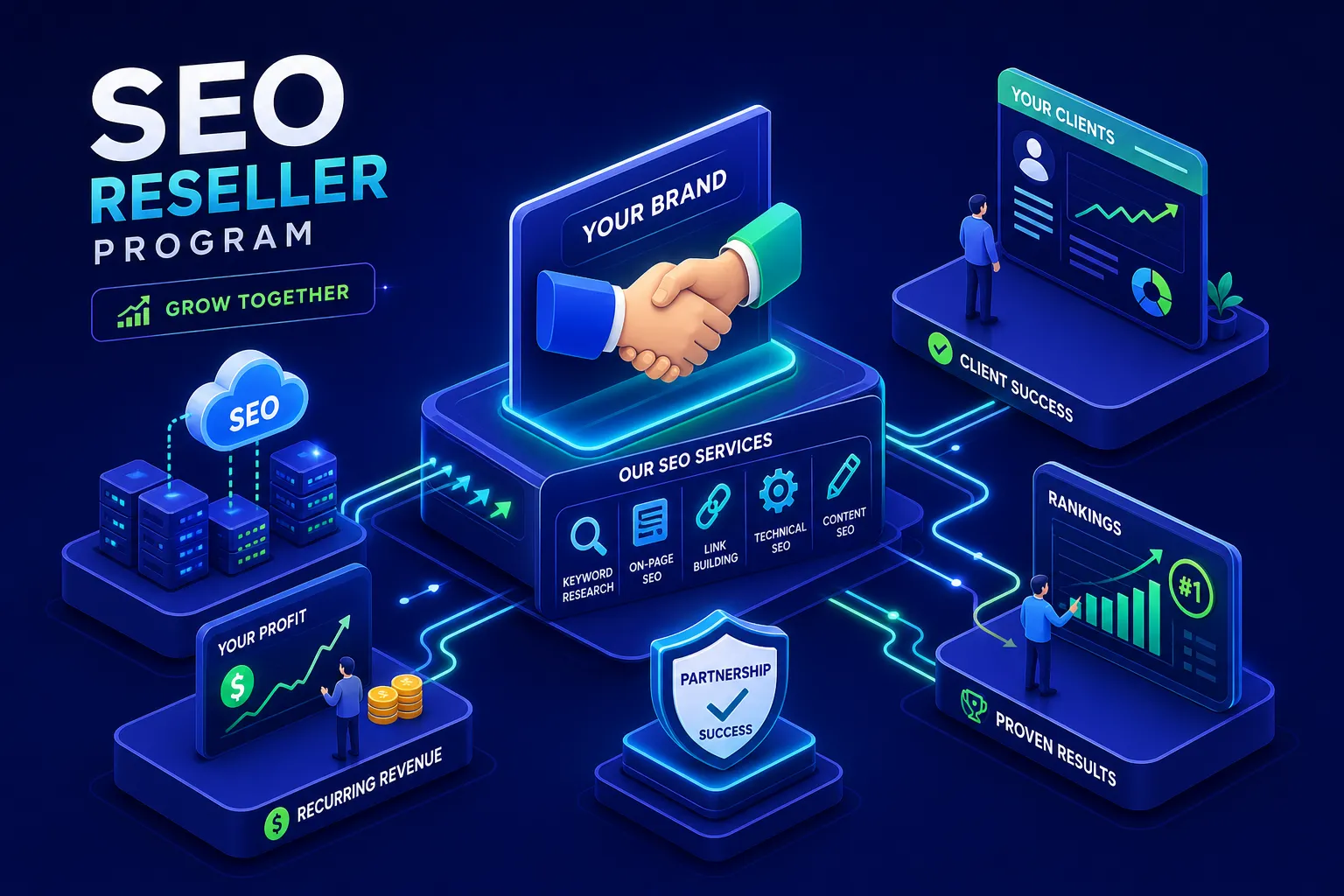
Most boutique agencies hit the same wall. Clients ask for SEO. The agency wants to say yes. But building an in-house SEO team, with specialists, tools, content writers, and link builders, costs more than the revenue that team would initially generate. For many smaller agencies, the economics simply don’t add up. An SEO service reseller program solves that problem cleanly: you sell SEO under your own brand, manage the client relationship, and a fulfillment partner executes the actual work behind the scenes.
The client never sees the fulfillment partner’s name. Your agency looks like a full-service shop. This is the model Brandleap Agency uses to support partner agencies, handling the SEO execution so agencies can focus on what they do best: client relationships and growth.
This guide covers everything you need to evaluate the model honestly, price your services correctly, vet a fulfillment partner, and launch an SEO reseller program that holds up at scale.
How an SEO Service Reseller Program Actually Works
The white-label fulfillment model explained
The structure involves three parties: your end client, your agency as the reseller, and the SEO fulfillment partner working in the background. Your agency signs the client, manages every conversation, and delivers branded reports. The fulfillment partner executes the SEO work. No deliverable, no report, and no communication ever references the fulfillment partner’s name.
This model exists because specialization is expensive. Technical SEO, content strategy, link building, and local optimization each require dedicated expertise and tooling. An SEO reseller program lets agencies offer all of it without hiring four specialists and paying for six enterprise software subscriptions. The agency captures margin on fulfillment it doesn’t have to staff.
What you own vs. what the partner delivers
The agency owns everything client-facing: pricing, strategy conversations, account management, and communication. If a client calls with a question, the agency answers it. If a campaign needs a new direction, the agency leads that conversation. The fulfillment partner stays invisible.
On the fulfillment side, the partner owns execution: technical audits, on-page fixes, content production, link building, local optimization, and the underlying reporting data. Before outsourcing, an agency can easily spend significant account management hours each month trying to deliver fragmented SEO work. After, the agency delivers a seamless service while the partner works quietly in the background, and that same time gets redirected toward building client relationships instead.
Margins and Pricing: What to Realistically Expect in 2026
Pricing tiers across the reseller market
White-label SEO fulfillment generally falls into three pricing bands. Entry-level managed SEO runs roughly $250 to $500 per month at wholesale. Mid-tier local SEO packages run $350 to $1,500 per month. Enterprise programs start around $5,000 per month and scale from there depending on scope and market competition.
Some providers tack on a monthly access or membership fee in the $5 to $42 range, treat that as noise, not a real program cost. The actual economics come from the wholesale cost of deliverables and what you charge your clients for them. Don’t evaluate an SEO reseller program based on its membership fee.
Running an SEO service reseller offering: hitting a 40% to 60% gross margin target
The math is straightforward. If you pay $500 per month wholesale and charge your client $900 to $1,200, your gross margin lands between 44% and 58%. The 40% to 60% range is a realistic target for a well-structured reseller program. Many agencies operating in this space report a median around 55% before account management time is factored in.
Margins thinner than 40% often indicate one of two problems: your client contracts are underpriced or your fulfillment partner is overpriced. Price confidently by starting with the deliverable cost, building in your margin target, and then checking against what a client of that size reasonably pays for SEO in their market. Don’t anchor to what competitors charge. Anchor to the value the work delivers.
What a Solid White-Label SEO Package Should Include
The five core deliverable categories
Every reputable white-label SEO package covers five areas:
- Technical SEO, audits and structural fixes, the foundation without which everything else underperforms
- Content creation and optimization, the pages and signals that search engines reward
- Link building, the off-page authority that competitive rankings require
- Local SEO, Google Business Profile management, citation consistency, and local landing pages for service-area businesses
- Branded performance reporting, data the client can read and the agency can use to justify the retainer
A gap in any one of these categories tells you something about the fulfillment partner’s actual capabilities. Missing link building means competitive rankings are out of reach in most markets. Weak or absent technical SEO quietly undermines everything built on top of it.
Red flags in a thin or incomplete package
Some warning signs are easier to spot than others. Packages that skip technical audits entirely and jump straight to content are a concern, and so is “content creation” that relies on AI-generated articles with no editorial review or topical strategy. The more serious red flag is link building described only in vague terms, “outreach campaigns” with no explanation of domain quality criteria and no documentation of what gets rejected. Vagueness there almost always signals low-quality, high-risk work.
Reporting is where weak fulfillment partners expose themselves fastest. A PDF showing keyword rankings and traffic trends without business context is not reporting. A strong fulfillment partner connects deliverables to outcomes: rankings moving on revenue-generating pages, organic leads increasing, and content driving qualified traffic. Activity metrics without business context give your client nothing to hold onto when they’re deciding whether to renew.
How to Vet a White-Label SEO Fulfillment Partner
Questions to ask before signing anything
Go into every evaluation conversation with direct questions. What is the exact scope of deliverables at each pricing tier? Who handles communication and accountability if a client’s rankings drop? What is the revision policy for content and technical recommendations? Can you see sample deliverables and sample reports before committing? Are there references or case studies from current agency partners you can speak with directly?
These questions separate partners who know their operation from partners who know their sales pitch. A competent fulfillment partner answers all of them without hesitation. A weak one hedges, deflects, or gives vague answers about “customized solutions.”
SLAs, turnaround times, and quality guarantees to expect
Reputable partners acknowledge standard requests within one business day and deliver most routine deliverables, including on-page changes, content briefs, and audit summaries, within two to five business days. Critical issues like deindexing or severe canonicalization problems get a response within one to four hours. Larger technical projects like bulk redirects, schema implementation, or hreflang work are typically scoped in sprint cycles rather than single-day windows.
No honest SEO fulfillment partner guarantees specific ranking positions or traffic numbers. What they guarantee is process quality: defined delivery windows, documented QA review before anything reaches your clients, revision rights, and clear escalation procedures. Any partner promising guaranteed rankings is telling you they prioritize closing deals over being honest about how search works. Walk away.
Setting Up Client Onboarding, Reporting, and Your Reseller Operation
White-label reporting tools and client portals
Running a professional reseller SEO operation requires reporting infrastructure your clients trust. The two main categories are white-label reporting platforms and all-in-one reseller suites. Platforms like AgencyAnalytics, Swydo, and Whatagraph produce branded dashboards and scheduled reports that connect to your data sources automatically. Suites like Vendasta, GoHighLevel, and SuiteDash combine client portals with CRM, project management, and automation in one system.
The core workflow is the same regardless of which tool you use: connect data sources, standardize the metrics that matter to each client, configure automated report generation, and deliver everything through a portal under your agency’s domain and branding. Clients see your logo and your agency name. They never see the software vendor, the fulfillment partner, or anything that breaks the perception of a unified team delivering their results.
Retention and the business case for consistent delivery
In our experience working with agency partners, structured performance reporting and quarterly roadmaps correlate strongly with lower churn and longer client relationships. Agencies that have moved from ad-hoc updates to a defined reporting cadence report significant retention improvements, in some cases, annual churn dropping from over 40% to under 20% after outsourcing SEO delivery to a reliable fulfillment partner, and retention rates climbing from the mid-70s into the low 90s after structured white-label processes replaced inconsistent internal delivery.
The pattern holds: consistent delivery builds trust, and trust keeps clients. Boutique agencies lose clients most often not because the results are bad, but because the client doesn’t understand what’s happening and loses confidence. Branded deliverables, scheduled reporting, and a clear communication cadence fix that problem before it costs you a renewal.
Why Boutique Agencies Partner With Brandleap for White-Label SEO
What Brandleap brings to agency partners
Brandleap Agency built its white-label SEO program specifically for boutique agencies that need enterprise-level execution at pricing that works for their clients. Full-scope fulfillment covers technical audits, semantic SEO strategy, content, link building, and local optimization, all delivered under your agency’s brand with no reference to Brandleap anywhere the client can see.
The differentiator is semantic SEO. Some budget fulfillment providers treat SEO as a checklist: keywords, backlinks, and a few meta tags. Brandleap’s approach builds topical authority through structured content clusters, intent mapping, and entity optimization, the same strategic depth that enterprise agencies charge premium rates for. Agency partners consistently report that this gives them a stronger positioning story with their own clients and a meaningful edge over agencies using commodity fulfillment.
How to launch an SEO service reseller program with Brandleap
The first step is a straightforward conversation about your current client scope and pricing goals. From there, Brandleap walks you through sample deliverables and reporting formats so you can evaluate the quality before committing anything. Onboarding timelines are built around your client pipeline, coordinate with your dedicated contact to align the schedule to your actual needs rather than a generic rollout window.
The relationship is a partnership, not a vendor contract. Your agency keeps the client relationship and the revenue positioning. Brandleap handles the execution and the deliverables. Both sides grow when clients see results. If you’re ready to add SEO to your service menu or scale an existing offering without the overhead of an internal team, reach out to Brandleap to explore the white-label program.
The Bottom Line on Building a Reseller Offering
An SEO service reseller program gives boutique agencies a real path to offering SEO profitably, but only when three things align: the fulfillment partner is vetted properly, the margins are priced to protect the business, and the deliverables are comprehensive enough to actually move rankings and retain clients.
Agencies that get this right see better client retention, cleaner operations, and revenue growth that doesn’t require hiring faster than the agency can sustain. The model works because it separates client relationships and strategy, what agencies already do well, from SEO execution at scale, which takes years and real investment to build internally.
If you’re ready to launch or expand an SEO service reseller offering in 2026, Brandleap’s white-label SEO program is built around the kind of fulfillment quality that holds up under scrutiny and scales with your business. Get in touch to review deliverables, discuss pricing, and see if the partnership is a fit.