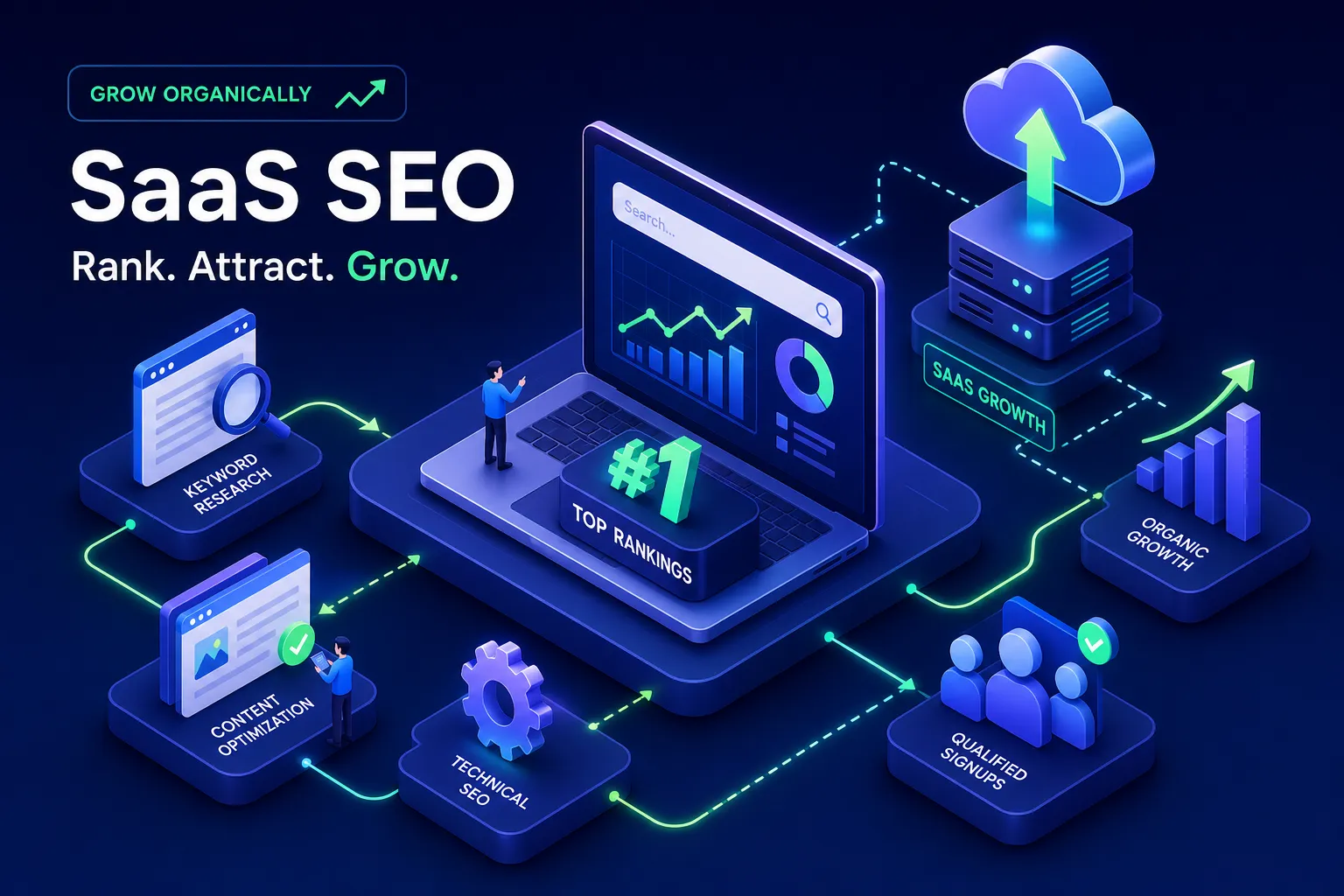
SEO for SaaS companies unlocks some of the highest organic growth potential of any business model. With compounding traffic, scalable content, and buyers who actively search for solutions before they purchase, SaaS sounds like a perfect match for SEO. Yet a common reason SaaS SEO underperforms is using tactics optimized for short-cycle e-commerce or lead-gen motions, playbooks never designed for long sales cycles, free-trial funnels, or product-led growth.
Organic growth for software companies is a distinct discipline with distinct rules. The buyer journey is longer, the keyword landscape is more competitive, and attribution gets messy fast. What works for a D2C brand or a local service business will not compound the way you need it to. This guide gives you a prioritized roadmap: keyword mapping by buyer stage, the technical blockers most SaaS sites quietly suffer from, content architecture that converts rather than just ranks, and the measurement stack that ties organic traffic to actual revenue. The guidance here reflects what the team at Brandleap Agency has observed across dozens of SaaS engagements, patterns that show up consistently regardless of category or company size.
Why SaaS makes SEO uniquely difficult
The long sales cycle problem
The standard SEO model (rank, get clicked, convert) breaks down for SaaS almost immediately. A buyer who discovers a blog post during the awareness stage may not sign up for a free trial for weeks or even multiple months afterward. By then, last-click attribution in GA4 has handed credit to a retargeting ad or a branded search, and the organic content that started the whole journey gets nothing. Teams lose confidence in the channel, cut content budgets, and wonder why pipeline isn’t growing. The fix isn’t a different tool; it’s shifting to multi-touch attribution and measuring organic’s contribution at the top and middle of the funnel, not just at the conversion event.
Competing in a keyword landscape built by giants
Most SaaS categories are dominated by well-funded incumbents with domain authority scores and content libraries that took years to build. A newer brand targeting “CRM software” or “project management tool” on day one is competing against companies with massive content budgets and established authority. The answer isn’t to avoid those terms forever; it’s to sequence your keyword strategy so you start where you can actually earn rankings, build authority incrementally, and graduate to broader category terms once your domain has the credibility to compete.
B2B SaaS SEO keyword mapping that matches how buyers actually search
Awareness, evaluation, and decision: the three keyword layers
Every SaaS keyword falls somewhere on the buyer-journey spectrum, and each stage calls for a different content format and a different conversion goal. At the awareness stage, buyers are problem-aware but solution-agnostic; they’re searching for things like “how to reduce customer churn” or “what is revenue intelligence software.” At the evaluation stage, they’ve identified the category and are now comparing options: “best email marketing platforms for small businesses” or “CRM platforms for remote teams.” At the decision stage, they’re close to purchase and searching with commercial intent: pricing pages, “[product] vs [competitor],” “[competitor] alternatives,” and free trial signup queries.
Each layer requires a distinct content format. Awareness content is educational: blog posts, research, how-to guides. Evaluation content is comparative: feature breakdowns, use-case pages, and category guides. Decision content is conversion-focused: alternative pages, comparison landing pages, and pricing pages that answer the exact question a buyer has right before they sign up. Publishing the right format for the wrong stage wastes both traffic and ranking potential.
Why bottom-funnel keywords deserve priority early
The instinct for most SaaS teams is to start with high-volume informational content because the traffic numbers look impressive. That instinct is usually wrong for a site with limited domain authority. Decision-stage keywords, pricing comparisons, alternative lists, and vs. pages, drive far more qualified signups per 100 visitors than awareness content does. The traffic volume is smaller, but the buyer is already sold on the category and just choosing between options. For a SaaS company building organic from scratch, ranking for 200 monthly searches on “[competitor] alternative” will move the revenue needle faster than ranking for 2,000 monthly searches on a broad informational query where the reader is still months away from a buying decision. Treat SaaS keyword research as a sequencing decision, not just a discovery task.
Technical SEO for SaaS companies: blockers quietly killing organic growth
JavaScript rendering, indexing, and canonicalization failures
Many SaaS marketing sites are built on React, Vue, or Next.js. When public marketing pages render key content client-side, Google often receives an empty HTML shell with no visible text, no internal links, and no metadata. This is one of the most damaging and most common technical SEO failures in the SaaS space, and it’s invisible unless you check the raw page source or use Search Console’s URL Inspection tool. The fix is server-side rendering or static site generation for all public-facing marketing pages, with the critical content, headings, and internal links present in the initial server response before any JavaScript executes.
Canonicalization deserves equal attention. URL parameter sprawl, www versus non-www inconsistencies, duplicate page templates from CMS configurations, and staging-domain leakage all split ranking signals across multiple URLs instead of concentrating them. Staging domains are a surprisingly common problem at growth-stage companies: a test environment gets indexed accidentally, creates a duplicate of the live site, and quietly drains crawl budget for months before anyone notices. Block staging environments behind authentication, add noindex directives as a secondary layer, and keep them out of sitemaps entirely.
Tracking demo requests and trial signups from organic traffic
Technical SEO for software companies isn’t only about crawlability. It also includes proper conversion instrumentation so organic traffic gets credited when it drives a demo request, a trial signup, or a meaningful pricing page visit. In GA4, this means creating dedicated key events, generate_lead for demo submissions and start_free_trial for signup completions, and firing them only on confirmed success, not on button clicks or form opens. Fire the event on a thank-you page load or a confirmed form-success trigger in Google Tag Manager, then mark it as a key event in GA4. A common mistake is letting form submissions fire incorrectly, which breaks the attribution chain and leaves organic conversions unreported in every revenue meeting.
Content strategy for SaaS companies: formats and architecture that convert, not just rank
Build bottom-funnel product pages before scaling content volume
The content hierarchy that works best for SEO-driven software growth starts with the pages closest to purchase: use-case pages, integration pages, feature pages, comparison pages, alternative pages, and pricing or demo pages. These pages convert the traffic they earn. Publishing 50 blog posts before building that product-page infrastructure is a strategic mistake because those posts have nowhere to send a buyer who is ready to act. Every piece of content needs a conversion destination, and that destination needs to exist before the traffic arrives.
The hub-and-spoke architecture makes this concrete. A pillar page, for example, a comprehensive guide covering every dimension of a core use case your product solves, links out to 8 to 12 supporting articles. Every supporting article links back toward the pillar and, more importantly, toward a product or conversion page. The content doesn’t just earn rankings in isolation; it functions as a pipeline, moving buyers from discovery toward a demo or a free trial signup.
Resource hubs and topical clusters that build lasting authority
Once the bottom-funnel foundation is in place, a resource hub earns top-of-funnel traffic that builds domain authority and fills the pipeline with earlier-stage prospects. The right content format depends on where the buyer sits: educational blog posts and original research for TOFU, comparison guides and webinars for MOFU, and case studies or ROI calculators for BOFU. The architecture should map directly back to the keyword layers covered earlier, every piece of content should serve a buyer stage and link toward a conversion path. Content that exists as a standalone traffic play, with no connection to a product page or a commercial intent keyword, builds traffic metrics but rarely builds revenue.
Measuring organic pipeline from first click to closed revenue
The SaaS SEO measurement stack
Connecting organic traffic to actual pipeline requires a deliberate tool stack working together. Google Search Console provides query-level ranking and click data. GA4 tracks on-site behavior and conversion events. Ahrefs or Semrush handles keyword tracking, rank monitoring, and competitive intelligence. HubSpot or Salesforce is the source of truth for pipeline stage and closed-won revenue. GA4 last-touch attribution alone will consistently understate organic’s contribution in long sales cycles; it credits the last channel before conversion rather than the content that initiated the journey. CRM-based first-touch attribution alongside GA4 gives a more accurate picture of how organic is actually performing.
The funnel dashboard that executives actually trust
A practical SaaS SEO dashboard follows the funnel: organic sessions, leads and MQLs, SQLs, opportunities, and closed-won revenue, each broken down by page type, keyword intent group, and content cluster. Looker Studio is a commonly used presentation layer because it pulls simultaneously from GA4, Search Console, and CRM data into a single view that leadership can act on. As calibration benchmarks: organic visitor-to-trial conversion for B2B SaaS typically lands between 3% and 5% for free-trial products, trial-to-paid runs 15% to 25% for opt-in trials, and organic visitor-to-lead rates commonly fall in the 1.9% to 2.6% range. If your numbers are well below those ranges, the problem is usually traffic quality, a weak conversion page, or attribution gaps, each of which points to a specific fix.
When to bring in a SaaS SEO specialist
The signals that it’s time to stop going it alone
There are clear inflection points where DIY SaaS SEO stops being cost-effective. When technical debt accumulates faster than your team can resolve it, when content is publishing consistently but rankings aren’t moving, or when your pipeline dashboard shows organic sessions growing while organic-sourced revenue stays flat, those are signals that the strategy or the execution has a structural gap. None of these problems resolve themselves through more content volume alone.
What a complete SaaS SEO program actually covers in 2026
SEO for SaaS companies in 2026 goes well beyond keyword research and link building. Buyers are increasingly using AI-powered tools like ChatGPT, Gemini, and Perplexity to research software before they ever open a traditional search results page, and ranking in Google doesn’t guarantee you appear in those AI-generated answers. AEO (Answer Engine Optimization) and LLM optimization are now integral to a complete organic growth strategy, structuring content so AI systems can extract, cite, and surface your brand alongside traditional search rankings.
Brandleap Agency’s approach to SaaS organic growth covers this next-generation search layer alongside technical SEO, content strategy, and conversion-focused web development, all under one roof, led by senior strategists rather than delegated to junior staff. For SaaS companies that need organic to compound rather than plateau, that integrated model eliminates the coordination overhead of managing multiple vendors while keeping the strategy aligned from technical foundation to pipeline attribution.
Build it as a system, not a campaign
SEO rewards SaaS companies that treat it as a business system rather than a marketing tactic. Keyword mapping, technical discipline, content architecture, and pipeline attribution have to work together for organic to become a reliable revenue channel. When any one of those layers is missing, ranking signals Google can’t read, content that doesn’t convert, attribution that under-credits the channel, the whole system underperforms relative to its potential.
As AI-powered search continues to reshape how buyers discover software, the SaaS brands that invest in AEO and LLM optimization alongside traditional organic search will build a compounding visibility advantage that competitors playing by the old rules won’t be able to replicate quickly. Start by auditing your current setup against the framework in this article: check your rendering configuration, map your existing content to buyer stages, confirm your GA4 conversion events are firing correctly, and identify which BOFU pages are missing from your architecture. If you want senior-level guidance on SEO for SaaS companies without building a large in-house team, Brandleap Agency can help you build the system that turns organic into a compounding revenue channel with predictable attribution.