If you’re hiring an SEO company in Australia, you’ve already figured out that this isn’t a market where you can paste a U.S. strategy and hit publish. The search landscape has distinct local signals, geo-trust preferences, and behavioral patterns that require a specialist approach. Whether you’re an Australian business fighting for local rankings or a U.S. company entering the AU market, choosing the right search optimization partner determines whether you gain ground or burn budget. At Brandleap, we’ve worked on cross-market campaigns spanning both the U.S. and Australian markets long enough to know what separates a credible AU agency from one recycling a generic playbook. This guide walks you through exactly what services to expect, what you should pay, and the questions that reveal whether an agency actually knows the AU market or just claims to.
How Australia’s search landscape differs from other markets
Why .com.au domains still carry local trust signals
Google’s algorithm in Australia places measurable trust in country-code top-level domains, particularly for queries with local commercial intent. Unlike the U.S. market where a .com domain dominates, Google’s local interpretation of authority in Australia associates .com.au with geographic relevance and business legitimacy. This doesn’t mean a .com site can’t rank well in Australia, it can, with the right signals in place. But any competent SEO company in Australia should factor domain choice into their early recommendations, not treat it as an afterthought.
The role of Australian hosting and geographic signals
Google Search Console’s geographic targeting settings and your domain choice, particularly a .com.au ccTLD, are the direct geotargeting signals that matter most in the AU market. Hosting location doesn’t function as a direct signal for how Google interprets geographic targeting, but it does reduce latency for Australian users, which supports Core Web Vitals scores and session behavior. These performance factors can indirectly affect rankings, so local hosting remains a worthwhile consideration. According to data aggregated by Statcounter, Google holds roughly 88, 94% of Australia’s search engine market share depending on the dataset, which means optimizing for Google’s AU-specific signals is where the real leverage lives. Skipping these configuration steps can delay measurable progress and reduce early campaign effectiveness, something a capable SEO company in Australia should address before any content or links enter the picture.
Core services any SEO company in Australia should deliver
Technical SEO and site health fundamentals
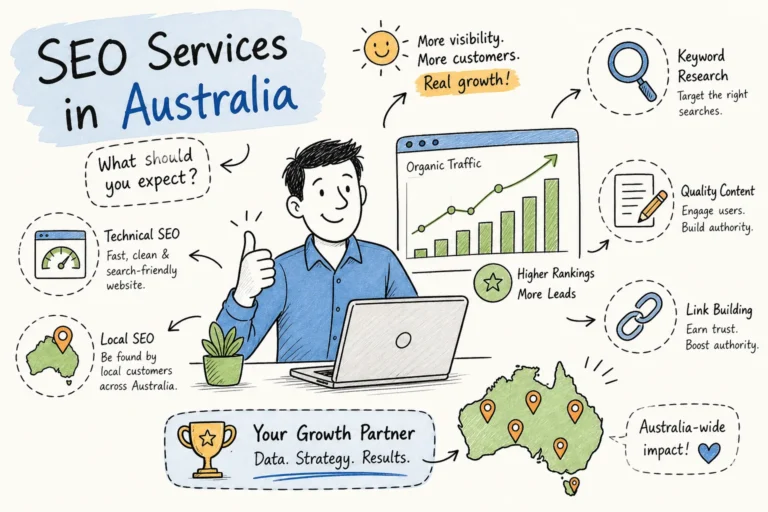
Technical SEO is the foundation. No credible search optimization agency in Australia should touch content or links before completing a thorough technical audit. That audit should cover crawlability, indexation errors, Core Web Vitals, page speed (critical given Australia’s mobile-first browsing habits), internal link architecture, and schema markup. On a monthly basis, you should receive documented progress on technical fixes, not just a report showing which issues still exist. If an agency jumps straight to keyword rankings without addressing site health, that signals a templated approach, not a strategic one.
Local SEO and Google Business Profile management
Local SEO in Australia centers on Google Business Profile, NAP consistency across AU business directories, and suburb-level keyword targeting. The key directories for citation building include Yellow Pages Australia, True Local, Hotfrog, StartLocal, and Yelp Australia, with industry-specific directories like hipages for trades or HealthEngine for healthcare adding additional relevance. For multi-location or service-area businesses, local citation work at this level is often an important and fast source of qualified organic leads, depending on category and competition. A strong local SEO package goes well beyond setting up a GBP listing; it should include citation audits, review strategy, and geo-targeted content mapped to the suburbs or regions you serve.
Content strategy aligned with Australian search intent
Australian search intent reflects different terminology, seasonal patterns, and buying cycles compared to U.S. searches. Summer falls in December, the financial year runs July to June, and product terminology often differs from American equivalents. A qualified Australian SEO company should conduct intent mapping specific to the AU market rather than repurposing a U.S. content calendar. Monthly content deliverables should include keyword-to-page mapping, topical cluster development, and briefs that account for how Australian buyers phrase their queries, not how their American counterparts do.
What Australian SEO pricing actually looks like in 2026
Monthly retainer bands by business size
The monthly retainer is the dominant pricing model across Australian SEO agencies, and the spectrum is wide. Entry-level local work runs approximately A$500, A$1,500, covering basic GBP management and limited on-page optimization. SMB growth retainers sit between A$2,500, A$5,000 and typically include technical work, content creation, and light link building. National or competitive campaigns run A$5,000, A$10,000+, often covering multi-location businesses, e-commerce, or high-competition niches. Enterprise engagements start around A$10,000, A$15,000 per month and include dedicated team resources, advanced technical SEO, digital PR, and developer support. These figures are drawn from aggregated 2026 Australian SEO market data; the pricing tier you choose should map to the scope of work, not just the size of the agency’s website.
Contract lengths and what “no lock-in” really means
Most Australian SEO agencies structure contracts around three common minimum terms: three months for trial-style engagements; six months for established retainers; and twelve months for broader strategic campaigns. Many agencies market “no lock-in” contracts, which typically means month-to-month billing after an initial minimum period, often paired with a 30-day exit clause or quarterly rolling terms. That flexibility is real, but it doesn’t change the timeline SEO requires. Organic results compound over time, and a realistic six-month runway is the minimum before meaningful movement appears in competitive markets. Sign for flexibility if you need it, but plan for at least six months regardless of what the contract allows.
Setting up international SEO for the Australian market
Hreflang, ccTLD, and geographic targeting explained
For U.S. companies targeting Australia or AU businesses expanding globally, international SEO architecture is where campaigns succeed or stall. Three structural options exist: a .com.au ccTLD, a subfolder structure like domain.com/au/, or subdomain targeting. Hreflang tags signal language and regional targeting to Google; for Australian English audiences, the correct tag is hreflang="en-AU", paired with self-referencing tags and reciprocal links across all variants. In our experience at Brandleap, misconfigured hreflang is one of the most common technical errors we encounter in cross-market campaigns, often causing the wrong page to rank in the wrong country or triggering duplicate content flags that suppress both versions. Google’s own hreflang documentation outlines the exact tag placement and structure requirements for anyone working through this setup.
How cross-market campaigns require a different kind of partner
Most SEO consultants operating in Australia are built for local-only work. Running a campaign that needs to perform in both the U.S. and Australian markets simultaneously requires international SEO architecture, separate content strategies, and unified reporting across markets. That’s a fundamentally different scope from a single-market local campaign. At Brandleap, our international SEO services are built to address this directly: structured campaigns that help U.S. businesses enter AU search markets and AU businesses gain visibility in North America, without the duplicate content penalties or hreflang conflicts that sink cross-market programs. If your business operates across both markets, the setup matters as much as the content.
Choosing the right SEO company in Australia: questions to ask before you commit
Vetting strategy, ethics, and link-building practices
The questions you ask on a discovery call reveal more than any agency proposal will. Start with link building: ask specifically how they build backlinks and what kinds of links they pursue. Credible agencies will describe earned links through content outreach, digital PR, and editorial partnerships. Vague answers or references to “high DA directories” without specifics are red flags. Also ask whether any client site they’ve worked on has ever been penalized, and how they handled it. A capable search optimization partner gives direct, specific answers to these questions, not reassurances about their “white hat approach.”
What accountability and reporting should look like
Reporting questions are equally important. Ask how often you’ll receive performance reviews, what KPIs they track beyond rankings, and who will manage your account day-to-day. Strong Australian digital marketing agencies define success in terms of organic traffic, qualified leads, and conversions, not just keyword positions. A good monthly report should cover actions taken, results against targets, and the specific work planned for the following month. A weak report shows a rankings table with no context, no attribution data, and no explanation of what changed or why. That distinction tells you whether you’re buying strategy or just renting a template.
Finding the right fit takes the right filter
The right SEO company in Australia understands the AU search landscape, configures international SEO correctly for businesses operating across markets, prices their work transparently against current market rates, and reports on outcomes tied to measurable business growth. Use the pricing benchmarks and vetting questions from this guide as your baseline filter before you start any discovery calls.
If you’re running a cross-market campaign between Australia and the U.S., the setup is more nuanced than most locally focused agencies are built to handle. That’s the gap Brandleap’s international SEO services are designed to close, structured campaigns that perform in both markets without the technical conflicts that undermine cross-market programs. Start with the right questions, and the right partner becomes much easier to identify.

BrandLeap Agency & BrandLeap Fashion | Founder & CEO
Mithun is an experienced SEO consultant recognized for helping businesses improve their digital presence through technical SEO, content optimization, and sustainable organic growth strategies. Working in the digital marketing industry since 2019, he has developed expertise in increasing search visibility, driving targeted traffic, and building long-term growth through data-driven SEO solutions. He has worked with businesses across multiple industries, helping brands strengthen their online authority and achieve measurable growth results.