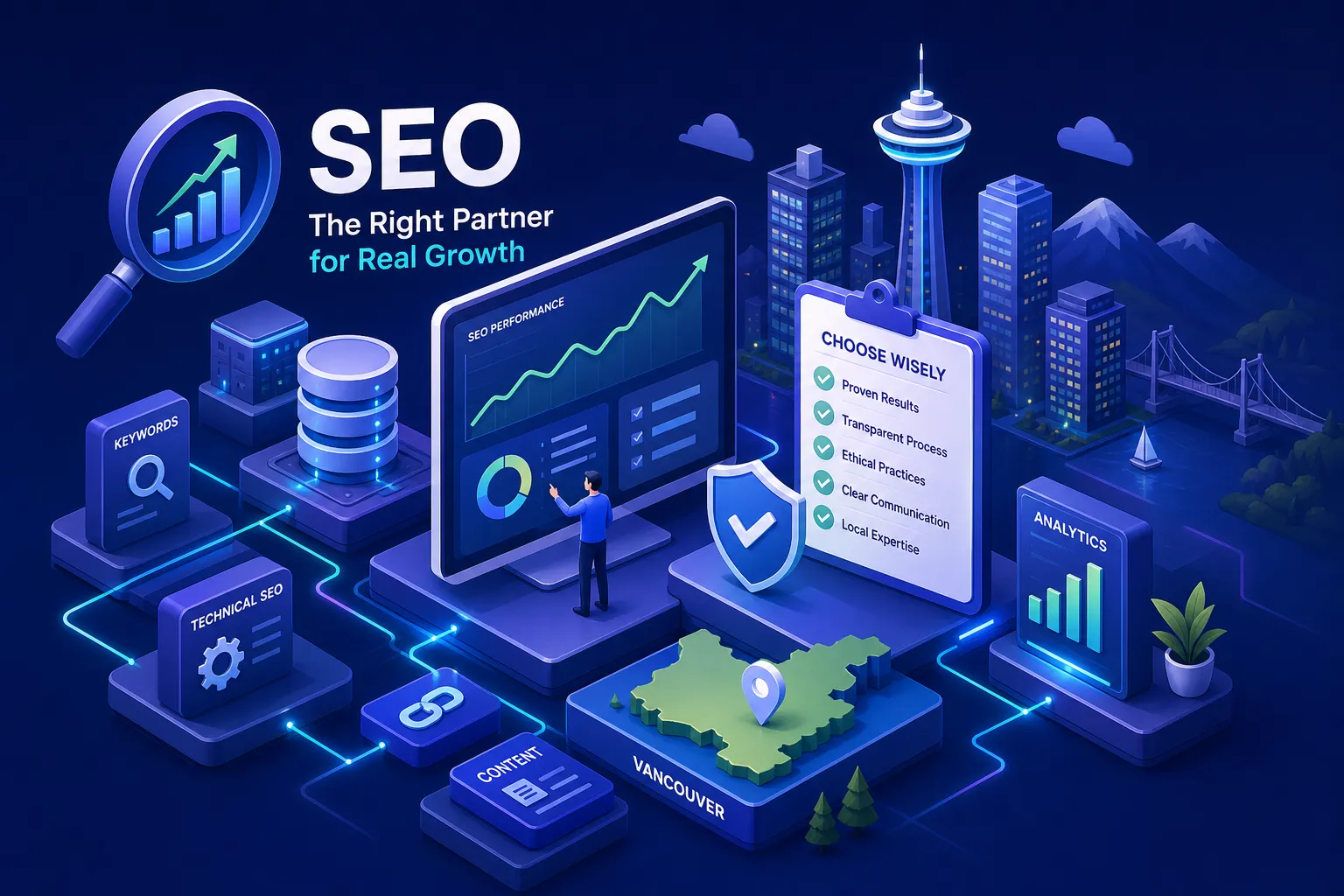
Finding the right SEO agency in Vancouver starts with a simple reframe: stop filtering by location and start filtering by results. Many Vancouver business owners default to proximity when searching for an SEO firm, prioritizing a local address over demonstrated strategic ability. That’s a costly shortcut. The market for professional SEO services has expanded well beyond city limits, and the strongest partner for your business may or may not have a downtown office. What matters is whether they can rank businesses like yours in competitive markets.
This guide walks you through exactly what to look for when hiring a Vancouver SEO company: how to read strategy pitches critically, what pricing actually covers at each tier, and the specific proof points that separate a high-performance partner from one that will burn six months of your budget chasing vanity metrics. By the end, you’ll have a clear shortlist framework and the right questions to get an accurate proposal.
1. What separates a real SEO strategy from a list of deliverables
Strategy-first vs. deliverable-first agencies
An agency that leads with “we’ll publish four blog posts per month and build 20 backlinks” is selling you a deliverable, not a strategy. A genuine SEO engagement starts with understanding your competitive environment, your target search intent, and the revenue outcome you’re trying to drive. The tactics follow from that, not the other way around. Ask any agency you’re considering to walk you through how they would approach your specific market before they pitch you a package.
The difference shows up clearly once work begins. A deliverable-first agency checks boxes and sends you a report. A strategy-first agency ties every action back to a defined goal, adjusts when data shifts, and measures success by business outcomes rather than activity volume. That distinction is worth pressing on hard during every sales conversation.
The communication standard you should demand from day one
Consistent, proactive communication is a non-negotiable signal of a high-quality partner. Strong agencies set clear cadences: monthly reporting calls, written updates tied to business outcomes, and a point of contact who actually knows your account. If an agency’s communication process sounds vague or optional during the sales process, it won’t improve once you’ve signed the contract.
Ask how often you’ll receive reports, what format those reports take, and whether they’ll include context alongside raw numbers. Any agency worth hiring should be able to answer those questions without hesitation. Communication drying up after onboarding is a commonly reported complaint on review platforms like Clutch and UpCity, and one of the clearest warning signs you can catch before signing.
2. How to verify an agency’s track record before you commit
Reading case studies the right way
Case studies tell you more than testimonials, but only if they include hard numbers. Look for specifics: organic traffic growth percentages, keyword ranking improvements, lead volume changes, or revenue impact within a defined timeframe. Several Vancouver-area agencies publish quantified results, including dNOVO Group’s claimed average of 727% traffic increase per client, Setsail’s documented 200% booking increases, and Thrive reporting 664% organic traffic lifts. Numbers tied to a clear timeframe and a defined starting point are the only case study metrics worth trusting.
Be skeptical of case studies that show only percentage improvements without a baseline. A 300% traffic increase sounds impressive; a 300% increase from 50 visitors per month tells a different story. Strong agencies show starting conditions, the work completed, and the outcome within a specific window, typically six to twelve months.
Certifications and awards: what they signal (and what they don’t)
Google Partner status confirms an agency follows Google’s approved methodologies and has verified spend performance across accounts. Premier Google Partner status is a higher bar. Clutch and UpCity awards, such as the 2026 Top SEO Company designation, reflect verified client reviews at scale. These credentials matter, but treat them as a floor, not a ceiling.
An agency with strong credentials and weak case studies is still a weak agency. Credentials confirm process quality; case studies confirm outcome quality. You need both before committing to any engagement.
3. SEO agency Vancouver pricing for 2026: what’s normal and what should concern you
Monthly retainer tiers and what each level actually delivers
Vancouver SEO pricing in 2026 ranges across clear tiers based on scope and competition level. Entry-level retainers typically run $800 to $1,500 CAD per month and cover basic local SEO and Google Business Profile management. The most common tier for small-to-midsize businesses falls in the $1,500 to $4,000 per month range and includes on-page optimization, technical work, content creation, and foundational link building.
Competitive local campaigns and growth-focused programs generally sit between $4,000 and $8,000 per month, while enterprise and e-commerce programs often start at $8,000 and scale from there. The Vancouver market average for a professional engagement runs around $3,500 per month. Typical SEO results take four to six months to materialize in measurable form. Early signals like improved crawlability and long-tail keyword movement can appear within the first three months, but meaningful organic traffic growth and lead generation usually follow in months four through six. Budget planning should account for that runway from the start.
Pricing structures that should make you pause
An agency that can’t explain what’s included at each price point is selling you ambiguity. Pricing that sits significantly below market rate usually signals offshore execution, minimal strategic input, or a high-churn account model designed to collect retainers without delivering sustained growth. Agencies charging $250 to $500 per month are typically covering maintenance at best.
Lock-in contracts without performance milestones are also a structural red flag worth pressing on before you sign. Watch for 12-month minimums with no exit clause, auto-renewal terms requiring 90-day notice, and contracts where the agency retains ownership of your content and analytics access if you cancel. A trustworthy agency offers flexible terms because they’re confident in their results.
4. Matching your business type to the right SEO specialty
Local SEO, e-commerce SEO, and technical SEO: which one you actually need
A local service business, whether that’s a contractor, dental clinic, or law firm, needs local pack visibility, Google Business Profile optimization, and citation consistency. That’s a fundamentally different engagement than an e-commerce brand that needs product schema, category architecture, and crawl efficiency. Choosing an agency that specializes in your category matters far more than choosing one that’s physically nearby.
Among Vancouver digital marketing agencies and SEO specialists, some firms focus on local and e-commerce work, while others lead with audit-heavy technical methodologies. Enterprise-scale work typically demands larger operations with the infrastructure to match. Knowing your category first makes the shortlisting process dramatically faster.
Why your best SEO partner might not be in your zip code
The strongest signal of a capable agency is their results across markets, not their mailing address. Remote-first agencies can serve clients across North America because strong SEO strategy adapts to any competitive market regardless of geography. The same analytical rigor that ranks a law firm in Vancouver can rank a contractor in Dallas or an e-commerce brand in Boston.
When capability, communication, and accountability travel across borders without friction, the local-first filter becomes a limiting one. Industry experience in your vertical consistently outweighs geographic proximity as a performance predictor. The question to ask isn’t “where are they located?” It’s “have they ranked businesses like mine in competitive markets?” That single shift in criteria will change every conversation you have with a prospective agency.
5. The exact questions to ask every agency before you sign
Questions about strategy, deliverables, and timelines
Before any proposal becomes a contract, ask the agency to walk you through their onboarding process and how they build their first 90-day plan. Ask specifically how they determine which keywords to target and how those tie to your revenue goals. Ask what happens if the strategy isn’t producing results after six months: do they iterate, or do they renew? The answers reveal whether they think in terms of your business outcomes or their own deliverable checklist.
Also ask whether they currently work with any of your direct competitors. A reputable agency will either have a conflict-of-interest policy or be transparent about how they manage competitive accounts. An evasive answer here is worth noting before you commit.
Questions about reporting, ownership, and accountability
Ask who owns the content, the links, and the data if you cancel. Ask what their reporting format looks like and whether you’ll get direct access to your own Google Analytics and Search Console accounts from day one. A professional SEO reporting dashboard should include organic conversions, traffic growth with year-over-year context, keyword ranking movement, technical health indicators, and backlink profile changes. If an agency can’t describe what their monthly report covers, that’s a problem.
Agencies that withhold data or make it difficult to leave have a structural incentive to underperform. Clear reporting, data ownership, and transparent performance benchmarks aren’t premium features; they’re the baseline for any professional engagement worth entering. Push on those terms before you sign, not after.
Build your shortlist with clear criteria, not geography
Choosing the right SEO agency in Vancouver comes down to three filters: genuine strategy, verifiable results, and transparent accountability. Location is not one of them. The Vancouver SEO market includes strong local specialists with niche expertise, and it now includes high-performing remote-first agencies that serve North American clients at the same level without the overhead of a downtown retainer model.
Once you’ve worked through this guide, your shortlist should include two or three local specialists matched to your business type alongside a remote-first agency that brings a broader strategic perspective, one whose track record spans markets and verticals, not just zip codes. Get proposals from all of them, compare their approach to your specific goals, and let the quality of their thinking make the final decision.
The right partner isn’t the one closest to you. Start with three proposals, one local specialist, one niche firm, one remote-first agency, and compare the strategic thinking, not just the price. A well-structured proposal that ties tactics to revenue outcomes tells you more than any award or rating ever will. That’s the standard every Vancouver SEO expert worth hiring should be able to meet.