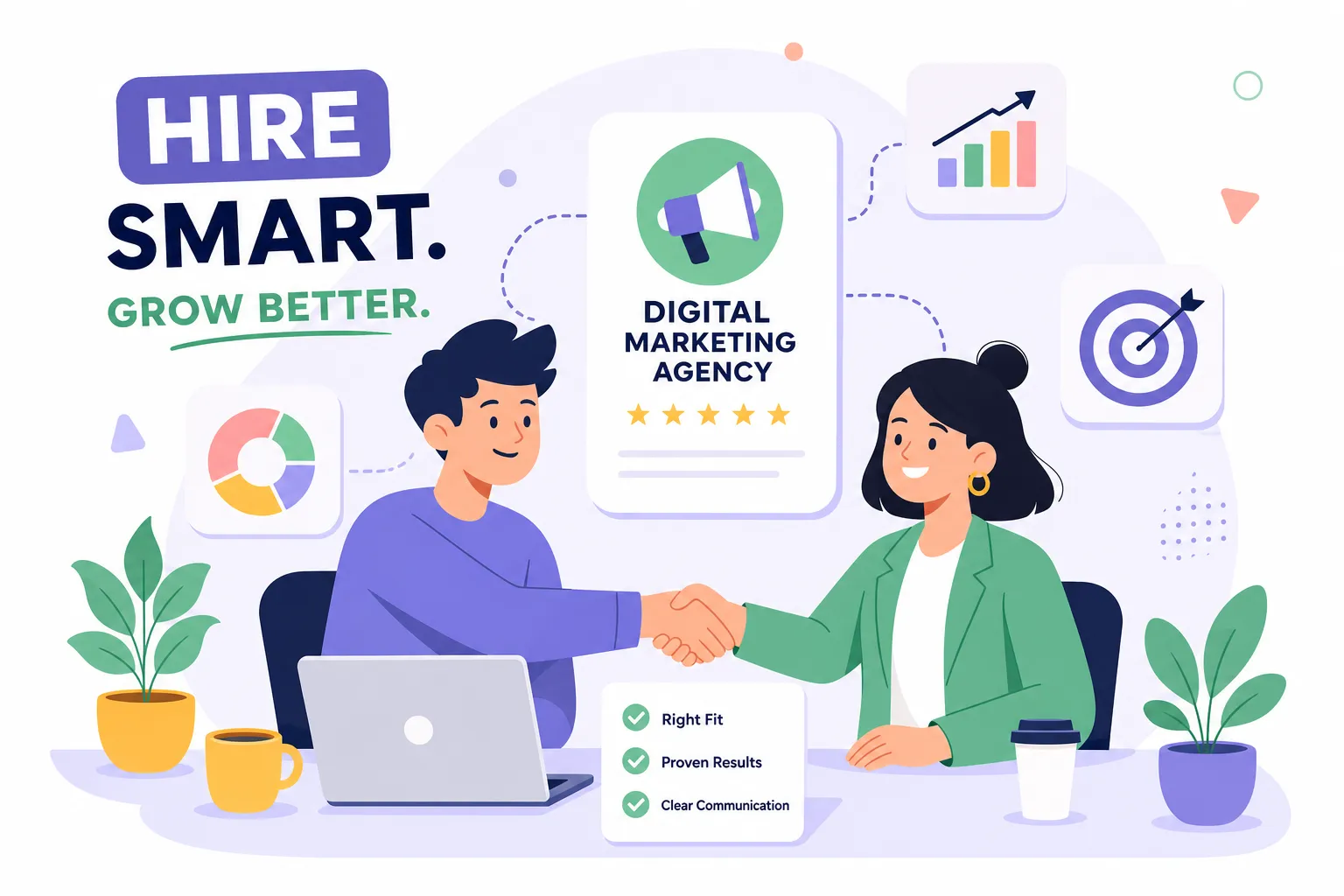
When you hire a digital marketing agency, the stakes are higher than most businesses realize. The wrong choice doesn’t just drain your marketing budget, it burns months of momentum you can never recover. Six months later, you’re back at square one, starting over with a new vendor and a hard lesson learned. Businesses that rush to outsource their digital marketing without a clear framework end up locked in bad contracts, chasing vanity metrics, and explaining to stakeholders why the needle hasn’t moved. The agency market makes this problem worse, not better. You’re choosing between boutique, founder-led shops that handle strategy and execution under one roof; niche specialists with deep expertise in a single channel; and large enterprise firms where your account is one of 50 on a manager’s plate. Without a decision framework, every agency pitch sounds equally convincing.
This guide gives you that framework. By the time you finish reading, you’ll know exactly what to define before your first discovery call, where to find agencies worth your time, how to evaluate them on proof rather than personality, and which contract terms you must have in writing before you sign anything.
What to nail down before you start your search
Most hiring mistakes happen before the first agency conversation because the buyer hasn’t done the internal work. If you walk into a discovery call without clear goals, you’ll evaluate agencies on their pitch skills instead of their strategic fit. That’s a recipe for a bad match.
Define your goals in measurable terms
Vague goals produce vague proposals. Before you contact a single agency, translate your ambitions into specific, time-bound outcomes: “increase organic traffic by 40% in 12 months,” “generate 30 qualified leads per month,” or “reduce cost-per-acquisition by 20% within two quarters.” These targets do two things: they filter out agencies that can’t speak to your specific outcomes, and they give you a baseline for holding whoever you hire accountable. An agency that can’t connect its work to your stated KPIs isn’t a strategy partner; it’s a vendor.
Know which services you actually need
The core service categories to consider are SEO Agency in India: How to Choose the Right Partner, 2026, PPC, social media marketing, content writing, and web development. Decide upfront whether you want a full-service partner managing all channels or a specialist with deep expertise in one area. Specialists are often more affordable, but they create coordination gaps when your channels aren’t talking to each other. A full-service agency that integrates SEO, content, and paid media under one strategy eliminates that fragmentation entirely. The right choice depends on what you already have in-house and where the real gaps are.
Where to find and hire a digital marketing agency worth your time
Not every directory or agency marketplace deserves a spot in your search process. Some are pay-to-play listing platforms where the highest bidder ranks first. Others are genuinely curated, with verified client reviews and real scope breakdowns. Knowing the difference saves you hours of wasted vetting.
Review platforms and directories that filter out noise
The most reliable places to find and evaluate agencies in 2026 are Clutch, G2, Trustpilot, the Semrush Agency Directory, and 50Pros. Clutch and G2 stand out because their reviews are verified and include detailed scope breakdowns, so you can see exactly what a client hired the agency to do and what results followed. Semrush’s directory filters agencies by skill certifications, which adds a layer of technical credibility beyond testimonials alone. Cross-reference at least two platforms before shortlisting any firm. For a curated starting list, see our Top 5 Digital Marketing Agencies to Consider in 2026, 2026. An agency that looks great on one platform but has no presence or mixed reviews elsewhere deserves a harder look.
If you prefer working locally, searching for a “marketing agency near me” on Google Maps or Yelp can surface regional firms with verifiable reputations. Just apply the same two-platform cross-reference rule before scheduling a call.
Full-service firms vs. niche specialists
A startup building brand awareness from scratch typically benefits more from an integrated partner that can coordinate SEO, content, and paid media as one connected strategy. An established brand with a strong in-house content team might only need a specialist for technical SEO or paid search. This is a business decision based on your current resources, not a quality judgment about either model. The key is matching the agency’s structure to your actual gaps, not to what sounds most impressive on a call.
How to evaluate agencies before you hire a digital marketing agency
Most businesses judge agencies on website aesthetics, pitch deck quality, and how confident the sales rep sounds. None of that tells you whether the agency can actually move your business metrics. Here’s what matters instead.
Case studies and the proof that actually matters
Strong case studies show specific business outcomes: revenue lifted, customer acquisition cost reduced, conversion rate improved. They include before-and-after data, a clear timeline, and the strategy used to get there. Weak case studies show “we grew traffic by 200%” with no context about what that traffic converted into or what it meant for the client’s bottom line. Ask yourself when reviewing any case study: “Does this show results that match my goals?” If the answer is no, that agency may have excellent skills in an area that won’t solve your problem.
Team structure and what it tells you about service quality
The client-to-strategist ratio is one of the most reliable quality signals you can check. A well-run agency typically carries five to ten clients per strategist. Once that number climbs to 15 or 20, your account gets reactive attention instead of proactive strategy, someone responding to problems rather than anticipating them. Ask agencies directly how many active clients each account manager handles. Founder-led agencies tend to keep this ratio tight because the founder’s reputation is directly tied to every client outcome, which creates built-in accountability that larger shops often can’t match.
Discovery call questions that reveal the real picture
The questions you ask during a discovery call determine whether you’re evaluating an agency or just listening to a sales pitch. Ask these specifically:
- “Walk me through the exact strategy you’d use for a business like mine.”
- “Who specifically will manage my account, and what is their background?”
- “What does your reporting cadence look like, and which KPIs will you track?”
- “Can I speak directly with two or three current clients?”
- “What results have you achieved for a client with goals similar to mine?”
A prepared, process-driven agency answers these questions without hesitation and with specifics. An agency relying on charm deflects, generalizes, or pivots back to its pitch deck. That gap tells you everything you need to know before a dollar changes hands.
Red flags and contract terms that can cost you
Knowing what good looks like is only half the job. The ability to recognize what to walk away from is just as critical when you’re ready to bring an outside partner into your growth strategy.
Promises and pitch tactics that signal trouble
Guaranteed rankings in 30 to 60 days is the most common red flag, and no credible agency makes that promise. Other signals to watch for: refusal to give you access to your own ad accounts (your data belongs to you, full stop), a one-size-fits-all proposal sent before any discovery conversation, and a track record you can’t independently verify through third-party platforms. There’s one more signal that’s easy to overlook, check the agency’s own website and blog. If their digital presence doesn’t reflect the standard they’re promising you, that gap tells you everything. An SEO agency with a thin, poorly optimized site isn’t practicing what it preaches. For practical guidance on how to vet an agency’s web and marketing presence, review these practical tips for vetting web design and digital marketing agencies.
Contract terms you must review before signing
Before you commit to anything, review these non-negotiables in writing:
- Exit terms and minimum contract length: Know exactly how you can leave and at what cost.
- Account ownership clauses: Who owns your ad accounts, your content, and your analytics data if you part ways? That ownership should be yours, not theirs.
- Scope-of-work specificity: Vague scopes enable scope creep and protect the agency, not you.
A 3-month pilot agreement with clear deliverables is always smarter than jumping directly into a 12-month retainer. Prove the relationship works before you commit to a year of it.
Pricing benchmarks, ROI timelines, and your final 7-point checklist
Once you’ve vetted your shortlist, you need realistic cost expectations and a consistent framework to make your final decision. Gut feel at this stage is where otherwise careful buyers go wrong.
What digital marketing agency pricing actually looks like in 2026
SEO retainers for small businesses typically run $1,000 to $5,000 per month; growing SMBs generally invest $5,000 to $10,000. PPC management fees usually fall between $500 and $5,000 per month, on top of your actual ad spend. Full-service retainers covering SEO, content, and paid media together range from $2,500 to $10,000 per month for most US businesses. Pricing varies by scope and complexity, not just agency size. The cheapest option almost never delivers the best ROI, and the most expensive option doesn’t guarantee it either. What matters is the value delivered relative to the fee, and you measure that by the KPIs you defined at the start. For a recent breakdown of digital marketing pricing in 2026, see this benchmarking analysis.
Keep ROI timelines realistic. SEO and content marketing typically show meaningful returns in three to six months, with compound growth building through the 9 to 12 month mark. Businesses that expect organic results in 30 days set themselves up for disappointment and bad decisions.
Your 7-point checklist before you sign with any agency
Use this as your final filter before committing:
- Your goals are defined in specific, measurable terms before the first conversation.
- At least two verified case studies match your industry or goal type.
- You’ve spoken directly with at least one current or former client.
- The account strategist is identified by name, not just described as “your team.”
- You have full access to your ad accounts, analytics, and data assets confirmed in writing.
- The contract includes a clear exit clause and performance accountability terms.
- The agency’s own digital presence reflects the standard they’re promising you.
A high-performing agency passes all seven without hesitation. One that pushes back on any of these points is giving you the answer before the work even begins.
The right partner changes everything
Deciding to hire a digital marketing agency is one of the highest-leverage moves a growing business can make. It’s also one of the easiest to get wrong when you’re evaluating agencies on charm and proposals rather than proof and accountability. The difference between a costly mistake and a great long-term partner almost always comes down to how prepared you were before the search started.
Use the framework in this guide as your starting point: define what you need, find agencies through verified sources, vet on results not promises, protect yourself in the contract, and apply the 7-point checklist before you sign. If you’re looking for an agency that combines hands-on strategic thinking with full execution across SEO, content, PPC, and web development, Brandleap Agency Blog | Expert Digital Marketing Insights was built specifically for businesses at that inflection point. Reach out to start a no-pressure growth conversation and see exactly how we’d approach your specific goals.