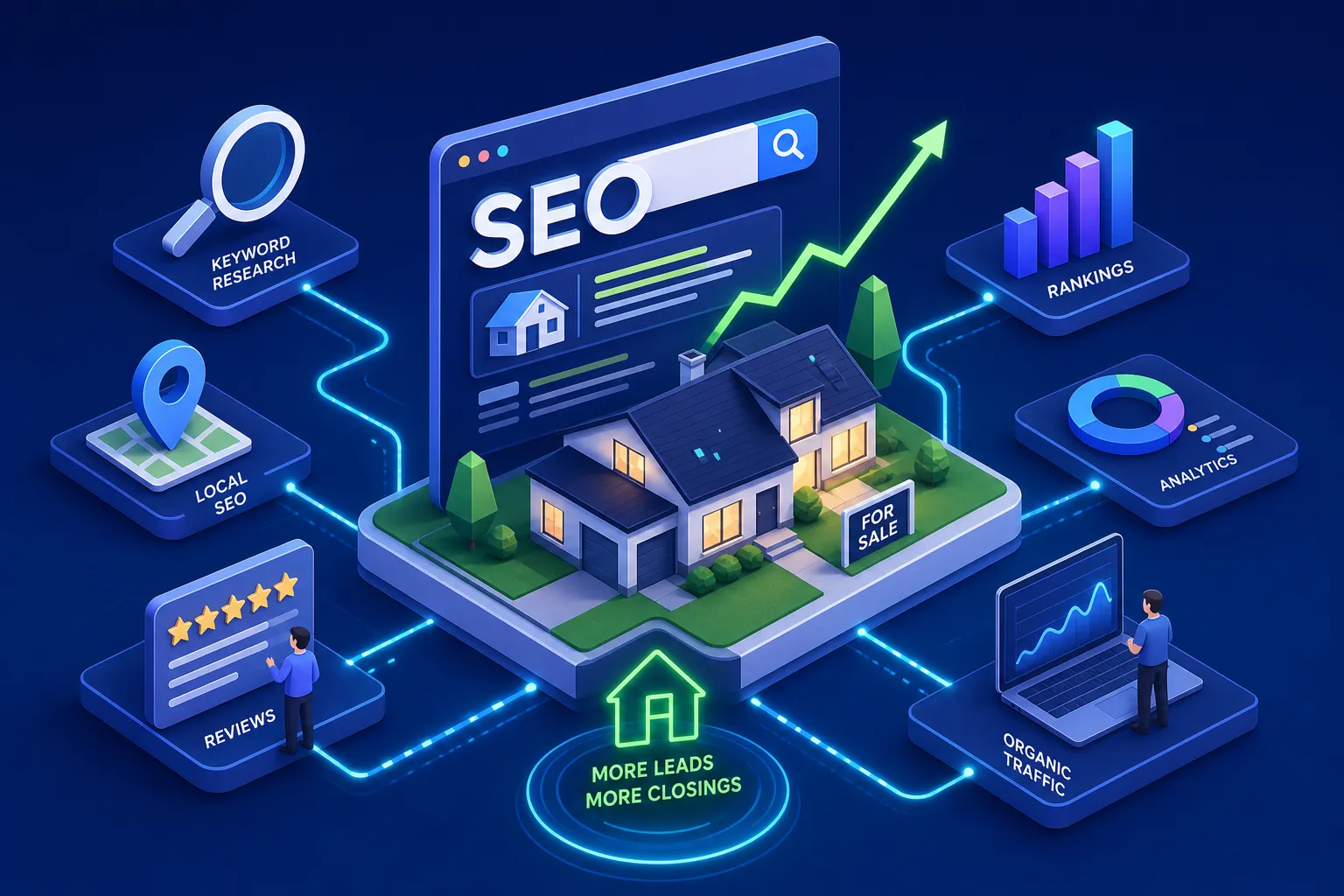
Most agents have a website. Far fewer invest in real estate SEO services that actually generate leads. The gap between those two realities comes down to search engine optimization done properly, not just technically, but strategically, with a clear understanding of how buyers search, what Google rewards, and what a qualified lead looks like at the end of the funnel. Many agents have sites, but a smaller share generate consistent organic leads, and the difference is rarely about design or content volume. It’s about whether the program is built around how real estate buyers actually search.
This guide is built from the practitioner’s perspective we apply at Brandleap Agency when evaluating digital marketing programs for service-based businesses. By the time you finish reading, you’ll know exactly what a strong real estate SEO services program should include, what to pay for it in 2026, which metrics to hold any agency accountable to, and seven direct questions that separate serious providers from ones that talk a good game.
Why many real estate websites struggle to generate organic leads
The core problem is structural. Real estate websites are typically built on templates designed for aesthetics, not search visibility. They rely heavily on IDX feeds that generate dynamic listing pages Google can’t easily crawl or index, particularly when those feeds are implemented via JavaScript or iframes rather than server-rendered HTML, and they carry almost no location-specific content that matches the language buyers actually use when searching.
Without dedicated neighborhood pages, hyperlocal copy, and a proper technical foundation, a website is effectively invisible to someone searching “condos for sale in Lincoln Park” or “best neighborhoods in Austin for families.” That’s a real problem. The large majority of home buyers begin their property search online, according to NAR’s annual home buyer studies, and most start with search engines before they ever contact an agent.
The opportunity is equally real. Local search queries tied to specific neighborhoods, zip codes, or property types carry high buyer intent and, in most markets, face less competition than agents expect. SEO for realtors compounds over time, unlike paid ads that stop generating traffic the moment you stop paying. Organic search consistently produces a lower cost-per-lead than paid search, a distinction that becomes significant over a multi-year program.
What a real estate SEO package should actually include
Any agency can list “SEO” as a line item. What you need to see are specific deliverables, with quantities attached, that map to the actual problems your website has. Here’s what a legitimate real estate SEO services package covers.
Local landing pages and neighborhood-level content
A strong SEO program for real estate builds dedicated pages for each city, neighborhood, and service area you compete in. These aren’t thin, templated pages. They include hyperlocal market data, school district information, lifestyle context, and conversion-focused copy written for buyers and sellers at different stages of their search. This content is the backbone of visibility in local markets, and it’s what separates agents who rank from agents who don’t.
Google Business Profile and citation work
Google Business Profile optimization covers category selection, service descriptions, photo uploads, Q&A management, and a structured process for generating and responding to reviews. This is the primary lever for map pack and “near me” visibility, and it’s often the fastest-moving part of a local SEO program. Citation work ensures your name, address, and phone number are consistent across Zillow, Realtor.com, Apple Maps, Yelp, and every relevant local directory, because inconsistency sends conflicting signals that erode Google’s trust in your listing.
IDX/MLS SEO services and technical fixes
This is the most overlooked problem in real estate search engine optimization. IDX feeds generate dynamic listing pages that Google frequently can’t crawl or index, which means your inventory is invisible in search. Proper IDX SEO services include canonical tag setup, schema markup (RealEstateListing, LocalBusiness, FAQ), crawl-control configuration for parameter pages, and Core Web Vitals improvements that affect both rankings and user experience. Any reputable agency specializing in real estate SEO specifies exactly which technical elements they address, not just “technical SEO” as a vague category.
The local SEO tactics that move the needle in 2026
Ranking for “near me” queries isn’t purely a content problem. It’s a combination of proximity signals, GBP relevance, review recency, and on-site authority signals working together. Agents who approach local SEO as a single tactic rather than a coordinated system consistently underperform.
Hyperlocal keyword targeting, specifically going after neighborhood-level phrases like “townhomes in South Loop Chicago” or “buying a home in Decatur GA”, captures high-intent buyers much earlier in their decision process than broad market terms. Neighborhood guides that incorporate schools, commute data, lifestyle context, and real MLS statistics outperform generic city pages because they match the specific language buyers actually search. These pages also signal genuine local expertise to Google in a way that no templated page can replicate.
On the technical side, boilerplate listing descriptions copied directly from MLS feeds register as duplicate content and get ignored. Unique property descriptions with buyer-intent phrasing and neighborhood context change that equation. Structured data including RealEstateListing and LocalBusiness schema helps search engines understand both individual listings and the agent’s authority within a geographic area. Internal linking between neighborhood pages, listing detail pages, and blog content reinforces local topical authority and keeps crawl budget focused on the pages that matter most.
What real estate SEO services cost in 2026
Pricing varies significantly by business size, market competition, and scope of deliverables. Here’s the realistic breakdown for U.S. markets.
- Solo agents: $1,500, $2,500 per month, with the average engagement running $1,800, $2,200 monthly
- Small to mid-size brokerages: $2,500, $4,500 per month, with competitive markets pushing toward $3,000, $6,000
- Enterprise and multi-market firms: $4,500, $8,000 or more per month, with some programs exceeding $10,000 when the portfolio requires significant depth
The difference between a $500/month package and a $2,000/month package isn’t a fundamentally different strategy. It’s volume, depth, and speed of execution. Low-cost packages typically exclude local landing page builds, skip IDX technical fixes entirely, and deliver no real link building. That’s not a bargain, it’s a setup for stagnation.
Realtor SEO services priced well below market often outsource deliverables to low-quality vendors. That creates penalty risk rather than ranking gains, and recovering from a Google penalty takes far longer than building an organic program correctly from the start.
KPIs your real estate SEO services provider must report on
Traffic reports without lead attribution are not performance reports. Hold any agency to these four metrics from the first month of engagement.
Organic traffic should be tracked as monthly growth in sessions to location pages, neighborhood guides, and listing pages, always measured against a baseline. “Impressions increased” is not a useful data point on its own. Qualified leads means form fills, calls, and inquiries attributed specifically to organic search, not just total traffic volume. The average conversion rate for real estate websites is approximately 2%, which means traffic reporting without lead tracking tells you almost nothing about actual business impact.
Cost per lead is a metric too many agencies avoid reporting because it forces a real comparison. Research comparing real estate inbound channels places organic CPL meaningfully lower than paid search, making the long-term case for SEO over ad-dependent programs compelling. An agency that can’t show you this number isn’t measuring what matters. The compounding effect of organic rankings also drives long-term ROI that paid channels simply can’t match, because earned rankings continue generating traffic without per-click costs.
Red flags in agency reporting are easy to spot once you know what to look for. Vanity metrics like “keywords tracked” or raw impression counts, without any connection to leads or revenue, signal an agency optimizing for retention rather than results. Ask for a sample monthly report before signing anything. A legitimate real estate marketing firm shows lead attribution clearly, not just traffic graphs with upward lines.
7 questions to ask before hiring a real estate SEO agency
These questions are designed to surface gaps in deliverables, accountability, and expertise before you commit to a contract. Use all seven, they reveal where vendors outsource work, where accountability breaks down, and where claimed expertise is thin.
Questions about deliverables and accountability
- How many local landing pages will you build per month, and what’s the content brief for each one?
- Does your package include IDX/MLS technical SEO, or is that scoped and billed separately?
- How do you handle Google Business Profile optimization if I have multiple agent profiles or office locations?
- What link-building tactics do you use, and can you show me documented examples from real estate clients?
- How do you attribute leads specifically to organic search, and what tools do you use to track that?
Questions about fit and expertise
- Have you worked with real estate clients in competitive markets, and can you share results with actual numbers, not just ranking screenshots?
- Who handles my account day-to-day, and do I have direct access to a strategist rather than an account manager reading from a dashboard?
The seventh question matters more than most agents realize. A junior coordinator managing your campaign through a checklist is a fundamentally different product than a senior strategist who knows your market, reads your data, and adjusts the program based on what the numbers actually say.
Fragmented vendor setups, where one agency handles SEO, another handles content, and a third handles web development, create accountability gaps that everyone quietly blames on each other. At Brandleap Agency, we operate as an integrated team covering technical SEO, local content production, GBP optimization, and link building under one roof. That structure eliminates the handoff gaps that stall results for service-based businesses in competitive local markets, and it means a single strategist can see how every part of the program connects.
The real estate SEO program you build now pays for years
Agents who treat search engine optimization as a compounding asset rather than a monthly expense win the long game in their market. Paid ads generate leads while the budget runs. Organic rankings generate leads while the market exists, and the infrastructure you build in year one keeps performing in year three without proportional additional spend.
Investing in real estate SEO services builds a lead generation system that compounds rather than resets. The approach is clear: demand specific deliverables in writing, track the four KPIs that connect traffic to revenue, ask all seven questions before signing, and verify results with documented case studies that show lead numbers, not just keyword rankings. Real estate SEO services done at this standard aren’t a marketing expense. They’re infrastructure for a lead generation system that runs independently of your ad budget.
If you’re evaluating providers and want a second opinion on a proposal or a benchmark comparison for your market, reach out to the team at Brandleap Agency. We review proposals and build custom program frameworks for agents and brokerages across competitive U.S. markets, the conversation is direct and the analysis is real.