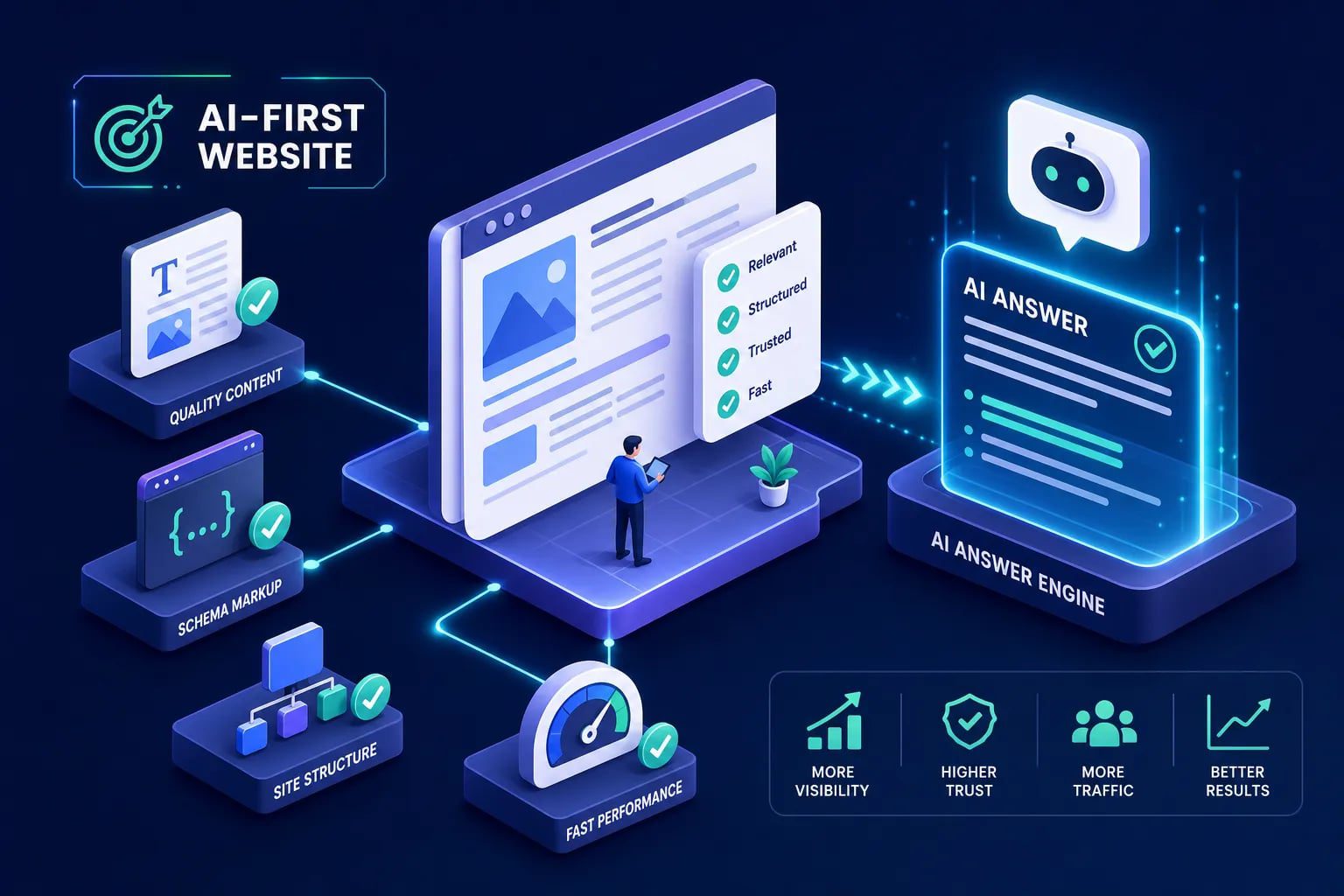
How do I optimise my website for AI answer engines? It’s a question more businesses are asking as search increasingly includes AI-generated overviews and conversational answers alongside traditional results. Google’s AI Overviews and Bing Copilot now synthesise answers directly on the results page, pulling content from a small selection of trusted sources and presenting it as a single, confident response. For sites not included in that selection, agency case studies show measurable shifts in AI-referred sessions, users receive a complete answer, close the tab, and never click through at all.
This guide follows the same framework Brandleap Agency uses when implementing AEO (answer engine optimisation) and LLM optimisation for clients. It covers content structure, schema markup, topical authority, provenance signals, and measurement. Every section below is something you can act on. Work through them in order, and by the end you’ll have a concrete plan to make your site the source AI engines reliably reach for.
How AI answer engines decide which sources to cite
These systems work in two distinct stages, and confusing them is one of the most common mistakes site owners make. The first stage is retrieval: the engine assembles a candidate pool of pages based on crawlability, index coverage, link-based authority, and query relevance. If you’re not in the index or your site has serious technical problems, you never enter that pool regardless of content quality.
The second stage is selection: from the candidate pool, the engine chooses which pages to cite and synthesise. This is where newer signals come into play. Topical authority, entity coverage, E-E-A-T, factual verifiability, and structured extractable content all influence whether your page gets cited or ignored. The key insight is that ranking on page one doesn’t guarantee citation. A page can sit in position three and still be selected for an AI answer if it’s cleaner, more authoritative, and easier to extract than the pages above it.
This is what makes AEO a distinct discipline layered on top of traditional SEO rather than a replacement for it. Visibility in AI-driven search is measured differently: AI citations, share of voice in generated answers, and brand mentions matter alongside organic click-through rates. Understanding both layers of the process tells you exactly where to focus your effort.
How do I optimise my website for AI answer engines, content structure
AI engines don’t read your page the way a human does. They scan for passages that can be lifted cleanly and synthesised without losing meaning, which means your formatting choices directly determine whether your content is extractable.
The most reliable structure is the 40, 60 word direct answer paragraph placed immediately after a heading or question. The formula is simple: one clear claim, two supporting sentences, no preamble. To illustrate the difference, consider two versions of the same opening:
Weak (not extractable): “There are many things to consider when thinking about the topic of schema markup, and in this section we’ll explore some of them.”
Strong (extractable): “FAQPage schema increases citation probability by signalling to AI engines exactly where the answer lives on your page. Add it to any page with genuine visible Q&A pairs, and use the acceptedAnswer.text property to make the response machine-readable.”
Format choice matters as much as length. Use bullets for enumerative queries (“types of,” “benefits of,” “steps to”), tables for comparisons or specifications, and prose paragraphs for definitions and direct “what is” answers. A simple decision rule: if the answer has clear parallel items, use a list; if it involves a trade-off or side-by-side comparison, use a table; if it’s a single concept, use a paragraph. Choosing the wrong format makes extraction harder and reduces citation likelihood.
Write your headings as questions that mirror how users actually search. When a heading and its following paragraph function as a self-contained Q&A unit, AI systems can map the content to a query more reliably. This is the core mechanic of AI snippet optimisation: the heading identifies the question, the first paragraph delivers the answer, and together they make citation straightforward.
Schema markup that signals answers to generative search
Structured data tells machines what your content is about in a language they can parse without inference. For AI answer engines, the right schema doesn’t just help with indexing; it actively signals which passage is the answer and who is responsible for it.
FAQPage is the highest-return schema type for question-based queries. A 2025 Semrush analysis found pages with FAQPage markup show 28, 40% higher citation probability compared to unstructured equivalents, though it’s worth noting these figures come from industry and vendor studies rather than large-scale independent audits. Use FAQPage only when the page genuinely contains visible Q&A pairs, not as a way to inject content that doesn’t appear on the page. The key properties are mainEntity, with each question using name and acceptedAnswer.text . HowTo schema works for procedural content because engines can extract discrete steps reliably without needing to parse the surrounding prose. Use step, name , and text as your core properties.
Article or BlogPosting should be the baseline schema on every piece of editorial content. The properties that move the trust needle are author, datePublished, dateModified, publisher, and sameAs. These aren’t optional extras; they’re the signals AI engines use to attribute content to a credible, identifiable source. Organisation and Person schema reinforce this by helping engines resolve your brand and your authors as real, verifiable entities rather than anonymous content sources.
The single most important rule in schema implementation is mirroring: the answer must appear in visible HTML first, then be reflected in structured data. Markup alone doesn’t compensate for weak on-page content. If the answer isn’t readable by a human on the page, the schema won’t save it. Add BreadcrumbList to content pages and product hierarchies where it helps clarify how that page sits within your site’s topic structure, this is particularly useful for engines assessing subject-matter depth.
Building the topical authority AI engines can verify
AI engines routinely prefer sources that cover a topic with depth and consistency. A single strong article surrounded by thin content sends a weak signal. What builds authority is a content architecture where your pillar pages cover broad topics comprehensively and cluster content addresses specific subtopics in detail, all connected through deliberate internal linking.
A practical example: a service-based business in accounting might build a pillar page on “small business tax planning” supported by clusters covering quarterly filings, allowable expenses, VAT registration thresholds, and payroll obligations. When an AI engine encounters one of these pages, it can verify that the site treats this subject with genuine depth rather than surface-level coverage. That verification is what pushes sites from the candidate pool into the citation set.
E-E-A-T implementation at this scale requires more than adding an author bio to a handful of posts. Named authors with real credentials, first-person experience woven into the writing, original data or commentary, and external citations all contribute. Applying those signals consistently across dozens of pages is where the real compounding happens, and, based on our experience working with clients, it’s also the point where specialist support tends to add the most leverage. At Brandleap Agency, we treat AEO and LLM optimisation as dedicated disciplines within the team’s workflow rather than tasks bolted onto a standard content brief. That separation of responsibilities is what makes consistent E-E-A-T achievable at scale.
Proving provenance so AI systems trust your content
Provenance is the evidence trail that distinguishes a credible source from an anonymous content page. AI engines are increasingly built to assess whether a claim can be attributed, verified, and traced. Pages that make this easy are cited more often than pages that bury or omit this information.
Every page containing factual claims should have a named author linked to a bio that establishes relevant expertise. Show both the original publication date and the date the page was last reviewed or updated. Freshness is part of the trust equation, but only when it’s honest: overuse of superficial update flags may reduce the perceived value of your freshness signals over time, so reserve meaningful update dates for substantive changes to content.
Place source links beside the claims they support, not in a references section at the bottom of the page. Linking directly to primary sources, research papers, official documentation, or government data, signals factual grounding in a way that linking to summaries or secondary commentary doesn’t. This inline sourcing approach also maximises verifiability for both human readers and extractive AI systems. For each key claim, a practical provenance structure looks like this:
- State the claim clearly
- Name the author or organisation responsible for the original finding
- Show the publication and update dates
- Link directly to the primary evidence
That structure makes your pages easier for both humans and AI systems to trust, and it’s the clearest signal you can send that your content is citation-worthy.
How to optimise for AI answer engines, tracking and refining your visibility
Success in AEO shows up in different metrics than traditional SEO, and if you’re only watching organic traffic, you’ll miss the leading indicators entirely. The common pattern across case studies is that visibility shifts before traffic does: AI citations and structured snippet appearances improve first, with traffic and conversion lifts following weeks later.
The metrics worth tracking are AI citations and brand mentions in generated responses, AI-referred traffic identifiable in GA4 via referral source (note that capturing this accurately depends on how each AI product passes referral headers, so complement GA4 with UTM parameters and server-log analysis), featured snippet appearances, branded search volume, and assisted conversions.
Several agency-published case studies report substantial results from structured AEO programmes. In one documented B2B SaaS engagement, a sustained AEO programme produced a 6x increase in AI-referred trials and a 600% citation uplift. Separate implementation data shows a 221% increase in AI citations alongside 61% organic traffic growth. These figures are drawn from agency case studies rather than independently audited benchmarks, and individual results will vary, but they illustrate the compounding effect that structured content, schema, authority signals, and provenance can produce when implemented together.
To test whether your content is being cited, query AI engines directly with the questions your pages target and check whether your source is referenced or paraphrased in the response. Tools that monitor AI Overview appearances can automate part of this. Set realistic expectations: AEO results take weeks to validate, not days, but the leading indicators move faster than traditional ranking shifts. Sites that begin building these signals now are more likely to be cited consistently over time, a pattern supported by current industry case studies, even if the precise timeline will vary by sector and query type.
Your next step
The implementation path is clear. Get into the candidate pool through sound technical SEO. Structure content for extraction using the 40, 60 word answer paragraph. Add FAQPage and Article schema with the correct properties. Build topical authority through content clusters. Make provenance explicit on every page. These aren’t separate strategies; they’re layers of the same approach to becoming a source that AI engines can trust and cite, and they’re the foundation of how to optimise your website for AI answer engines effectively.
The compounding effort involved often surprises businesses that start from scratch. Each layer reinforces the others, and the work builds over months rather than delivering instant results. For teams that want to skip the guesswork and implement this properly from the start, Brandleap Agency handles AEO and LLM optimisation as part of a broader search strategy, building the kind of trusted, extractable presence that AI engines consistently prefer.
Pick one section from this guide and implement it this week. Citation visibility builds incrementally, and acting early may confer meaningful advantages as AI-driven discovery grows, a conclusion supported by current industry trends and the case studies cited throughout this guide.