
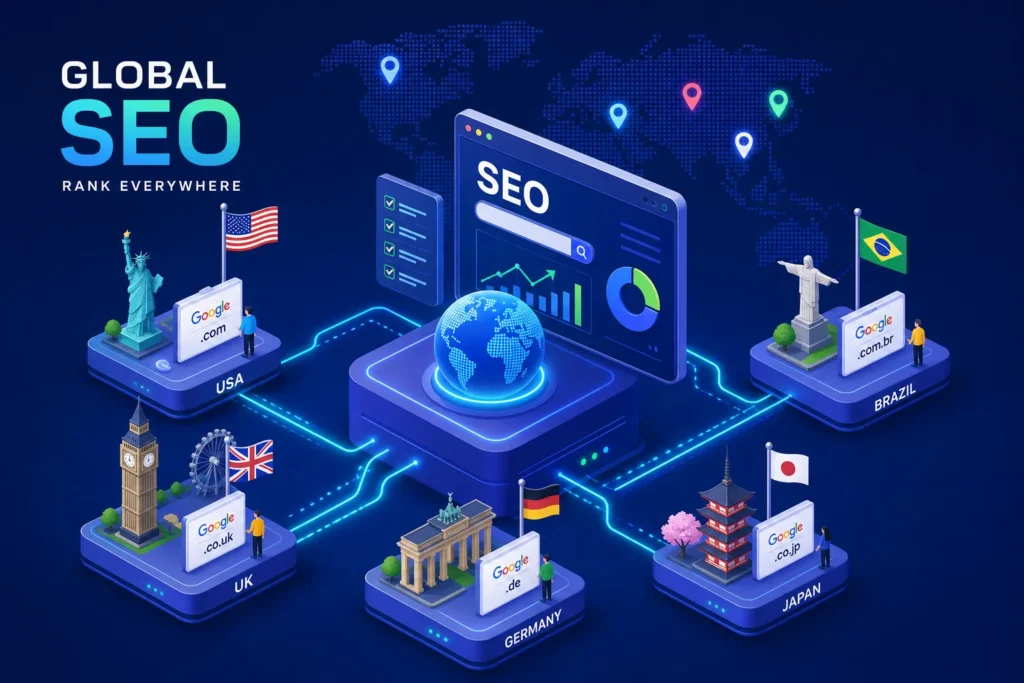
If you’re asking “how do I do SEO for multiple countries?”, you’re already ahead of most businesses that stumble into international expansion without a plan. Many companies commit to the wrong architecture on day one, or translate their content without doing any local keyword research first. Both mistakes tend to cost months of wasted effort before anyone realizes what went wrong. The architecture error is especially damaging because reversing it later means restructuring URLs, rebuilding hreflang, and potentially losing rankings in markets you’ve already started to build.
This guide covers the four decisions that determine whether a multi-country SEO strategy succeeds or stalls: URL structure, hreflang implementation, content localization, and tracking. It also touches on a distinction worth understanding early, multilingual SEO (serving different languages to the same or multiple countries) and multi-regional SEO (serving different countries, sometimes in the same language) require overlapping but distinct tactics. The framework here reflects what the team at Brandleap Agency has seen work consistently for US businesses expanding internationally, built from auditing and rebuilding international setups across dozens of industries. By the end, you’ll know exactly which architecture to choose, how to implement hreflang without errors, how to localize content that actually ranks, and how to measure results market by market.
How do I do SEO for multiple countries? Start with URL structure
This decision comes first because it’s the hardest to reverse. Once you’ve built out international content under a particular structure, migrating it is a significant technical project with real ranking risk, so get this right before a single international page goes live.
ccTLDs: the strongest geo-signal, but a high price to pay
Country code top-level domains, like example.fr or example.de, send the strongest geographic targeting signal Google reads. Users in markets where local domain extensions carry cultural or regulatory weight often respond more favorably to a country-specific TLD than to a generic .com, and Google doesn’t require any additional configuration to understand which country you’re targeting.
The drawbacks are real and often underestimated. Every ccTLD builds its own domain authority independently with no cross-domain synergy, so you’re essentially starting from zero in each market. Renewal costs vary widely, .pr can run over $800 per year at some registrars, while .co.uk costs a few dollars, and you’re also managing separate CMSes, analytics setups, and hosting environments for each country. This structure makes sense if you face regulatory requirements (Baidu in China is the clearest example) or if extreme local trust justifies the investment. For most growing businesses, it’s overkill.
Subdirectories: the right choice for most growing businesses
Subdirectories, structured as example.com/fr/ or example.com/de/, concentrate all backlink authority and domain strength into one root domain. When you add a new country folder, it immediately benefits from the authority your main domain has already built, which means new international pages rank faster than they would on a fresh ccTLD.
The trade-off is a weaker immediate geo-signal compared to ccTLDs, which makes hreflang implementation non-negotiable. But the operational efficiency alone is compelling: one CMS, one hosting setup, and unified analytics across all markets. For most US businesses expanding globally, subdirectories are the recommended path. The SEO upside is strong and the management overhead is manageable.
Subdomains: when they make sense (and when they don’t)
Subdomains like fr.example.com allow separate server setups and some design flexibility, which appeals to teams that want distinct user experiences per country. The problem is that subdomains often don’t inherit the full domain authority of the main site, and without airtight hreflang, they risk competing with each other, and with the main domain, for the same keywords.
Subdomains are rarely the best default. They’re a middle-ground option that delivers neither the SEO efficiency of subdirectories nor the geo-targeting power of ccTLDs. Unless you have a specific technical need for regional server separation, skip them.
How to implement hreflang tags without breaking your international rankings
Hreflang is where most international SEO quietly fails. The tags look simple, but the rules are strict and errors are common. Since Google removed the manual geo-targeting tool from Search Console in September 2022, hreflang has become the primary signal Google uses to determine which page version to serve by country. Getting it wrong doesn’t just hurt rankings, it can cause Google to serve the wrong version to the wrong audience entirely.
The non-negotiable rules for valid hreflang
Four rules apply to every implementation without exception:
- Language code before region code: The correct format is en-US, not US-en. Language (ISO 639-1) always comes first; region (ISO 3166-1) comes second and is optional.
- Every page must tag itself: Include a self-referential hreflang tag on every page pointing to its own URL. Pages without this are unanchored in the cluster.
- Bidirectional links are mandatory: If Page A tags Page B, Page B must tag Page A back. Asymmetric links invalidate the relationship.
- Absolute URLs only: Relative paths break the signal. Every href must include the full URL with protocol (https://example.com/fr/page, not /fr/page).
Missing the self-referential tag and missing the reciprocal tag are among the most common hreflang errors in international implementations, common enough that they’ve been called the default failure mode for teams implementing hreflang without a checklist. These aren’t rare edge cases; they’re easy to miss without proper QA.
Common hreflang errors that silently kill rankings
The four most damaging mistakes are missing return tags, incorrect ISO codes, broken links pointing to deleted pages, and mixing implementation methods. If you’re using HTML head tags on some pages and XML sitemap entries on others for the same pages, Google reads that as conflicting signals. Pick one method per page and use it consistently across the site.
To validate your implementation, check the Language tab inside Search Console’s Legacy Tools. Google removed the Country tab in 2022, see the announcement and details about the change, and the Language tab still surfaces hreflang errors and is the fastest way to catch issues introduced by CMS updates or developer changes. Run this check after every significant CMS deployment, not just as a one-time audit.
Country-specific keyword research: a commonly skipped step
Translating your existing English content and calling it localized is one of the most expensive shortcuts in international SEO. A direct translation of an English keyword rarely matches how native speakers actually search, and building a content plan around the wrong terms means optimizing for demand that doesn’t exist in that market.
Why local search behavior differs even within the same language
Search habits, terminology, and spelling vary significantly by country, even among English-speaking markets. A keyword driving 10,000 monthly searches in the US can have near-zero volume in the UK if the phrasing differs. Americans search for “trashcan,” Brits search for “bin.” Americans search for “realtor,” Brits search for “estate agent.” A literal translation passes neither test.
The gap widens further in non-English markets where idiomatic expressions and industry terminology don’t map cleanly across languages. The only reliable way to build a content plan for a new country is to research how people in that country actually describe what they’re looking for, using real volume data from that market.
Tools that give you real volume data by country
A practical research stack for most markets starts with Google Keyword Planner for baseline data with country filters, it pulls directly from Google’s own index and is the most reliable free starting point. Pair it with Semrush or Ahrefs for organic data and competitor keyword gaps by region.
For non-English and emerging markets where English-focused tools lack precision, Keyword Tool Pro covers a wide range of countries and languages and is worth evaluating for your stack. Ahrefs is particularly useful if your target market is dominated by a search engine other than Google, since it includes Yandex and Baidu data as well. Check current vendor documentation for the latest coverage details, as these platforms update frequently.
Always cross-check two sources before building a content plan for a new market. Use one ads-focused tool (Keyword Planner) and one organic tool (Semrush or Ahrefs) together. Each tool has its own estimation methodology, and aligning them reduces the risk of building a strategy around inflated or deflated volume figures.
Localizing content and on-page signals that actually move rankings
Once your architecture and keywords are right, content localization is what converts traffic potential into actual rankings and user trust. This goes well beyond swapping language, several technical and structural layers need attention for each market.
Metadata, URL slugs, and schema: the technical localization checklist
Title tags and meta descriptions must be adapted to local search habits and character conventions, not just translated word-for-word. German titles, for example, can run 30% longer than English equivalents before they truncate in the SERP. A character limit that works fine in English can cut off the most important keyword in German. Adapt each metadata element to the language, not just the meaning.
URL slugs should be rewritten in the target language using clean, readable phrases. Auto-generated slugs from translation plugins often produce strings of encoded characters that are unreadable to users and carry no keyword value. Schema markup fields, including “name,” “description,” and “priceCurrency”, should include locale attributes so rich results display correctly in local SERPs. These are small implementation details that compound into significant ranking differences over time.
Currencies, dates, and legal compliance: trust signals that affect engagement
Displaying local currencies and region-appropriate payment methods reduces friction and improves engagement metrics. A German user who sees prices in euros and recognizes the payment method is more likely to stay on the page, and stronger engagement signals indirectly support rankings. Date format conventions matter for the same reason: MM/DD/YYYY in the US reads as a formatting error to a European user expecting DD/MM/YYYY, and imperial measurements feel foreign to metric-system markets.
Privacy policies and cookie notices must be adapted to local regulations, not just translated. GDPR in the EU and LGPD in Brazil carry real compliance requirements that differ from US standards. A translated privacy page that doesn’t satisfy local law is a compliance risk, not a localization achievement. Treat legal adaptation as a foundational requirement for each market, not a final step.
Measuring results and building a rollout plan that doesn’t spread you thin
Some teams try to launch five countries at once and end up with mediocre results everywhere. Traffic data gets mixed together, hreflang errors go unnoticed because no one is monitoring country-level performance, and six months in, no one can explain why the strategy isn’t working. A sequenced rollout with market-specific tracking from the start changes that equation.
Setting up Search Console and analytics for international visibility
Set up each country version as a separate property in Google Search Console. For a subdirectory structure, that means adding example.com/fr/ and example.com/de/ as individual properties alongside your root domain. This lets you track impressions, clicks, and average position per market independently, so a ranking problem in France doesn’t get masked by strong performance in Germany.
In Google Analytics, segment traffic by country and track conversion rates separately for each market. A page that ranks well in Germany but converts poorly is likely a localization gap, not a traffic problem. Use country-level segmentation as your diagnostic lens, not just a reporting filter.
Prioritize markets, launch sequentially, and know when to get help
Start with one or two high-opportunity markets where your keyword research shows strong demand and manageable competition. Build the architecture correctly, localize thoroughly, and measure the results before expanding. Launching too many markets simultaneously fragments your resources and makes it nearly impossible to diagnose what’s driving or dragging performance in any single market.
For businesses that want to move fast without the costly trial-and-error of figuring out architecture, hreflang, and localization from scratch, working with an international SEO specialist is often the more efficient path. Brandleap Agency builds these foundations for US businesses expanding internationally, helping teams get the structure right from day one rather than reverse-engineering a broken setup six months later. If you also need to support market-level visibility through local linking and outreach, see our guide on Link Building for Local SEO.
How do I do SEO for multiple countries? Start with one market and build it right
The sequence matters as much as the tactics. URL architecture first, then hreflang, then local keyword research, then content localization, then tracking and sequenced rollout. Each layer depends on the one before it, and skipping steps is how international SEO projects end up rebuilt from scratch twelve months later.
Expanding your SEO into multiple countries is not just translating your existing site. It’s a deliberate set of technical and strategic decisions where the foundation determines everything built on top of it. Get the structure right once and you can scale to new markets efficiently. Get it wrong and you’re paying twice: once to build it, once to fix it.
Still asking yourself “how do I do SEO for multiple countries?”, start with one market, implement everything in this guide, measure the results, and then expand. Brandleap Agency works with US businesses at exactly this stage, reach out if you want it done right the first time.

BrandLeap Agency & BrandLeap Fashion | Founder & CEO
Mithun is an experienced SEO consultant recognized for helping businesses improve their digital presence through technical SEO, content optimization, and sustainable organic growth strategies. Working in the digital marketing industry since 2019, he has developed expertise in increasing search visibility, driving targeted traffic, and building long-term growth through data-driven SEO solutions. He has worked with businesses across multiple industries, helping brands strengthen their online authority and achieve measurable growth results.