Meta description: How do I decide between Facebook Ads and Google Ads for my business? Compare targeting, CPA, and ROI by business type, then run a 4-week test to find your winner.
Many business owners running paid ads face the same dilemma. You have a fixed budget, two platforms with very different sales pitches, and a comment section full of conflicting opinions. The advice is almost always “use both,” which helps no one decide where to put their money first. The patterns that separate winning platform choices from expensive guesswork are consistent once you understand what drives them, and that’s exactly what this guide covers.
If you’re asking how do I decide betweenFacebook Ads and Google Adsfor my business, the short answer is: it depends on whether your audience is already searching for what you sell, or whether you need to build that interest first. By the end of this article, you’ll know which platform fits your specific goal, what realistic costs look like across business types in the Egyptian market, and how to run a structured 4-week test before committing your full budget to either side.
The core difference: intent vs. audience targeting
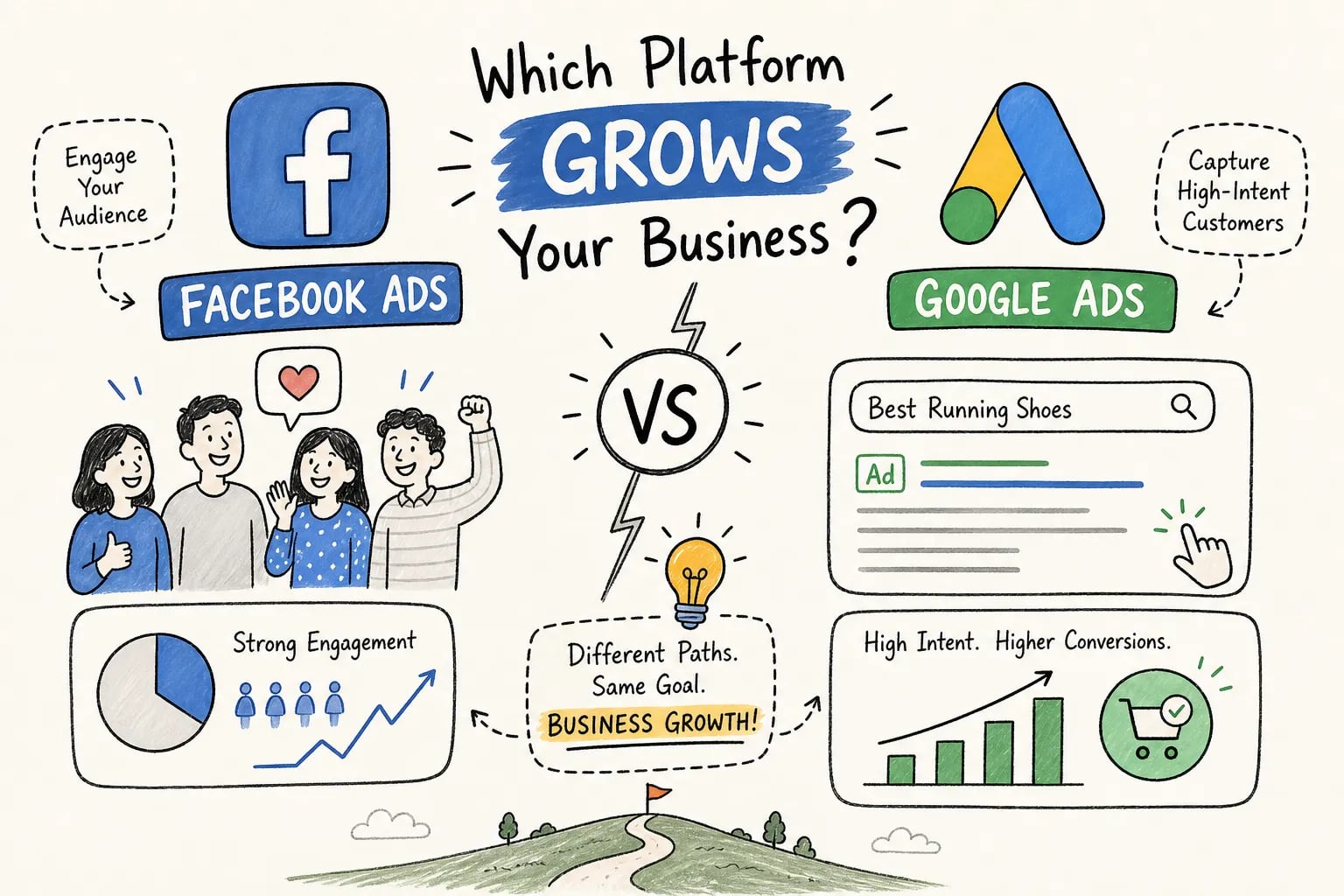
Google Ads is built around demand that already exists. When someone searches “emergency plumber in Cairo” or “best accounting software,” they’ve defined their need. Your ad intercepts that intent at the exact moment it surfaces. The main formats, search ads, shopping ads, and responsive search ads, are all designed around text and query-based matching, which is why they perform so well for transactional searches.
Meta Ads operates on the opposite logic. Instead of waiting for someone to search, you define who you want to reach using demographics, interests, behaviors, custom audiences, and lookalike profiles. The visual-first formats, video, carousel, Reels, and collection ads, are built for storytelling and impulse-driven offers. You’re putting your product in front of the right people before they’ve thought to search for it.
This distinction shapes every budget decision that follows. A plumber benefits immediately from Google because the search demand is already there. A DTC fashion brand launching a new line benefits from Meta because it needs to build interest before anyone knows to search for it. The question isn’t which platform is better. It’s which one fits what your business is trying to do right now.
How do I decide between Facebook Ads and Google Ads for my business: what real costs look like
Generic CPC numbers aren’t useful without context. For businesses operating in the Egyptian market, Meta CPCs for consumer categories typically fall in the EGP 0.40, 2.50 range, while professional services run EGP 2.00, 8.00. Google Search CPCs in Egypt vary significantly by sector: e-commerce product keywords sit around EGP 0.80, 3.50, while healthcare, legal, and real estate verticals can reach EGP 2.80, 18.00 depending on competition.
For e-commerce, Meta usually wins on discovery cost, but Google often wins on conversion rate for high-intent shopping queries. A user clicking a Google Shopping ad for “buy running shoes online” is far closer to purchasing than someone who saw a carousel ad on Instagram during their morning scroll. For local service businesses, Google typically delivers better lead quality and intent, while a well-built Meta campaign can produce a lower cost per lead, though that tradeoff often means trading lead quality for volume.
B2B is where the gap is clearest. In one internal account comparison we’ve observed in the B2B space, Google Search produced sales leads at roughly 35% lower cost than Facebook, with cost per form completion running notably lower on Google after six months of running both platforms in parallel. Keep in mind these figures came from a USD-market account; Egyptian market results will vary by vertical and budget level. Lower CPC doesn’t automatically mean better ROI. Conversion rate and lead quality determine the real cost per outcome, not the cost per click.
Matching your business goal to the right platform
Google is the stronger starting point when your business is capturing demand that already exists. This covers legal services, home repairs, medical queries, SaaS tools with defined problem statements, and any product category where users already search with commercial intent. Speed to conversion matters here, and Google delivers because the audience has already raised their hand.
Meta earns a bigger share of budget when the product needs visual demonstration, when the audience is defined by lifestyle rather than search behavior, or when you’re launching something with no existing search volume. DTC products, fitness services, fashion, and event promotion all fit this profile. If your offer has a strong creative hook and the audience needs to see it before they’ll want it, Meta builds that foundation more efficiently.
Here’s how that maps by business type:
- E-commerce brands, use Meta for product discovery and Google for purchase-intent traffic, where shoppers are already comparing options.
- Local service businesses, lead with Google to capture active searchers, then use Meta for retargeting and brand familiarity.
- B2B SaaS companies, Google Search delivers better-qualified leads; Meta works as a top-of-funnel awareness channel for warming cold audiences.
- Brick-and-mortar retail, Meta’s reach and footfall-focused campaign formats tend to drive store traffic more cost-effectively.
- Healthcare and real estate professionals, high-intent queries drive most qualified leads in these verticals, so Google should take priority.
How to run a fair test before committing your full budget
Setup and tracking
The most common testing mistake is changing too many variables at once. If you use a different landing page per platform, you’re measuring the page, not the platform. Test validity requires the same offer, the same landing page, and the same conversion goal on both sides.
On the tracking side, that means:
- Meta: Meta Pixel combined with Conversions API. The combined setup recovers approximately 85, 98% of conversions, compared to the 20, 60% that a Pixel-only setup can miss due to ad blockers and iOS privacy changes.
- Google: Google Ads conversion tracking paired with Google Tag Manager.
- Cross-platform: UTM parameters for clean GA4 attribution across both channels.
Budget split
Start with a 50/50 or 60/40 budget split so neither platform is starved of data. If your total monthly budget is below $1,000, splitting it thin makes both tests inconclusive. At that level, commit to one primary platform first and treat the secondary channel as a smaller directional test.
Timeline and sample KPIs
A 7, 14 day window gives you a fast directional read; 30 days gives you a stable decision. Aim for at least 50, 100 conversions per platform before drawing strong conclusions. Judge the winner by cost per acquisition and ROAS, not clicks or impressions. Secondary signals worth tracking include qualified lead rate, landing page conversion rate, and booked-call or close rate if your sales cycle extends beyond the form fill. A cheap click from the wrong audience costs more than a pricier click that converts. Track lead quality all the way through the funnel, not just at the submission stage.
Attribution differences that will confuse your reporting
Here’s a common scenario that illustrates why reporting numbers rarely agree: Meta reports 40 conversions, Google reports 28, and GA4 reports 19 for the same period. Each system is answering a different question. Meta credits conversions within its own touchpoint window, a 7-day click and 1-day view window by default. Google Ads credits interactions within the Google ecosystem using data-driven attribution. GA4 measures on-site session paths using its own model. The same sale can be claimed by all three systems because each observed a different touchpoint in the user’s journey. This is expected behavior, not a tracking error.
Pixel-only tracking is the most common undercounting problem on Meta. Browser restrictions, ad blockers, and iOS privacy changes can block Pixel events before they fire. This causes Meta’s in-platform reporting to undercount actual conversions. Running Conversions API alongside the Pixel solves this by creating a server-side backup that doesn’t depend on the browser. On the Google side, tags that fail to fire or users switching devices between click and purchase create gaps in Google Ads reporting.
The practical framework is straightforward. Use Meta’s in-platform reporting to understand Meta-influenced demand and creative performance. Use Google Ads reporting for keyword-level efficiency and search intent signals. Use GA4 for channel-level path analysis across the full site. Compare CPA trends over time rather than raw conversion counts across platforms. The platform showing a consistently lower CPA and higher lead quality over 30 days is your winner, regardless of which one reports the highest absolute conversion number.
When running both platforms together delivers the best ROI
The most effective paid media setups aren’t either/or arrangements. They pair demand creation with demand capture. Meta builds awareness and warms cold audiences; Google converts the search intent those warm audiences generate. The Seltzer Goods case illustrates this clearly: a Facebook-led campaign drove a 785% increase in monthly revenue by building discovery and brand interest, while Google captured the purchase intent that followed. For businesses with enough budget to fund both properly, a combined funnel with a clear role for each platform consistently outperforms going all-in on one side.
If you’ve tested both platforms without a clear framework, or you’ve seen inconclusive results and wasted spend, the problem usually isn’t the platform. It’s the structure of the test, the attribution setup, or the mismatch between the platform’s strength and the campaign goal. At Brandleap Agency, the process starts with the business goal and budget before a single dollar is spent, then maps the right platform strategy, whether that’s Google-first, Meta-first, or a combined funnel with defined roles for each channel. That clarity is what separates campaigns that produce clean, actionable data from ones that leave you second-guessing every number.
How to decide between Facebook Ads and Google Ads: the right call depends on your goal
There’s no universal answer to which platform wins, and anyone who tells you otherwise is selling a shortcut. Google Ads captures existing demand faster. Meta Ads builds and warms audiences before they search. When the budget allows, running both with clearly defined roles consistently outperforms either channel alone. The key is knowing which goal you’re funding, not just which platform you’re paying.
A structured 4-week test with clean tracking, a consistent offer, and CPA as your primary KPI removes most of the guesswork. If you’re still working through how to decide between Facebook Ads and Google Ads for your business and want a team that has already mapped these patterns across industries, Brandleap Agency builds the strategy, handles the tracking setup, and manages both platforms so your budget goes where the data points, not where the loudest opinion does.