
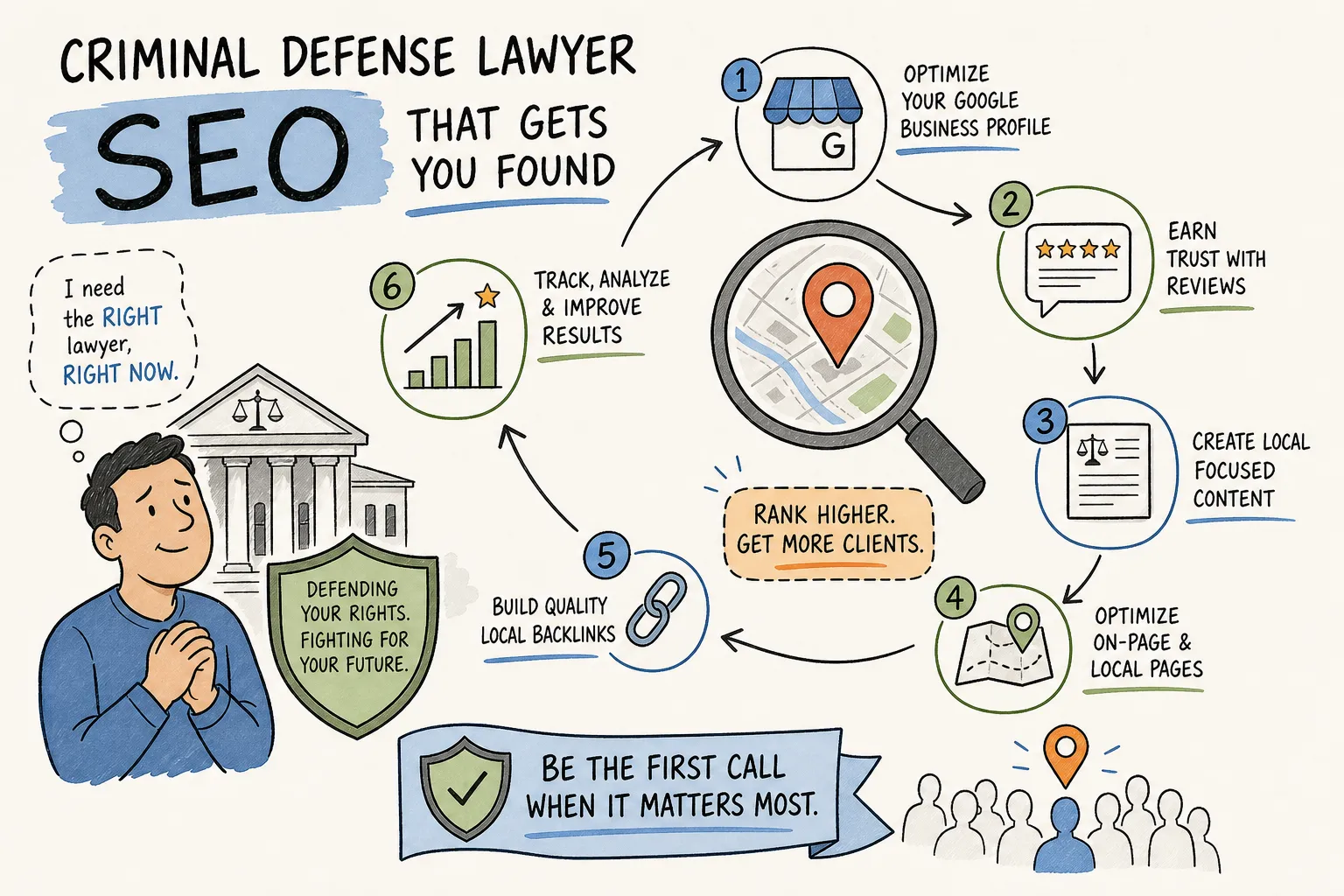
Every month, more than 90,000 people search “criminal lawyer near me” on Google, making criminal defense lawyer SEO one of the most competitive and highest-stakes investments a firm can make. Many of these searches show high urgency, arrest-related, court-deadline-driven, or family-crisis intent, and high-intent queries like these strongly correlate with immediate contact. Searchers are not browsing casually the way someone picks a new restaurant. They want to reach a credible attorney fast, and the firms that appear first get the call.
That urgency is exactly what makes local SEO for criminal defense attorneys so consequential. Page-two rankings receive dramatically fewer clicks than page-one positions, research consistently shows a steep CTR drop-off after the first few results, so a firm that is not visible at the top is functionally invisible to the clients who need it most. Better-optimized competitors get the consultation and the retainer. The gap between page one and page two is not a minor traffic difference; it is the difference between a full case pipeline and a struggling one.
This article gives you a six-step playbook covering Google Business Profile setup, keyword targeting, landing page structure, intake conversion, technical SEO, and reputation management. Each step is sequenced by impact. At the end, you will find realistic cost ranges so you can decide whether to run this in-house or bring in a specialized partner like Brandleap Agency, which focuses exclusively on law firm SEO strategies for competitive metro markets.
Why criminal defense SEO is a different game entirely
Most local service searches follow comparison-shopping behavior. Someone looking for a plumber might spend two days reading reviews before calling. Criminal defense searches do not work that way. A person searching “DUI lawyer near me” at 2 a.m. is not building a shortlist, they need to speak with someone immediately. The site that loads fast, communicates clearly, and shows credible social proof wins the call, not the site with the most blog posts.
The competitive landscape compounds the challenge. Criminal defense is one of the most contested legal niches on Google, with large legal directory aggregators, well-funded regional firms, and pay-per-click advertisers all fighting for the same local pack and organic positions. Keyword competitiveness and CPCs for criminal-defense terms consistently rank among the highest across all local service categories. A thin, generic website has almost no realistic path to page one in a competitive market without a deliberate, sustained SEO strategy.
Google’s quality standards also apply at a higher level for legal content. The E-E-A-T signals that matter most here are demonstrable experience, visible attorney credentials, real case context, and a trustworthy local presence. These signals map directly to the tactics in the steps below, so building them into the site is both an SEO investment and a conversion investment.
Step 1: Criminal defense lawyer SEO starts with your Google Business Profile
Your Google Business Profile is the fastest lever for generating calls from local intent searches. GBP visibility in the local pack can improve within 30 to 90 days with consistent optimization, significantly faster than the six to twelve months typically required for organic page-one rankings. That timeline makes it the right starting point for any criminal defense firm serious about attorney SEO for criminal lawyers.
Start with the primary category. For most criminal defense firms, “Criminal Justice Attorney” is the correct primary selection. If DUI work makes up the majority of your caseload, “DUI Attorney” may be the stronger primary choice. Add relevant secondary categories such as “Trial Attorney” only when they genuinely reflect what you practice. Overstuffing the profile with unrelated categories creates category confusion and weakens relevance signals.
NAP consistency is a baseline signal that many firms still get wrong. Your firm name, address, and phone number must match exactly across your GBP, website, and every directory listing. Even small discrepancies, “Suite” versus “Ste.”, can dilute local authority. Service-area additions for nearby cities and counties signal geographic relevance without requiring physical offices in each location, which is useful for firms covering a metro region.
Review velocity often matters more than total review count. In practice, a firm with 12 recent reviews consistently outranks one with 80 older reviews in local pack results, recent activity signals ongoing relevance to Google’s local ranking systems. Build a post-case review request process into your intake workflow, respond to every review whether positive or negative, and populate the Q&A section with answers to common client questions. That Q&A content captures additional keyword surface area and builds trust with prospective clients before they ever call.
Step 2: Target specific charges, not just “criminal defense”
Ranking for “criminal defense attorney [city]” is a long-term goal that requires authority you may not have yet. Charge-specific keywords like “DUI lawyer [city],” “drug possession attorney [city],” and “assault defense lawyer [city]” are highly convertible and often less contested, making them the smarter starting point for a newer or lower-authority site. This is where SEO for criminal defense firms gains traction fastest.
The search volume data supports this prioritization. “DUI lawyer near me” pulls approximately 9,900 searches per month nationally according to 2026 keyword research, and city-modified DUI terms add volume on top of that. Build a dedicated page for the highest-volume charge your firm handles, add city variations, and you have a structured path to rank for terms that actually convert to consultations.
Question-based and long-tail keywords serve a different purpose: they build topical authority over time. Blog content targeting searches like “what happens after a DUI arrest in [state]” or “can drug charges be expunged in [state]” captures top-of-funnel traffic from people researching their situation before they decide to hire a lawyer. These visitors take longer to convert, and they do convert, consistently, once topical authority compounds, and the content signals to Google that your site has real depth on the subject.
Step 3: Criminal defense lawyer SEO, practice area and location pages
A high-performing criminal defense service page follows a clear structure. The title tag and H1 should align with the charge and location the page targets. Sub-headers should walk through what the client faces legally, why this attorney handles this type of case, and local context like relevant courts, jails, or county procedures. Every page must end with a prominent call-to-action that includes a click-to-call phone number visible without scrolling.
Each page must contain genuinely unique content, not a duplicate of another page with the city name swapped. Location pages should reference local legal procedures, courthouses, or jurisdiction-specific details that make them substantively different from each other. Doorway pages, those that exist only to capture keyword traffic without providing real information, risk penalties and typically fail to convert even when they do rank.
ABA Rules 7.1 and 7.2 apply to everything on these pages. Content cannot make false or unverifiable claims, cannot promise outcomes, and must accurately identify the responsible attorney or firm. In practice, this means avoiding terms like “best,” “guaranteed,” or “specialist” unless certifications specifically support that language. If your SEO vendor writes this content, it is still your legal responsibility under bar rules, so reviewing it before publication is not optional.
Step 4: Fix your intake page, add schema, and clean up technical issues
Intake conversion
Most criminal defense websites convert somewhere between 3% and 5% of their traffic into form submissions or calls. High-performing intake pages achieve 7% to 12% by making the action obvious and removing friction. The structural difference usually comes down to a few specific elements: a short form with three to five fields rather than ten, plus a single primary CTA and a visible click-to-call phone number. Add attorney photos and trust signals like bar certifications or review counts near the form to reinforce credibility at the moment of decision.
Schema markup
Schema markup does not directly boost rankings, but it helps Google understand your site as a legal entity with a specific location and service scope. For a criminal defense website, implement LegalService and LocalBusiness schema on your homepage and contact page, FAQ schema on question-driven pages, and Breadcrumb schema for site structure. The service names inside your schema should be specific, use language like “DUI Defense” and “Drug Possession Defense” rather than the generic label “criminal law.” Free tools like Google’s Rich Results Test can validate your implementation before you push it live.
Page speed and crawl health
Technical performance problems are often the hidden drag on ranking potential. Many law firm websites are built on heavy WordPress themes that fail Core Web Vitals, particularly Largest Contentful Paint on mobile. Pages should load in under 2.5 to 3 seconds on a mobile connection, in line with current Core Web Vitals benchmarks. Fixing crawl errors and resolving indexation issues frequently produces faster ranking gains than adding new content. The reason is simple: those fixes allow Google to properly evaluate the content that already exists.
Step 5: Manage reputation through the unique constraints of criminal defense
Criminal defense has a reputation management challenge that other legal niches do not: clients often cannot or will not leave public reviews due to the sensitive nature of their cases. That limits one of the most powerful local ranking signals, so firms need to build trust through other channels. Attorney-authored blog content, directory profile accuracy, and professionally handled negative review responses become more important precisely because organic review volume is harder to build.
Maintaining complete and accurate profiles on Avvo, Justia, and FindLaw adds citation authority and provides alternative surfaces where prospective clients evaluate credibility before calling. When negative reviews do appear, a professional, measured response signals responsiveness to both the reviewer and anyone reading. Monitoring brand mentions across the web also helps catch inaccurate directory listings before they create NAP inconsistency problems.
Step 6: Understand the real costs and decide whether to run this in-house
Criminal defense SEO pricing scales with market competitiveness and required scope. Solo attorneys and small-market firms typically see retainers in the $1,500 to $3,500 per month range, covering core technical SEO, local setup, limited content, and reporting. Mid-size competitive markets run $3,000 to $6,000 per month with ongoing optimization, content production, citation work, limited link building, and conversion tracking. Major metro markets where DUI and felony defense searches are highly contested typically cost $5,000 to $10,000 per month, with multi-location or top-three push campaigns in saturated metros reaching $10,000 to $18,000 per month or more.
The decision between in-house and agency depends on where the firm operates and what cases it is competing for. A solo practitioner in a low-competition market can handle foundational SEO with consistent effort, basic GBP management, and a few targeted service pages. Any firm in a competitive metro market pursuing DUI defense, felony cases, or multi-city visibility needs a specialized partner to compete effectively. The technical depth, content volume, and authority-building required in those markets exceed what a single person can manage alongside an active caseload.
Brandleap Agency works with criminal defense firms across competitive US markets, handling the full stack under one roof, local SEO, charge-specific landing pages, technical optimization, schema implementation, and citation authority building. Strategy is applied at the senior level on every account. The KPIs to track regardless of who runs the SEO are organic call volume, local pack impressions, form submission rate, and cost per acquired lead.
Start with an audit before you spend a dollar
Criminal defense lawyer SEO is not a single tactic. It is a layered system where GBP, targeted landing pages, technical health, intake conversion, and reputation signals all reinforce each other. This approach is the foundation of effective criminal defense law firm lead generation. The search data confirms the demand is real: more than 90,000 people search “criminal lawyer near me” every month. The only question is whether your firm appears when they do.
Before committing to any investment, run a basic audit of where you currently stand. Check your GBP for category accuracy and review velocity. Test your homepage speed on mobile. Count how many charge-specific pages your site actually has indexed. If the gaps are significant and you operate in a competitive market, that audit result is the clearest signal available that waiting for organic growth without professional, consistent execution is not a strategy, it is a decision to cede cases to competitors who are executing.
If you want a structured assessment of where your firm’s digital presence stands right now, Brandleap Agency offers site audits specifically designed for legal practices. The findings give you a prioritized roadmap you can act on immediately, whether you handle the work in-house or bring in outside expertise to move faster. Get the 6-step checklist and request your audit today.