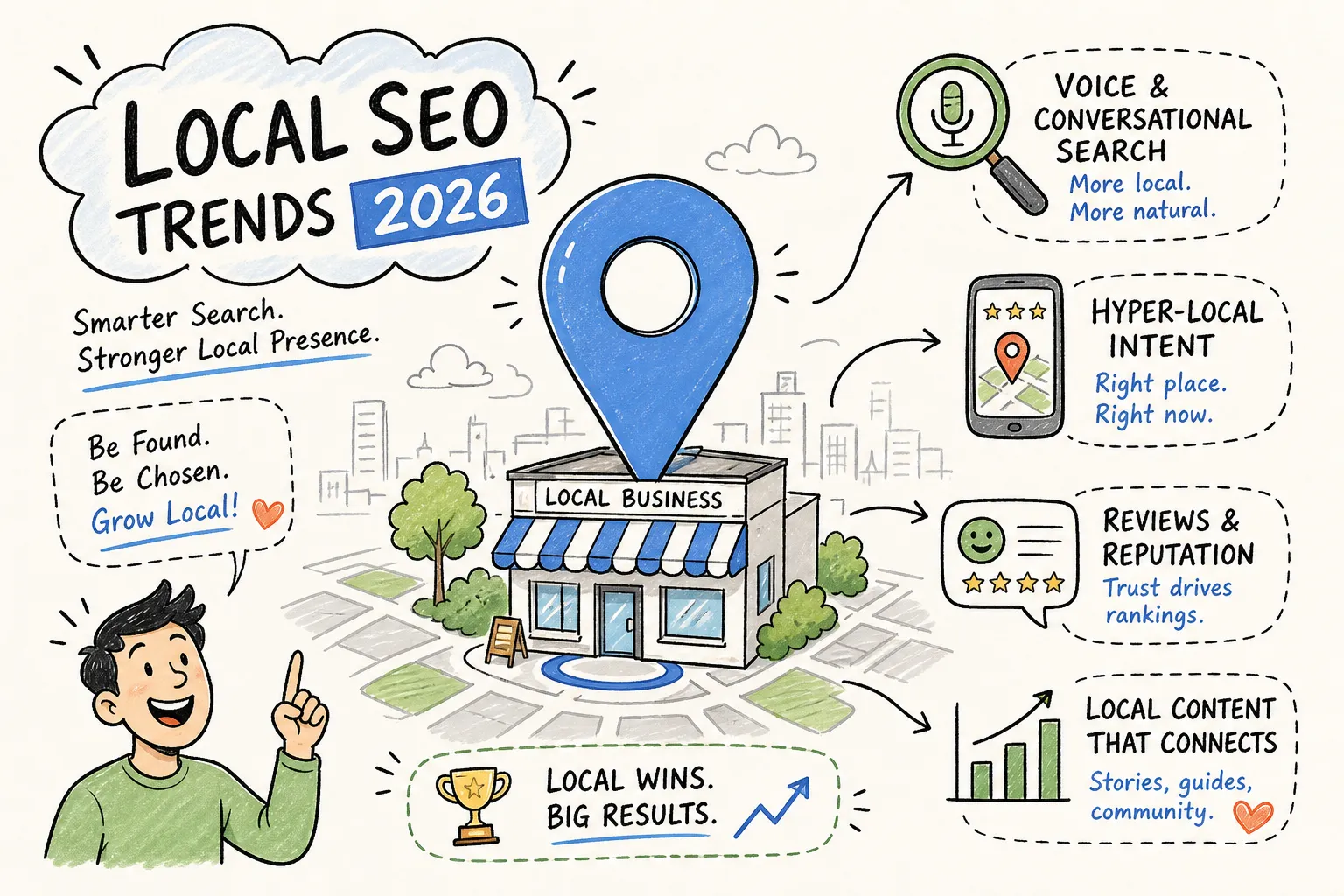
Local search in 2026 looks fundamentally different from even 18 months ago. The playbooks that worked in 2024 are producing diminishing returns, a pattern we’ve observed consistently across client accounts in competitive US markets. According to the Whitespark 2026 Local Search Ranking Factors survey, Google Business Profile now accounts for 32% of map pack ranking signals. That single number should change how you prioritize your marketing time and budget. Understanding which innovative local SEO patterns are actually moving the needle right now is the difference between maintaining visibility and quietly losing ground to competitors who have already adapted.
What’s shifting isn’t just algorithm weighting. These are structural changes in how Google discovers, evaluates, and surfaces local businesses. At Brandleap Agency, our semantic SEO consultancy work gives us direct visibility into these shifts across client accounts in competitive US markets, and the patterns we track are grounded in account-level data, not conference slide decks. The seven patterns this article covers include AI-driven discovery, GBP freshness and attribute precision, hyperlocal content clustering, entity-based optimization, local schema markup, citation authority, and discovery diagnostics.
Each section ends with something actionable. The final section includes a short implementation checklist you can start on today. Local schema markup, local citations and NAP consistency, and near-me search trends all factor into what follows.
Innovative Local SEO Patterns: How AI Is Rewriting the Rules of Local Discovery
Google’s local search is no longer a keyword-match game. It’s an intent-matching engine powered by AI Overviews and zero-click results, and that distinction changes everything about how you position your business profile. Many small business owners are still focusing primarily on branded searches, and that’s a problem, because 86% of GBP impressions now come from category-based “near me” and intent-driven queries, not searches where someone typed your business name directly.
The discovery model has flipped. Your potential customers are finding you through category relevance and behavioral signals before they ever know your name exists. If your profile isn’t optimized for how Google categorizes your business and interprets your service descriptions, you’re invisible to the majority of people searching in your area. Near-me search trends have made category and intent alignment the primary battleground for local visibility.
Google’s “Ask Maps” and AI-Generated Short-Lists
The “Ask Maps” feature takes this further. Google now contacts businesses on behalf of users to ask about pricing, availability, and hours, often before a user has selected a result. The profiles landing on those AI-generated short-lists share a consistent set of traits: recent reviews, fresh photos uploaded within 60 days, complete attribute fields, and service descriptions written in natural language that matches how people actually speak. Generic, keyword-stuffed service descriptions don’t make these lists. Clear, structured, conversational profile content does. For a deeper look at how GBP is evolving with AI-driven features, see the Google Business Profile AI guide (2026) which outlines practical implications for profile content and verification.
Practically speaking, your GBP data needs to read like a conversation, not a corporate brochure. A roofing company that describes itself as “providing premium residential and commercial roofing solutions” is speaking past the customer who searched “emergency roof repair near me.” Describe what you do in the same words your customers use when they search for it, and you close that gap.
GBP Micro-Optimizations with Outsized Ranking Impact
Most GBP optimization advice stops at “fill everything out.” In 2026, a complete profile is table stakes. The innovative local SEO patterns actually moving map pack rankings are more precise than that, and many businesses haven’t implemented them yet.
The 30-Day Freshness Rule That Many Businesses Overlook
Profiles inactive for 30 or more days see measurable visibility drops. Google rewards profiles it can classify as real, current, and trustworthy, and inactivity signals that a business may not be operating normally. The practical cadence this creates is straightforward: add new photos at least every 60 days, publish posts or event updates monthly, and treat your GBP like a living storefront rather than a set-it-and-forget-it listing. A single recent photo outperforms a large collection of outdated images. Google isn’t evaluating the volume of your profile content. It’s evaluating whether that content reflects a business that’s active right now. For tools and platforms that help manage this cadence and other profile maintenance tasks, check resources that review the best management tools and platforms for Google Business Profile management, which can help scale consistent updates and verification workflows (best Google Business Profile management tools).
Category Precision and the Attributes Driving Discovery
Your primary category is the single most important individual ranking factor in the Whitespark 2026 survey. It functions as a strict relevance filter. If your primary category is even slightly off, you’re competing in the wrong pool. Beyond category selection, 2026 introduced new attribute fields around sustainability practices, accessibility features, and service guarantees. These aren’t cosmetic additions. They serve as AI answer signals that determine whether your business appears in filtered, high-intent searches.
Video verification is now standard for storefront and service-area businesses, and unverified profiles are excluded from high-intent searches entirely.
If your profile isn’t verified, everything else in this article is irrelevant until that’s resolved.
Hyperlocal Content Clustering: Innovative Local SEO Patterns in Action
This is where semantic SEO and local SEO converge, and it’s where most small businesses leave the most significant ranking opportunity sitting untouched. A single location page cannot carry all the local relevance signals Google needs to surface your business across an entire service area.
Why One Location Page Isn’t Enough
Hyperlocal content clustering means building a network of neighborhood-level, service-area-specific pages that collectively signal topical authority for your location. The results from implementing this approach are far from marginal. In one Brandleap client engagement, combining local schema markup with seven service-area location pages moved average rankings from position 13.40 to 8.20 and pushed top-3 map pack appearances from 1% to 31% in three weeks. Pages showing “out of map pack” dropped from 26% to 4% in the same period. For detailed examples of how this approach works in different verticals, see Brandleap’s vertical guides like Local SEO for Jewelry Stores: The Ultimate Guide, 2026 and our vertical playbook Local SEO for Real Estate: Rank Higher in Your Market, 2026.
Building Content Clusters That Align with Google’s Service Area Mapping
The structure that produces these results follows a clear pattern: a primary location hub page, supporting neighborhood or suburb pages, and on-page content that addresses specific local intent rather than generic service descriptions. A plumber in Chicago shouldn’t have one page that says “plumbing services in Chicago.” They should have a hub page supported by cluster pages targeting Lincoln Park, Wicker Park, Logan Square, and so on. Each cluster page should address the specific concerns and search patterns of residents in that neighborhood. For tactical guidance on designing content clusters that support topical authority, see this overview of content clusters and how to structure supporting pages around a central hub.
This approach feeds Google’s entity graph directly. When your content cluster consistently signals what you do, where you do it, and who you serve, Google’s ability to trust and surface your business increases substantially. Generic location pages tell Google almost nothing useful. Hyperlocal clusters tell Google everything it needs to place you confidently.
Entity-Based Optimization and Local Schema Markup
Entity optimization is the foundation of durable local rankings. It’s also the area where most SMB SEO underinvests, largely because it’s less visible than a new review or a freshly published post. Ensuring every signal your business sends reinforces a single, consistent entity definition is at the core of Brandleap Agency’s semantic SEO consultancy framework, and it’s what compounds ranking authority over time.
The Schema Types with Proven Map Pack Impact
LocalBusiness schema with comprehensive fields produces measurable results. In a Brandleap engagement tracking an auto collision shop, structured data combined with a strong citation profile expanded map pack coverage area from 24% to 30% within 30 days. The schema fields that drove this included opening hours, payment methods, service areas, geo-coordinates, and service-specific markup. Using the most specific subtype available, not just “LocalBusiness” but “AutoRepair” or “Dentist” depending on your industry, gives Google the granular relevance signals it needs to match your profile to the right queries.
Aligning Your Business Entity Across the Web
Entity alignment means your GBP data, your website structured data, and your citations must tell a consistent, identical story. When Google’s knowledge graph encounters conflicting signals about your business name, address, category, or service descriptions, it reduces trust in your profile data. When every source confirms the same entity definition, that trust compounds. The practical implication is that schema implementation isn’t a one-time technical task. It’s an ongoing consistency discipline that requires your GBP data and your on-site structured data to be audited together regularly.
Citation Authority and NAP Consistency in 2026
Citations don’t carry the standalone weight they once did, but inconsistent NAP data is still one of the fastest ways to undermine every other signal you’re building. Think of it as a trust tax: every inconsistency forces Google to reconcile conflicting information, and that reconciliation effort reduces confidence in your entity data. Local citations and NAP consistency remain foundational, not because they drive rankings on their own, but because without them, nothing else performs at full capacity.
A Tiered Citation Strategy Built for 2026
The approach that works in 2026 follows a four-tier structure. Tier 1 covers your GBP and Yelp listings, handled manually with maximum precision. Tier 2 covers data aggregators like Infogroup and Acxiom, which feed dozens of downstream directories automatically. Tier 3 targets industry-relevant directories specific to your niche. Tier 4 covers local chamber of commerce listings and regional “best of” lists. Build 5 to 10 quality citations per month rather than bulk-submitting 50 at once. Citation building at scale without quality control creates more problems than it solves.
Auditing and Cleaning Inconsistencies Before They Compound
Define one canonical version of your NAP data and align everything to it, down to formatting details like whether you write “Street” or “St.” Tools like BrightLocal and Whitespark’s citation finder surface existing inconsistencies and duplicate listings efficiently. According to BrightLocal’s citation research, duplicate listings with conflicting NAP data are the most common cause of citation-related ranking problems, and correcting them typically produces noticeable visibility gains within 60 to 90 days. Run a citation audit before you build new citations. Cleaning what exists will often outperform adding new listings.
Diagnosing Discovery Pattern Drops Before They Compound
Pattern awareness matters less than early detection. Catching a quiet erosion in your map pack position before it becomes a recovery project is what distinguishes businesses that maintain rankings from those scrambling to understand why they disappeared.
The Tools and Metrics That Surface Local Visibility Problems Early
Geo-grid tracking tools give you position-level visualization across your service area. Local Viking and BrightLocal both provide heatmap-based rank tracking that shows you exactly where your rankings are holding and where they’re slipping. Inside GBP Insights, the Discovery versus Direct search split is the metric to watch. A drop in discovery impressions signals lost organic visibility. A simultaneous drop in calls and direction requests is the earliest behavioral warning sign that a ranking problem has already started affecting real customers. Cross-reference these signals with Google Analytics UTM tracking on your GBP website link to confirm whether the drop is confined to your profile or also affecting your site traffic. For practical troubleshooting steps and common causes of drops in Google Business Profile visibility, see this diagnostic guide to Google Business Profile ranking drops (Moz: Google Business Profile ranking drop diagnosis & fix).
A Short Implementation Checklist to Act on Today
These seven actions map directly to the innovative local SEO patterns covered in this article. Work through them in order, since each one builds on the one before it.
- Verify your GBP status and ensure video verification is complete
- Schedule a 30-day update cadence for photos, posts, or offers
- Audit your primary category against your top revenue-driving service
- Map out a hyperlocal content cluster for your top two or three service areas
- Implement or audit LocalBusiness schema with geo-coordinates and service-specific fields
- Run a citation audit using BrightLocal or Whitespark and define your canonical NAP
- Set up weekly geo-grid rank tracking with Local Viking or BrightLocal
Start applying these innovative local SEO patterns today, this checklist is the baseline Brandleap Agency uses with new consultancy clients to make every subsequent optimization decision measurable.
These Patterns Work as a System, Not a List
The seven local SEO patterns this article covers, AI-driven discovery, GBP freshness and attribute precision, hyperlocal content clustering, entity alignment, schema markup, citation authority, and discovery diagnostics, none of them works in isolation. The businesses pulling ahead in map pack rankings in 2026 are treating local SEO as an interconnected system where every signal reinforces the others. A perfectly optimized GBP with inconsistent citations undermines itself. Strong schema with a stale profile sends mixed trust signals. The system only performs when the components align.
If you’re unsure where your current local search footprint stands or want a specialist to audit it with fresh eyes, Brandleap Agency’s semantic SEO consultancy is built for exactly this kind of structured, ROI-focused work. Ben Stace and the Brandleap team work through the innovative local SEO patterns outlined in this article with clients across a range of industries and US markets. Explore our local SEO resources on the Brandleap blog or reach out directly to discuss a consultancy engagement. To learn more about our offerings, including managed engagements, see Best Local SEO Service, Brandleap Agency.
Businesses that implement these patterns systematically are compounding their local authority month over month. Based on what we see across client accounts, the businesses that delay six months will find it meaningfully harder to close the visibility gap, because their competitors won’t be standing still.