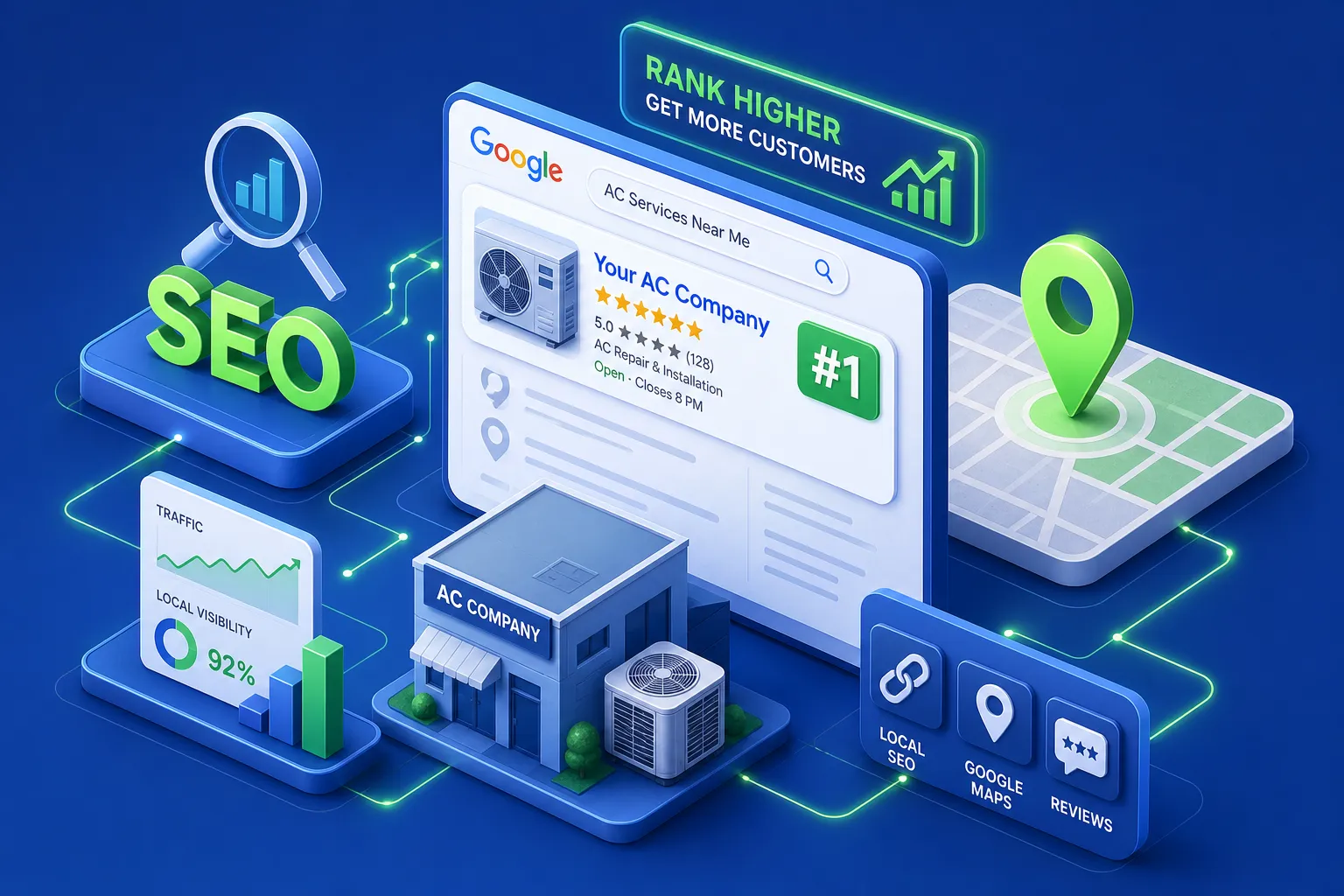
When a homeowner’s AC dies at 7 p.m. on a Tuesday in August, they’re not scrolling to page two of Google. They’re calling one of the first results in the local map pack, and research shows 88% of HVAC searches result in a service call within 24 hours. “AC repair” searches spike 266% in July, and “emergency AC repair near me” volume climbs nearly 400% from winter to peak season. That demand window is narrow, urgent, and worth real money to the contractor who owns it. An effective AC company SEO strategy puts your business in front of those searchers before a competitor does.
HVAC is one of the most geographically concentrated service categories in local search. Your competitors aren’t national brands with eight-figure marketing budgets. They’re the three other contractors in your zip code who’ve figured out that local search visibility is a revenue lever, not a vanity project. The good news: many of them are still getting the basics wrong, which means the window to establish dominance is still open.
This guide is built from the same SEO framework the team at Brandleap Agency applies when onboarding home service clients, where seasonal demand volatility and local pack visibility determine whether a campaign pays for itself within the first quarter. You’ll walk away with clear priorities: local pack factors, seasonal content timing, Google Business Profile optimization, citation building, and a framework for evaluating whether an agency is actually measuring booked jobs.
Why HVAC search intent doesn’t behave like other local categories
Most local service searches allow a homeowner to comparison shop for hours or even days. AC repair in summer removes that window entirely. When someone searches “AC not cooling” at 6 p.m. in July, they are not browsing options. They’re ready to call the first credible result that appears, and they are unlikely to return to comparison shopping the following day.
Emergency intent queries like “AC stopped working” and “24/7 emergency HVAC” carry a ready-to-call signal that other home service categories rarely match. Landscaping and remodeling leads have research cycles measured in weeks. HVAC emergency leads have research cycles measured in minutes. This urgency gap means local pack placement isn’t just a ranking metric for heating and cooling companies. It’s the difference between receiving a call and being completely invisible during your highest-revenue window.
The data reinforces this: 88% of all HVAC searches result in a service call within 24 hours, and businesses appearing in the local map pack top three are four times more likely to receive those calls than businesses that don’t. The top three results capture the majority of clicks on high-intent HVAC queries, particularly emergency searches where users want the fastest credible option. Optimizing for the local pack requires a fundamentally different strategy than ranking for standard organic blue links. It’s driven by Google Business Profile signals, proximity, and review volume, not just on-page content length.
AC company SEO: building a season-aware strategy for AC and heating companies
“AC repair” searches peak in July, but if your content and GBP updates aren’t in place by March, you’ve missed the indexing window. Google needs time to crawl, evaluate, and weight new content before it surfaces in high-competition local queries. Publishing a pre-season tune-up landing page in June to capture July traffic is too late. The content needs to be live and gaining signals months before peak demand hits.
The framework is straightforward: publish “pre-season prep” content starting March 1 for cooling season and September 1 for heating season. AC tune-up service pages, system maintenance landing pages, and energy efficiency guides published in early spring will have the authority to rank when July search volume spikes. The same logic applies in reverse for furnace content heading into fall. One additional tactic that produces measurable lift is the seasonal GBP category swap: switching your primary category between “Air Conditioning Service” in spring and summer and “Heating Contractor” in fall and winter to align your listing with the dominant search intent at each point in the year. Industry timing guidance typically points to April and October as the practical switch dates.
Shoulder months are where smart heating and cooling SEO creates a revenue floor, not just a seasonal ceiling. Searches for “pre-season maintenance,” “indoor air quality upgrades,” and “when should I replace my HVAC system” spike from March through April and September through October. These are proactive homeowners with high retention potential, and most contractors ignore them entirely. A cadence of one to two posts per month covering maintenance bundles, financing content, and indoor air quality upgrades fills technician schedules during slower periods and builds the topical authority that supports peak-season rankings.
Google Business Profile optimization that drives service calls
For HVAC local pack optimization, GBP primary and secondary categories are the single strongest ranking signal within Google’s direct control. The data is specific: using four or more additional categories correlates with an average map ranking of 5.2, compared to significantly worse performance for profiles with no additional categories. That’s a meaningful gap, and most contractors leave it on the table by defaulting to a single category and calling it done.
Category strategy
A recommended category stack starts with “HVAC Contractor” as the primary, then layers in secondary categories like “Air Conditioning Service,” “Heating Contractor,” and “Air Duct Cleaning Service” based on your actual revenue mix. Don’t add categories for services you don’t actively sell. The goal is alignment with real search intent, not padding the profile. Apply the seasonal swap to the primary category in April and again in October to match the dominant queries your potential customers are typing.
Review velocity
Review velocity and response time function as direct ranking inputs, not just social proof. Automated review request systems triggered post-job via SMS are the fastest method to lift local pack position. Send the request within one to two hours of job completion, while the customer’s experience is fresh. Follow up once, 24 to 48 hours later, for non-responders. Respond to every review within 24 hours.
Seasonal category swaps
For HVAC companies operating from a home address with a hidden location on their profile, review content becomes even more critical because physical proximity signals are reduced, making review volume and keyword-rich review content the primary trust mechanism. Pairing consistent review acquisition with timely category swaps maximizes your profile’s relevance across both cooling and heating seasons.
AC company SEO: citations and backlinks that move the local pack needle
NAP consistency across directories underpins citation strategy, and inconsistency actively suppresses rankings rather than just failing to help them. A listing with “Suite 100” in one place and “Ste 100” in another across 30 directories creates conflicting signals that Google interprets as uncertainty about your business’s legitimacy. Start with the highest-authority general platforms: Google Business Profile, Yelp, HomeAdvisor, Angi, BBB, and Facebook. These carry the broadest reach and the highest domain authority in this category.
Layer in HVAC-specific directories next: HVAC.com, Houzz, Porch, and Thumbtack. These validate category relevance to Google’s local algorithm. General citation volume matters, but category-specific citations tell Google your business belongs in HVAC-related searches specifically. Data aggregators like Data Axle and Foursquare feed information to hundreds of smaller directories simultaneously, so getting your NAP right at the aggregator level amplifies consistency across the entire directory ecosystem.
Local backlinks carry disproportionate weight for map pack rankings in U.S. cities. A link from your city’s chamber of commerce directory, a local news outlet’s business section, or a city government contractor registry signals geographic relevance in a way that no national directory replicates. Building editorial links with complementary local contractors, electricians, plumbers, and general contractors, can strengthen your local backlink profile, provided the relationships are genuine and not part of a structured reciprocal scheme. Excessive reciprocal link exchanges can draw algorithmic scrutiny, so prioritize natural, contextually relevant partnerships over volume.
What organic search actually delivers: benchmarks worth tracking
A well-optimized HVAC website converts 5 to 8% of organic visitors into leads. Top-performing emergency service pages reach 10 to 12%. The industry-wide median SEO ROI for HVAC sits at 27x, with the bottom quartile still returning more than 12x. These aren’t optimistic projections, they’re benchmarks drawn from tracked campaigns across real HVAC contractors, and they reflect what’s achievable when the strategy focuses on the right queries with the right conversion infrastructure in place.
One number worth paying close attention to: organic customers generate an average of $1,079 more per ticket than customers acquired through paid channels. For high-ticket installations and full system replacements, that difference compounds significantly across a year’s worth of closed jobs. Phone leads from organic search convert at 46%, with 37% closing on the first call. This is why call tracking from organic is not optional. It’s how you connect rankings and traffic to actual revenue, not just impressions and sessions.
Use call tracking numbers assigned specifically to your GBP listing and your organic landing pages, separate from the numbers on paid ads. Track call volume, call duration, and lead-to-booked-job rate by source.
Booked service calls are the metric that maps directly to revenue, and your reporting structure should reflect that hierarchy from day one. Traffic and keyword rankings are intermediate signals worth monitoring, but they earn their place only when connected to a closed job downstream.
What to look for when evaluating an HVAC SEO agency
A generalist agency reports clicks and keyword positions. A specialist in HVAC marketing services reports call volume, cost per lead, and lead-to-job rate, because those are the numbers that determine whether the engagement is profitable. HVAC has seasonal demand volatility, emergency search patterns, and a local pack dependency that most generalist agencies never account for in their reporting or strategy cadence. A consultancy that understands home service competitive dynamics builds the campaign around those realities from the beginning, not as an afterthought after the first quarterly review.
That’s the model applied at Brandleap Agency. The approach to HVAC and home service clients is built around organic lead pipeline, not vanity metrics. The first deliverable is always a seasonal content and GBP audit that maps strategy to revenue periods, not an arbitrary keyword list. This reflects a core principle: the campaign should be structured around when homeowners are searching and what they’re trying to accomplish, not what keywords happen to have the highest monthly volume in a keyword tool.
Before signing a retainer with any agency, ask which specific GBP categories they plan to use and why. Ask how they track calls from organic versus paid. Ask what their reporting cadence is and whether they report booked jobs or just traffic. On cost: in-house SEO runs $80,000 to $150,000 annually once salary, tools, and benefits are factored in. A specialized agency retainer runs $2,000 to $10,000 per month with tools included. The math favors an agency at early and mid-growth stages, provided they’re measuring the outcomes that actually matter to a service business.
Your 90-day local SEO roadmap
The core principle behind effective AC repair SEO and HVAC local pack optimization is this: you’re not trying to rank for every possible keyword. You’re trying to own the local pack during the windows when homeowners have no choice but to call someone right now. Everything else is secondary to that objective.
The sequence below is ordered by impact and dependency:
- Weeks 1 to 4: Audit and optimize GBP categories, activate your review request automation, and clean up NAP consistency across major directories.
- Weeks 5 to 10: Publish pre-season service pages and shoulder-season content targeting maintenance and indoor air quality queries.
- Ongoing: Build out your citation stack with HVAC-specific directories and pursue local backlinks from chambers, local press, and complementary contractors.
- Before scaling: Set up call tracking by source and establish your conversion benchmarks so you can measure what’s working.
Whether you’re running HVAC digital marketing in-house or evaluating an outside partner, the framework in this guide gives you a clear standard for what good looks like and where your current gaps are. If you want a specialist to audit your AC company SEO footprint and build a season-aware roadmap mapped to your actual revenue calendar, Brandleap’s consultancy team works specifically with home service businesses on exactly that. The starting point is always the same: figure out where you stand before deciding where to invest.