Many dealerships invest heavily in third-party lead platforms while their own websites sit buried in Google search results. Car dealer SEO services exist to fix exactly that problem. Cars.com, AutoTrader, and paid search all work, but every lead you buy from those platforms is a lead you don’t truly own, the contact data stays with the vendor, and so does the relationship. Car buyers already know what they want: the model, trim, and price range. They’re typing specific, high-intent searches into Google every day. The dealerships that capture those searches organically don’t pay a platform fee every time a buyer raises their hand.
Dealership SEO helps you own your organic real estate in the markets you serve, rather than renting leads indefinitely. But not all automotive SEO services are built the same. This article breaks down which car dealer SEO services actually move the needle, the KPIs that prove it’s working, realistic timelines, and the questions you need to ask before signing with any agency.
Why car dealer SEO services differ from standard local SEO
The inventory problem: thousands of pages constantly turning over
A typical franchise dealer publishes hundreds of vehicle detail pages (VDPs) that turn over every few weeks as cars sell and new units arrive. Search engines have to crawl a moving target, and many dealer websites lack a robust strategy for managing this at scale. Without proper canonicalization, crawl budget management, and internal linking discipline, Google ends up indexing the wrong pages while the high-intent VDPs shoppers actually search for go unfound.
Dynamic inventory systems generate URL variants filtered by color, mileage, trim, and price, creating thousands of near-identical pages. Bots waste resources on faceted search URLs and sold-inventory pages instead of the make/model landing pages that actually drive leads. This is an inventory SEO problem specific to dealerships, and one that some generalist local SEO providers may not have the dealer-specific expertise to solve.
Why model-level and “near me” intent dominates automotive search
Car buyers search with high geographic specificity: “Honda Accord dealer in Austin,” “used trucks for sale near me,” “Toyota Camry financing Dallas.” Dealership SEO lives or dies on local search performance, not just general organic rankings. The shoppers who type those queries are in active decision mode, not casually browsing. Capturing them at that moment is substantially more valuable than capturing a generic visitor earlier in the funnel, since bottom-funnel searchers convert to leads and sales at a materially higher rate.
The technical SEO gaps that cost most dealer sites their rankings
Most dealer websites are built on vendor-managed platforms like DealerSocket, DealerFire, or Reynolds Web. These platforms prioritize feature sets over performance, and many commonly exhibit bloated JavaScript, uncompressed inventory images, and third-party scripts that tank Core Web Vitals scores. Site speed is both a direct ranking factor and a user experience signal. A slow VDP doesn’t just rank lower. It loses buyers who bounce before the page finishes loading.
Schema markup is the other chronic gap. Most dealer sites are missing structured data for vehicle listings, local business information, and FAQ content. Without proper Vehicle schema, LocalBusiness markup, and structured FAQs, dealer sites forfeit eligibility for rich results in the SERPs, the kinds of enhanced listings that dominate above-the-fold real estate on competitive queries. A basic Vehicle schema implementation identifies the make, model, year, price, and VIN for each listing so Google can surface that data directly in results. A LocalBusiness block locks in your dealership name, address, phone, and hours in a format search engines can read without ambiguity.
The most damaging pattern isn’t any single issue. It’s the combination: slow templates, thousands of duplicate inventory URLs, weak internal linking, and crawl controls that let the wrong pages get indexed while important model pages are missed entirely. A proper technical SEO audit surfaces all of these simultaneously and prioritizes fixes by revenue impact. For practical examples of common problems and how to fix them, see common technical SEO mistakes.
Local car dealer SEO services and Google Business Profile
What a fully optimized dealership GBP actually looks like
For mobile buyers searching locally, your Google Business Profile is often the first thing they see, before your website. A neglected profile directly costs you phone calls and showroom visits. A fully optimized profile for a dealership includes accurate primary and secondary categories (such as “Used Car Dealer” and relevant financing or service categories), complete service inventories, high-quality photos refreshed regularly as inventory changes, geo-relevant business descriptions, and Google Posts that highlight current promotions and inventory.
Review management belongs here too. For local automotive SEO, Google uses review velocity, recency, and content as local pack ranking signals. Build a system that covers the full cycle: a post-purchase email and text sequence, staff training to ask at key service moments, and a process for responding to every review, positive and negative. That combination builds the review profile that moves your listing up in the map pack. See Google Business Profile optimization for car dealers for practical tips on GBP tactics and review processes.
Building model + city landing pages that capture ready-to-buy traffic
Dedicated pages for each vehicle-market combination are one of the highest-leverage tactics in car dealership marketing. Pages targeting “Toyota RAV4 for Sale in [City],” “[Brand] Financing in [City],” and “Certified Pre-Owned [Model] near [Neighborhood]” capture buyers at the bottom of the funnel. These aren’t browsers. They’re buyers who have already done their research and are choosing a dealership.
What makes these pages rank: geo-modified keywords in the title and H1, city-specific copy (not templated content spun across 50 locations), embedded maps, live inventory feeds, clear CTAs, and internal links from the homepage and navigation. Financing pages deserve particular attention. Buyers searching for “low down payment car loans [city]” or “auto lease deals [city]” show strong purchase intent, and many dealer sites under-optimize for these financing-related queries despite the conversion potential they represent.
What a real car dealer SEO services retainer should include each month
Any reputable dealer SEO agency engagement should deliver a consistent set of core services each month. Look for the following in your retainer agreement:
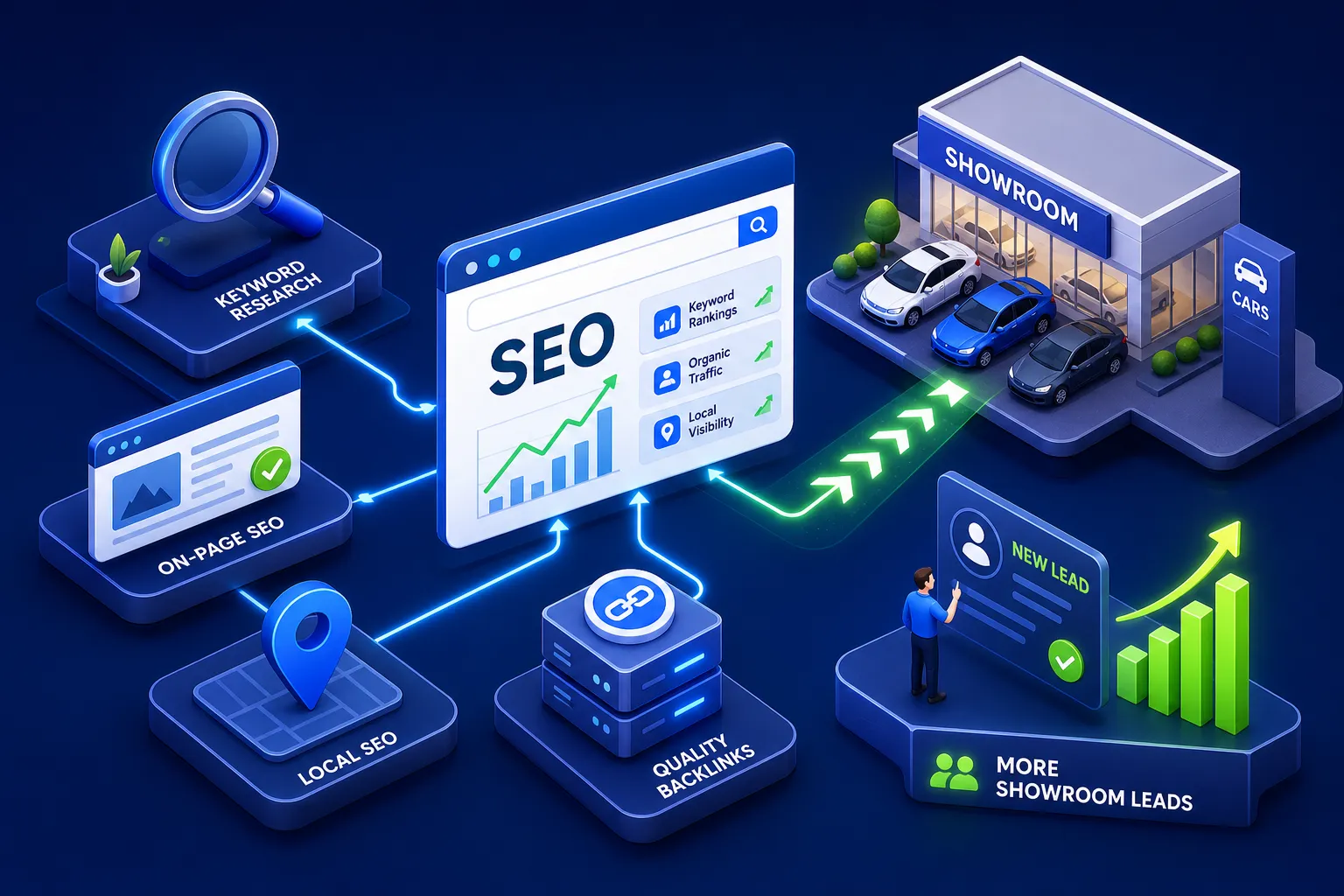
- Keyword research and strategy updates
- On-page optimization (title tags, meta descriptions, headers, internal links)
- Local SEO management (GBP, citations, NAP consistency)
- Technical SEO monitoring and fixes
- Content development (make/model pages, financing pages, location pages, blog content)
- Link building from relevant automotive and local sources
- Monthly reporting tied to actual business outcomes
Be cautious about deliverables that look active on a dashboard but don’t produce results. Generic blog posts with no keyword strategy, vanity ranking reports disconnected from lead data, and link building from irrelevant directories are common filler items in poorly constructed retainers. A reputable agency should be able to connect every line item in their reporting to organic leads, phone calls, or VDP engagement, not just rankings on a PDF.
On pricing: single-point dealers should expect to invest $1,500 to $5,000 per month for a full-service engagement, with multi-rooftop groups or high-competition markets typically running higher. The cheapest retainers rarely include meaningful content creation or link building. Frame the investment against what a single additional car sale generates in gross profit. At that math, SEO stops looking like overhead and starts looking like a revenue channel with compounding returns.
What SEO results actually look like at 3, 6, and 12 months
Months 1 through 3: foundations and early signals
The first three months are foundational: technical SEO cleanup, GBP optimization, inventory indexing strategy, and initial content deployment. Dealers should expect improvements in Google Search Console (impressions up, crawl errors down), early GBP lead volume increases (calls, direction requests), and initial ranking movement for lower-competition terms. A 20 to 40 percent lift in organic traffic from baseline has been documented in early-stage dealership SEO programs, though outcomes vary based on starting baseline and local market competitiveness.
Month 6 and beyond: when leads and ROI become measurable
By month six, content depth, local authority, and technical health compound into meaningful lead volume. Organic leads, phone calls from GBP, and VDP engagement should all show clear upward trends. The four KPIs every dealership should track throughout the engagement:
- Organic leads (form submissions plus chat initiations from organic search)
- Phone calls from organic and GBP
- VDP views from organic traffic
- Local pack rankings for priority model and city terms
By month twelve, SEO should function as a primary lead channel. Dependence on third-party platforms and paid leads should begin to drop materially. The strongest ROI often compounds between months nine and eighteen, which is why dealerships that abandon SEO programs at the six-month mark rarely see the full return their investment earned.
How to choose the right car dealer SEO services provider
The problem with large automotive SEO vendors
Many large dealership-focused SEO vendors sell a standardized package built to service hundreds of rooftops simultaneously. They use templated content, shared playbooks, and account managers who oversee far too many clients to give any single dealership meaningful attention. The result: dealerships pay monthly retainer fees for work that looks active on a dashboard but doesn’t translate into showroom traffic.
The red flag to watch for is an agency that cannot show you specific examples of ranking improvements and lead growth tied to their actual work on a client’s account. Generic case studies and aggregate stats are not the same thing as a documented before-and-after on a real dealership in a competitive market. For curated lists of reputable firms and examples of agencies that deliver results, review automotive SEO companies that deliver results.
What to look for in a boutique auto dealer SEO agency
The smarter alternative to a large platform vendor is a boutique agency with a founder-led model where strategy and execution stay with the same accountable team. The best boutique partners operate this way: strategy and execution under one roof, no handoffs between siloed departments. That integration means the strategy set in month one is the same strategy executed in month six, with no version loss between a sales team and a delivery team. Brandleap Agency is built on exactly this model, with technical SEO, content, local SEO, and reporting all handled by the same core team that sets the strategy.
Before signing with any dealer SEO agency, ask these questions directly:
- Who will be managing my account day-to-day, and what is their caseload?
- Can you show me specific case examples from automotive or competitive local verticals, with before-and-after organic lead data?
- How does your reporting connect back to actual leads in my CRM, not just keyword rankings?
If an agency hesitates on any of those three, you have your answer. The right partner won’t just answer them. They’ll come prepared with the documentation before you ask. If you need help articulating vendor value and structuring the RFP, see How to Sell SEO: Boost Your Business Today, 2026.
Read a practical car dealership SEO guide for additional tactics you can evaluate during vendor interviews.
Your next move: from reading to action
Car dealer SEO services are not a commodity. The difference between agencies that produce rankings on a PDF and agencies that produce leads in the CRM comes down to specialization, accountability, and execution quality. Dealerships that treat organic search as a genuine growth channel consistently outperform competitors who rely on paid lead platforms for every customer in the door.
Where you start depends on your current situation. If you’ve never had a technical audit, start there. A proper audit will surface the specific crawl, indexation, and speed issues that are costing you visibility today. If you’ve worked with an agency that underdelivered, the questions above will help you run a sharper RFP process the second time around. And if you want to test results before committing to a full retainer, a pilot engagement with a focused boutique partner gives you a practical way to see what data-driven, personalized dealership SEO looks like in execution. For a comparable vertical playbook, see SEO Services for Real Estate Agents: A Complete Guide, 2026.
Buyers searching for your inventory are out there right now. The question is whether they find your website or your competitor’s.