When clients ask how to compare rankings to website visibility, the conversation at Brandleap Agency usually starts the same way: the business owner pulls up their rank tracker, points to three or four keywords sitting comfortably in the top five, then slides over a Google Analytics report showing organic traffic that’s been flat for months. The rankings look fine. The traffic doesn’t match. Something is off, and the gap between those two data points is exactly where most SEO decision-making breaks down.
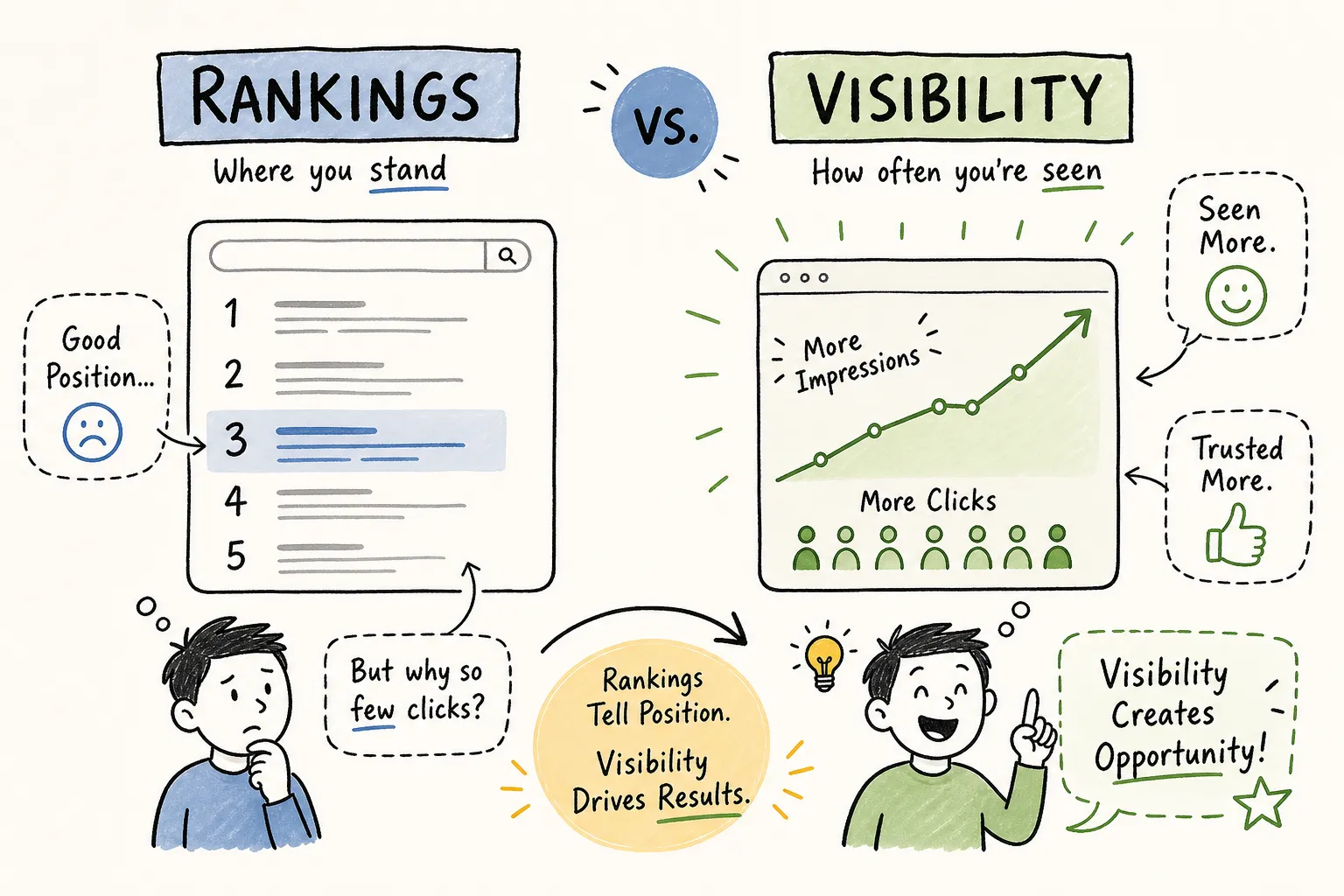
The problem isn’t that rank tracking is useless. It’s that ranking position and search visibility are measuring two fundamentally different things, and treating one as a proxy for the other leads to decisions built on an incomplete picture. A keyword position tells you where you showed up for one specific query. A visibility score tells you how much of the broader search landscape you actually own. These are not the same metric, and reading them independently produces strategy gaps that are costly to close later.
This article breaks down both metrics precisely: what they measure, how they’re calculated, how to pull and compare them properly, what the gaps between them reveal, and how to build a concrete action plan from what the data shows.
What keyword rankings actually measure (and where they fall short)
A keyword ranking is a point-in-time, point-in-place measurement. It tells you where a specific URL sits in the search results for a specific query, on a specific device, in a specific location, at the moment the tracker checked. That’s a useful signal, but it answers only one narrow question: did we show up, and how high? It says nothing about reach, competitive share, or how much of the available organic opportunity the site is actually capturing across the full topic landscape.
Rankings tell you position, not reach
A site can rank in the top three for five keywords and still generate minimal organic traffic if those five terms carry low search volume, attract heavy SERP feature competition, or represent only a thin slice of what users are actually searching around that topic. Position and reach are not the same thing. A #2 ranking for a keyword with 50 monthly searches contributes almost nothing to traffic, while a #6 ranking for a term with 8,000 monthly searches can drive meaningful volume even from a mid-page position.
Why a page can rank in the top 5 and still lose traffic
Google’s results pages in 2026 are dense with features that absorb clicks before users reach standard organic listings. Featured snippets, People Also Ask boxes, local packs, shopping carousels, and paid ads all sit above or alongside organic results and take a meaningful share of click-through. According to CTR benchmark studies from sources such as Backlinko and Advanced Web Ranking, the average CTR for the #1 organic position ranges roughly from 27.6% to 39.8%, depending on how many SERP features appear on that specific query. On heavily featured SERPs, that #1 ranking can fall to the high-teens in CTR. A ranking is not a guarantee of organic visibility in the click-earning sense; it’s a prerequisite that still needs favorable SERP conditions to convert into traffic.
What search visibility really means and how it’s calculated
A search visibility score, sometimes called a visibility index in tools like Semrush, is a site-level or campaign-level metric that aggregates ranking performance across an entire tracked keyword set, weighted by how much organic traffic opportunity each position actually represents. Rather than showing you where you ranked for one query, it answers a broader question: across all the keywords your site is being tracked for, what percentage of the available search real estate are you capturing? That’s a meaningfully different question, and it produces a meaningfully different answer.
The formula most tools use under the hood
The general industry method works like this: each keyword’s ranking position is mapped to an estimated CTR using a position-based CTR curve, then that CTR estimate is multiplied by the keyword’s search volume to produce an expected traffic opportunity value. Those values are summed across all tracked keywords and then normalized against the maximum possible score, what you’d earn if the site ranked #1 for every tracked term. The result is a percentage-based visibility score. This turns rankings into a traffic-opportunity metric rather than a positional snapshot, which is what makes it more useful for strategic planning than a raw position list. It’s also why keyword visibility and organic visibility metrics tend to diverge sharply when a site dominates a narrow niche but has little content coverage beyond it.
How Semrush defines Visibility % and what it actually counts
Semrush’s Position Tracking documentation calculates Visibility % based on CTR by position across the keywords in your active campaign, with the score decreasing as rankings drop and reaching 100% only when the domain ranks #1 for every tracked keyword. According to Semrush’s Position Tracking documentation, one important limitation is that the tool does not publish the exact CTR weights it uses, so the metric is best treated as a directional estimate rather than a reproducible calculation. More importantly, the metric is only as strong as the keyword set you build into the campaign. If your tracked keyword list is too narrow or doesn’t reflect the full topic landscape, the visibility score will look artificially healthy even when your actual organic footprint is weak. That’s a limitation users miss constantly.
How to compare rankings to website visibility using the right data
The right comparison isn’t putting two numbers side by side and calling it analysis. It requires pulling data from the same keyword set, covering the same time period, with consistent device and location filters applied across both sources. When those conditions aren’t met, the gap you’re looking at is often a measurement artifact rather than a real SEO problem. Consistency in the data foundation is what makes the comparison produce actionable insight rather than noise.
Pulling consistent ranking and visibility data from the same keyword set
Start by defining a tracked keyword set in a tool like Semrush, Ahrefs, or SE Ranking. Every keyword in that set should reflect a query your audience actually searches, not just your preferred target terms. Then export ranking data by keyword, URL, device, and region from the same campaign. Your export should include at minimum: keyword, ranking position, URL, search volume, device, country, and date. Using different keyword sets for your ranking analysis versus your visibility score is one of the most common errors in this comparison, and it produces false gaps that send SEO teams chasing problems that don’t exist.
Comparing rankings to SERP visibility with Google Search Console data
Search Console adds a critical layer to any comparison of rankings to website visibility because it reflects what Google actually served to users, not what a third-party tool estimated. Impressions measure how often your pages appeared in search results; average position shows where they appeared on average across all queries that triggered an impression; CTR shows how often those appearances turned into actual clicks. Use these three together alongside your tool’s SERP visibility score to build a complete picture. Impressions function as your organic visibility proxy, average position functions as your ranking proxy, and CTR is the bridge connecting both to the organic traffic numbers in your analytics platform.
One important note on average position: because Google reports the topmost position across all impressions before averaging that value, the number can shift even when your core rankings haven’t moved. This happens because your page started appearing for more queries or on different devices, which pulls the average without changing any individual ranking.
Reading the gaps: what ranking-visibility mismatches reveal
Once the comparison is mapped, patterns in the data point to specific, diagnosable problems. A ranking-visibility gap isn’t random; it signals something structural about how search opportunity is being captured or lost. The two mismatches that surface most often each have a different root cause and require a different fix.
High impressions with low CTR: visibility without clicks
The first pattern, and often the easier one to address, is when a page earns a strong impression count but delivers a below-average CTR. The site has SERP presence but is failing to convert that presence into traffic. This typically points to title and meta description relevance issues, a mismatch between the keyword intent and what the snippet actually promises, or heavy SERP feature competition suppressing click-through regardless of position. In most cases, the fix is not “rank higher.” It’s a content or metadata change aimed at making the snippet more compelling relative to what the user is actually looking for at that moment in their search, for example, rewriting the title to match navigational or transactional intent more precisely, or testing a meta description that addresses the user’s primary concern head-on.
Strong individual rankings with a low visibility score: a narrow keyword footprint
When a site ranks well for a small cluster of target terms but shows a low visibility percentage across the full tracked set, the issue is content coverage, not individual page performance. The site has concentrated authority in a narrow slice of the topic and hasn’t built the broader keyword footprint needed to capture related search demand. This is especially common with B2B service sites that have optimized a handful of core service pages but never built supporting content around the questions, comparisons, and subtopics that surround those core terms in the search landscape.
Building an action plan from what the data shows
The value of comparing rankings to search visibility isn’t in the comparison itself, it’s in the prioritization it enables. The gaps tell you where to focus first: which pages need snippet optimization, which topic clusters need content expansion, and which technical barriers are suppressing crawlability and indexation at scale. Each gap type maps to a distinct category of work, so the data functions as a triage tool rather than just a diagnostic.
Prioritizing by visibility opportunity, not just rank position
Start with pages that have high impressions and low CTR. The search demand already exists for those pages; the search engine is already surfacing them. The fix is often a content or metadata change rather than a full SEO rebuild, which makes this category the highest-leverage place to start. After addressing CTR gaps, move to low-visibility topic clusters by expanding content coverage around terms adjacent to your existing ranked pages. Supporting content, FAQ pages, comparison articles, and long-tail topic coverage are how you grow from a narrow keyword footprint into genuine topical authority.
Where a professional SEO audit goes further than DIY comparisons
The comparison exercise surfaces symptoms but doesn’t always explain root causes. A rankings-versus-visibility analysis might show you that impressions are flat and your visibility score hasn’t moved in three months, but it won’t tell you whether that stagnation is driven by crawlability issues, thin content patterns, keyword cannibalization across multiple pages, or indexation problems that rank trackers and visibility scores won’t flag on their own. That’s where a structured SEO audit goes further.
At Brandleap Agency, our audit process goes a layer deeper than surface-level data pulls. Rather than delivering a list of observations, we diagnose what’s actually driving the gaps and build a prioritized roadmap so clients have a clear path forward from the first deliverable. Learn more about our Top SEO Company Driving Proven Rankings & Growth.
The real goal: managing organic search as a share-of-market metric
Rankings tell you where you stand for individual queries. Visibility tells you how much of the broader search landscape you actually own. Neither metric gives you the full picture on its own, and neither should drive strategy in isolation. The goal of understanding both is to move from tracking isolated positions to managing organic search the way you’d manage any competitive market share question: with data that reflects the whole opportunity, not just the handful of terms you happened to optimize first.
For your business, that translates directly into smarter prioritization, fewer SEO resources spent chasing rank movements that don’t produce traffic, and a clearer line between the work your agency or internal team is doing and the organic growth it produces. Tracking both metrics together, and knowing how to read the gaps between them, is what separates reactive position management from a genuine growth strategy. If you’re focused on UK markets, see our SEO company in London Grow Your Business Online Brandleap Agency for local and national support.
Understanding how to compare rankings to website visibility is the foundation of that shift. If you want to see what your own ranking-to-visibility gaps look like and what’s actually driving them, a Brandleap SEO audit is the clearest route from raw data to a prioritized action plan. Explore our Expert SEO Services in London for Local & National Rankings. Reach out to the Brandleap team and we’ll show you exactly where your organic opportunity is sitting uncaptured.