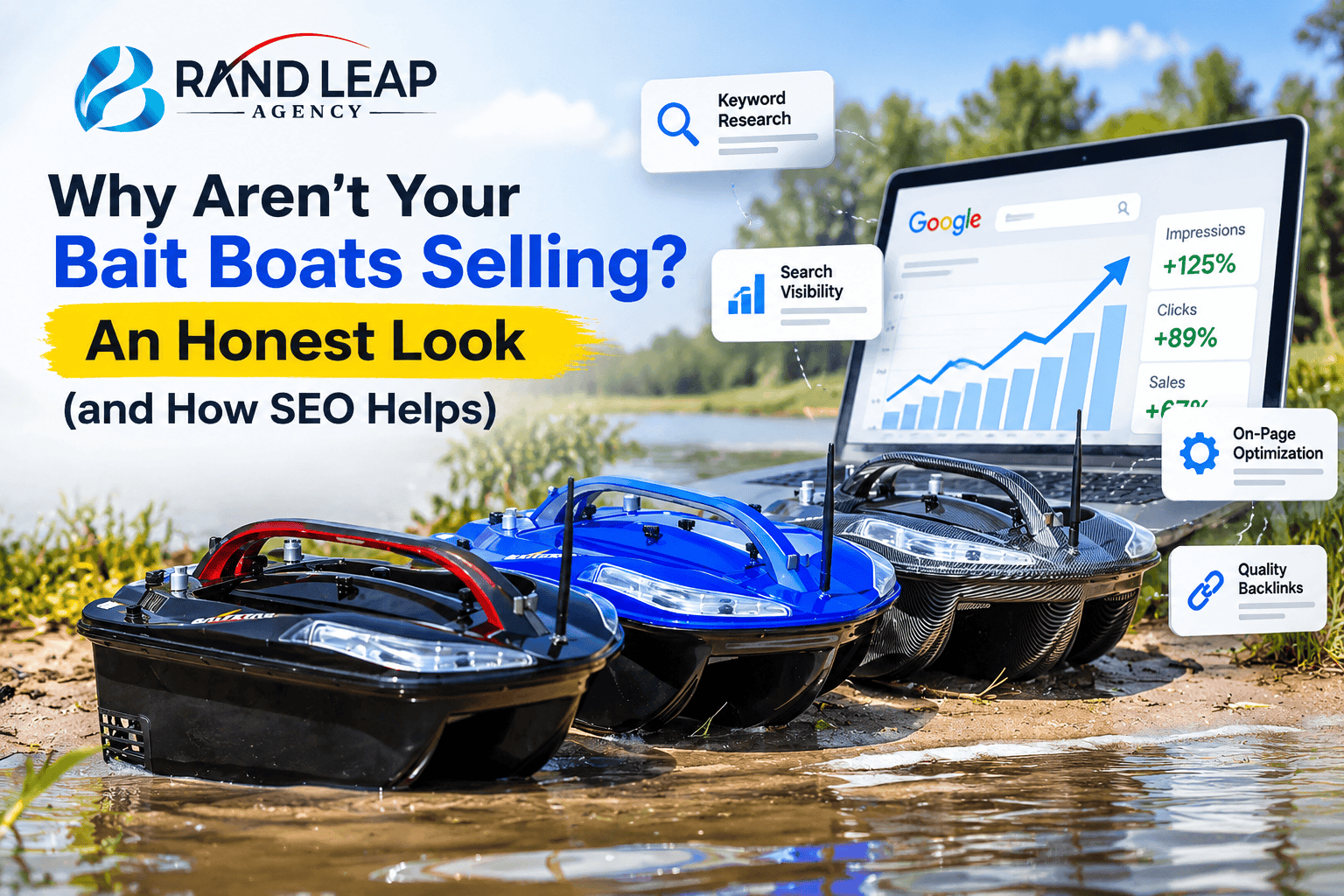
Let’s start with something uncomfortable. If your bait boats are sitting in the warehouse, the boats are probably not the problem.
I see this a lot with online fishing stores. The owner checks the product, the price, the specs, even the competitors, and everything looks fine. Yet orders stay slow. The hard truth is usually simpler: the right anglers never find the store, or they find it and don’t feel sure enough to buy.
A bait boat is not a tub of boilies. It costs real money, it goes out on the water alone, and if it fails, the angler is the one standing on the bank with a dead boat and a ruined session. People think about this purchase for weeks. They read, they compare, they ask around. If your website isn’t part of that research, you simply aren’t in the race.
Let’s go through the reasons one by one, and what you can do about each.
- Buyers Search in Specific Words, and Your Site Doesn’t Speak Them
Think about how a carp angler actually searches. Nobody types “fishing equipment online.” They type things like:
- bait boat
- carp fishing bait boat
- GPS bait boat
- sonar bait boat
- bait boat with fish finder
- best bait boat for carp fishing
- USA bait boat
These are different searches with different intent. Someone typing “best bait boat for carp fishing” is still comparing. Someone typing “GPS bait boat” already knows what feature they want. Someone typing a specific model name is close to buying.
If your pages say “Premium Fishing Boat” or “Advanced RC Vessel,” Google has no clear idea you sell what these people want.
What to do: Give every important page one main keyword and use it naturally in the title, the main heading, the first paragraph, and the image names. Your collection page can target “carp fishing bait boats.” Each product page should target its own model plus its key feature, like “GPS bait boat.” Write the way anglers talk, not the way a catalogue talks.
- Your Product Pages Don’t Answer the Questions in the Buyer’s Head
Picture the buyer on your product page. Before they spend, they are silently asking:
How far can it really go?
How much bait can it carry?
How long does the battery last?
Does it have GPS or autopilot?
Can it show me the bottom with sonar?
What happens if I lose signal?
Who do I call if something breaks?
If the page gives one photo and two lines of text, none of those questions get answered. So the buyer opens another tab, and that tab is your competitor.
What to do: Treat every product page like a conversation with a nervous buyer. Include clear specifications, real photos, a short video of the boat working on actual water, and a plain explanation of who it suits, whether that’s a beginner on a small lake or an experienced angler fishing big water. Add warranty, spare parts, and shipping information too. Longer, more helpful pages usually rank better, and they convert better, because they remove doubt.
- Your Search Listing Doesn’t Give People a Reason to Click
Before anyone lands on your site, they see your title and description in Google. That is your first sales pitch, and many stores waste it.
Compare these two:
“Bait Boat | My Store”
“GPS Bait Boat for Carp Fishing | Sonar Options | Fast US Shipping”
The second one tells the angler exactly what’s inside and why it fits them. The first tells them nothing.
What to do: Put the main keyword near the start of the title, add one clear benefit, and keep the title under roughly 60 characters. Write the meta description like a short, honest invitation, around 155 characters, and mention things buyers care about, like US shipping or support.
- There’s No Content to Build Trust Before the Sale
Here’s something many store owners miss. Most buyers aren’t ready to buy when they first search. They’re learning. If your site has only product pages, you’re ignoring everyone in the learning stage, and that’s most of your audience.
The store that teaches the angler usually wins the sale. Not because it’s pushy, but because it was helpful first.
What to do: Publish guides that match real questions:
How to choose a bait boat for carp fishing
GPS vs non-GPS bait boats: which one do you need?
Sonar bait boats explained
How far can a bait boat go?
Bait boat battery care and maintenance
Whether bait boats are allowed at your venue (rules vary, so tell readers to check with their water)
Each guide should link naturally to the relevant product pages. That’s how an information search turns into a sale.
- You Aren’t Clear That You Serve US Anglers
Many buyers want a seller close to home: local shipping, easier returns, support in their own time zone. If your site doesn’t make it obvious that you serve the US market, they’ll assume you don’t and move on to a store that does.
What to do: Where it fits naturally, use phrases like “USA bait boat” and “carp fishing in the US.” State shipping times, return policy, and support details clearly. Keep your business name, address, and contact details consistent everywhere they appear online.
- Technical Problems Are Quietly Costing You Sales
Sometimes the content is fine and the site is the issue. Slow pages, broken links, missing sitemaps, and awkward mobile layouts all push both Google and visitors away. And remember, plenty of anglers browse on their phones, often from the bank, between casts.
What to do: Run a proper technical check:
Compress heavy images and videos to speed up pages
Fix broken links and 404 errors
Submit your sitemap in Google Search Console
Make sure robots.txt isn’t blocking important pages
Check that the site works smoothly on mobile
Add Product schema so details like price, availability, and reviews can show in search results
None of this is exciting, but it’s the foundation everything else stands on.
- Nobody Is Vouching for You
Google pays attention to who talks about you. If no fishing blogs, forums, or review sites link to your store, it’s harder to outrank bigger names. Buyers also pay attention. A bait boat is a trust purchase, and trust grows when other people recommend you.
What to do: Earn links from places your audience already visits, like angling communities, fishing blogs, and product reviewers. Collect honest customer reviews and show them on your product pages. A few relevant links beat a pile of random ones.
- You Might Be Judged Only on Price
When a store gives buyers nothing else to compare, they compare price. That’s a hard game for a small seller. If your pages don’t explain what makes your boats worth it, whether that’s support, spare parts, testing, or advice, the cheapest listing wins.
What to do: Show your value. Explain why you chose these models, what you test, and how you help after the sale. Real photos, real customer catches, and clear aftercare turn a price comparison into a trust decision.
What Actually Happens When SEO Is Done Right
Put these pieces together and the buying journey changes:
An angler searches “GPS bait boat” and finds your collection page.
They read your guide and finally understand which features matter.
They open a product page that answers their questions, with real photos and video.
They see reviews and clear warranty and shipping details.
They feel confident, and they order.
Notice that you never had to shout. The angler found you while looking, learned from you, and trusted you. That’s what search traffic does, and unlike ads, it doesn’t disappear the moment you stop paying.
A Realistic Word on Timing
SEO isn’t instant, and anyone who promises overnight results isn’t being honest. Most stores start seeing movement in a few months, with stronger results building over six months or longer, depending on competition and the current condition of the site. The good news is that the work compounds. Every guide, fixed page, and quality link keeps working for you.
Frequently Asked Questions
Why are my bait boats not selling online?
Usually buyers can’t find your pages, or the pages don’t give enough detail to feel safe buying. Weak keywords, thin product pages, and technical issues are the most common causes.
Which keywords should a bait boat store target?
Start with “bait boat,” “carp fishing bait boat,” “GPS bait boat,” and “sonar bait boat.” Then add specific model names and US-focused variations.
How long does SEO take to bring sales?
Often a few months to see early movement, and six months or more for stronger results. It depends on competition and your site’s starting point.
Do blog posts really help sell bait boats?
Yes. Guides reach anglers while they’re still deciding and lead them to your product pages.
Is SEO better than paid ads for bait boats?
They work well together, but SEO keeps bringing visitors without paying for every click.
Final Thoughts
If your bait boats aren’t moving, don’t rush to cut the price or blame the season. Look at how easy you are to find, how well your pages answer real questions, and how much a nervous buyer can trust what they see.
Fix those things, and the same boats that sat still can start finding owners.
Want help getting your bait boats in front of the right anglers? Start with a full SEO audit and a keyword plan built around how carp anglers really search.
Ready to grow your business with SEO?
Contact Brandleap Agency for a free website audit and a custom growth plan.