
If you’re weighing up why you should hire an SEO agency instead of a freelancer, the freelancer often looks like the smarter choice on paper: lower rate, direct access, no account manager in the middle. The agency looks expensive, corporate, and full of people you’ll never speak to. It’s a reasonable hesitation. But for most growing UK businesses, a well-structured agency is the stronger investment, and the reasons go well beyond what any rate card shows. This article breaks down the structural, financial, and operational differences between the two models so you can make a decision based on substance rather than assumptions. By the time you finish, you’ll have a clear framework and the specific questions to take into your next provider conversation.
Where the freelancer model starts to show its limits
Freelancers are not inherently the wrong choice. For a contained, well-defined task, a one-off technical audit, a set of content briefs, or a short link-building sprint, a skilled freelance SEO consultant can deliver real value. The problem is not the person; it’s the model. A single specialist has one calendar, one skill set, and a fixed number of hours in the week. As your SEO needs expand across technical work, content production, outreach, and analytics, a single person begins to bottleneck progress regardless of how capable they are.
When a single specialist is enough, and when it isn’t
A freelance SEO consultant fits well in a narrow set of scenarios: a startup with one specific problem to fix, a business that’s testing SEO for the first time, or a company with an in-house team that needs specialist input on a defined area. These situations share something in common: the scope is contained and the dependencies are limited. The picture changes significantly for a growing business that needs ongoing, multi-channel SEO execution with interconnected workstreams. At that point, the constraints of a one-person operation become a structural ceiling, not just a temporary inconvenience.
The skill gap problem that compounds quietly
Most freelancers have a genuine area of strength, whether that’s on-page optimisation, content strategy, or local SEO. Modern SEO is a system, not a single discipline. A freelancer who excels at content may have limited experience in technical SEO, digital PR, or analytics configuration. Over time, these gaps compound. Link-building stays thin. Site speed issues go unaddressed for months. The content strategy lacks the analytical backing needed to prioritise the right topics. The result is rarely one obvious failure; it’s a slow drift away from results that’s hard to diagnose until the gap is significant.
Why hire an SEO agency instead of a freelancer: what full-team delivery actually provides
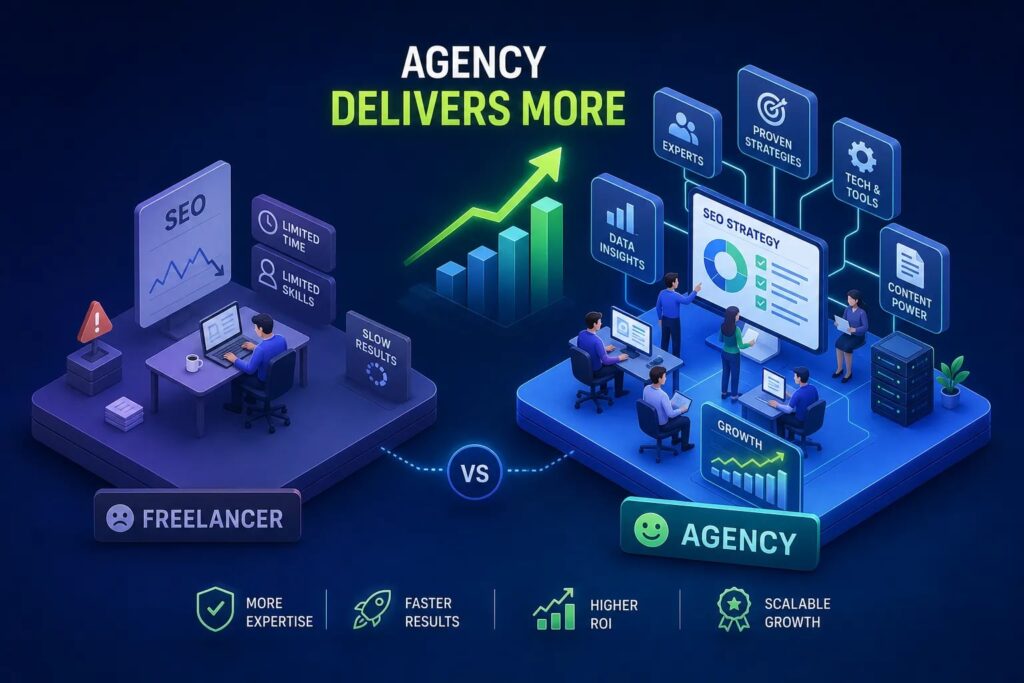
When you hire an SEO agency instead of a freelancer, you are not buying one person’s time at a higher price. You’re buying coordinated specialist capacity across multiple disciplines running in parallel. A typical mid-market UK agency team includes an account strategist, a technical SEO specialist, content support, an outreach and link-building lead, and analytics oversight. Each function operates simultaneously rather than queuing behind a single person, which compresses timelines and raises the standard of execution at every layer.
The disciplines a growing business actually needs covered
SEO as a system has four core disciplines: technical SEO, content production, off-page authority building, and analytics with reporting. When any one of these is missing or underdeveloped, the others suffer. Strong content with weak technical infrastructure won’t rank effectively. A clean, fast site with no authority signals won’t reach its ranking potential either. Reporting that doesn’t connect to commercial outcomes leaves you optimising for the wrong things. A coordinated agency team treats these four areas as interdependent, not as separate to-do lists. This is one of the clearest agency SEO team benefits: no discipline gets left to drift because a single operator ran out of hours.
Parallel workstreams versus sequential tasks
A freelancer, by necessity, moves task to task: complete the audit, then write content, then begin outreach. A team runs these simultaneously. For a business trying to build momentum in a competitive UK market, the compounding effect of parallel execution over six to twelve months is substantial. In practice, work that a solo operator cycles through sequentially can often be completed in a fraction of the time when specialist functions run concurrently, and with higher output quality at each stage. That time difference has a direct impact on when organic traffic begins converting into leads and revenue.
The single point of failure risk most businesses ignore
This is where the risk argument becomes concrete. A freelancer is a single point of failure in every meaningful sense. Illness, a holiday, or an overloaded client roster can halt an entire SEO programme. Unlike an agency, where knowledge is shared, documented, and distributed across a team, a freelancer typically holds all of the campaign context in their head: the technical decisions made six months ago, the content priorities agreed but never written down, the outreach relationships still in progress.
What happens when your freelancer goes quiet
The scenario plays out more often than most businesses expect. The freelancer misses one check-in, then a second. Deliverables slip. Emails get slower responses. By the time the client acknowledges the problem and begins managing it, several weeks of momentum have been lost. The business then spends time recovering lost ground rather than building rankings. It’s not a dramatic failure; it’s a slow stall that costs real competitive ground in markets where rivals are continuing to execute.
The knowledge loss problem when you switch providers
Replacing a freelancer after a programme breakdown is expensive and slow. Without proper documentation, which freelancers rarely maintain at the same standard as agencies, a new provider starts from near-zero. They need to re-audit the site, reconstruct the strategy rationale, and rebuild the reporting baseline before they can begin adding value. Factor in two to three months of ramp-up time and the hidden opportunity cost of that gap, and the “cheaper” option looks considerably less cheap than the headline rate suggested.
How the costs compare when you look past the headline rate
The honest starting point is that the headline numbers overlap more than most people expect. A mid-level UK SEO freelancer on retainer in 2026 typically runs between £1,500 and £3,000 per month. A small-to-mid-market UK agency retainer sits in a comparable range of £1,500 to £5,000 per month depending on scope. The real question is not what the number is; it’s what that number buys. This is where the SEO retainer vs hourly freelancer debate most often misleads businesses into comparing the wrong things.
Breaking down the UK rate reality in 2026
Senior freelancers charge between £100 and £200 per hour. That sounds manageable until you calculate what a full month of coordinated SEO activity across technical, content, and outreach actually requires in hours. At £2,000 per month, a freelancer typically covers one or two disciplines. At a comparable agency rate, a business gets coordinated specialist input across technical SEO, content strategy, and monthly reporting. The cost-per-discipline comparison, not cost-per-hour, is the metric that matters. When you run the numbers that way, the agency rate tends to work out comparably or better for businesses that need more than one discipline covered, which most growing UK businesses do.
The hidden costs of the cheaper option
Missed deadlines, strategy gaps, and time spent managing a solo contractor all carry a real cost that doesn’t appear on the invoice. A marketing manager or business owner spending a non-trivial amount of time chasing updates and filling in strategic gaps is contributing significant resource to a setup that was supposed to reduce their workload. Add that to the ramp-up cost if the relationship breaks down and the gap closes fast. The freelancer’s lower headline rate is frequently an illusion by month six.
The questions and KPIs to use before you commit to either
A polished pitch tells you very little about accountability. The questions you ask before signing a retainer reveal far more than any proposal deck. Whether you’re evaluating outsourced SEO services or a solo consultant, the goal is the same: get to specifics, not generalities.
When to hire a freelance SEO consultant vs an agency: what to ask first
Ask who will work on your account day to day and what their direct experience is. Ask for the process from month one through month six, including specific deliverables and what is excluded from the retainer. Ask how success is measured beyond rankings. Then establish what happens if results plateau after six months. These questions expose the difference between a provider who has a genuine plan and one who is relying on vague promises and impressive-looking terminology. Reluctance to answer any of these clearly is a signal worth taking seriously.
The KPIs that separate confident providers from the rest
A credible SEO provider should be able to discuss all of the following without deflecting to vanity metrics. The indicators that matter for a growing UK business are: organic leads and enquiries, organic traffic from non-branded search terms, conversion rate from organic sessions, keyword visibility for commercially important topics, referring domain growth and backlink quality over time, and technical health scores. If a provider anchors the conversation on raw keyword counts or impressions alone, they’re measuring the wrong things. Results that connect to leads and revenue are the only results worth paying for.
The model that combines expert strategy with full-team delivery
There’s a legitimate concern buried in the agency argument: when you move from a freelancer to an agency, do you lose the strategic depth and personal accountability that a senior specialist provides? It’s a fair question, and it depends entirely on how the agency is structured. The founder-led, team-executed model addresses that concern directly.
One example of this approach in practice is Brandleap Agency. Strategic direction is led by founder and SEO consultant Mithun Baroi, bringing senior-level thinking and clear accountability to every client relationship. Execution runs across a specialist team covering technical SEO, content, paid media, and off-page authority building. The client gets the rigour and insight of working with a principal-level expert without the exposure of relying on a single person for every deliverable.
Why leadership and execution need to be separate functions
SEO strategies can underperform when the person who set the strategy is also responsible for implementing every task. Breadth of thinking and depth of execution require different modes of work, and forcing one person to switch between them continuously can degrade both. A founder-led agency separates those functions deliberately. The strategist shapes the direction; the specialists execute it with precision. The output quality at both levels reflects that separation.
What this means for a business at the growth stage
The businesses that benefit most from this model are past the startup phase, generating consistent revenue, and ready to treat SEO as a long-term growth channel rather than a one-time fix. They need strategic coherence, execution discipline, and a team that can scale the programme as the business grows, without the fragility of a single-person dependency. For businesses at this stage, the structured agency model is consistently better placed to deliver than a freelancer alternative. Brandleap is built specifically for this profile.
Making the right call for your business
Freelancers have genuine value for contained, specialist tasks with a defined scope and a clear endpoint. For those situations, a skilled contractor remains a sensible option. But if you’re asking why you should hire an SEO agency instead of a freelancer for a growth-stage programme, the structural advantages are decisive: broader team coverage, parallel workstreams, shared knowledge, continuity through transitions, and accountability that doesn’t disappear when one person has a difficult month. That is the fundamental difference between outsourced SEO services delivered by an agency and the freelance model.
The key decision factors are team coverage, cost-per-discipline rather than cost-per-hour, knowledge continuity, and the quality of the questions your provider can answer before you sign. Take those four criteria into your next provider conversation and they’ll tell you almost everything you need to know.
If you want to see what a founder-led, full-team approach looks like in practice, Brandleap Agency is worth a conversation. You’ll get a clear picture of how the model works, what’s included from month one, and whether the fit is right for where your business is heading.

BrandLeap Agency & BrandLeap Fashion | Founder & CEO
Mithun is an experienced SEO consultant recognized for helping businesses improve their digital presence through technical SEO, content optimization, and sustainable organic growth strategies. Working in the digital marketing industry since 2019, he has developed expertise in increasing search visibility, driving targeted traffic, and building long-term growth through data-driven SEO solutions. He has worked with businesses across multiple industries, helping brands strengthen their online authority and achieve measurable growth results.