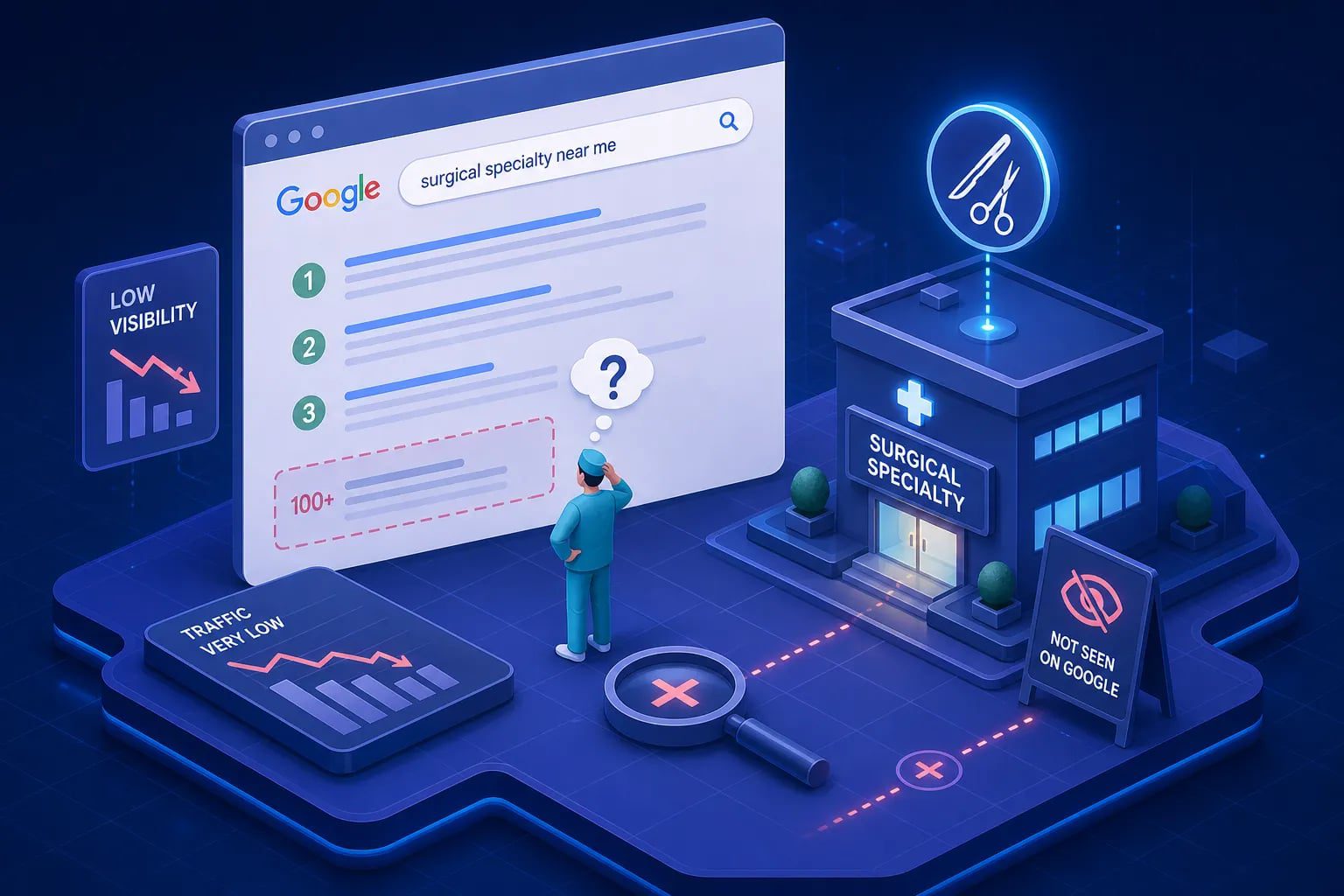
If you currently don’t rank on Google for your surgical specialty, you’re dealing with a predictable problem, not a mysterious one. You built the website. You listed your credentials. You added a contact form and professional photos. Then you typed your specialty into Google and watched three competitors, two hospital networks, and a directory you’ve never heard of appear above you. That is not bad luck. It is a predictable outcome of four specific problems that show up on almost every surgical practice website we audit at Brandleap: thin content, wrong keyword targeting, missing schema, and low domain authority. Each one is fixable. This article walks you through exactly what is happening and gives you six concrete actions to change it.
One honest warning before we get into the fixes: healthcare is one of the hardest niches in search. Google applies its highest-quality evaluation standards to medical content because a patient making a decision based on unreliable information faces real consequences. According to Google’s own Search Quality Evaluator Guidelines and E-E-A-T framework, the bar for ranking medical content is genuinely higher here than in most other industries. The good news is that many surgical websites are not even clearing the basics, which means closing that gap is entirely achievable with the right approach.
Why you don’t rank on Google for your surgical specialty
The search results page for a surgical specialty is not filled with random websites. It is filled with hospital networks, multi-location clinic chains, and established medical directories that have been building domain authority for years. Your practice page is competing against organizations with dedicated marketing teams, content calendars, and technical SEO infrastructure. A five-page website with a generic “Services” page cannot out-rank that through willpower alone. Understanding the competitive gap is the starting point for closing it.
Google evaluates medical content through E-E-A-T: experience, expertise, authoritativeness, and trustworthiness. A practice page that says “we offer laparoscopic surgery” with no author credentials, no supporting procedure content, and no external signals of authority will not clear that threshold. Google needs machine-readable and contextual proof that the person or practice behind the page is the real expert. A generic service description does not provide that proof. Your competitors who are ranking have built more of those signals than your site currently has.
Thin content and wrong keywords are the most expensive mistakes
Thin content is not about word count. It is about whether your page actually answers what a patient types into Google. A single “Our Services” page listing ten procedures in three sentences is thin. A procedure page with one vague paragraph and a call button is thin. These pages give Google no topical relevance to work with and give patients no reason to trust you before they decide to book. The fix is a content cluster: one hub page for your specialty, plus individual procedure pages that each answer a patient’s actual questions about candidacy, costs, recovery timelines, and expected outcomes.
For surgical practices in Egypt, keyword targeting needs to reflect how patients here actually search. Egyptian patients search in Arabic first, and they often combine the procedure, city, and cost into one query. High-intent searches like “عملية تكميم + القاهرة + بكام” (sleeve gastrectomy + Cairo + how much) or “دكتور تجميل + الإسكندرية + سعر” (cosmetic surgeon + Alexandria + price) represent patients who are ready to book, and many surgical websites completely ignore them. If your content is only in English or only targets broad English terms, you are invisible to the majority of your local market. Effective SEO for surgeons in Egypt means building content around how patients phrase their searches, including Arabic-language variants, not how you describe your services internally.
Missing schema markup: the ranking signal your site is probably skipping
Schema markup is structured data that tells search engines, in machine-readable language, exactly what your page is about. For a surgical practice, three schema types matter most.
MedicalBusiness should go on your practice and location pages to identify your business as a medical entity. MedicalProcedure (or the more specific SurgicalProcedure subtype) belongs on each individual procedure page, telling Google precisely what intervention the page covers and who performs it. medicalSpecialty supports your hub page as a contextual entity signal. Many surgical websites have no schema implemented at all, handing a structural advantage to every competitor that does.
Schema does not directly guarantee a ranking jump, but it solves a real problem: it removes ambiguity. Without structured data, Google has to interpret the relationship between your pages and your specialty from plain text alone. With schema, you make those relationships explicit at a machine level. That clarity contributes to entity understanding, which supports rankings in both local map pack results and organic positions. It also makes your pages eligible for rich results on the search results page, which improves click-through rates even before your ranking position changes. Given how few surgical websites implement this correctly, it represents one of the fastest wins available in any medical practice SEO checklist.
Low domain authority and citation gaps are holding back your local rankings
Domain authority is built primarily through backlinks from trusted external sources. For a surgical practice, the challenge is structural: most high-authority websites do not naturally link to a surgeon’s service page. Hospital networks earn links because they publish research, appear in news coverage, and host community events. Individual practices rarely do any of those things, which leaves their websites with a weaker authority profile and a limited ability to compete for high-intent surgical keywords. Passive link building does not work in this niche. You need a strategy.
For local map pack visibility specifically, your Google Business Profile signals carry more weight than on-page factors, making it the single most controllable lever for ranking on Google Maps for clinics and individual practices alike. That means your GBP needs to be fully completed with the correct primary category, all procedures listed as services, recent photos uploaded, and a consistent name, address, and phone number across every directory where your practice appears. Patient reviews also matter significantly: recent reviews with consistent velocity signal to Google that your practice is active and trusted. In Egypt, any review strategy must stay fully compliant with local regulations. That means using only authentic, consented feedback and avoiding any misleading claims about outcomes or superiority. The Ministry of Health and Population guidelines apply to public-facing medical content, and review solicitation falls within the scope of those standards.
The 6-fix action plan for surgical specialty SEO
Apply these in order. Each fix builds on the previous one, so skipping early steps will limit how far the later ones can take you.
-
Optimize your Google Business Profile fully.
Set the correct primary medical category, add every procedure as a listed service, upload recent clinical photos, and activate the messaging feature. This is your fastest path to local map pack visibility and requires no technical expertise to start. -
Build a content cluster around your specialty.
Create one hub page for your specialty area and individual procedure pages beneath it, each targeting a specific patient search intent. Include Arabic-language variants that match how Egyptian patients actually phrase their queries, with city and cost modifiers built into the keyword targets. -
Run a technical SEO audit.
Use Google PageSpeed Insights to identify mobile speed problems. Check Google Search Console for crawl errors, indexability gaps, and coverage issues. Fix broken pages, resolve duplicate metadata, and verify that no important procedure or location pages are accidentally blocked from indexing. -
Implement schema markup on every key page.
Add MedicalBusiness schema to your location pages, MedicalProcedure or SurgicalProcedure schema to each procedure page, and medicalSpecialty to your hub page. Use Google’s Rich Results Test (available at search.google.com/test/rich-results) to verify each implementation before publishing. -
Build your citation profile and review velocity.
Get your practice listed consistently across local directories and healthcare-specific platforms. Ask satisfied patients for authentic reviews, respond publicly to every review, and ensure your NAP data is identical across all listings. Keep all review practices compliant with Egyptian healthcare advertising standards. -
Start a targeted link-building campaign.
Pursue placements in local medical publications, healthcare associations, hospital partner pages, and digital PR opportunities tied to original patient education content or procedure guides. A small number of high-quality backlinks from authoritative medical domains can measurably shift your authority in a competitive local market; benchmark your target number against your top-ranking competitors’ link profiles to set realistic expectations.
When specialized expertise makes the difference
DIY SEO works in low-competition niches. Surgical specialties are not a low-competition niche. The competitors outranking you are often applying all six of the fixes above simultaneously, while also running paid ads, producing video content, and building brand authority across multiple channels. Closing that gap as a solo practitioner or small practice team is genuinely difficult without external support, because the execution requires technical knowledge across multiple disciplines at the same time.
At Brandleap Agency, we work specifically with service-based businesses in competitive niches where generic SEO advice fails. Our team includes dedicated specialists for technical SEO, content strategy, off-page authority building, and local SEO, rather than a single generalist handling everything at once. For surgical practices, our approach covers a structured audit, a content cluster built to match actual patient search behavior in your market, full schema implementation verified for correctness, and a white-hat link strategy designed specifically for the healthcare environment. That disciplined, multi-track approach is how we move rankings in this space.
Your next step is simpler than you think
If you don’t rank on Google for your surgical specialty right now, that is not a permanent condition. It is a fixable combination of thin content, missing schema, mismatched keyword targeting, and insufficient domain authority. The six fixes above give you a clear, prioritized starting point. Work through them systematically and your visibility will improve. The structural issues holding your site back are the same ones we find on almost every surgical practice website we review, which also means the path forward is well-established.
If you want results faster, or if you want an experienced team to handle the execution while you focus on patients, Brandleap will audit your practice site, identify the exact ranking gaps, and build a sequenced plan to close them. Book the audit, find the gaps, and start closing them before your next competitor does.