
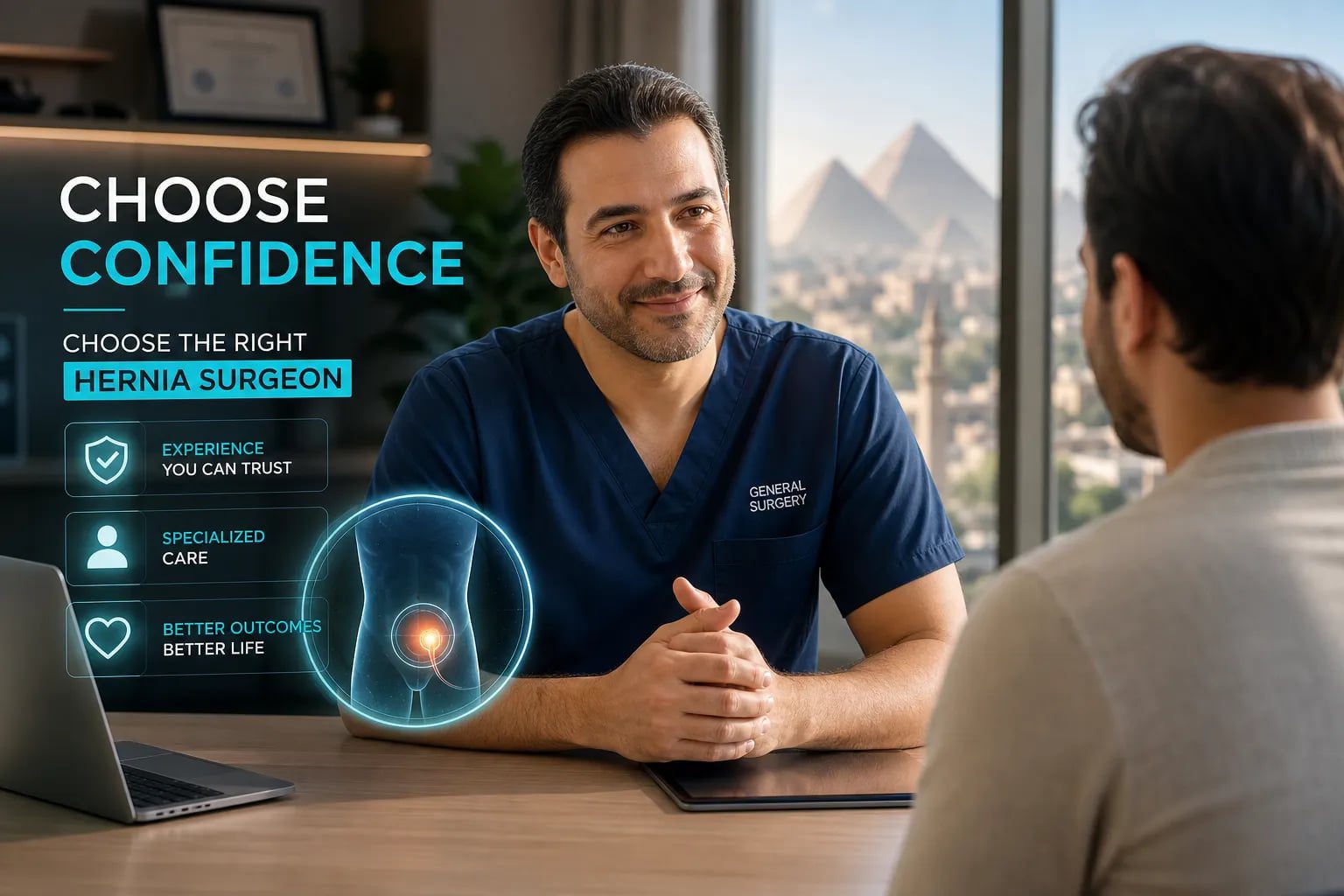
When you’re planning hernia surgery in Cairo, the decision you make in the next few weeks directly affects your recovery, your recurrence risk, and your peace of mind. That’s significant pressure, especially when most patients have never navigated this kind of choice before. The stakes are real: choosing the wrong surgeon or facility can mean a longer recovery, a failed mesh repair, or a hernia that returns, risks that are meaningfully higher when patients skip the verification steps this guide covers.
This guide gives you the practical information you need: realistic cost ranges for 2026, hospitals worth considering, credentialed surgeons currently active in Cairo, and a clear framework for making the final call with confidence.
Laparoscopic vs. open hernia repair: what actually changes for your recovery
How laparoscopic hernia repair works
Laparoscopic hernia repair uses three or four small incisions, a camera-guided technique, and mesh placement under general anesthesia. It is commonly offered and frequently used in private Cairo hospitals, and the clinical advantages are concrete: less post-operative pain, smaller scars, and a faster return to normal activity. Most patients resume light activity within one to two weeks of a laparoscopic procedure.
When open repair is still the right call
Open repair remains the right tool for specific situations: larger or more complex hernias, recurrent hernias, patients with contraindications to general anesthesia, or cases where cost is a hard constraint. Open repair is not a lesser option, experienced surgeons choose it for sound clinical reasons, including very large defects, certain recurrent presentations, and cases where minimally invasive access carries additional risk. Don’t dismiss it based on reputation alone.
Recovery timeline for both approaches
Laparoscopic patients typically return to desk work within one to two weeks. Both approaches share a similar full-recovery window of four to six weeks, with heavy lifting restricted until the surgeon clears you. Mesh hernia repair is now standard in both laparoscopic and open procedures across Cairo private hospitals. In most uncomplicated cases, the type of mesh used influences cost more than it changes recovery time, though your surgeon’s recommendation based on your specific anatomy should guide that choice.
What hernia surgery in Cairo realistically costs in 2026
Breaking down the fees: hospital, surgeon, anesthesia, and mesh
The all-in cost of hernia repair at a private Cairo hospital typically falls between EGP 18,000 and EGP 42,000, depending on the hospital tier, surgeon seniority, and case complexity. The four main cost components are:
- Hospital and facility fees: EGP 8,000, 15,000
- Surgeon fees: EGP 5,000, 12,000
- Anesthesia: EGP 3,000, 7,000
- Mesh (depending on type and brand): EGP 2,000, 8,000
Many clinics quote package-style prices that bundle some of these components together, so always confirm in writing what is and isn’t included before you commit to anything.
Medical tourism packages for international patients
For patients traveling from outside Egypt, Cairo hernia repair packages typically start around $1,500 for umbilical hernia repair and range from $2,000 to $3,500 for inguinal hernia surgery. Reputable medical tourism operators often bundle pre-operative testing, airport transfers, hospital stay, post-operative follow-up, and hotel accommodation into a single quoted price. Always confirm in writing whether surgeon fees, mesh, anesthesia, and follow-up care are genuinely included or estimated separately, because some packages cover only the medical procedure while treating travel logistics as an additional line item.
Hospitals in Cairo with strong hernia surgery programs
The hospitals patients are choosing for hernia surgery in Cairo
Several well-regarded institutions stand out for hernia-related procedures. Internationally accredited and high-volume facilities include: As-Salam International Hospital, which carries JCI accreditation and appears in hiatal hernia repair listings; Cleopatra Hospital, recognized for robotic and minimally invasive surgical capability; and Dar Al Fouad, which maintains a strong surgical reputation across multiple specialties.
Facilities frequently cited for specific hernia procedures include: Saudi German Hospital Cairo, a major tertiary-care facility listed for laparoscopic surgery programs; Andalusia Al Maadi / Andalusia Health Group, which appears in clinic listings specifically for laparoscopic inguinal hernia repair; and Arab Contractors Medical Center (ACMC), which surfaces in umbilical hernia repair rankings. Private hospitals generally charge higher fees, commonly reflecting accreditation standards, experienced nursing teams, and operating rooms equipped for laparoscopic technique.
What to confirm with any hospital before you book
Ask four questions before signing anything. Is the operating room accredited? Does the quoted price include anesthesia and mesh? What is the post-operative follow-up protocol? How many hernia repairs does the surgical team perform each month? Volume matters, hernia center models with high surgical caseloads tend to deliver more consistent outcomes than general surgery departments that handle hernia cases occasionally. A hospital that can’t answer these questions clearly is signaling that hernia surgery is not a primary specialty, or that standardized protocols may not be in place.
Hernia surgeons in Cairo: credentials and what the records show
Surgeons currently active in Cairo hernia repair
Several credentialed surgeons stand out in available Cairo directories and hospital listings. Dr. Ahmed M. Ammar is a Consultant Laparoscopic Surgeon and Lecturer at Cairo University, holding an MRCS England and membership in the European Hernia Society, with approximately ten years of focused laparoscopic hernia experience. Dr. Magdy Abdel Ghany is a Consultant General Surgeon at Saudi German Hospital with over 44 years of experience and a medical degree from Ain Shams University. Dr. Mohamed Farid holds a professorship in General and Laparoscopic Surgery and carries a 5/5 patient rating across listed platforms. Dr. Rami Said is an Associate Professor of Digestive Surgery with a 4.9/5 rating. Dr. Wael Shalaan and specialists at Oasis Clinics round out the visible shortlist. Online ratings are a useful soft signal, but they are not a substitute for verifying credentials directly with the hospital or clinic before you book.
How to read a surgeon’s credentials without a medical degree
Focus on four things: university affiliation, board-certification body (Egyptian Medical Syndicate, MRCS, or an international fellowship), membership in a hernia-focused specialty society such as the European Hernia Society, and whether the surgeon treats hernia repair as a regular subspecialty focus or as an occasional general surgery case. A surgeon who performs hernia repairs consistently as a subspecialty is a meaningfully different choice from a general surgeon who handles them a few times a year. Volume and focus matter more than any single credential.
Choosing your surgeon for hernia surgery in Cairo: the checklist that actually matters
Six questions to ask before you confirm a booking
Ask each of these during your consultation and pay close attention to how the surgeon responds. How many hernia repairs have you personally performed in the last twelve months? What is your recurrence rate? Will you be the operating surgeon on the day, or will a resident be performing the procedure under your supervision? What mesh brand do you use and why did you choose it? What are my options if I have a post-operative concern after hours? Is the hospital equipped to convert a laparoscopic case to open surgery if needed during the procedure?
A confident, credible surgeon welcomes all of these questions. Be aware, though, that a surgeon who defers certain follow-up or aftercare questions to a post-operative appointment is behaving differently from one who dismisses the questions entirely, the former is appropriate, the latter is a reason to keep looking.
Red flags that should make you pause
Patients choosing a hernia surgeon in Cairo fall into a few predictable traps. Selecting the cheapest quote without confirming what it actually includes is the most common, and most avoidable. Booking through a clinic without independently verifying the surgeon’s credentials is the second. The third is assuming a hospital’s brand name guarantees surgical quality for a specific procedure; general surgical reputation and hernia subspecialty depth are not the same thing. Before your first consultation, look for clinics that publish detailed, procedure-level information including technique options, mesh policy, and realistic recovery expectations. That transparency is a meaningful indicator of a well-organized program.
Preparing for surgery and knowing what recovery looks like
What to do in the two weeks before surgery
Standard preparation covers four areas. Review all current medications with your surgeon, particularly blood thinners and anti-inflammatory drugs, which are usually paused before surgery. Complete any pre-operative blood work and imaging your clinic requires; most Cairo packages include this as standard. Follow fasting instructions carefully: nothing by mouth for at least eight hours before the procedure. Arrange your transport home before surgery day, not the morning of. Laparoscopic hernia repair at private Cairo hospitals is typically a same-day or next-day discharge procedure, so out-of-city patients should plan a short local stay.
Week-by-week recovery: what to expect
Week one is for rest, limited walking, and monitoring the wound site for any signs of infection or unusual swelling. Week two brings light activity back, and most patients are off prescription pain relief by this point. Weeks three and four allow a gradual increase in movement, with heavy lifting still off the table. By week six, most patients receive clearance for full activity, including exercise and physical work. Following your surgeon’s post-operative instructions precisely during this window is one of the most important things you can do to reduce your long-term recurrence risk.
Making the decision with confidence about hernia surgery in Cairo
Choosing the right surgeon for hernia surgery in Cairo means understanding which procedure fits your clinical case, verifying that your surgeon and hospital genuinely specialize in hernia repair rather than handling it occasionally, and knowing the real cost before you commit. Private care in Cairo ranges from EGP 18,000 to EGP 42,000 all-in, and for international patients, reputable packages typically fall between $1,500 and $3,500 depending on hernia type and inclusions.
The patients who tend to make the best decisions start by finding clinics that publish specific, transparent, procedure-level information, before they ever pick up the phone. That kind of clarity signals a well-organized program. At Brandleap Agency, we help healthcare providers across Egypt build exactly that kind of trusted, patient-first online presence, so that the clinics investing in transparency are also the ones patients find first when searching for hernia care in Cairo.
If you are planning hernia surgery in Cairo, use the checklist in this guide and bring the six questions to your consultation. Book with the surgeon and facility whose answers earn your confidence, not just the one whose name appears first in a search result.