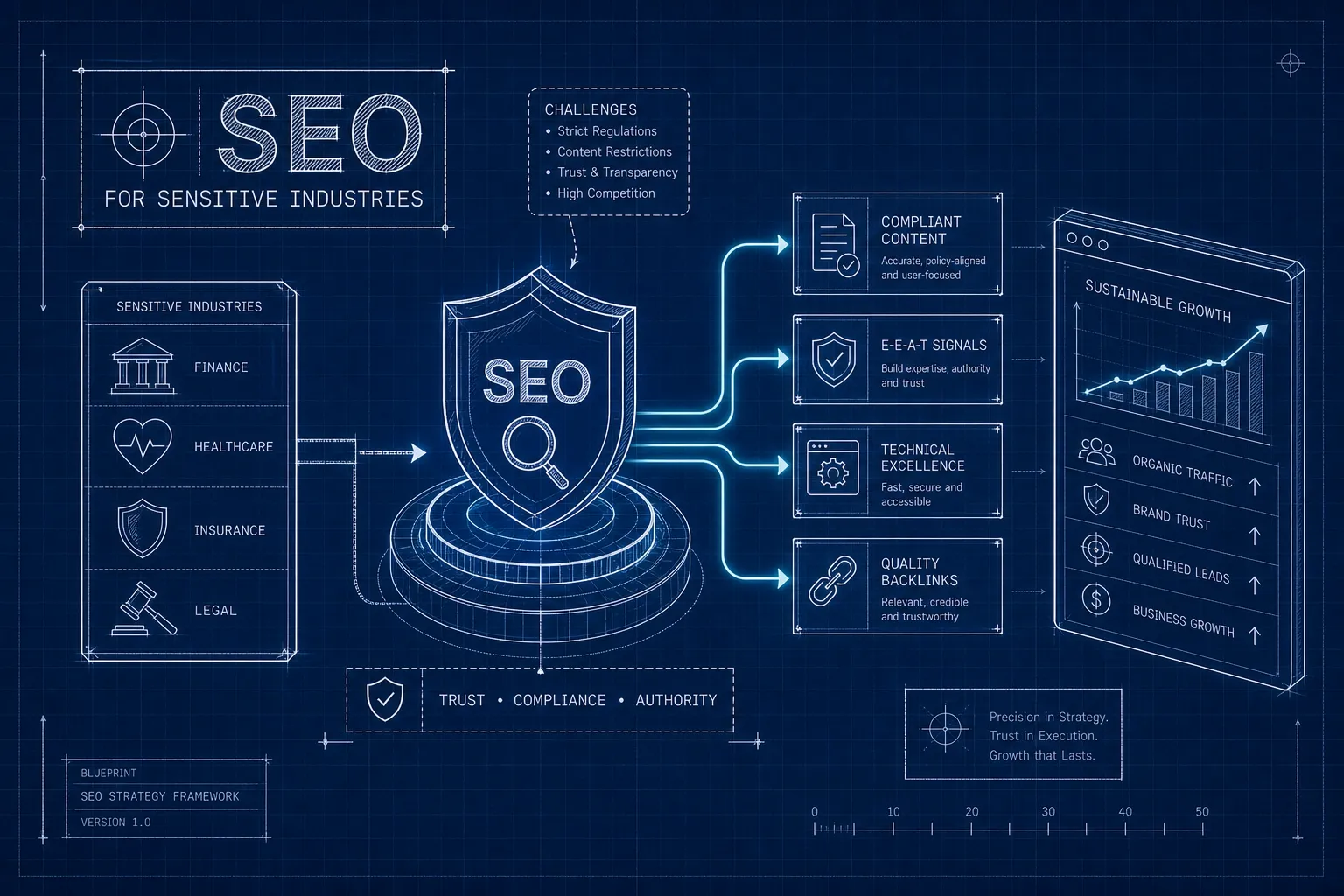
Most SEO playbooks were written for mainstream industries, and they break down fast the moment you operate in a sensitive or restricted niche. Whether you run an adult site, a cannabis brand, a gambling platform, or any other regulated vertical, the rules change at every layer of search optimization. If you need a specialized adult SEO service, understanding those structural differences is the only place to start. From how Google indexes your content to where you can legally earn backlinks, this game is built differently.
Starting with a constraint audit isn’t procedural caution, it’s the only logical entry point when platform policies, indexing friction, and backlink scarcity all compound against you from day one. Compliance-first agencies apply this methodology before recommending a single tactic, because the cost of skipping that step is invariably higher than the time it takes to complete it.
Not all adult SEO service providers operate cleanly or transparently, though. Some use tactics that produce short-term gains and long-term penalties. Others promise rankings without showing a single verifiable case study. This article covers the real challenges sensitive industries face in search, the strategies that actually work, realistic pricing expectations, and the exact questions you should ask before hiring anyone to manage your organic visibility.
Why restricted industries operate in a different SEO environment
Platform policies that cut off standard growth levers
Google, Meta, and most major ad networks restrict or outright ban paid promotion for adult, cannabis, firearms, and similar verticals, a policy position each platform documents in its official advertising guidelines. That forces organic search to carry more of the acquisition load. The problem is that those same search engines apply stricter quality scrutiny to sensitive content sites. Age-gating, content warnings, and content moderation signals all affect how pages get crawled and surfaced. When Googlebot hits an age verification wall before reaching your content, indexing becomes incomplete or, in some cases, impossible.
Indexing gaps and trust signals in sensitive niches
Adult and NSFW sites routinely face thin indexation relative to the number of pages they publish. Template-heavy, script-generated category pages, tag pages, and gallery URLs create crawl dilution that weakens your entire domain’s trust signal. SafeSearch is on by default for most users, which means explicit pages get filtered out of standard results even when they’re technically eligible to rank. Domain authority is harder to build when mainstream publishers won’t reference or link to your site. Every layer of your strategy, content, links, and technical infrastructure, needs to account for these barriers before any tactics are deployed.
Building a compliant content strategy that search engines will surface
Keyword research when mainstream tools fall short
Tools like Ahrefs and Semrush work for adult keyword research, but volume data can skew because search behavior in restricted niches tends to be highly specific and long-tail. Broad head terms are rarely the play here. Intent-specific queries convert better and face less algorithmic skepticism. Category pages, tag pages, and model or product pages each need unique, substantial copy of at least 200 to 300 words to avoid thin-content filtering. A page with a title, three images, and no descriptive text isn’t something Google can evaluate with any confidence, so it won’t rank.
Structuring pages for intent without triggering filters
Title tags, meta descriptions, headings, and image alt text need to describe content clearly without relying on shock phrasing or keyword stuffing. For video and image-heavy sites, this means adding schema markup, transcripts, descriptive file names, and captions. Search engines can’t watch your video content, so every surrounding signal needs to do that interpretive work. Clean, user-first structure improves rankings while reducing the risk of triggering content moderation filters that suppress domain-wide visibility, two outcomes that reinforce each other at every layer of the site.
The backlink challenge in adult and NSFW verticals
Why generic link outreach fails here
Most mainstream bloggers, publications, and resource pages frequently decline to link to adult or NSFW content. Outside the niche itself, editorial acceptance is rare enough that generic outreach templates typically produce no meaningful results. Agencies that promise high-DA backlinks without specifying source relevance are usually referring to private blog networks or paid placements, exactly the link sources Google’s spam systems are designed to detect and discount. An adult marketing agency that can’t name its publishers before you sign anything is signaling something important about how it operates.
White-hat link acquisition for adult SEO service campaigns
Building domain authority in restricted verticals requires a narrower but more durable approach. Outreach to niche-relevant directories and industry publications produces links that hold up under algorithm updates. Digital PR within the adult industry ecosystem can generate citations that mainstream outreach never could. Original research and data studies give adjacent sites a legitimate reason to link. Guest contributions to reputable legal or health publications that cover the industry work well when positioned correctly. Syndication partnerships with complementary platforms round out the mix. Topical relevance matters far more than raw domain authority numbers in these niches, a contextually relevant link from a mid-DA industry publication is often more valuable than a high-DA placement from an irrelevant general blog.
Traffic channels that matter when paid ads aren’t an option
Community, syndication, and referral traffic in restricted niches
Adult and NSFW sites have built significant traffic ecosystems entirely outside of Google organic: adult tube site syndication, niche aggregator platforms, subreddit communities, OnlyFans and cam platform cross-promotion, and affiliate networks all drive meaningful volume. These aren’t replacements for organic search. They act as discovery channels that build brand recognition over time, which tends to feed branded search queries, and stronger branded search is generally associated with improved organic visibility. Niche directories and RSS feeds provide supplemental indexation signals that help crawlers find and categorize newer content faster.
Filling the paid media gap with owned and earned channels
Since Google Ads and Meta Ads are largely unavailable for adult and most sensitive verticals, the alternative stack includes email list building, SMS marketing, content syndication agreements, adult-specific ad networks, and platform-native SEO such as optimizing for in-platform search on OnlyFans or cam sites. Each channel serves a different function in the acquisition funnel. The goal isn’t to replace paid media with a single alternative but to build a diversified strategy where no single channel, including organic search, becomes a single point of failure.
How to vet an adult SEO agency before you sign anything
Realistic pricing ranges for adult SEO service programs in 2026
Starter-to-mid packages from reputable adult SEO providers typically run between $1,297 and $2,997 per month. Competitive campaigns in higher-traffic niches run $5,000 to $15,000 per month, and enterprise-level programs exceed that significantly. One-time technical audits generally fall between $1,000 and $5,000 depending on site size and complexity. What drives price is niche competition level, site size, scope of services (content plus links plus technical versus one layer only), and how aggressively growth targets are set. Very low pricing, under $500 per month for an active site, commonly reflects high-volume, low-quality work that treats your site as one of hundreds on a spreadsheet rather than a business with specific growth constraints.
Red flags in proposals and the tactics that cause long-term damage
The following warning signs turn up repeatedly in proposals from agencies that cut corners on compliance and quality. Treat any of them as a reason to ask harder questions before moving forward:
- Guaranteed ranking promises within a specific timeframe
- “Safe PBN” link placements or references to “owned authority sites”
- Exact-match anchor text packages delivered at volume
- Doorway page builds for city, model, or category targeting
- AI content spinning or “mass content creation” for rapid page scaling
- Keyword density optimization listed as a standalone deliverable
- “Exclusive adult link networks” with no publisher transparency
Each of these tactics risks either an algorithmic penalty or a manual action from Google that can suppress visibility across entire sections of your site. An agency that can’t clearly explain where links will come from or how content will be produced is telling you something important about their methods.
10 questions to ask any adult SEO agency before hiring
- Can you show adult-niche case studies with specific traffic and revenue metrics?
- Which publishers or platforms will links come from, and what is your editorial vetting process?
- How do you produce content, and who writes it?
- What does your technical audit process include, and what will you deliver at the end of it?
- What is your reporting cadence, and which KPIs do you own?
- What are the contract terms, and what does exit look like?
- Who handles the account day-to-day, and what is their experience level?
- How do you respond when a Google algorithm update affects your clients’ rankings?
- How do you handle age-gating, content compliance, and crawl access for restricted content?
- How do you define success for my specific goals, and what benchmarks are you committing to?
What specialized agencies do differently for restricted industries
How an adult SEO service runs a constraint audit
The clearest dividing line between a general SEO agency and a genuinely specialized one is what happens before any tactic is recommended. A serious provider starts with a full assessment of the site’s specific constraints: which platform policies apply, what the indexing history looks like, whether the backlink profile is clean, where content compliance gaps exist, and what technical issues are already working against you. That constraint audit shapes every decision that follows. Applying a generic strategy to a niche with real restrictions produces, at best, generic results, and at worst, penalties that take months to recover from. Brandleap Agency structures its engagements in sensitive and restricted verticals around this assessment-first methodology, because the diagnostic work determines whether any subsequent tactic is appropriate for that specific site.
KPIs and reporting that verify ROI in sensitive verticals
A credible adult SEO agency reports across three layers. Business outcomes include organic-sourced revenue, conversion rate, and customer acquisition cost. Leading indicators include non-branded organic traffic, keyword rankings by page type, and click-through rate. Technical health covers Core Web Vitals, crawl coverage, index ratio, and backlink growth. Monthly reporting is the minimum standard, with weekly check-ins on indexation anomalies and ranking shifts. Commercial page performance should always be segmented from informational content in reports, because vanity metrics like total impressions hide whether the pages that actually drive subscriptions or purchases are moving in the right direction.
Making a confident hiring decision in a complicated niche
Restricted and sensitive industries face a structurally different SEO environment, and the agencies that perform well in these niches succeed because they understand compliance, build authority carefully over time, and diversify traffic before the need arises. Quality varies widely across adult SEO service providers in this market, and the pricing benchmarks, case study criteria, and proposal red flags covered here give you a concrete filter for separating competent operators from risky ones.
If your business operates in a sensitive vertical and you want a strategy built around your actual constraints rather than a recycled playbook, the right starting point is a site-specific assessment from an agency that understands the difference between what works in mainstream SEO and what works in yours. The right agency asks the hard questions before it pitches a single deliverable. If it doesn’t, that tells you everything you need to know before you sign anything.
Brandleap Agency specializes in competitive and restricted verticals, combining technical SEO, compliance-aware content development, and senior-level strategy for businesses that can’t afford to learn from a generalist’s mistakes. If you’re ready to build organic visibility on a foundation that holds up under scrutiny, request a site assessment and get a clear picture of where your organic growth actually stands.