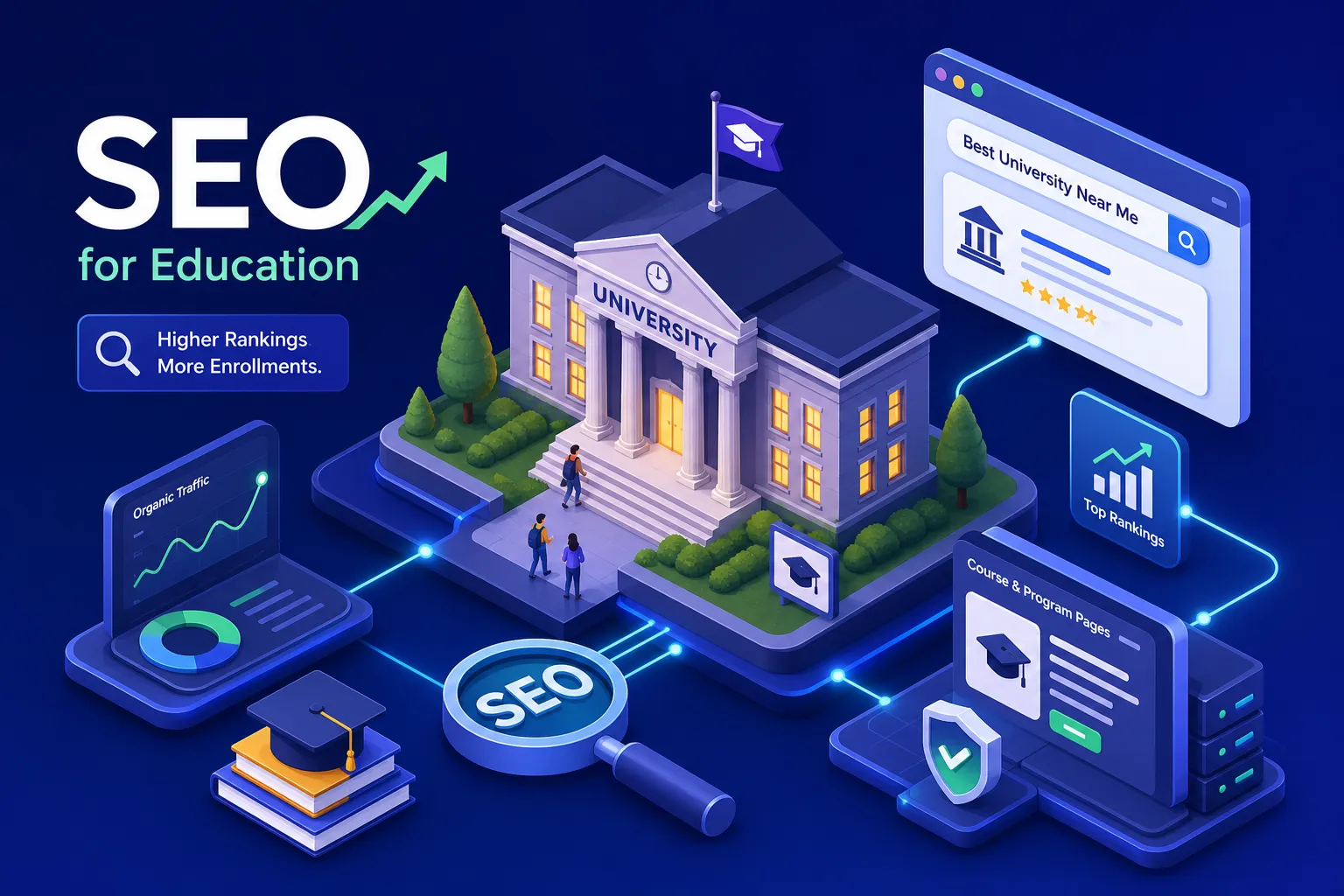
Effective SEO for educational institutions starts with one foundational truth: organic search drives the majority of prospective student research before any campus visit or inquiry form submission ever happens. Students don’t show up on your website by accident. They find you through a specific search query at a specific moment in their decision process. Generic advice tells schools to “add keywords and build links,” and that’s exactly where most institutional SEO efforts stall. Higher education operates in a fundamentally different search landscape than e-commerce or local service businesses, and the tactics need to match the environment.
This guide covers what actually moves the needle for schools, colleges, and universities in 2026. You’ll walk away with a prioritized set of actionable tactics, a clear 90-day roadmap, and a metrics model that tracks performance from organic traffic all the way through to enrolled students. Every tactic here is grounded in how students actually search and how institutions actually grow.
How prospective students actually search for programs in 2026
Before you write a single title tag or publish a single blog post, you need to understand how your audience searches. Modern student search behavior is conversational, long-tail, and outcome-driven. Students aren’t typing “university MBA” into Google. They’re typing “best online MBA for working professionals” or “what jobs can I get with a nursing degree.” Any serious approach to SEO for educational institutions has to start at this behavioral layer.
The search query clusters driving enrollment research
Prospective students search in five distinct clusters: program type, career outcomes, cost and affordability, admissions requirements, and format flexibility. Specific examples include “most affordable accredited bachelor’s,” “test-optional admissions 2026,” “online nursing programs,” and “what GPA do you need for business school.” These are not broad head terms you can chase with a homepage. Each cluster represents a different moment in the decision journey, and each requires its own dedicated content.
Fields like nursing, AI, data science, cybersecurity, and business administration generate disproportionately high search volume right now. If your institution offers programs in those areas, they deserve first priority in your SEO roadmap.
Why program-level keyword targeting outperforms homepage SEO
Your homepage ranks for brand queries. Students who type your institution’s name already know you exist. The real SEO leverage sits at the individual program page level, where undecided students are searching for options. Each degree, certificate, or course should target its own primary keyword cluster built around how students actually phrase their searches, not how your admissions team describes the program internally.
A single well-optimized program page targeting “online cybersecurity bachelor’s degree” will consistently outperform a homepage trying to rank for everything. Program-level specificity is the foundation of enrollment-driven SEO.
Mapping keywords to the enrollment funnel
Keyword intent changes as students move through their decision process. Awareness-stage queries like “what is a cybersecurity degree” belong on blog content that introduces the field. Decision-stage queries like “apply to cybersecurity program in Austin” belong on program pages and geo-targeted landing pages. Matching keyword intent to content type isn’t optional. It’s the difference between ranking for traffic that never converts and ranking for traffic that completes inquiry forms.
Program page SEO for educational institutions: on-page optimization and schema markup
Once you understand how students search, program page optimization becomes straightforward. Every page needs to be built with one program, one audience, and one conversion goal in mind.
On-page fundamentals every program page must have
The non-negotiables: a unique title tag with the primary keyword near the front, a single H1 that matches the page’s focus, keyword presence in the first 100 words, and structured content sections covering curriculum, admissions, delivery format, duration, and tuition context. The most effective title tag format for program pages follows this pattern: Primary Program Keyword + Specific Modifier + University Name. For example:
- Online MBA in Finance | Your University Name
- Accredited RN to BSN Program | Your University Name
- Master’s in Cybersecurity Online | Your University Name
Duplicate boilerplate across program pages is one of the most damaging education SEO mistakes. When multiple program pages share the same generic description with only the program name swapped out, Google treats them as low-quality near-duplicate content. Every program page needs to be genuinely unique in its content and intent.
Using EducationalOccupationalProgram schema correctly
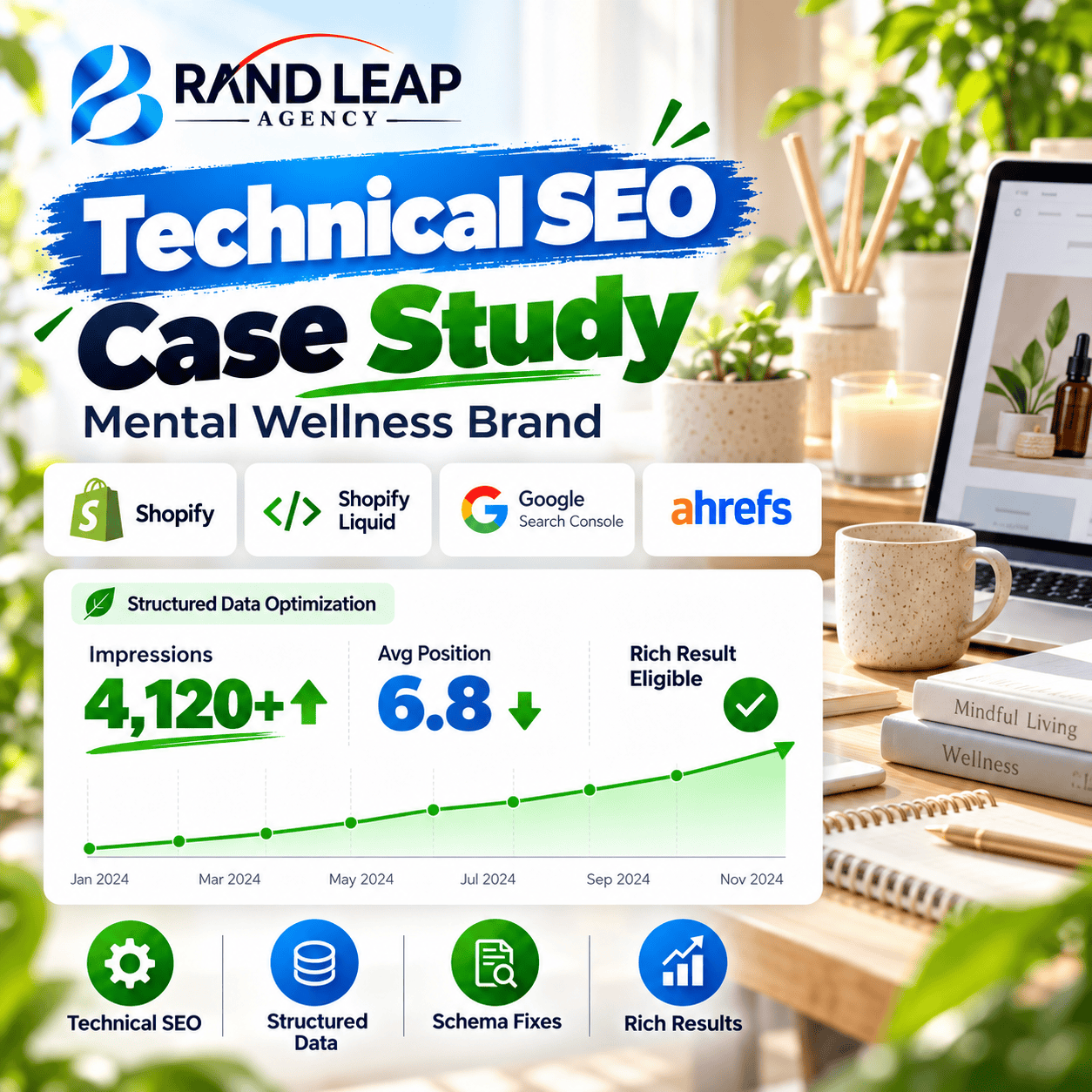
EducationalOccupationalProgram structured data tells Google exactly what your page represents. The markup should include program name, description, provider, delivery method, duration, application dates, and credential details. Every attribute in your schema must match what a visitor can actually read on the page. A mismatch between your structured data and your visible content blocks rich result eligibility entirely.
Implement this in JSON-LD format, placed in the page head or body. Here is a minimal example of what that markup looks like in practice:
{
  "@context": "https://schema.org",
  "@type": "EducationalOccupationalProgram",
  "name": "Online MBA in Finance",
  "description": "An accredited 18-month online MBA program focused on financial leadership.",
  "provider": {
    "@type": "CollegeOrUniversity",
    "name": "Your University Name"
  },
  "educationalProgramMode": "online",
  "timeToComplete": "P18M",
  "applicationDeadline": "2026-08-01",
  "offers": {
    "@type": "Offer",
    "category": "Tuition"
  }
}
Validate the markup before publishing and re-check it whenever the program details change, especially application deadlines or delivery mode.
FAQ schema: when it helps and when to skip it
FAQ schema only qualifies for rich results when the FAQ content is genuinely visible on the page. Don’t mark up questions that aren’t there. A practical program page FAQ block covering admissions requirements, class format, and career outcomes serves two goals simultaneously: it answers real student questions and creates rich result eligibility. If your program page doesn’t already have a visible FAQ section, add one before adding the markup.
Local SEO for educational institutions: campus visibility in search and maps
Local search is one of the most underused channels in higher education SEO. Students searching “colleges near me” or “universities in [city]” are often at a high-intent decision stage, and most institutions aren’t competing seriously for those results.
Optimizing Google Business Profiles for campus locations
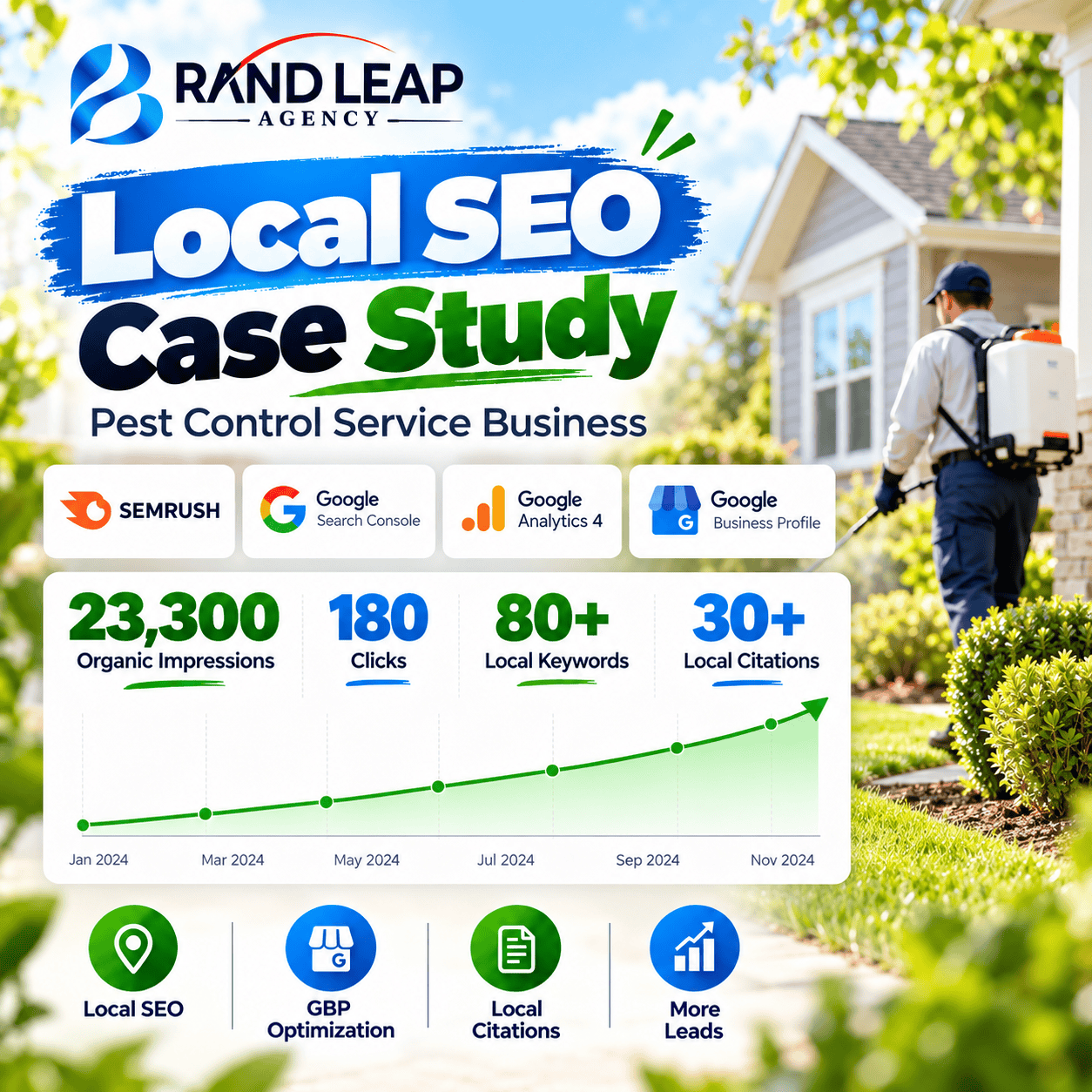
Each physical campus location needs its own verified Google Business Profile. Correct category selection, complete and consistent contact information, high-quality photos, and regular post activity all contribute to local pack visibility. In one documented case, a sustained GBP optimization effort was directly linked to 44 new applications for a single university campus within a defined period. Each campus is a separate local entity in Google’s eyes and should be treated as one.
A basic GBP setup checklist for each campus location should cover:
- Verified business category set to “University” or “College”
- NAP information matching exactly what appears on the institutional website
- At least 10 high-resolution photos including exterior, interior, and campus life
- Services or programs listed within the GBP profile
- Monthly Google Posts covering enrollment deadlines, events, and program highlights
- Q&A section seeded with common admissions questions and accurate answers
The citation sources that move the needle for campus rankings
The foundation citation stack for campus locations includes Google Business Profile, Apple Maps, Bing Places, Yelp, Facebook Business Page, Yellow Pages, and BBB. Beyond those, locally relevant sources carry extra weight: the campus-area chamber of commerce, regional business directories, and city-level sites send strong geographic signals that reinforce location relevance for geo-specific searches.
NAP consistency, your name, address, and phone number formatted identically across every listing, is a prerequisite. A single address inconsistency across listings creates conflicting signals that suppress local visibility.
Targeting “near me” and city-specific enrollment searches
Geo-targeted landing pages for campuses in different cities or regions let you compete for location-modified queries without forcing keywords awkwardly onto your main program pages. Weave location terms like “colleges in [city]” or “universities near [neighborhood]” into page titles and header structure naturally, where they reflect the actual geographic focus of the page. These pages also support your GBP by providing location-relevant content Google can associate with your listing.
A content strategy that moves students from search to inquiry
Content strategy for higher education isn’t about publishing frequently. It’s about publishing the right content at the right stage of the student decision journey. That means producing two fundamentally different content types: awareness content that captures students early and decision-stage content that converts researchers into applicants.
Awareness content: answering the questions students search before they know your school
Top-of-funnel content attracts students who haven’t considered your institution yet. Career outcome guides like “what you can do with a data science degree,” “how to choose between an MBA and a master’s in management,” and comparison content between program formats all drive high-volume organic traffic from students in early research mode. These pages build domain authority and introduce your institution to prospective students before they’ve formed any brand preference.
Decision-stage content: converting researchers into inquiries
When students are ready to decide, they look for specific proof. Student success stories with concrete outcome data, financial aid breakdown pages, application requirement FAQs, and program comparison pages all reduce friction at the inquiry stage. Internal linking from awareness content to decision-stage pages creates a logical conversion path that guides students through the funnel without requiring them to search again. This linking structure is one of the highest-leverage content moves you can make in student recruitment SEO.
Using Core Web Vitals performance as a conversion lever
If a prospective student clicks your program page on mobile and it loads slowly or shifts layout while they’re reading, they bounce. Core Web Vitals targets for 2026 are LCP under 2.5 seconds, INP under 200 milliseconds, and CLS under 0.1. These aren’t just ranking factors; they’re direct conversion factors. A fast, stable page holds attention. A slow one loses students to a competitor with better load performance, regardless of how strong your content is.
Technical SEO priorities that education websites frequently ignore
University websites are often large, legacy-heavy, and poorly structured from an SEO perspective. Addressing the most common technical issues doesn’t require a developer on every fix, but it does require a clear priority list.
Site architecture and internal linking for large university sites
A clean site hierarchy means main program category pages linking to individual program pages, blog content linking to relevant program pages, and no orphaned pages sitting without internal link equity. When search engines crawl a university site with hundreds of pages, clear architecture signals which pages matter most. Without it, crawl budget gets wasted on low-value pages and your highest-priority program pages receive less indexing attention.
Mobile optimization and page speed targets for 2026
Education sites commonly carry legacy code, bloated CMS plugins, and unoptimized media that create unnecessary speed drag. Practical fixes include compressing and lazy-loading images, reducing third-party scripts, optimizing TTFB below 200ms, and eliminating render-blocking resources. University websites that move all three Core Web Vitals into the “good” range see measurable improvements in both search rankings and on-page engagement metrics. Start with the pages that receive the most organic traffic and work outward from there.
Your 90-day SEO roadmap and the agency vs. in-house decision
Everything above is actionable, but only if it’s sequenced correctly. A structured 90-day roadmap gives any institution a clear starting point with measurable checkpoints at every stage.
The 90-day priority sequence for institutional SEO
Structure the work in three phases:
- Days 1, 30: Audit and foundation. Claim and optimize GBP profiles for each campus. Complete a technical site audit to identify crawl errors, duplicate content, and page speed issues. Build a keyword map for every active program using student-phrased search queries.
- Days 31, 60: On-page optimization. Rewrite program page titles and H1s to match your keyword map. Implement EducationalOccupationalProgram schema across all program pages. Add or update visible FAQ sections to support schema eligibility.
- Days 61, 90: Content and authority. Publish two to three awareness-stage blog posts targeting top-of-funnel program queries. Build out the priority local citation stack for each campus location. Complete internal linking between blog content and program pages to establish conversion paths.
Metrics that actually track enrollment impact
The right measurement model tracks three layers. Organic traffic volume is your leading indicator; use Google Search Console to monitor keyword rankings and click-through rates by program page. Inquiry form completions are your mid-funnel metric; set these up as conversion events in GA4. Enrolled student source attribution is your outcome metric, traced back through your CRM to the original organic session. Avoid raw impressions as a success metric, they measure visibility, not student intent or action.
When to hire an agency and what to look for
In-house SEO makes sense when your team includes dedicated staff with technical capability and bandwidth. An agency makes sense when the team is lean, results are time-sensitive, or the institution needs a strategy partner rather than just execution. The data supports the investment: eCornell documented a 48% increase in organic enrollments after implementing structured SEO work, alongside a 43% increase in organic web traffic.
That’s the kind of outcome that separates a well-executed strategy from one that simply generates impressions. At Brandleap Agency, we work with institutions and specialized businesses that need enterprise-quality SEO strategy without the overhead of an enterprise retainer. Our approach adapts proven frameworks to specific industries, including education, because generic SEO applied to a university website produces generic results. If your institution is ready to build a search presence that actually drives inquiries, we’re built for exactly that kind of work.
The bottom line on SEO for educational institutions
SEO for schools, colleges, and universities is not a variation of generic SEO. It is a specialized discipline with its own keyword behavior, schema requirements, local signals, and content logic. The institutions that build their search strategy around how students actually search, and track results from traffic through to enrolled students, consistently outperform peers in organic enrollment growth. That is what effective SEO for educational institutions looks like in practice.
The phased framework in this guide gives you a clear starting sequence with measurable outcomes at every stage. Whether you execute in-house or bring in a specialized partner, the priority order stays the same: keyword foundation first, program page optimization second, local SEO third, content fourth, and technical work running throughout. Get those four tracks moving in parallel and you’ll see inquiry volume shift within 90 days.
Ready to put a strategy behind your institution’s search presence? Explore how Brandleap Agency builds education-ready SEO frameworks that connect organic traffic to real enrollment outcomes.