Google’s systems are designed to prefer helpful, reliable content, yet most guides on the topic stay abstract. You hear phrases like “demonstrate expertise” and “build authority,” but nobody hands you a concrete picture of what those signals look like when they actually exist on a page. That gap is exactly what keeps well-meaning site owners stuck: writing good content while quietly wondering why results don’t move.
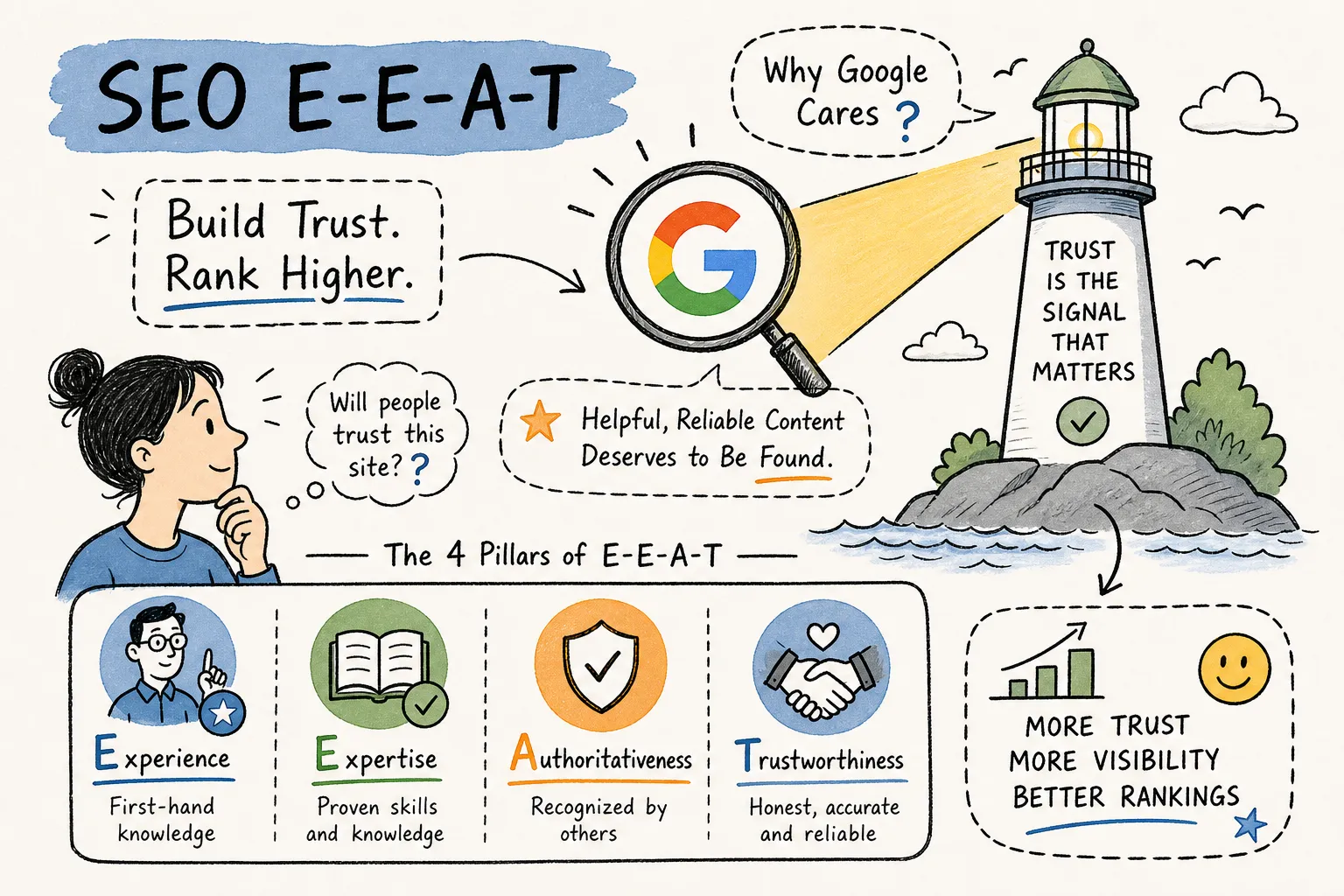
SEO E-E-A-T is the framework Google uses, as defined in its Search Quality Rater Guidelines, to answer one core question: can a real person trust this page with something that matters to them? The framework evolved in December 2022 when Google updated those guidelines and added a fourth letter, Experience, to the existing E-A-T (Expertise, Authoritativeness, Trustworthiness) model. That addition placed new emphasis on firsthand engagement with a topic, not just formal knowledge of it. For YMYL topics especially, understanding SEO E-E-A-T is now a baseline requirement for competing in search, not an advanced tactic reserved for enterprise brands.
At Brandleap Agency, we work inside these signals every day across health, finance, and e-commerce client projects. What follows is our full breakdown of what each letter signals, how Google actually applies the framework, and eight concrete actions you can implement to build credible, lasting trust signals on your site.
What the four letters actually signal, and what changed in 2022
Experience, expertise, and why Google added a fourth letter
The original E-A-T framework covered Expertise, Authoritativeness, and Trustworthiness. Those three pillars served Google’s quality raters for years, but they created a blind spot: a skilled researcher can write a technically accurate article about a topic they have never lived. Google’s 2022 Search Quality Rater Guidelines update closed that gap by placing Experience first, creating E-E-A-T. The revision signals that Google now distinguishes between someone who knows a topic in theory and someone who has direct, firsthand engagement with it.
A travel writer who has actually visited the destinations they review carries a different experiential signal than one who synthesizes other articles, a distinction the guidelines explicitly highlight as a factor raters consider. A financial blogger who has personally navigated a Chapter 13 bankruptcy carries more experiential weight on that topic than a generalist copying statistics. Experience does not replace expertise: for technical subjects like tax law or clinical medicine, formal credentials still take priority. For product reviews, software comparisons, and lived-experience narratives, firsthand engagement now carries real weight in how Google calibrates its systems.
Why trust sits at the center of everything
Trust is not just one pillar among four equals. Google’s guidelines frame it as the foundation the other three support. A page can demonstrate experience, expertise, and authority simultaneously, but if the content is inaccurate, deceptive, or unsafe, its E-E-A-T rating still falls to low. This hierarchy matters because it shapes where you prioritize effort when building your SEO E-E-A-T checklist.
Visible author credentials and clean schema markup will not offset factual errors, misleading claims, or opaque affiliate disclosures. Accuracy and transparency are the floor, not the ceiling. Every other signal you build sits on top of that foundation, so fix the content before you optimize the wrapper around it.
How Google actually uses this framework to evaluate your pages
The search quality rater connection
Google employs human contractors called quality raters who review pages using the Search Quality Rater Guidelines. According to Google’s own documentation, rater assessments are used to evaluate and improve its ranking systems, not as direct ranking inputs. That distinction matters: E-E-A-T is not a direct ranking factor the way backlinks or Core Web Vitals are. No “E-E-A-T score” appears in Search Console, and no single action triggers a measurable boost. Instead, the framework shapes how the algorithm gets calibrated over time to reward credible, people-first content over thin, low-trust pages.
Think of quality raters as the feedback loop that teaches the machine what good looks like. When enough raters consistently rate pages with strong authorship, accurate information, and cited sources as high-quality, those patterns get encoded into Google’s ranking systems. Your job is to produce signals that match those patterns.
YMYL pages and the higher bar they face
YMYL stands for “Your Money or Your Life,” and it refers to any content that could materially affect a person’s health, finances, legal situation, safety, or major life decisions, a category defined explicitly in the Search Quality Rater Guidelines. Google applies a stricter E-E-A-T threshold to these topics because low-quality content in these categories causes real harm. A general travel blog has far more latitude than a medical symptom guide or a retirement planning article.
If your site covers health, finance, legal advice, or anything in that category, your author credentials need to be verifiable, your claims clearly sourced, and your site-level reputation corroborated by independent, credible sources. For every other site, the standard is still worth meeting, the competitive edge it produces compounds over time.
Eight concrete actions that strengthen your SEO E-E-A-T signals
1. Build author bios that actually prove something
Vague bylines destroy credibility signals. “Staff Writer” tells Google nothing. A strong author bio includes a full name, specific job title, topic focus, one or two proof points (certifications, years of direct experience, publications), and links to LinkedIn or institutional profiles. A format that performs well looks something like this:
“[Name] is a [role] at [company]. They write about [specific topic] because of [direct experience or credential].”
Short, specific, and verifiable outperforms long and vague. The goal is to give both users and Google something they can actually check, not just a name attached to a title.
2. Create a dedicated, crawlable author page for each contributor
A sidebar bio and a dedicated author page are not interchangeable. The author page is a standalone, crawlable URL that aggregates all of a contributor’s articles, lists their credentials, and builds an entity signal around their name, helping Google resolve the author as a real, identifiable person across your site. Link from every article byline to that author page, and link from the author page back to the author’s strongest external profiles.
3. Collect and display reviews on third-party platforms
Google looks beyond your own content at what other credible sources say about your brand. Genuine customer reviews on Google Business Profile, Trustpilot, or industry-specific directories function as independent validation of your reputation, off-site signals that reinforce your on-page claims. Encourage satisfied clients to leave specific, detailed reviews rather than one-sentence ratings. The specificity and volume of reviews signal authentic engagement, and that signal is genuinely hard to fabricate at scale.
4. Earn editorial mentions and backlinks from authoritative sources
A strong off-site reputation is one of the most durable trust signals you can build. Editorial backlinks from trade publications, industry associations, academic institutions, and news outlets carry far more weight than directory links or paid placements. Tools like Brand24 or Google Alerts help you track unlinked brand mentions so you can convert them into linked citations. Every credible mention of your brand or your authors on an external site strengthens your authoritativeness in Google’s eyes.
5. Implement schema markup for authorship and organization
Schema markup makes authorship and content details machine-readable. Per Google’s structured data guidelines and schema.org documentation, the most impactful types for E-E-A-T are Person (for individual authors), Article, Organization, and Review. Use JSON-LD format, keep the author name and profile URL consistent across the entire site, and add “sameAs” links to verified external profiles like LinkedIn. Validate your markup with Google’s Rich Results Test after implementation and re-check after any site changes.
6. Add visible on-page trust signals throughout your site
HTTPS is the baseline. Beyond that, visible trust signals include clear contact information, an accessible “About” page with real organizational details, an editorial or review policy, disclosure statements for affiliate content, and visible publication plus last-updated dates on every article. For YMYL pages in particular, the Search Quality Rater Guidelines identify these on-page signals as key indicators of site transparency, gaps in any of them increase the risk of a low quality rating from raters. Both users and Google read these signals as evidence that your site operates with accountability.
7. Link to credible external sources within your content
Citing government agencies, peer-reviewed research, professional associations, and recognized industry bodies signals that your content is grounded in evidence. External links are not a ranking negative, they demonstrate that you have done the research and can direct readers to primary sources. For health content, that means links to clinical studies or established medical organizations. For finance or legal content, jurisdiction-appropriate authoritative sources apply. Link selectively and prioritize primary sources over secondary summaries.
8. Build topical authority through consistent, interconnected content
Publishing a single well-cited article in a niche does less for site-level authoritativeness than publishing a deep, interconnected cluster of content across that topic over time. Topical authority accumulates when Google sees consistent expertise signals across many pages within a subject area, not just on individual posts. That means creating pillar pages, supporting cluster content, and interlinking them deliberately. Each new piece of credible content reinforces the credibility of every other page in that cluster, making site-level authority genuinely compounding.
How to measure your SEO E-E-A-T progress with real tools
Authority and reputation metrics worth tracking
No tool gives you a direct E-E-A-T score, Google has confirmed no such metric exists in Search Console. But several proxy metrics indicate whether your signals are moving in the right direction. Moz Domain Authority, Majestic Trust Flow, and Semrush Authority Score each measure site-level authority through backlink quality and traffic signals; treat them as directional heuristics, not official Google metrics. Use Google Search Console to track branded search trends and click-through rate changes over time, both of which reflect growing brand recognition. Review volume and sentiment across Google, Trustpilot, and industry directories round out the picture at the reputation level.
Check authority metrics monthly. A sustained upward trend in Trust Flow or Domain Authority alongside growing review volume suggests your off-page signals are accumulating correctly. When you see a sudden drop, cross-reference it with known Google core update windows, that correlation gives you a diagnostic starting point for identifying which signals weakened and why.
Monitoring brand mentions and sentiment over time
Brand24, Google Alerts, and Meltwater each offer different coverage tiers for tracking unlinked brand mentions and editorial coverage across news, blogs, and forums (Google Alerts is free; Brand24 and Meltwater are paid tools with broader reach). A rising volume of positive, unprompted mentions from credible sources is one of the clearest indicators that your off-page reputation is building organically. Review sentiment quarterly rather than reactively so you can spot pattern shifts before they affect rankings.
What sites gained after fixing these signals, and where an audit fits in
Real results from E-E-A-T-focused improvements
GoInflow’s published case study reported a 291% year-over-year organic session increase and a 375% increase in impressions following content and E-E-A-T improvements across a 14-month project. A healthcare brand case study from Jasmine Directory reported a 340% organic traffic increase within eight months after a structured E-E-A-T overhaul, along with a 250% growth in lead generation. Both are agency-published case studies rather than independently audited results, so treat them as directional benchmarks rather than guaranteed outcomes.
The important caveat holds: these results combine E-E-A-T work with broader SEO improvements, so they are not proof that any single action drives a specific outcome. What they do illustrate is what becomes achievable when you commit to the full framework over a meaningful time horizon. Similar patterns have been reported in multiple agency case studies across health, finance, and e-commerce verticals when trust signals are treated as a strategic priority rather than a box-checking exercise.
Where a professional E-E-A-T audit accelerates the process
A common pattern in client audits: the raw ingredients already exist, published authors, some reviews, a backlink profile, existing content, but the signals are fragmented, inconsistent, or technically invisible to Google. Author pages exist but aren’t crawlable. Schema is missing or malformed. Reviews live on a platform that doesn’t surface in search. Content covers a topic broadly but lacks the depth and interconnection needed to build topical authority.
A structured audit identifies exactly where those gaps are. At Brandleap Agency, our advanced semantic SEO services include a dedicated E-E-A-T signal audit that maps your current authorship signals, schema implementation, off-page reputation, and content structure against the framework, then pairs the findings with topical authority mapping to build compounding authority gains over time. If you want a faster, more systematic path to credibility rather than a slow accumulation of individual fixes, that’s the starting point.
The reputation you build, not the checklist you complete
SEO E-E-A-T is not a one-time project. It is a reputation that builds through consistent, credible content and verifiable expertise signals applied over months and years. These eight actions each contribute to a cumulative signal that grows more durable over time: strong author bios, dedicated author pages, third-party reviews, editorial backlinks, schema markup, on-page trust signals, cited sources, and topical authority. No single action moves the needle alone, the framework rewards the combination.
If your site covers YMYL topics, the urgency is highest and the margin for signal gaps is smallest. But every site competes in a search environment where Google is increasingly capable of distinguishing credible sources from thin, unverifiable ones. Building these signals now means your site earns authority before competitors do. Waiting means catching up from a deficit.
Ready to identify exactly where your SEO E-E-A-T signals fall short? Brandleap Agency’s semantic SEO and E-E-A-T audit services give you a structured, prioritized roadmap built around your specific site, industry, and competitive position. Get in touch with our team to start your full signal audit today.