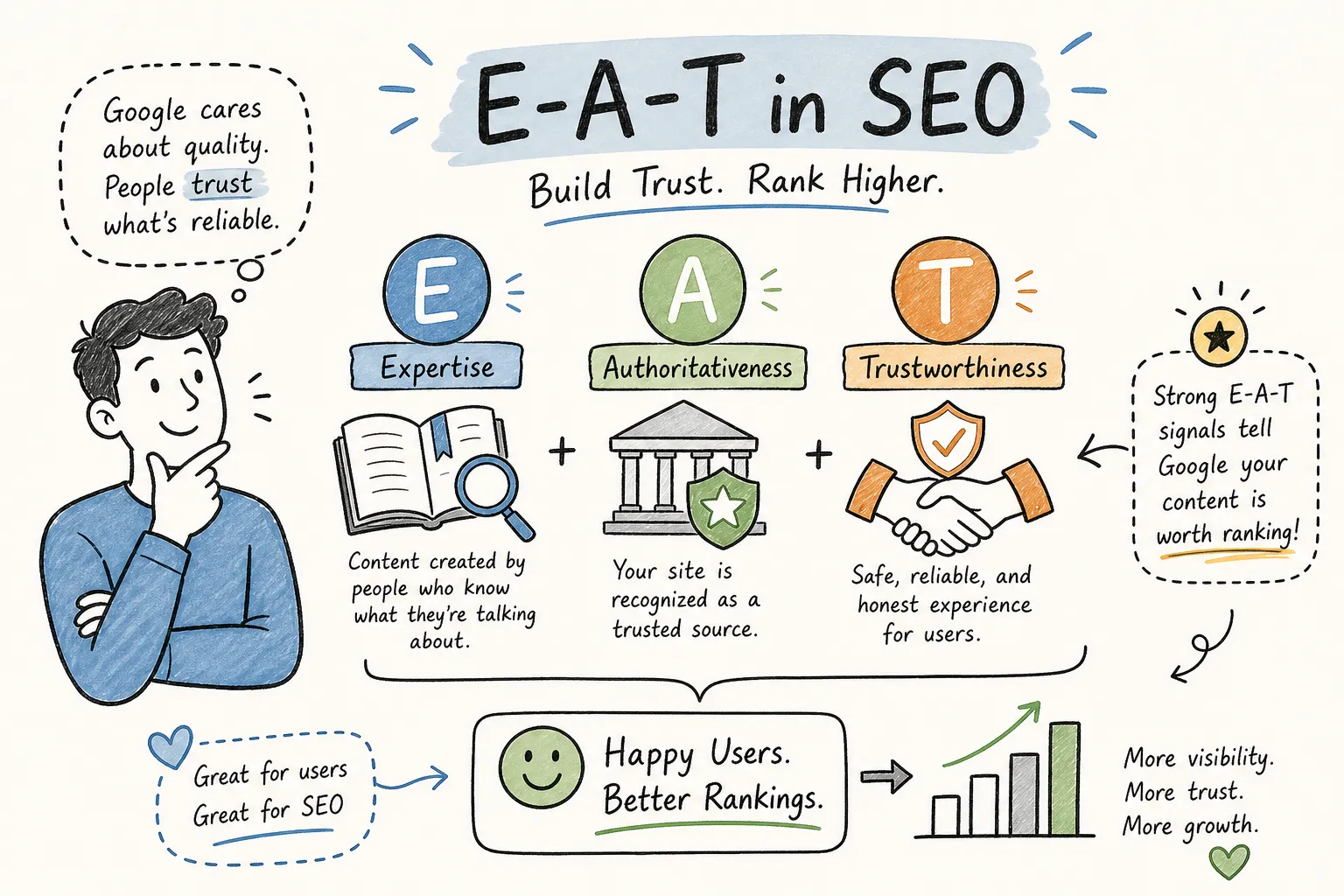
If your content isn’t earning Google’s trust, your rankings will always feel unstable. You might climb for a few weeks, then drop without warning. You’ll keep optimizing title tags and chasing backlinks, but the issue won’t move because the underlying problem isn’t tactical. It’s credibility. E-A-T SEO is the strategic lens through which Google evaluates that credibility, and understanding it is non-negotiable for any business trying to build durable organic visibility.
Google officially upgraded its original E-A-T SEO framework to E-E-A-T in December 2022, adding “Experience” as the first pillar. That update wasn’t cosmetic. It reflected a real shift in how Google thinks about content quality, specifically rewarding creators who demonstrate first-hand knowledge over those who simply aggregate information. This article breaks down all four components, explains how Google actually uses the framework, and gives you the on-page and off-page moves to close your trust gaps.
For agencies and businesses serious about sustainable rankings, building a strong E-A-T SEO foundation isn’t a one-time task. It’s a strategic investment, and it separates surface-level optimization from a real semantic content strategy. As Google’s quality systems sharpen, the gap between superficial optimization and real credibility strategy keeps widening.
What the four letters in E-E-A-T actually stand for
Experience and expertise: what E-A-T SEO expects from the creator
Experience is the newest addition to the framework and the most misunderstood. Google wants proof of first-hand involvement with the topic. A product reviewer who has actually used the product, a contractor blog written by someone who has built homes, or a finance article by someone who has navigated real investment decisions all demonstrate experience. This pillar specifically rewards content with original, lived-knowledge evidence that a content farm or AI without subject knowledge simply cannot replicate convincingly.
Expertise is subject-matter depth. It can come from formal credentials, years of professional practice, or demonstrated knowledge depth within the content itself. Expertise is evaluated at the creator level, meaning Google looks at who wrote the piece, not just what the piece says. A tax attorney writing about estate planning carries different expertise signals than an anonymous contributor covering the same topic.
Authoritativeness and trust: the credibility layer Google weighs
Authoritativeness is about recognition. Backlinks, citations, and brand mentions from reputable sources all signal that others consider you a go-to source in your space. For a small or mid-size business, this might look like earning a feature in a respected trade publication, getting cited in an industry roundup, or securing a link from a local university extension program. You don’t declare authority; you earn it through consistent output and external validation from sources that already carry credibility with Google.
According to Google’s Search Quality Rater Guidelines, trustworthiness is the most critical pillar in the framework. The page must be accurate, honest, safe, and transparent. Without trust, the other three signals lose their weight. A site with impressive credentials and strong backlinks that publishes misleading content will still fail Google’s quality evaluation because trust anchors the entire framework.
Why E-A-T SEO matters for your content quality system
How quality raters use EEAT guidelines in practice
The most common misconception is that E-E-A-T is a direct ranking signal that Google’s algorithm reads like a meta tag. It isn’t. Google trains human quality raters using its Search Quality Rater Guidelines, and E-E-A-T is the primary lens those raters use to judge page quality. These raters don’t directly change rankings, but their evaluations help Google calibrate its automated systems over time, essentially teaching the algorithm what high-quality content looks like.
Google’s systems then look for signals that correlate with strong E-E-A-T. Demonstrating those signals through concrete, verifiable evidence is the practical path to better search performance. You’re not gaming a score; you’re building the kind of real credibility that the algorithm has been trained to recognize.
YMYL pages and why the E-A-T SEO trust bar is significantly higher
YMYL, or Your Money or Your Life, covers health, finance, law, and safety topics. For these categories, Google applies a much stricter standard because weak or inaccurate content can cause real harm. Quality raters are specifically trained to scrutinize these pages more heavily, and Google’s ranking systems give trust-related signals extra weight on YMYL content.
For YMYL content, every claim needs a source, every author needs verifiable credentials, and trust signals across the entire site need to be airtight. Non-YMYL pages are evaluated with more flexibility, but E-A-T SEO still matters throughout. The difference is that a weak author bio on a recipe blog carries far less risk than the same weakness on a page advising readers about medication interactions or investment decisions.
On-page signals that prove experience and expertise
Building author bios and bylines that actually signal credibility
Every article should carry a named byline linked to a dedicated author bio page. The bio should include relevant credentials, professional background, and links to external profiles such as LinkedIn or industry association pages. A strong author bio answers one question clearly: why should a reader trust this person on this specific topic? Name, role, and relevant experience are the minimum; proof points like publications, certifications, or measurable outcomes make the bio genuinely persuasive.
For sensitive or YMYL topics, add a “reviewed by” credit attributing the review to a qualified professional with their own credential context. This layered approach, combining a primary author with a subject-matter reviewer, signals both expertise and accountability to Google’s quality systems.
First-hand content evidence that shows Google you were there
Original photos, screenshots, test results, case studies, and “from our experience” sections are high-signal proof of real experience. These are elements that generic content production cannot replicate convincingly, which is exactly why they carry weight with Google. When you document your own process, show your own results, or describe a specific client scenario with real outcomes, you’re producing content that has a credibility fingerprint no template can copy.
Citing primary sources, including government databases, academic studies, and authoritative industry publications, also strengthens expertise signals. Outbound links to credible references show Google your content exists in an ecosystem of trusted information rather than in isolation.
People-first content and E-A-T SEO best practices for off-page authority
Reviews, backlinks, and brand mentions: the trust signals Google notices
E-E-A-T isn’t only built on your own site. Google evaluates your reputation across the entire web, including what others say about you when you’re not in the room. Positive reviews on Google Business Profile and niche review platforms are direct reputation signals. A consistent pattern of detailed, specific reviews tells Google your business is real, active, and trusted by actual customers.
Backlinks from authoritative, relevant domains carry significant authoritativeness weight. A mention in a respected industry publication, a link from a university domain, or coverage in a recognized trade outlet each strengthen your off-page trust profile. Relevance matters most: a backlink from a respected source in your niche carries more E-E-A-T signal than dozens of links from unrelated directories.
Reputation consistency across the web
Inconsistent business name, address, and phone details across directories and listing platforms erode trust signals. Consistent, verified listings across Google, Yelp, and niche directories reinforce the legitimacy of your brand entity. This kind of consistency is a basic hygiene requirement, and its absence creates doubt in both Google’s systems and the human raters evaluating your site.
Media coverage, expert roundups, conference speaking credits, and community recognition all compound over time. These signals are hard to fake and disproportionately valuable for establishing authoritativeness. They represent third-party endorsement of your expertise, which is more credible to Google than any claim you make about yourself on your own site.
Schema markup and semantic entity strategy: the technical trust layer
Which schema types signal authorship and credibility
Use Article or BlogPosting schema on every content page, with author, datePublished, dateModified, and publisher properties populated accurately. Implement this in JSON-LD, which Google recommends as the preferred format. The markup should reflect what’s actually on the page; structured data that misrepresents content does more harm than having no markup at all.
The author field should point to a Person entity with name, url linking to their bio page, jobTitle, and sameAs linking to LinkedIn or other verified profiles. The publisher field should point to your Organization entity with logo and matching sameAs links. This structure allows Google to connect your on-page content to verified entities across the web, strengthening the credibility chain from author to brand.
How E-A-T SEO connects to semantic SEO strategy
Schema markup works as part of a broader semantic content architecture where your topics, entities, and author profiles are all internally connected and externally verified. When Google can confirm that the same person wrote multiple articles on a consistent topic, links to a verifiable profile, and is cited elsewhere on the web, the entity-level trust signal compounds significantly.
Brandleap Agency structures its semantic SEO consultancy around this entity-level trust-building process, helping clients establish the credibility signals that accumulate into lasting rankings. Surface-level SEO can move rankings temporarily; entity-level credibility is what makes those gains stick.
How to audit your site for E-E-A-T gaps right now
Checking your on-page trust foundation
Start with your author pages. Does every content creator on your site have a named byline, a bio page, and linked external credentials? If not, that’s your first fix. Review your About page, Contact page, Privacy Policy, and Terms of Service next. Missing or thin versions of these pages are a basic trust failure, and Google’s quality raters look for them as part of their page quality evaluation.
Verify that high-stakes pages cite authoritative sources, carry last-updated dates, and include schema markup that accurately describes the content and its author. Each element reinforces the others: the citation establishes the factual standard, the date signals freshness, and the schema makes the whole package machine-readable.
Prioritizing off-page reputation work for the biggest lift
Run a Google search for your brand name and assess the sentiment and authority of what comes up. If the first page shows thin listings or no third-party coverage, that’s a reputation gap to close. A business with no off-site footprint looks unverifiable to both human raters and Google’s quality systems, which is a significant credibility disadvantage regardless of how strong your on-page content is.
Focus on earning one or two authoritative backlinks in your niche before spreading effort across dozens of low-quality directories. Quality of off-page signals consistently outperforms volume. One feature in a respected industry publication delivers more E-A-T SEO lift than fifty generic directory listings, and it compounds differently over time because quality sources are more likely to be cited by other quality sources.
Building E-E-A-T is a long-term investment, not a one-time fix
E-A-T SEO is not a one-time checklist. It’s an ongoing signal-building process that touches your content, your authors, your schema, and your off-page reputation simultaneously. Google’s quality systems are designed to reward brands that are genuinely credible, not brands that game individual signals in isolation. The framework is specifically constructed to be difficult to fake because it evaluates multiple layers of trust at once.
Small businesses that commit to building real trust signals, from detailed author bios to consistent reviews to authoritative backlinks, compound their credibility over time in a way that algorithmic shortcuts simply can’t replicate. A dramatic visibility increase doesn’t come from a single tactic. It comes from systematically closing every credibility gap across the site until Google’s quality evaluation has no reason to doubt you.
Start with the audit framework in the previous section and fix the gaps in order of priority. Pick one weakness from the audit above and close it this week. Each fix compounds on the last, and every signal you add brings you measurably closer to the level of trust that durable E-A-T SEO rankings are built on.