Many small business owners chase backlinks the same way: more links, better rankings. The logic seems sound, but it skips over something important. Link equity, the transferable ranking value that flows through hyperlinks, is not distributed equally, and if you don’t account for that, you can earn dozens of backlinks and still watch your rankings stall. One of the first things we audit at Brandleap Agency when a client’s organic performance plateaus is their link equity flow, because broken or misdirected equity is one of the most common invisible drags on search visibility we encounter in practice.
When a strong page links to yours, it passes a portion of its own authority along with that link, and search engines factor that transferred value into how they evaluate your page’s importance. By the end of this article, you’ll know exactly what controls that value, where sites commonly lose it, and the specific steps to make sure your best pages are actually receiving it.
What link equity actually means
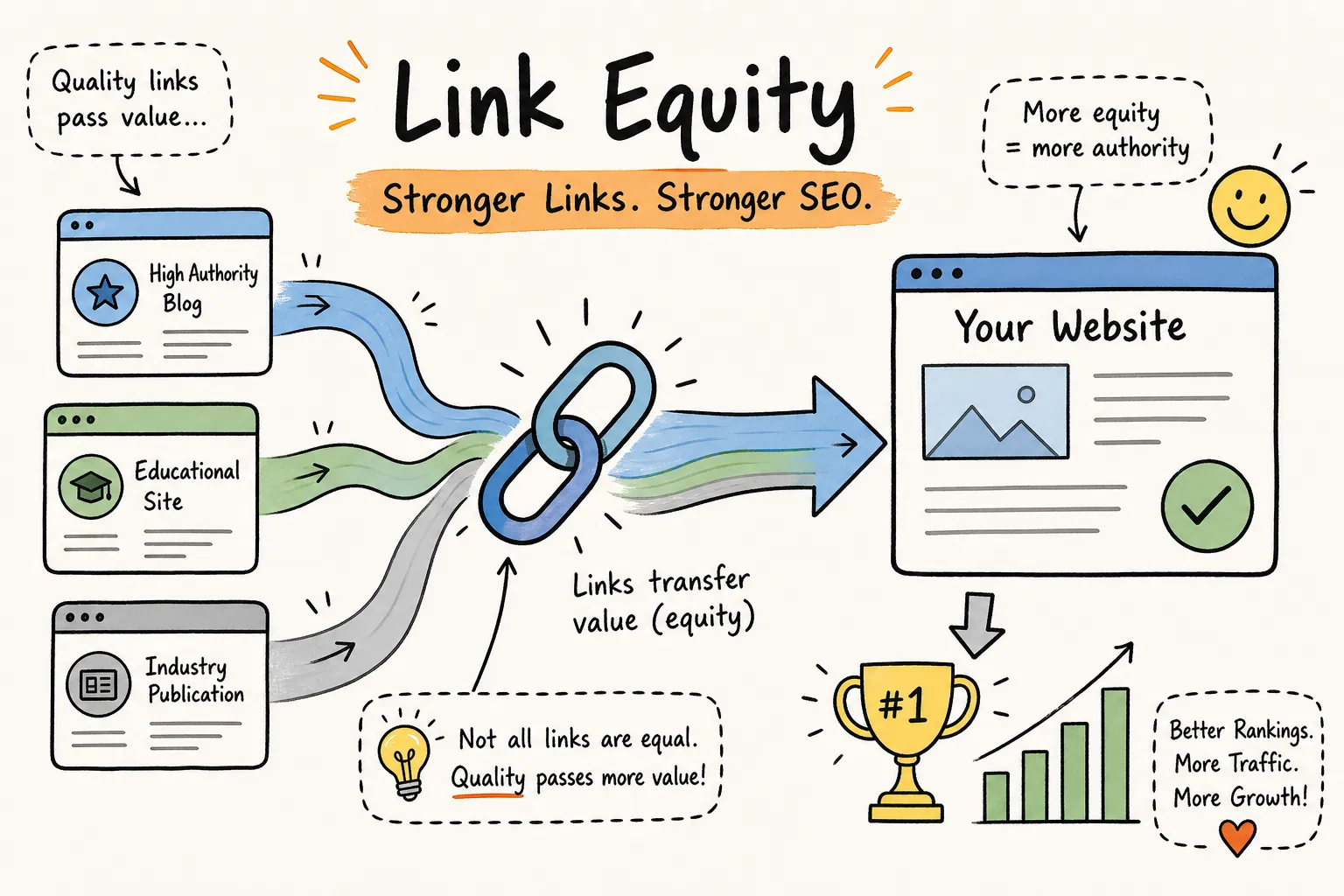
Link equity is the ranking value that flows between pages through hyperlinks. When page A links to page B, it transfers a fraction of its own authority to that destination. Search engines treat this transfer as a signal of trust and importance: the more equity a page accumulates from credible sources, the stronger its position in search results.
The PageRank origin
Link equity is rooted in Google’s original PageRank algorithm, built by Larry Page and Sergey Brin on a simple premise: a link is a vote of confidence. The more votes a page receives from credible sources, the more trustworthy it appears. That mathematical model calculates a page’s score recursively by summing the contributions from linking pages, each contribution divided by that source page’s total outbound link count and scaled by a damping factor of roughly 0.85. Google still uses an internal version of this model today, even though it stopped publishing public PageRank scores in 2016.
Why “link juice” is the same idea
Link juice, link authority, backlink value, and link equity are all informal terms for the same underlying concept. The SEO community uses them interchangeably depending on context, and none is technically more precise than the others. Understanding what they describe, the transferable ranking power a hyperlink carries from one page to another, matters far more than settling on a preferred label.
What controls how much value a link actually passes
Not every link passes equal equity. Several measurable factors determine how much value actually transfers when a page links to yours, and ignoring them is why many link-building campaigns underdeliver.
Source authority and topical relevance
A link from a high-authority page in your industry passes significantly more equity than a link from a low-authority page in an unrelated niche. Source authority reflects how much PageRank the linking page has accumulated itself. Topical relevance shapes how meaningful that equity is for your target page’s rankings. The strongest combination is a high-authority, topically relevant link. A high-authority but off-topic link is less impactful than most people assume.
Anchor text and link placement
Descriptive, relevant anchor text tells search engines what the destination page is about. Generic anchors like “click here” or “learn more” pass link equity but contribute no topical information. Placement matters just as much: editorial links embedded within the main body of an article carry more weight than links tucked into footers, sidebars, or boilerplate navigation. This isn’t arbitrary, Google has long weighted links by their likelihood of being clicked, a concept closely associated with the Reasonable Surfer model in SEO literature, which treats click probability as a proxy for editorial intent.
How rel attributes change the calculation
Links tagged with rel="nofollow", rel="sponsored", or rel="ugc" are treated by Google as hints rather than hard directives. In practice, these attributes generally suppress normal equity transfer, though Google may still use them for link discovery. Using them correctly on paid or user-generated links is good hygiene. The mistake many site owners make is applying nofollow to their own internal links, which accidentally cuts off equity flow to pages that need it.
How link equity flows through your site’s architecture
External backlinks often get all the attention, but internal link equity is the system that determines which of your own pages actually benefit from the authority your site has accumulated. Every website is a network, and how you wire that network controls where equity lands.
The pillar-and-cluster model and link equity distribution
A pillar page is your highest-priority, highest-authority page on a given topic. Cluster pages cover related subtopics and link back to the pillar; the pillar links out to the clusters in return. This bidirectional structure drives deliberate link equity distribution, circulating authority toward your most important pages rather than letting it disperse randomly across the site. It also signals topical depth to Google, which strengthens the pillar’s relevance for competitive search terms. For a small business, a practical example would be a “Lawn Care Services” pillar page supported by cluster pages on aeration, fertilization schedules, and seasonal cleanup, with every cluster pointing back to the main service page.
Crawl depth and orphan pages
Pages buried more than three to four clicks from the homepage receive less internal equity simply because fewer internal links reach them. Orphan pages, those with zero internal links pointing to them, are even worse off: they receive no equity from internal sources at all. Even a page with solid external backlinks loses the amplifying effect of internal link equity when it’s disconnected from the rest of the site. Orphan pages are one of the most overlooked reasons priority pages underperform.
Where small business sites unknowingly leak link equity
Understanding how equity flows is only half the picture. The other half is knowing where it quietly disappears on sites that look perfectly functional on the surface.
Redirect chains, link value dilution, and canonical misuse
A single 301 redirect passes nearly all link equity to the destination URL. A chain of redirects, where URL A redirects to B, which redirects to C, causes link value dilution with each additional hop, weakening the signal before it ever reaches the intended page. Using 302 redirects for permanent moves compounds the problem because a 302 tells search engines the change is temporary, so they hold equity at the original URL instead of consolidating it at the destination. Canonical tag errors create a separate but equally damaging issue: when a canonical points to the wrong URL, or multiple pages carry conflicting canonical declarations, equity gets split instead of concentrated on the intended page.
Poor internal linking patterns that bury priority pages
It’s common to see small business websites that heavily link to the homepage and contact page while barely linking to their service or product pages. The result is that the pages most valuable for generating revenue sit in an equity desert. If a page matters for rankings, it needs deliberate internal links from multiple relevant, well-visited pages across your site. Linking to your most important pages once, from a footer or navigation menu, is not enough to move meaningful equity in a competitive niche.
Practical tactics to protect and maximize your link authority
Diagnosing equity problems is the first step; fixing them is where the ranking gains happen. The steps below are ordered by priority, starting with the issues that produce the fastest recovery.
Fix your redirect and canonical setup
- Audit for redirect chains and compress each one to a single-hop 301 so equity reaches the destination without dilution.
- Replace any 302 redirects being used for permanent moves with 301s immediately.
- Audit canonical tags across paginated pages, filter pages, and product variants to eliminate conflicting or self-contradictory declarations.
Build deliberate internal linking toward priority pages
- Identify your three to five highest-priority service, product, or money pages and aim for several contextual internal links each, roughly three to six, depending on your site’s size and how much related content exists, drawn from relevant pages across your site.
- Use descriptive anchor text with natural keyword variation instead of generic labels like “read more” or “this page.”
- Structure your site using the pillar-and-cluster architecture so equity circulates between topically related pages rather than spreading thin across unconnected content.
Audit and address orphan pages
- Run a site crawl using a tool like Screaming Frog, Ahrefs, or Semrush to identify pages with zero internal inbound links, then connect them to relevant hub or category pages. If the content is thin or redundant, consolidate it into a stronger page with a 301 redirect.
- Keep important pages within three clicks of the homepage, using your main navigation and pillar pages as the primary equity distribution nodes across the site.
Making link authority part of your broader SEO strategy
Link equity doesn’t operate in isolation. It works alongside on-page optimization, technical SEO, content quality, and external link equity acquisition. When all of those elements align, each one amplifies the others and the results compound over time.
Why link equity is often the missing piece in small business SEO
Many small business SEO efforts focus on content creation or Google Business Profile optimization without ever examining how equity moves through the site. A business can publish strong content and earn quality backlinks, but if internal linking is weak and redirects are broken, a significant share of that value never reaches the pages that need it most. In our experience at Brandleap Agency, fixing equity flow can produce meaningful SEO gains that are cost-effective compared with creating new content from scratch, largely because you’re working with authority the site has already earned. That said, the gains are structural rather than set-and-forget: as your site grows and evolves, periodic audits ensure the architecture continues to route equity where it matters.
How a holistic SEO consultancy addresses link authority
At Brandleap Agency, link authority strategy is built into every SEO engagement from the start. That includes auditing internal link architecture, identifying equity leaks, structuring pillar-and-cluster networks, and aligning external backlink acquisition with the pages that will benefit most from the additional authority. A piecemeal approach to SEO often leaves these connections unaddressed; a system-level strategy ensures link equity works as a reinforcing mechanism throughout the site, not as a background concern that gets ignored until rankings stall.
Start with the structure, then build from there
The businesses that consistently outperform their competitors in search aren’t always the ones with the most backlinks, they’re often the ones whose site architecture ensures every link they earn actually reaches the pages that matter. Fixing that architecture is where the leverage is.
The fastest wins are usually close at hand: compress redirect chains to eliminate link value dilution, identify orphan pages, and add intentional internal links to your priority pages. Those actions alone can unlock equity your site has already earned but hasn’t been routing correctly. From there, building a pillar-and-cluster architecture and maintaining clean canonical declarations keeps the link equity distribution system working as your site grows.
If you want a full link authority audit as part of a broader SEO strategy, the team at Brandleap Agency is ready to map out exactly where your equity is going and how to redirect it toward the pages that drive real business results. Explore our SEO services to get started.