Many businesses hiring an on-page SEO service report genuine uncertainty about what they’re actually paying for. That knowledge gap is exactly how low-quality agencies survive: they deliver a PDF report, collect a monthly retainer, and leave you wondering why your rankings haven’t moved. The deliverables matter, the pricing benchmarks matter, and the KPIs you agree to up front matter just as much as the work itself.
This guide covers all of it. You’ll find a clear breakdown of what a serious on-page SEO service engagement actually includes, what it costs in 2026, how to measure results by page type, and the seven warning signs that should stop you from signing a contract. Providers that go beyond a standard checklist, layering semantic SEO strategy on top of page-level fixes, tend to produce traffic gains that compound over time rather than plateau after a few months. That’s the approach Brandleap Agency applies across its on-page engagements.
By the end, you’ll know exactly what to ask before you hire, what to expect in your reporting, and how to tell the difference between an agency that can prove its work and one that just talks about it.
What an on-page SEO service actually covers
Content and HTML-level optimization
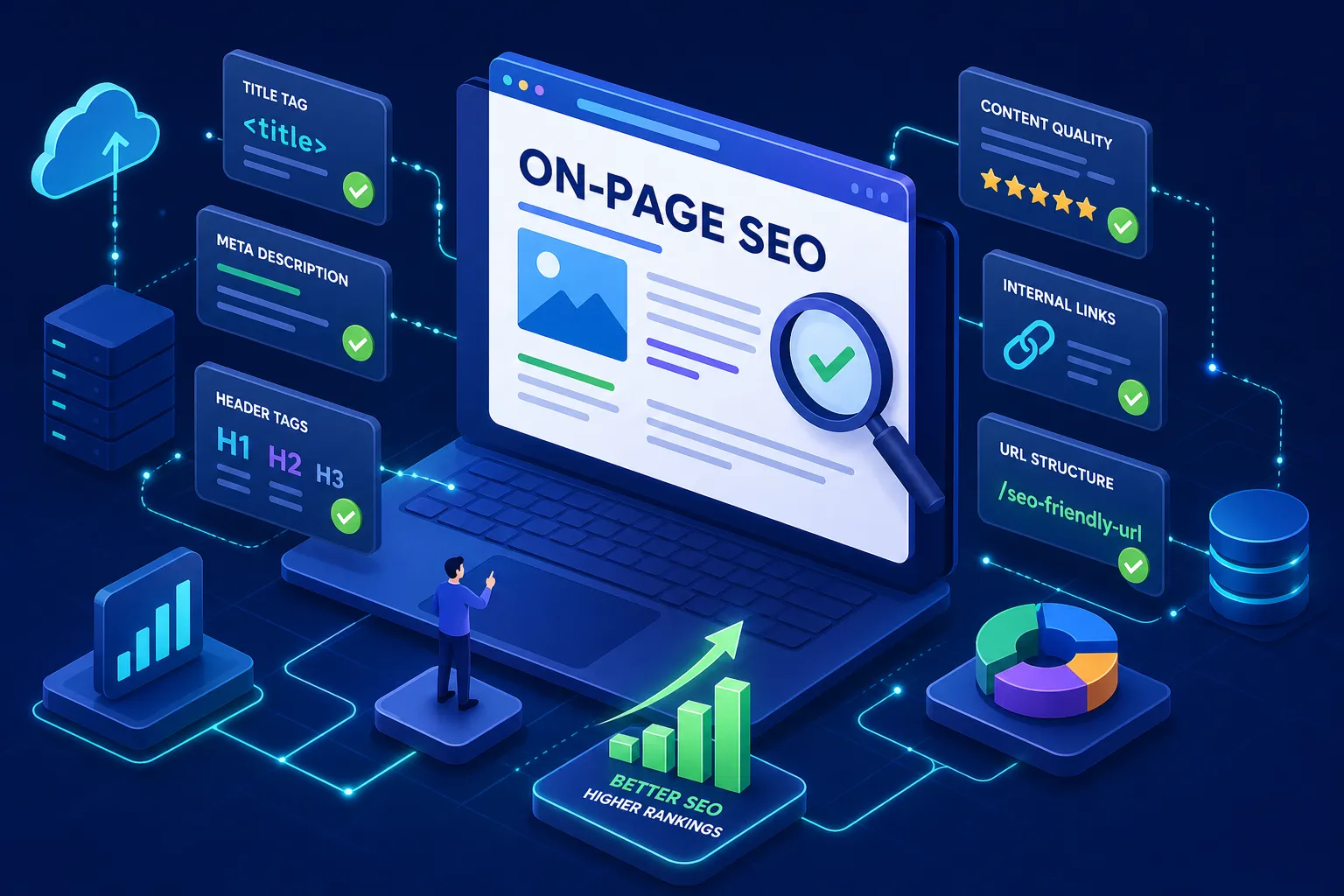
The foundation of any on-page SEO service starts with the elements Google reads first: title tags, meta descriptions, heading hierarchy from H1 through H4, URL slug structure, and the content itself. These aren’t cosmetic changes. Title tag rewrites affect click-through rate directly; heading structure tells Google how your content is organized and which topics you’re actually covering on a given page.
Content optimization services go well beyond inserting a keyword into a paragraph. A real engagement includes semantic keyword integration, freshness updates for outdated content, readability improvements, and content gap fixes where your page simply doesn’t cover what searchers expect to find. When a page is weak on any of these dimensions, it signals to Google that it’s a poor match for the query, regardless of how many backlinks point to it.
Technical on-page elements, schema, and internal linking
The second layer of technical on-page SEO covers the structural details that affect how Google crawls, understands, and displays your pages. This includes image optimization with alt text and file compression, canonical tag implementation to eliminate duplicate content issues, and schema markup that makes your pages eligible for rich results like star ratings, FAQ dropdowns, and featured snippets.
Internal linking is often underestimated in these conversations. Strategic link placement with proper anchor text helps Google understand the relationship between pages and distributes ranking authority across your site. Core Web Vitals (LCP, INP, and CLS) belong in any complete audit and round out this structural layer. Most packages bundle these into an audit-plus-recommendations model; whether the agency also handles implementation is a separate question worth asking before you sign anything.
How page-level SEO directly moves your search rankings
The ranking signals only on-page work can fix
Off-page authority, backlinks and brand mentions, is valuable but slow and difficult to control. On-page SEO is different: it’s the one area where you have complete authority over what changes and when. Google’s algorithm evaluates relevance signals like title tags, headings, and content depth; page experience signals like mobile usability and Core Web Vitals; and structured data that enables rich results. A technically sound, semantically optimized page will consistently outperform a thin, poorly structured page, even when backlink profiles are comparable.
This is the argument for prioritizing on-page work before chasing links. When the foundation is broken, no amount of external authority will push a page past its ceiling.
What real results from on-page optimization look like
Published case studies make the case clearly. After title, meta, heading, and alt text rewrites, one documented engagement showed a 48% increase in total website traffic alongside a 59% rise in impressions. On transactional keywords, structured on-page improvements produced a 117% ranking improvement, with average position moving from 28.6 to 13.2. In cases where content issues and indexation problems were fixed together, monthly organic sessions increased by 2,550%.
These results reflect what happens when pages that already have some search presence are finally optimized correctly. The pages had potential that poor structure, weak content, and unresolved technical issues were suppressing. Fixing those issues unlocks results that were already within reach.
What on-page SEO services cost in 2026
On-page SEO service pricing by business size and scope
Small businesses typically pay between $500 and $2,500 per month for on-page SEO services. Mid-market companies running competitive sites land in the $2,500 to $15,000 per month range. Enterprise engagements start around $7,500 and scale well past $100,000 per month depending on site size, content volume, and how aggressively the brand competes in search. For one-time page work, per-page pricing generally runs $200 to $500 per page. These ranges reflect current market benchmarks across SEO industry surveys and vary based on agency size, location, and specialization.
These ranges reflect different scopes, some quotes cover audit and recommendations only, while others include implementation, so confirm exactly what is included before comparing proposals. Two agencies quoting $1,500 per month can deliver very different things depending on how many pages they touch, whether implementation is included, and how reporting is structured.
Per-page pricing vs. monthly retainer: which model fits your situation
Per-page or project-based pricing works well when you have a defined set of pages to fix or a one-time on-page SEO audit need. If you have ten service pages that haven’t been touched in three years, a project scope makes sense. Monthly retainers are the right fit when your site has ongoing content production, regular technical updates, or competitive keywords that need active management over time.
One warning worth stating directly: retainers priced under $500 per month often do not include genuine implementation. At that price point, you’re typically getting an audit delivered as an ongoing service, meaning someone sends you a report each month without actually changing anything on your site. On-page SEO packages at that level should be evaluated carefully before you commit.
KPIs and timelines to hold your agency accountable
The metrics that actually matter by page type
The right KPIs depend on what the page is supposed to do. Blog and content pages should be measured on organic clicks, dwell time, average position, and assisted conversions. Product and service pages need tracking on rankings, CTR, organic traffic, and conversion rate. Technical pages warrant attention on crawl health, page speed scores, and index status. Mixing these together produces a dashboard that looks full but tells you nothing useful about whether specific work moved the needle.
One pattern to watch for: agencies that report only aggregate rankings or total traffic without separating branded from non-branded results. Branded traffic grows when you run ads or get press coverage, not when your SEO improves. An agency hiding behind blended traffic numbers is using vanity metrics to avoid accountability.
Realistic timelines by optimization type
Technical fixes like page speed and Core Web Vitals improvements are visible within days to weeks after deployment, though ranking impact tends to follow more slowly. Title and meta rewrites can lift CTR within a few weeks if the page already has search impressions. Ranking movement from content and relevance changes typically takes three to six months. Meaningful organic traffic growth usually requires six to twelve months of sustained work.
Conversion improvements are tied to traffic quality changes, but reliable attribution generally requires sixty to ninety days of clean data. Any agency promising results faster than these ranges across all metrics should explain exactly what they mean by “results” before you accept that claim.
How to tell a serious on-page SEO agency from a low-quality one
What a reputable on-page SEO service provider actually delivers
A quality on-page SEO agency shows verified case studies with measurable outcomes, not testimonials or generic before-and-after graphs. Verification means Google Analytics or Search Console screenshots with dates, clear methodology, and references you can actually contact. They document their audit-to-implementation process in writing so you know what phase you’re in at any given time. Monthly reporting connects KPIs directly to business outcomes: organic sessions to lead volume, ranking improvements to estimated traffic value, CTR changes to the specific rewrites that caused them.
The tool stack matters too. Fluency across Google Search Console, GA4, Screaming Frog, and Ahrefs or Semrush is the baseline expectation for any credible provider. A strong agency can tell you exactly what changed on which page, why that change was prioritized, and what happened after. Diagnosis, implementation, validation, and reporting should be clearly separated, not bundled into a vague monthly activity log.
7 red flags that signal trouble before you sign
Guaranteed rankings promises. No legitimate agency guarantees specific rankings. Google’s algorithm is not something any provider controls, and anyone claiming otherwise is either misinformed or misleading you. Ask instead for projected traffic ranges based on historical data from comparable sites.
No before-and-after evidence or contactable references. Case studies without client names, verification, or measurable outcomes are marketing copy, not proof of work. If an agency can’t provide a reference you can call or email, treat their results claims as unverified.
Reports cluttered with data and no business outcome separation. If a monthly report doesn’t connect SEO activity to leads, conversions, or revenue, it exists to create the appearance of value rather than demonstrate it. Ask specifically how each metric ties back to your business goals.
No discussion of a technical audit. Skipping the audit means they’re making changes without diagnosing the actual problems. That approach wastes budget and risks making things worse before they get better.
Keyword stuffing or black-hat tactics. These tactics may produce short-term movement but invite manual penalties and algorithm recovery costs that exceed any early gains. Any provider still recommending keyword density targets above what reads naturally is behind the times.
No written documentation of process or cadence. If the agency can’t describe their workflow in writing before the contract starts, you have no basis for accountability when results stall.
Inability to explain their approach without jargon. A competent agency can explain what they’re doing in plain language. Hiding behind technical terminology during a sales conversation is a sign they’re relying on complexity to avoid scrutiny.
Questions to ask any on-page SEO provider before you hire
The questions that expose how an agency actually works
Ask for a sample audit with prioritized issues and expected impact. This one request reveals whether the agency produces structured, prioritized deliverables or loose lists of fixes with no context. Ask how they separate the audit phase from the implementation phase: the answer tells you whether they have a real process or treat everything as one continuous activity with no clear checkpoints.
Ask what their monthly reporting includes and which KPIs are tied to your specific business goals. A strong agency answers this with specifics: Search Console data by page, conversion tracking from GA4, and position movement on non-branded queries. Finally, ask for case studies in your industry with contactable references. Agencies that struggle with this question either haven’t done work worth referencing or haven’t maintained relationships with clients worth citing.
Beyond on-page: why semantic SEO strategy matters
Standard on-page SEO service work fixes relevance signals: titles, headings, content depth, internal links, and technical structure. That work is necessary but not sufficient for rankings that hold over time. Semantic SEO builds on top of that foundation by mapping topical authority across clusters of content, signaling to Google that your site doesn’t just answer one query but commands a subject area. The difference in durability is significant.
At Brandleap Agency, we pair technical on-page SEO audits with semantic SEO strategy to help small businesses and growing brands earn traffic gains that build over time. If you want an on-page SEO service that goes deeper than a checklist, explore Brandleap Agency’s SEO services to see how the two approaches work together, and book a call to discuss what that looks like for your site.
The bottom line on on-page SEO services
An on-page SEO service is only as valuable as what it actually delivers, how results are measured, and whether the agency can prove its work connects to business outcomes. The filters are straightforward: confirmed deliverables across content, technical, schema, and internal linking; transparent pricing matched to scope; KPIs tied to actual revenue rather than vanity metrics; and an agency that can show its process in writing before work begins.
Use the pricing ranges, KPI frameworks, red flags, and questions in this guide to evaluate every proposal on equal terms. Agencies that pass those filters are worth a serious conversation. Agencies that stumble on the basic questions aren’t ready to manage real on-page SEO work, regardless of how polished their website looks.