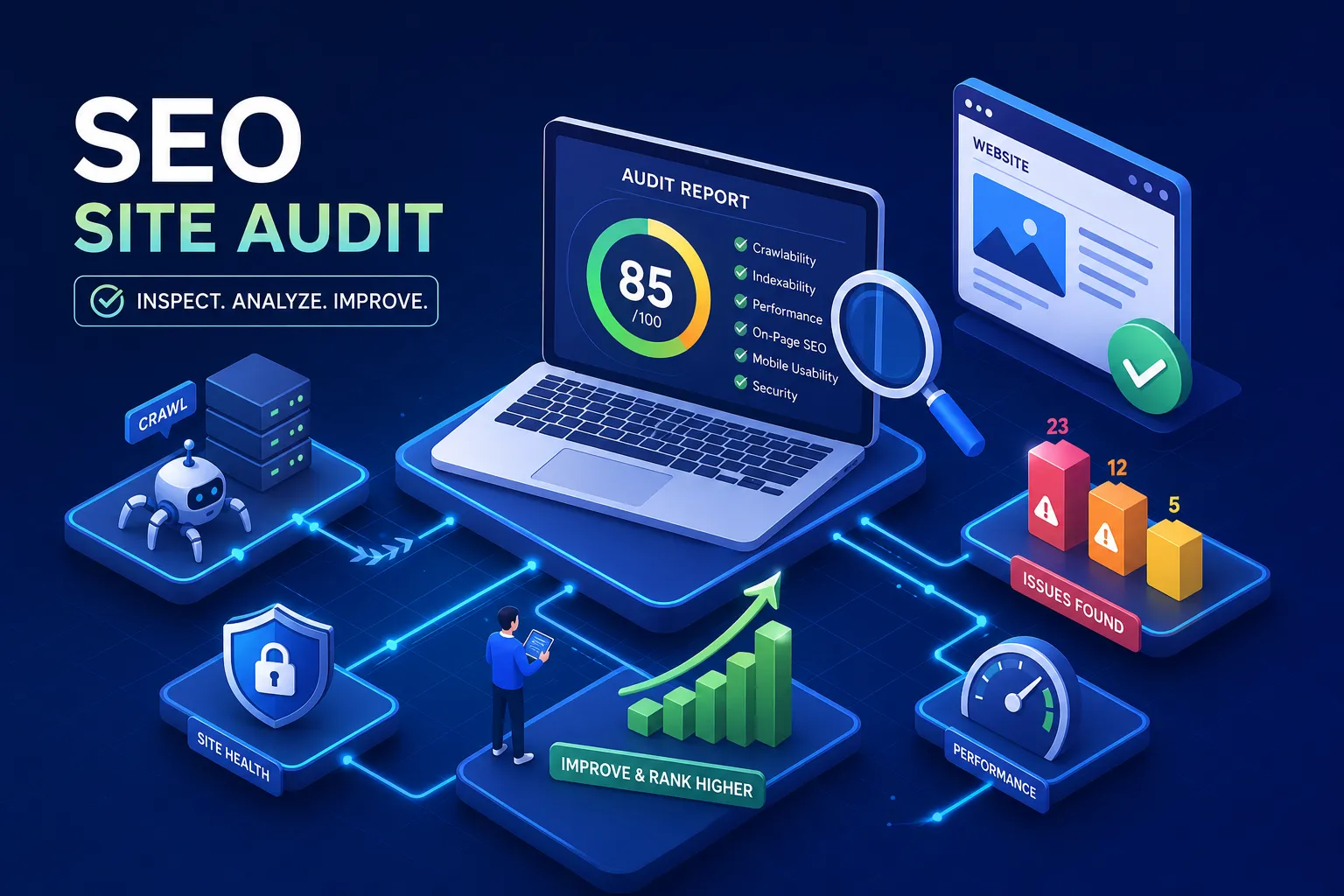
Many businesses invest in SEO content or link building before they know what’s broken on their site. That’s like renovating a house with a cracked foundation. An SEO site audit service is the diagnostic step that serious businesses take before spending a dollar on strategy, and skipping it can quietly drain an SEO budget faster than almost any other oversight in digital marketing.
In 2026, with AI-driven search results reshaping rankings and Core Web Vitals baked into Google’s core signals, a thorough website audit isn’t optional. This guide covers exactly what a site audit examines, how to pick the right approach for your budget, which tools actually deliver, what professional audits cost, and the five fixes you should tackle first after getting your report.
What an SEO site audit service actually checks
A complete website audit service doesn’t look at just one dimension. It examines the full ecosystem of signals that determine how Google crawls, indexes, and ranks your site across three main pillars: technical, on-page, and off-page. The depth of each check varies depending on whether you’re running an automated scanner or working with a professional SEO audit company.
Technical health: what’s under the hood
Technical checks are the highest-priority findings in any audit because they block Google before it even reads your content. A thorough technical review covers crawlability, indexability, redirect chains, duplicate content, Core Web Vitals, mobile-first indexing, JavaScript rendering, site speed, and HTTPS security. Tools like Screaming Frog and Semrush run 100 to 140+ technical checks across these areas, surfacing issues that most site owners don’t know exist.
The stakes are real. A single misconfigured robots.txt file can unintentionally block large sections of a site from indexing. A long redirect chain can bleed link equity before it ever reaches its destination. These aren’t edge cases. They show up consistently in professional audits across all site sizes.
On-page signals: content and structure
On-page checks go well beyond verifying that meta tags exist. A solid site health check assesses whether your content actually matches what a searcher intends to find. That includes meta titles and descriptions, heading hierarchy, internal link distribution, canonical tags, schema markup, thin content, and keyword cannibalization.
This is where automated tools start showing their limits. A scanner can flag that two pages share a similar keyword. Only a human analyst can tell you which page to consolidate, which to redirect, and how to restructure your internal links to support the surviving URL.
Off-page factors: authority and link health
Your backlink profile is part of the audit picture too. A professional website SEO analysis will cover backlink quality, toxic link identification, anchor text diversity, and competitor link gap analysis. Tools like Ahrefs provide strong backlink depth, but a manual agency audit adds strategic context, including which competitors are gaining authority in your space and where your link profile creates algorithmic risk.
Why the audit should come before any SEO strategy
Skipping the audit and jumping straight to content or link building is also where most SEO budgets quietly bleed out. Industry data suggests that companies implementing 70% or more of audit recommendations see an average 147% increase in organic traffic within 12 months. Technical SEO fixes identified in audits typically deliver a $2.40 return for every $1 invested, figures consistent with broader SEO ROI research, though results will vary by site and competitive landscape.
At Brandleap Agency, every client engagement starts with a comprehensive SEO site audit service, not as a formality, but because building an SEO strategy without one is guesswork. You need to know what’s broken, what’s competing against you, and which pages are already performing before changing a single thing.
The cost of building on a broken foundation
Consider a business that runs six months of content production and link building, then discovers a crawl directive was blocking Google from indexing large sections of its site the entire time. Or two pages were cannibalizing each other for the same keyword, diluting both rankings simultaneously. Audits frequently surface these kinds of blockers within the first week of review. Frame the audit cost as an insurance policy against wasted strategy spend, not as an add-on service.
Results that follow fixing audit findings
In one Brandleap client engagement, we recorded a 382% increase in ranking keywords and a 2,345% increase in organic impressions over nine months following audit implementation. In another, a client grew from 1,535 to 10,322 organic visits within six months, a roughly 400% increase. E-commerce sites that addressed Core Web Vitals failures reported a 23% improvement in conversion rates. These results reflect what happens when real technical barriers get removed and a strategy runs on a clean foundation.
Automated SEO scanner vs. professional agency audit: the key differences
Both approaches have a role, but they serve different purposes and carry very different blind spots. An automated site audit tool gives you a technical checklist fast. A professional audit gives you the “why” behind the data and a roadmap built around your actual business goals.
What automated tools do well (and where they stop)
Automated scanners like Semrush, Ahrefs, and SE Ranking are highly effective at flagging broken links, missing meta tags, slow pages, and crawl errors. They run hundreds of checks in minutes to hours depending on site size, and the resulting site health score gives you a useful benchmark. For businesses with tight budgets or clean, small sites, they’re a strong starting point. But they flag symptoms, not causes.
Automated audits are also static. They reflect a single moment in time and fail to account for the competitive landscape shifting around your site. A tool won’t tell you that a competitor just built 200 high-quality links in your niche or that your top-ranking page is losing ground because search intent shifted.
What a manual agency audit catches that tools miss
Manual audits surface search intent mismatches, where a page ranks for the wrong audience despite technically correct keywords. They identify content quality problems like thin or overly promotional messaging that kills conversions even when traffic is present. They catch UX issues that affect user behavior without triggering crawl errors. And they correctly diagnose keyword cannibalization in a way that includes a resolution strategy, not just a flag.
Dynamic JavaScript rendering is another common blind spot. Automated crawlers often misinterpret metadata on platforms like Shopify or WordPress where data is injected dynamically, generating false positives that send teams chasing non-issues. A human reviewer validates the rendered output and filters the noise.
Top tools for an SEO site audit service in 2026
Most professional agencies use a combination of these tools alongside manual analysis. No single tool covers everything well, and the right choice depends on your budget, site size, and what you’re trying to diagnose.
Tools for comprehensive technical and on-page audits
Semrush runs 140+ checks including Core Web Vitals, mobile-first indexing, HTTPS, hreflang, and redirect chains. Its 2026 addition of AI search visibility flags pages underperforming in AI Overviews and LLM-powered results, making it one of the strongest all-in-one options available.
Ahrefs runs 130 to 170+ checks with strong backlink intelligence and bulk URL analysis built in. Both Semrush and Ahrefs start around $99 to $129 per month.
Screaming Frog is the desktop-based crawler agencies rely on for JavaScript rendering validation and migration troubleshooting. It offers competitive annual pricing for unlimited crawls and remains a go-to for hands-on technical practitioners.
For small businesses and free starting points
SE Ranking covers 115+ checks with white-label reporting and scales up to 2 million pages per project, making it a solid value pick for small businesses and boutique agencies. Google Search Console is free, mandatory, and irreplaceable. It’s the only tool that shows how Google actually crawls and indexes your site, and it surfaces Core Web Vitals data, mobile usability issues, and manual action alerts at no cost. Any business that hasn’t set it up has a real gap in their site health check process.
What a professional SEO site audit service costs and what you get
Small business audits covering 50 to 500 pages typically run $750 to $2,500. Mid-size business audits run $1,500 to $7,500. Enterprise audits for sites with 5,000+ pages and multi-region complexity run $5,000 to $30,000 and up.
What’s inside a professional site audit report
At the professional tier, a complete site audit report includes a full technical crawl and Core Web Vitals analysis across mobile and desktop. That review also covers on-page elements like meta tags, headings, and internal links, a content audit for thin pages and cannibalization, a backlink review for toxic links and anchor text diversity, and competitive gap analysis. The deliverable also includes schema validation, an AI search readiness check, and a prioritized action roadmap ranked by impact-to-effort ratio. Quality agencies include a post-audit walkthrough session of one to two hours to align on priorities before implementation begins.
Timeline: how long an audit actually takes
Automated tools scan a typical small-to-medium site in minutes to eight hours. A professional agency audit for the same site takes one to two weeks. For larger sites with 1,000 or more pages, agency audits run two to three months with 52 to 104 hours of actual human work involved. That extended timeline reflects manual analysis, QA, competitive research, and building a strategic deliverable rather than simply exporting raw crawl data.
Five fixes to prioritize after your SEO site audit service report
Audit reports often surface 50 to 100+ issues depending on site size and complexity. Most businesses either do nothing or fix the wrong things first. These five categories consistently deliver the fastest ranking impact when addressed early.
- Crawlability and indexation errors: Fix any robots.txt blocks, noindex tags on pages that should rank, and redirect chains longer than two hops. These prevent Google from accessing your content entirely and are the single highest-priority fix in any site health check.
- Core Web Vitals failures: Largest Contentful Paint (LCP), Cumulative Layout Shift (CLS), and Interaction to Next Paint (INP), which replaced First Input Delay as a Core Web Vital, are confirmed Google ranking signals. Start with image compression, eliminate render-blocking scripts, and stabilize layout elements. Addressing these issues has been linked to meaningful improvements in both rankings and conversion rates.
- Duplicate and cannibalized content: Consolidate or redirect duplicate pages and resolve keyword cannibalization by clarifying the primary page for each target term. This is one of the most impactful fixes automated tools flag but rarely explain how to resolve strategically.
- Title tags and meta descriptions: Missing, duplicated, or truncated meta elements affect click-through rates directly. Update them to be unique, under 60 characters for titles and 160 characters for meta descriptions, and aligned with the page’s target search intent.
- Toxic backlinks and anchor text imbalances: Use Google’s Disavow Tool for confirmed spam links (following Google’s official guidelines on when disavowal is appropriate) and diversify anchor text that skews too heavily toward exact-match keywords. This protects your site from algorithmic penalties and prepares the link profile for future outreach campaigns.
The right audit approach for your situation
The honest answer for most growing businesses is both approaches, used in sequence. Start with Google Search Console and one crawler like Semrush or SE Ranking to get a technical baseline fast. Then invest in a professional SEO site audit service before building or scaling an SEO strategy. The baseline tells you what’s broken. The professional audit tells you what to do about it and in what order.
Brandleap Agency’s audit-first engagements deliver a prioritized technical and strategic roadmap, built to act on in the first week, not sit in a folder. A professional SEO site audit service is only as valuable as the strategy it informs, and that strategy needs to start from an accurate picture of what’s actually happening on your site right now. Get in touch to start with a site audit that gives your SEO work a foundation worth building on.