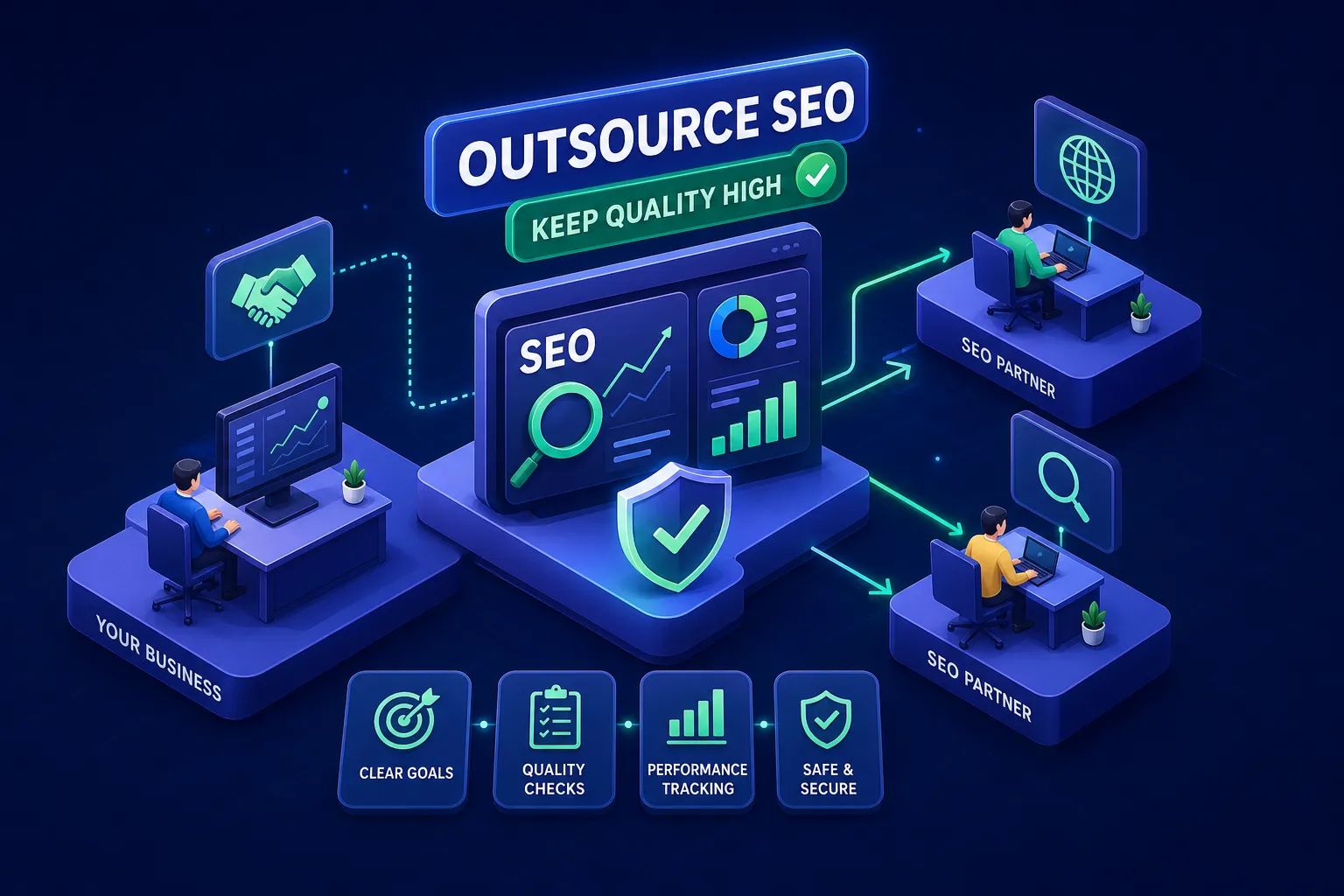
Using SEO outsource services is one of the most effective ways to scale your marketing output, and one of the fastest ways to torch your rankings if you hand it off without a system. Many agencies and business owners sign a contract based on a polished pitch deck, skip the hard vetting questions, and have no written scope to fall back on when results stall three months in. That is not an agency problem. It is a process problem.
The good news is that outsourcing SEO without losing quality is completely achievable. Specialized partners and white-label SEO agencies have built entire delivery models around transparent reporting and flexible engagement structures designed for businesses that need to scale without adding headcount. The difference between campaigns that build lasting momentum and campaigns that collapse often comes down to how the engagement was set up before anyone wrote a single line of copy or pulled a single crawl report.
This guide walks you through the full outsourcing lifecycle: what to delegate, how to vet the right partner, what your contract must include, how to structure communication, and which KPIs actually tell you whether the investment is working.
What to Hand Off and What to Keep In-House
Outsourcing failures are driven by both provider shortcomings, insufficient industry knowledge is a leading cause, and client-side governance gaps. Getting the division of responsibilities right before any vendor conversation starts saves months of frustration.
High-Value SEO Tasks Worth Delegating
The best candidates for outsourcing are tasks that are execution-heavy, time-consuming, and require specialized tooling or expertise you do not have on staff. Technical SEO audits and implementation, schema markup, crawlability fixes, Core Web Vitals remediation, internal linking, belong in this category. So does content creation and optimization at scale, link building and digital PR outreach, keyword research and content mapping, and local citation management. In practice, citation cleanup is routinely the first task agencies delegate to outside partners, and content creation has seen the sharpest growth in SEO subcontracting over the past decade. These tasks benefit from established systems and specialist teams that your internal staff should not have to build from scratch.
What Your Team Must Own
SEO strategy, brand voice oversight, and final content approval must stay internal. An external partner does not know your pipeline goals, your sales cycle, or your brand positioning the way your team does. Reputation management and link cleanup also carry too much brand risk to fully delegate, because both involve sensitive decisions that require business context no agency can replicate. The framework is straightforward: outsource what is repeatable and execution-heavy; keep what requires strategic judgment and deep knowledge of your business.
How to Vet an SEO Outsourcing Agency Before You Sign Anything
Many buyers get burned at this stage. They review a clean agency site, skim a few testimonials, and skip the hard questions entirely. A rigorous vetting process is not optional, it is what separates a productive long-term engagement from a wasted retainer.
The Non-Negotiable Evaluation Checklist
When you decide to hire an SEO agency, these criteria separate real partners from pretenders:
- Industry-specific case studies. Look for documented results in your vertical, not generic “we grew traffic” claims.
- Ethical link-building practices. Verify there are no purchased links or private blog network schemes in their history.
- Documented methodology. Demand a clearly described process with named tools and named workflows, not vague promises.
- Modern strategy for AI Overviews and LLM search visibility. Ask them to explain their approach to AI-driven search in 2026. Any agency ignoring this is already behind.
- Correct analytics setup. Confirm they configure GA4, Google Search Console, and call tracking from day one.
- A sample report during discovery. If they cannot show one, they are telling you everything you need to know.
Also flag any agency where no specific team members are identified anywhere on their site or proposal. That is a bait-and-switch waiting to happen.
Interview Questions That Expose Weak Providers
Ask these questions on every discovery call:
- “What will be live and measurable on day 30?” A competent partner can name specific deliverables. Vague answers expose agencies with no immediate-action plan.
- “Who specifically does the work, by name and title?” This prevents the senior-pitch, junior-execution switch that burns clients constantly.
- “Which tactics do you refuse to run?” Ethical standards surface faster here than in any certification badge.
- “Can you guarantee top rankings?” Any yes is disqualifying. The agency is either uninformed or deliberately misleading.
- “Can I speak with a current client in my industry?” A legitimate agency makes the introduction without hesitation.
Setting Scope, Deliverables, and SLAs for Your SEO Outsource Services Engagement
A verbal agreement on “monthly SEO work” is not a scope. Without a written contract that defines what done looks like, disputes are inevitable and quality degrades fast. Add one more layer of risk: most engagements fail quietly at this stage, before the first deliverable is ever late, because neither side agreed on what success actually means.
Standard Deliverables to Include in Every Contract
Professional SEO outsource services contracts define deliverables across three categories. Label these as typical ranges rather than universal requirements, since the right volume depends on your budget and site size.
- Technical: Prioritized audit backlog, schema implementation, crawl health monitoring, and ongoing internal link updates.
- Content: Six to eight content briefs per month with keyword and SERP analysis, four optimized pages per month, and a keyword-mapped editorial calendar.
- Authority building: One to two digital PR campaigns per quarter, link outreach with defined quality thresholds, and coverage reports that specify link attributes.
Month one should always be a full audit and strategy phase before execution begins. Any agency that jumps straight into content and links without that foundation is prioritizing activity over results.
SLA Benchmarks Worth Enforcing
Standard SLA terms that protect both parties include a 24-hour response time for questions, revision windows tied to scope (minor revisions in one to two business days, major revisions in five to seven business days), and a 95% on-time delivery requirement. Your contract must also define what “delivered” actually means. An artifact shipped to your inbox and a fix verified live on your site are two very different things. The gap between them is where quality complaints are born. Clarifying asset ownership upfront, who owns the content, links, and reporting data if the engagement ends, prevents expensive disputes later.
Communication Workflows and Reporting Cadence That Hold Up Over Time
Even a perfectly scoped engagement falls apart without a structured communication rhythm. The operational layer that keeps outsourced SEO aligned with your business goals is not complicated, but it has to be intentional from the start.
Building the Right Reporting Rhythm
The industry standard cadence works in three layers. Weekly async updates via Slack or a shared Kanban board give you task-level visibility without requiring a standing call. Monthly narrative reports tie outcomes to goals and include specific next actions, they should never be a data dump. A good report explains what changed, why it changed, and what happens next. Quarterly strategic reviews, standard for mid-market and enterprise SEO retainer services, assess competitive position and roadmap priorities so the strategy evolves with your business. If your partner only sends you a traffic screenshot each month, that is a process problem on their side, one you can spot during the vetting stage.
KPIs to Track by Stage, Not All at Once
Use a staged evaluation framework to avoid premature panic or misplaced confidence. Months one through three focus on foundation: pages indexed, Core Web Vitals, crawl errors resolved, and tracking setup confirmed. Months three through six shift to visibility: non-branded organic traffic growth, impressions, and average ranking position for priority keywords. Months six through twelve measure business impact: conversion rate from organic, cost per acquisition, and organic revenue contribution. The ROI formula is straightforward: Revenue from Organic minus SEO Costs, divided by SEO Costs, multiplied by 100. Judging an outsourced partner on keyword rankings alone in the first 90 days is the wrong benchmark. The technical and content foundation built in those early months is what makes the ranking gains in months four through twelve possible.
Red Flags That Should End the Conversation Early
Knowing what good looks like is only half the equation. Recognizing specific signals that a vendor will waste your budget or damage your site is equally important, and some of these signals are less obvious than you would expect.
Promises That Indicate Risk
Start with the guarantees. Any promise of top-3 rankings is impossible to make ethically, Google’s algorithm is not a vending machine, and agencies that guarantee outcomes are either uninformed or counting on you not knowing the difference. “Instant results” timelines ignore how sustained SEO momentum actually builds and suggest an agency either planning to use risky shortcuts or setting you up for disappointment. References to purchased link schemes or private blog networks in a proposal, without flagging them as risks to avoid, indicate an agency comfortable gambling with your domain authority. The penalty risk lands on your site, not theirs.
Structural Warning Signs in Proposals and Agencies
The less obvious red flags show up in how an agency operates day to day. Reporting exclusively on vanity metrics like impressions with no conversion attribution means the agency cannot connect their work to your revenue. A proposal that is just a price list with no strategy or timeline tells you the agency is selling a commodity, not a plan. An offshore SEO services arrangement where all work is delegated to anonymous teams without disclosure is a transparency gap that will eventually affect your results. Perhaps the clearest signal of all: if an agency cannot rank its own website for the keywords it claims to target for clients, ask them to explain why before you sign anything. A transparent partner welcomes scrutiny on all of these points. The ones that dodge the hard questions are giving you your answer.
Get the ROI You’re Paying For
Using SEO outsource services without losing quality is achievable, but it requires doing the work upfront on vetting, scoping, and structuring the engagement correctly. Businesses and agencies that get burned almost always skipped a step, in the vetting process, the contract negotiation, or the reporting structure they agreed to accept.
The framework that works is linear: decide what to delegate and what to keep internal, vet partners against concrete criteria and hard interview questions, lock in a scope with real SLAs and a clear definition of done, establish a structured communication rhythm from day one, and track the right KPIs at the right stage of the engagement. None of these steps are complicated. They are just consistently skipped in favor of speed.
For agencies looking to scale delivery without adding full-time headcount, white-label SEO partnerships built around transparent reporting and clearly defined deliverables make it possible to grow client results without stretching internal capacity. That is exactly the model Brandleap Agency is built on: enterprise-level SEO strategy and execution at pricing that works for growing agencies and small businesses alike. If you are ready to scale your SEO delivery the right way, reach out to Brandleap Agency for a free consultation and see what a structured outsourcing partnership looks like in practice.